Sayfa 1
Hevalo’s book
Rêya Kurmancî
The Kurmanji Road
Every lesson of the road with Hamo, Xezal and Hevalo, in words and pictures.
Sêvan
Chapters 1 to 12
hevalo.app
Ücretsiz kitap
Kurmanci yolu · Hevalo’nun kitabı
Kurmanci bir ders kitabı; her satırın yanında İngilizcesi var. İlk merhabadan masallara ve şarkılara kadar Hamo, Xezal ve Hevalo ile öğrenin: burada sayfa sayfa okuyun ya da yazdırıp saklamak için indirin.
Hevalo’s book
The Kurmanji Road
Every lesson of the road with Hamo, Xezal and Hevalo, in words and pictures.
Sêvan
Chapters 1 to 12
hevalo.app
Bi xêr hatî! · Welcome!
I am Hamo, and every line of this road is mine: in the app you hear me say it, and here you can read it at your own pace, with a pencil, in the shade of a tree if you have one.
The road runs through Sêvan, a village of apple orchards under the mountains. You will not find it on a map: Sêvan is a made-up village, drawn from the villages of the Kurdish countryside, with their flat roofs, their springs and their walnut trees.
Read everything aloud, even when you are alone. Kurdish lives in the mouth, not only on the page. And when a word will not stay in your head, go back to the app, listen, and say it after me. What you still remember on the second day is yours.
One more thing. If you meet a young deer with round cheeks near the apple trees, that is Hevalo, your guide. He will tell you he is not hungry. Watch the apple in the corner of the page as you go through a chapter, and judge for yourself.
Hamo
How to read this book
Every lesson opens with its little scene. Read it first: it tells you where you are and who is up to what.
The line in the speech bubble is Hamo’s. Say it out loud, as he says it in the app, until it comes out by itself.
New words come with a picture where there is one. A small m or f marks a masculine or a feminine noun: Kurdish cares.
Kurdish stands on the left and English on the right, everywhere. Cover the right side with your hand and see how far you get.
Each chapter ends with a story, pencil practice, and a stamp for your passport. The answers wait at the back.
The passport of the road · 4
The alphabet · 5
The people of the road · 7
1 · Silav · Hello · 9
Silav! · Çay û nan · Navê te çi ye? · Şev baş!
2 · Malbat · Family · 22
Malbat û cîran · Yek, du, sê · Taştê · Heye û tune
3 · Mal û gund · House and village · 35
Ev mala me ye · Rengên Sêvanê · Li ku ye? · Gundê me
4 · Bazar · The market · 50
Em diçin bazarê · Çi dixwazî? · Bi çend e? · Na, naxwazim
5 · Roj û dem · Days and time · 64
Rojên hefteyê · Meh û sal · Demjimêr çend e? · Her roj
6 · Bajar · The city · 79
Li bajêr · Werin, rûnin! · Divê em biçin · Bi çi diçî?
7 · Hewa û Newroz · Weather and Newroz · 94
Hewa çawa ye? · Ez ê biçim · Govend · Newroz pîroz be!
8 · Laş û tenduristî · Body and health · 110
Serê min diêşe · Ez te dibînim · Mezintir, herî mezin · Ez ditirsim
9 · Duh · Yesterday · 126
Duh çi bû? · Berê · Pêşî, paşê · Wê rojê
10 · Zozan · The summer pastures · 142
Min nan xwar · Jiyana zozanê · Min dixwar, ez diçûm · Me çi kir?
11 · Kar û xwendin · Work and school · 158
Karê te çi ye? · Me sêv berhev kirine · Ji ber ku… · Planên me
12 · Çîrok û stran · Stories and songs · 174
Şengê û Pengê · Mêvan hatin · Gotinên pêşiyan · Rêya te vekirî be!
Answers · 189
The word list · 193
About the author · 201
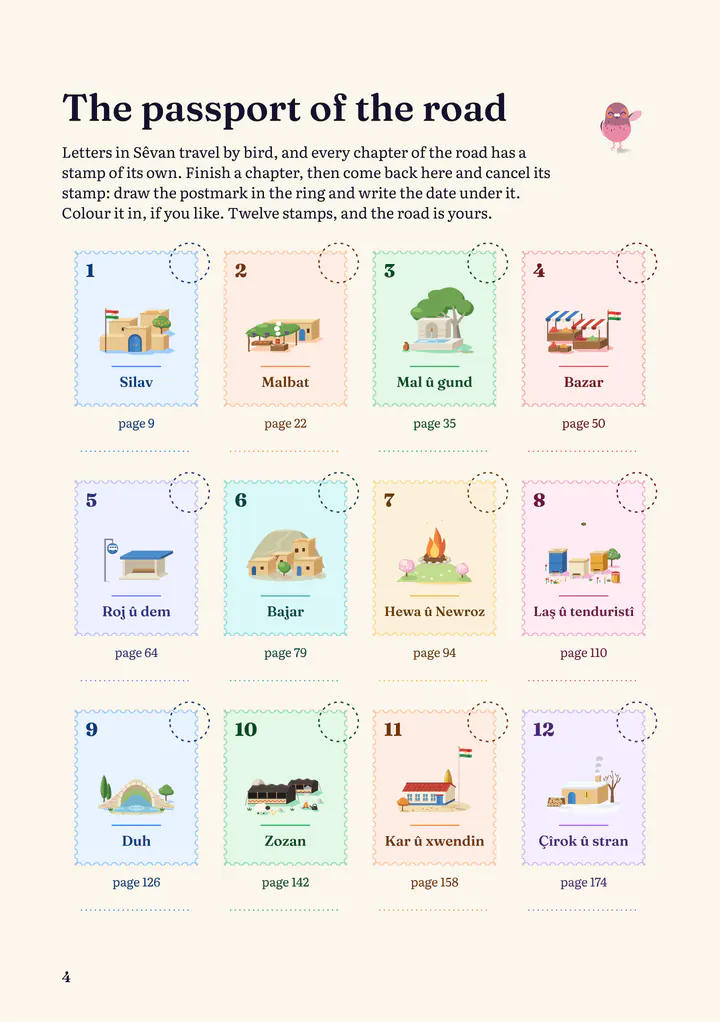
Letters in Sêvan travel by bird, and every chapter of the road has a stamp of its own. Finish a chapter, then come back here and cancel its stamp: draw the postmark in the ring and write the date under it. Colour it in, if you like. Twelve stamps, and the road is yours.
Silav
page 9
Malbat
page 22
Mal û gund
page 35
Bazar
page 50
Roj û dem
page 64
Bajar
page 79
Hewa û Newroz
page 94
Laş û tenduristî
page 110
Duh
page 126
Zozan
page 142
Kar û xwendin
page 158
Çîrok û stran
page 174
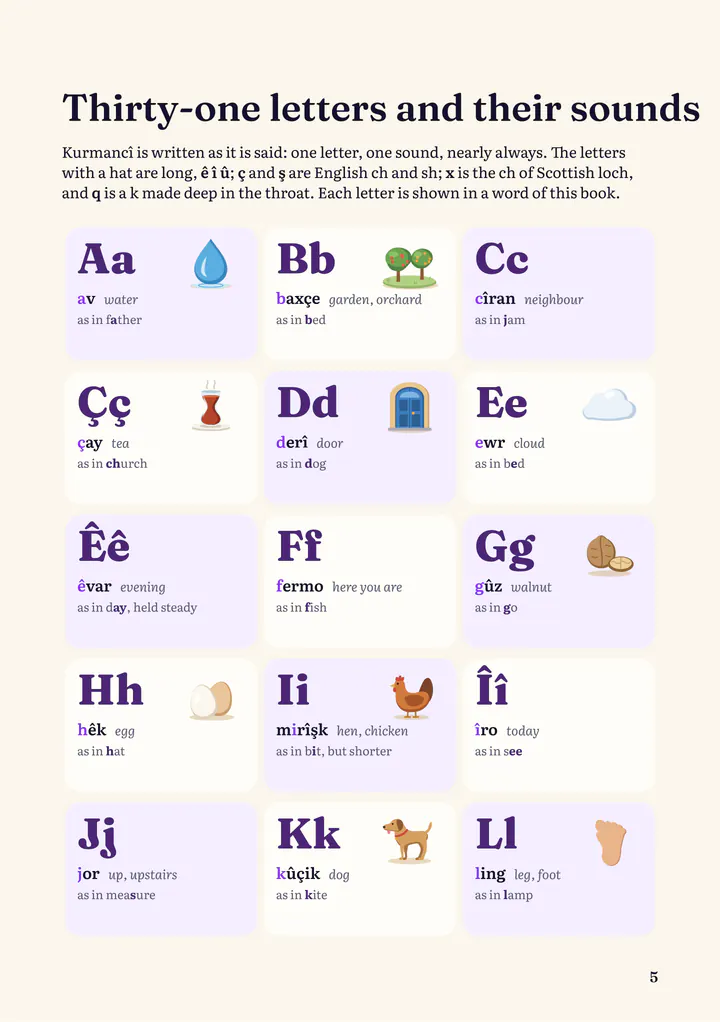
Kurmancî is written as it is said: one letter, one sound, nearly always. The letters with a hat are long, ê î û; ç and ş are English ch and sh; x is the ch of Scottish loch, and q is a k made deep in the throat. Each letter is shown in a word of this book.
as in father
av · water
as in bed
baxçe · garden, orchard
as in jam
cîran · neighbour
as in church
çay · tea
as in dog
derî · door
as in bed
ewr · cloud
as in day, held steady
êvar · evening
as in fish
fermo · here you are
as in go
gûz · walnut
as in hat
hêk · egg
as in bit, but shorter
mirîşk · hen, chicken
as in see
îro · today
as in measure
jor · up, upstairs
as in kite
kûçik · dog
as in lamp
ling · leg, foot
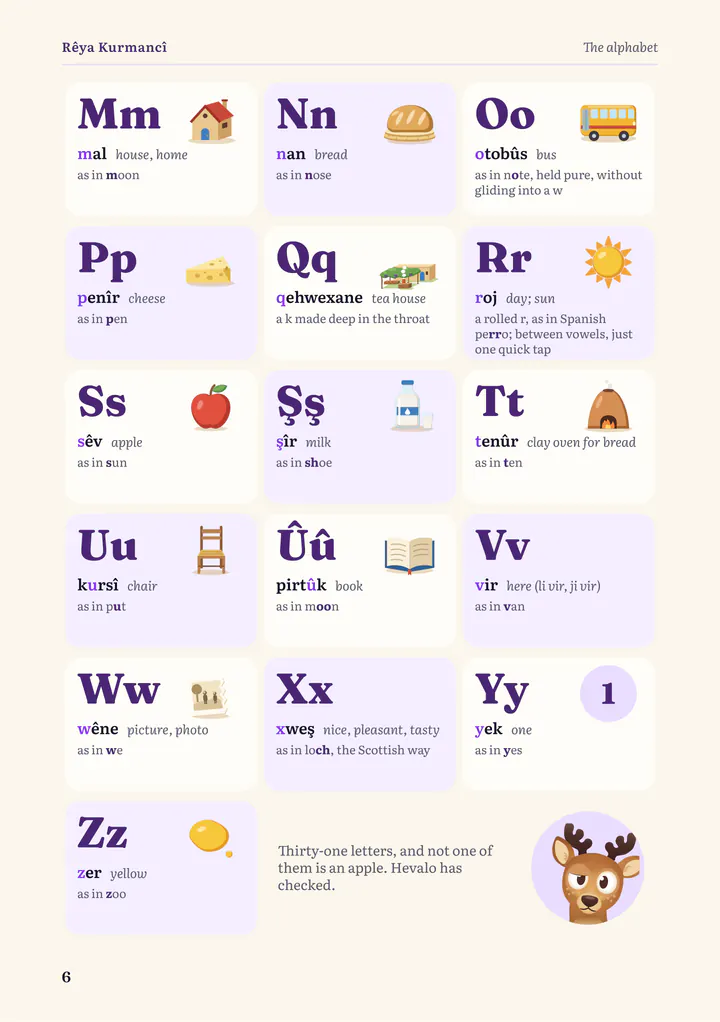
as in moon
mal · house, home
as in nose
nan · bread
as in note, held pure, without gliding into a w
otobûs · bus
as in pen
penîr · cheese
a k made deep in the throat
qehwexane · tea house
a rolled r, as in Spanish perro; between vowels, just one quick tap
roj · day; sun
as in sun
sêv · apple
as in shoe
şîr · milk
as in ten
tenûr · clay oven for bread
as in put
kursî · chair
as in moon
pirtûk · book
as in van
vir · here (li vir, ji vir)
as in we
wêne · picture, photo
as in loch, the Scottish way
xweş · nice, pleasant, tasty
as in yes
yek · one
as in zoo
zer · yellow
Thirty-one letters, and not one of them is an apple. Hevalo has checked.
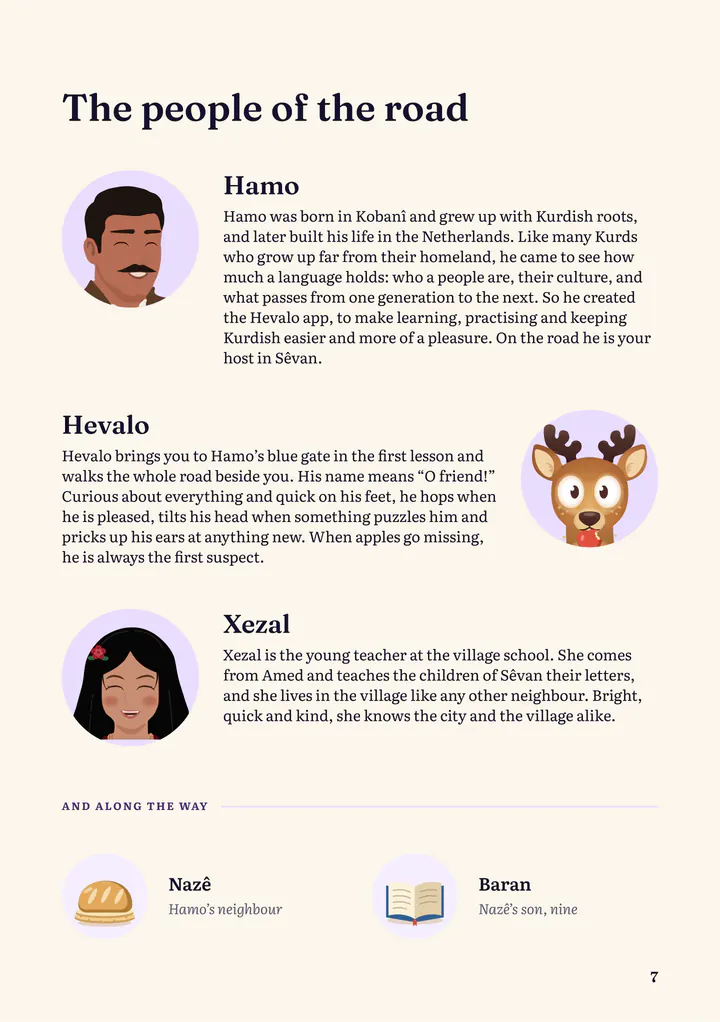
Hamo was born in Kobanî and grew up with Kurdish roots, and later built his life in the Netherlands. Like many Kurds who grow up far from their homeland, he came to see how much a language holds: who a people are, their culture, and what passes from one generation to the next. So he created the Hevalo app, to make learning, practising and keeping Kurdish easier and more of a pleasure. On the road he is your host in Sêvan.
Hevalo brings you to Hamo’s blue gate in the first lesson and walks the whole road beside you. His name means “O friend!” Curious about everything and quick on his feet, he hops when he is pleased, tilts his head when something puzzles him and pricks up his ears at anything new. When apples go missing, he is always the first suspect.
Xezal is the young teacher at the village school. She comes from Amed and teaches the children of Sêvan their letters, and she lives in the village like any other neighbour. Bright, quick and kind, she knows the city and the village alike.
And along the way
Nazê
Hamo’s neighbour
Baran
Nazê’s son, nine
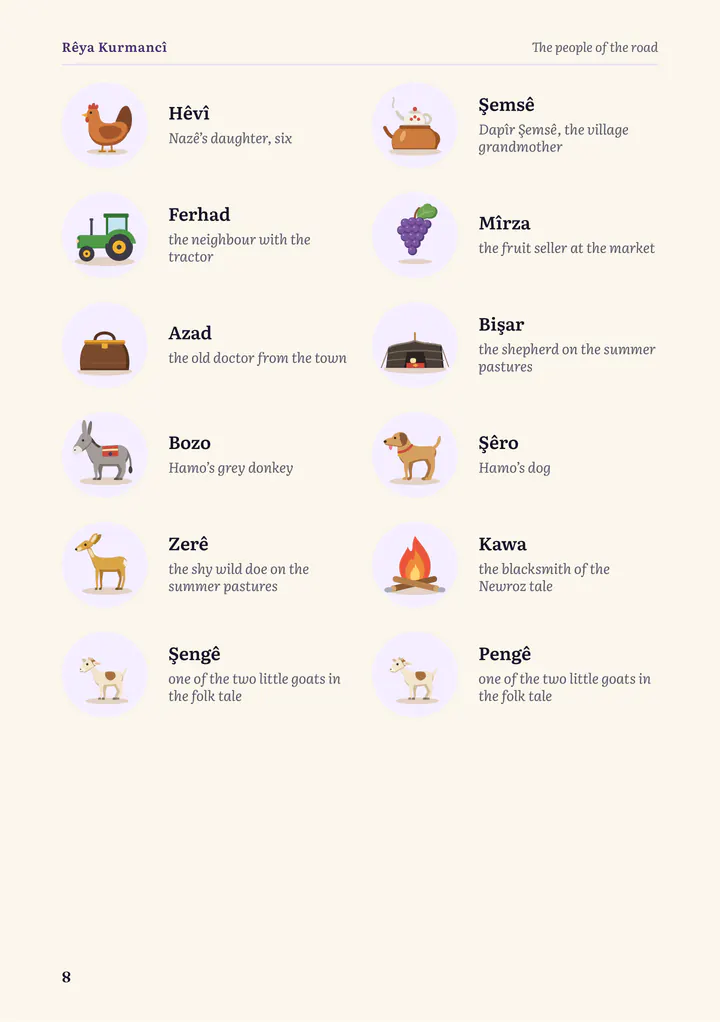
Hêvî
Nazê’s daughter, six
Şemsê
Dapîr Şemsê, the village grandmother
Ferhad
the neighbour with the tractor
Mîrza
the fruit seller at the market
Azad
the old doctor from the town
Bişar
the shepherd on the summer pastures
Bozo
Hamo’s grey donkey
Şêro
Hamo’s dog
Zerê
the shy wild doe on the summer pastures
Kawa
the blacksmith of the Newroz tale
Şengê
one of the two little goats in the folk tale
Pengê
one of the two little goats in the folk tale
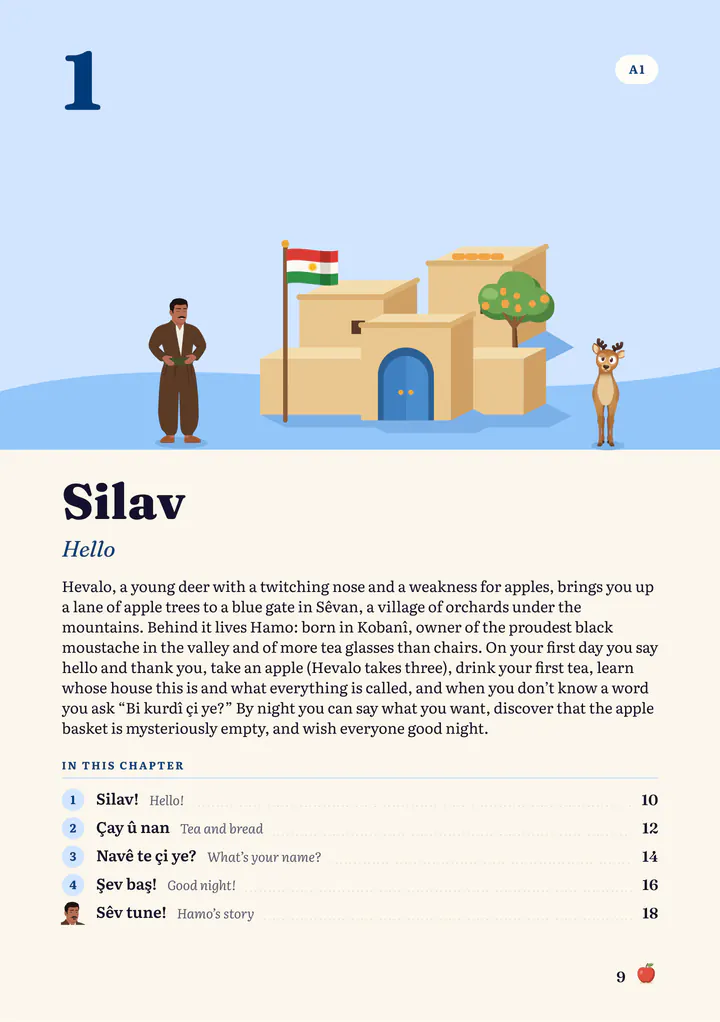
Hello
Hevalo, a young deer with a twitching nose and a weakness for apples, brings you up a lane of apple trees to a blue gate in Sêvan, a village of orchards under the mountains. Behind it lives Hamo: born in Kobanî, owner of the proudest black moustache in the valley and of more tea glasses than chairs. On your first day you say hello and thank you, take an apple (Hevalo takes three), drink your first tea, learn whose house this is and what everything is called, and when you don’t know a word you ask “Bi kurdî çi ye?” By night you can say what you want, discover that the apple basket is mysteriously empty, and wish everyone good night.
In this chapter
1 · Silav! · Hello! · 10
2 · Çay û nan · Tea and bread · 12
3 · Navê te çi ye? · What’s your name? · 14
4 · Şev baş! · Good night! · 16
Sêv tune! · Hamo’s story · 18
Hello! · Part 1 of 4
Grammar
Ez baş im. I am well. In Kurmancî “am” and “are” are not words of their own: they are short endings after the word they go with.
ez … im after a consonant, ez … me after a vowel: Ez baş im. · Ez Hamo me.
tu … î after a consonant, tu … yî after a vowel: Tu baş î? · Tu çawa yî?
Sêv → Ez sêvê dixwim. I’m eating the apple: the verb comes last, and the apple you eat takes -ê.
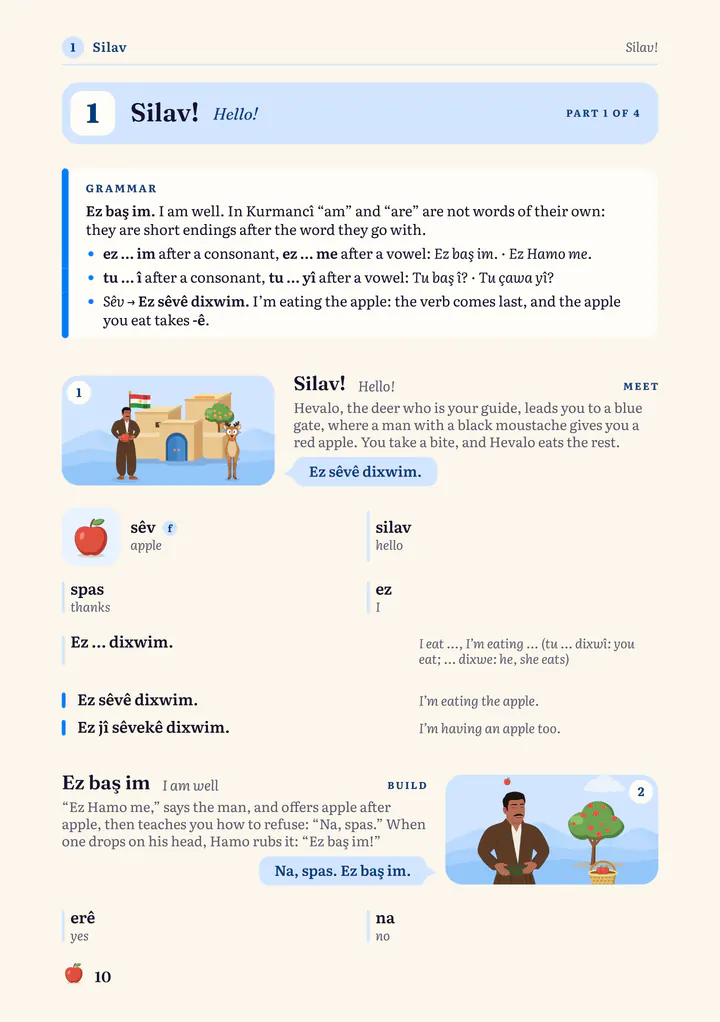
Silav! · Hello! · Meet
Hevalo, the deer who is your guide, leads you to a blue gate, where a man with a black moustache gives you a red apple. You take a bite, and Hevalo eats the rest.
Ez sêvê dixwim.
sêv (f) · apple
silav · hello
spas · thanks
ez · I
Ez … dixwim. · I eat …, I’m eating … (tu … dixwî: you eat; … dixwe: he, she eats)
Ez sêvê dixwim. · I’m eating the apple.
Ez jî sêvekê dixwim. · I’m having an apple too.
Ez baş im · I am well · Build
“Ez Hamo me,” says the man, and offers apple after apple, then teaches you how to refuse: “Na, spas.” When one drops on his head, Hamo rubs it: “Ez baş im!”
Na, spas. Ez baş im.
erê · yes
na · no
baş · good, well, fine
im / me · am (im after a consonant, me after a vowel)
Ez Hamo me. · I’m Hamo.
Ez baş im. · I’m fine.
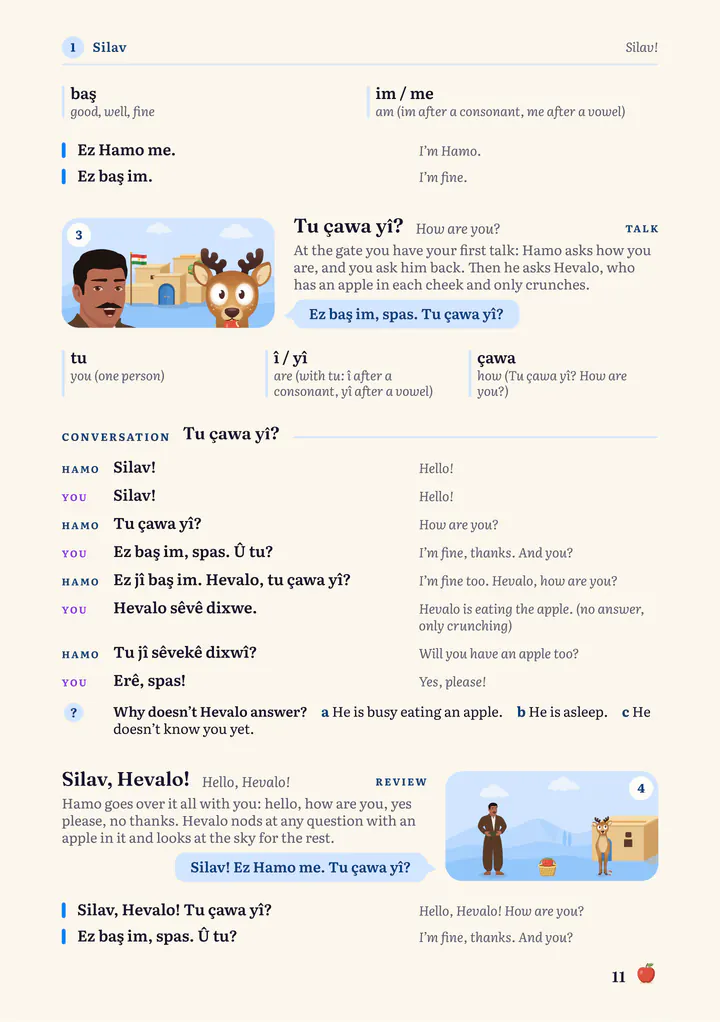
Tu çawa yî? · How are you? · Talk
At the gate you have your first talk: Hamo asks how you are, and you ask him back. Then he asks Hevalo, who has an apple in each cheek and only crunches.
Ez baş im, spas. Tu çawa yî?
tu · you (one person)
î / yî · are (with tu: î after a consonant, yî after a vowel)
çawa · how (Tu çawa yî? How are you?)
Conversation · Tu çawa yî?
Hamo: Silav! · Hello!
You: Silav! · Hello!
Hamo: Tu çawa yî? · How are you?
You: Ez baş im, spas. Û tu? · I’m fine, thanks. And you?
Hamo: Ez jî baş im. Hevalo, tu çawa yî? · I’m fine too. Hevalo, how are you?
You: Hevalo sêvê dixwe. · Hevalo is eating the apple. (no answer, only crunching)
Hamo: Tu jî sêvekê dixwî? · Will you have an apple too?
You: Erê, spas! · Yes, please!
Why doesn’t Hevalo answer? a He is busy eating an apple. b He is asleep. c He doesn’t know you yet.
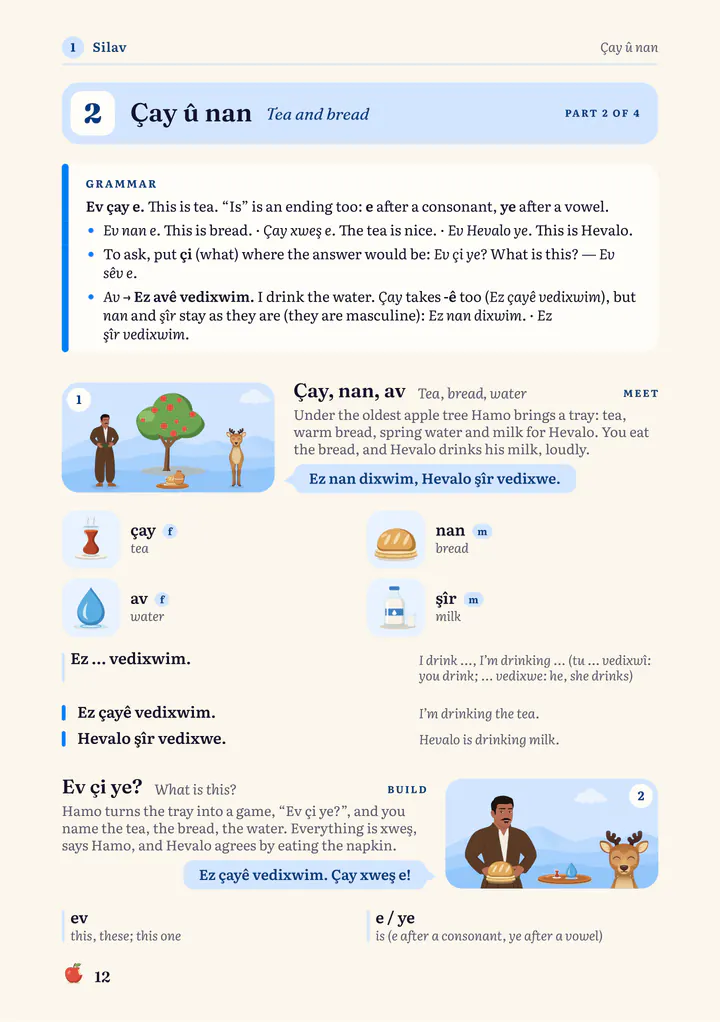
Silav, Hevalo! · Hello, Hevalo! · Review
Hamo goes over it all with you: hello, how are you, yes please, no thanks. Hevalo nods at any question with an apple in it and looks at the sky for the rest.
Silav! Ez Hamo me. Tu çawa yî?
Silav, Hevalo! Tu çawa yî? · Hello, Hevalo! How are you?
Ez baş im, spas. Û tu? · I’m fine, thanks. And you?
Tea and bread · Part 2 of 4
Grammar
Ev çay e. This is tea. “Is” is an ending too: e after a consonant, ye after a vowel.
Ev nan e. This is bread. · Çay xweş e. The tea is nice. · Ev Hevalo ye. This is Hevalo.
To ask, put çi (what) where the answer would be: Ev çi ye? What is this? — Ev sêv e.
Av → Ez avê vedixwim. I drink the water. Çay takes -ê too (Ez çayê vedixwim), but nan and şîr stay as they are (they are masculine): Ez nan dixwim. · Ez şîr vedixwim.
Çay, nan, av · Tea, bread, water · Meet
Under the oldest apple tree Hamo brings a tray: tea, warm bread, spring water and milk for Hevalo. You eat the bread, and Hevalo drinks his milk, loudly.
Ez nan dixwim, Hevalo şîr vedixwe.
çay (f) · tea
nan (m) · bread
av (f) · water
şîr (m) · milk
Ez … vedixwim. · I drink …, I’m drinking … (tu … vedixwî: you drink; … vedixwe: he, she drinks)
Ez çayê vedixwim. · I’m drinking the tea.
Hevalo şîr vedixwe. · Hevalo is drinking milk.
Ev çi ye? · What is this? · Build
Hamo turns the tray into a game, “Ev çi ye?”, and you name the tea, the bread, the water. Everything is xweş, says Hamo, and Hevalo agrees by eating the napkin.
Ez çayê vedixwim. Çay xweş e!
ev · this, these; this one
e / ye · is (e after a consonant, ye after a vowel)
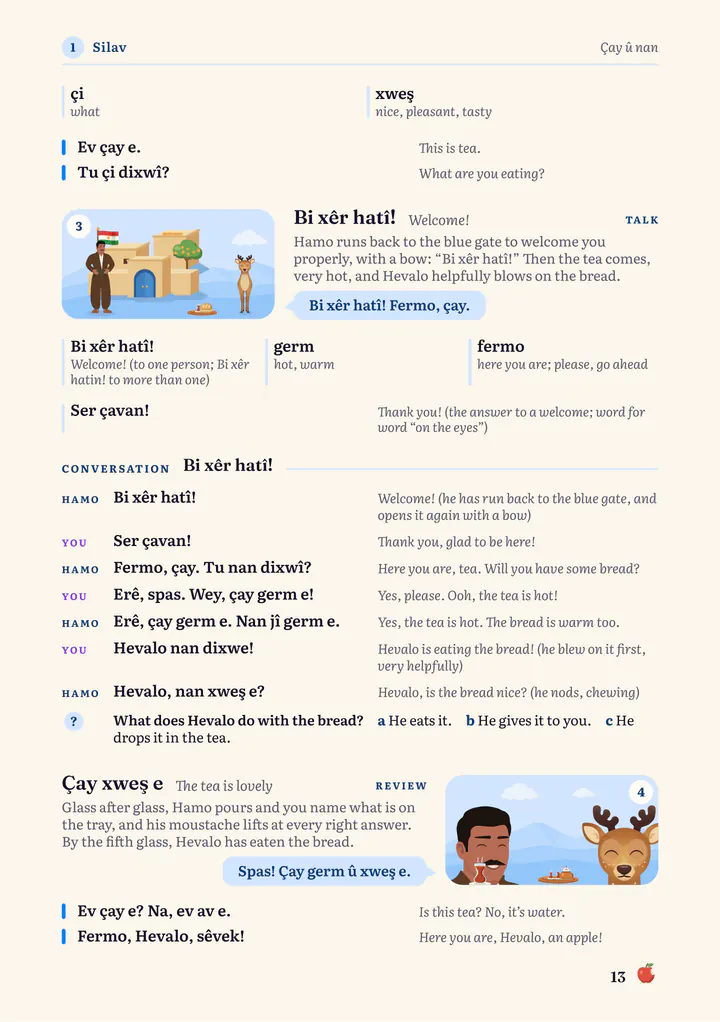
çi · what
xweş · nice, pleasant, tasty
Ev çay e. · This is tea.
Tu çi dixwî? · What are you eating?
Bi xêr hatî! · Welcome! · Talk
Hamo runs back to the blue gate to welcome you properly, with a bow: “Bi xêr hatî!” Then the tea comes, very hot, and Hevalo helpfully blows on the bread.
Bi xêr hatî! Fermo, çay.
Bi xêr hatî! · Welcome! (to one person; Bi xêr hatin! to more than one)
germ · hot, warm
fermo · here you are; please, go ahead
Ser çavan! · Thank you! (the answer to a welcome; word for word “on the eyes”)
Conversation · Bi xêr hatî!
Hamo: Bi xêr hatî! · Welcome! (he has run back to the blue gate, and opens it again with a bow)
You: Ser çavan! · Thank you, glad to be here!
Hamo: Fermo, çay. Tu nan dixwî? · Here you are, tea. Will you have some bread?
You: Erê, spas. Wey, çay germ e! · Yes, please. Ooh, the tea is hot!
Hamo: Erê, çay germ e. Nan jî germ e. · Yes, the tea is hot. The bread is warm too.
You: Hevalo nan dixwe! · Hevalo is eating the bread! (he blew on it first, very helpfully)
Hamo: Hevalo, nan xweş e? · Hevalo, is the bread nice? (he nods, chewing)
What does Hevalo do with the bread? a He eats it. b He gives it to you. c He drops it in the tea.
Çay xweş e · The tea is lovely · Review
Glass after glass, Hamo pours and you name what is on the tray, and his moustache lifts at every right answer. By the fifth glass, Hevalo has eaten the bread.
Spas! Çay germ û xweş e.
Ev çay e? Na, ev av e. · Is this tea? No, it’s water.
Fermo, Hevalo, sêvek! · Here you are, Hevalo, an apple!
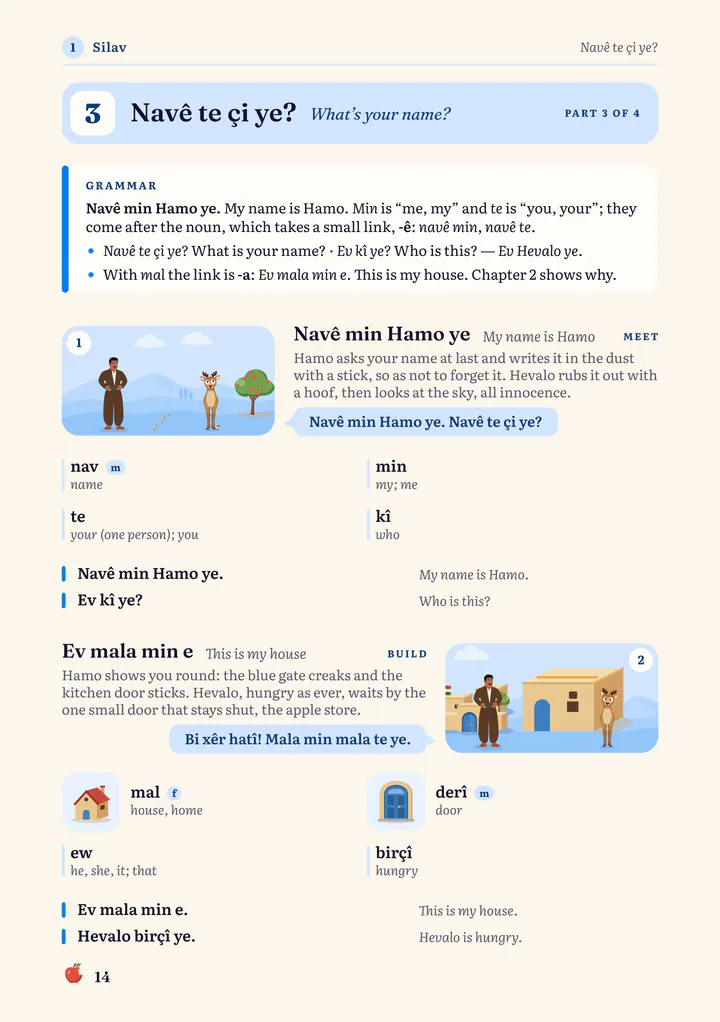
What’s your name? · Part 3 of 4
Grammar
Navê min Hamo ye. My name is Hamo. Min is “me, my” and te is “you, your”; they come after the noun, which takes a small link, -ê: navê min, navê te.
Navê te çi ye? What is your name? · Ev kî ye? Who is this? — Ev Hevalo ye.
With mal the link is -a: Ev mala min e. This is my house. Chapter 2 shows why.
Navê min Hamo ye · My name is Hamo · Meet
Hamo asks your name at last and writes it in the dust with a stick, so as not to forget it. Hevalo rubs it out with a hoof, then looks at the sky, all innocence.
Navê min Hamo ye. Navê te çi ye?
nav (m) · name
min · my; me
te · your (one person); you
kî · who
Navê min Hamo ye. · My name is Hamo.
Ev kî ye? · Who is this?
Ev mala min e · This is my house · Build
Hamo shows you round: the blue gate creaks and the kitchen door sticks. Hevalo, hungry as ever, waits by the one small door that stays shut, the apple store.
Bi xêr hatî! Mala min mala te ye.
mal (f) · house, home
derî (m) · door
ew · he, she, it; that
birçî · hungry
Ev mala min e. · This is my house.
Hevalo birçî ye. · Hevalo is hungry.
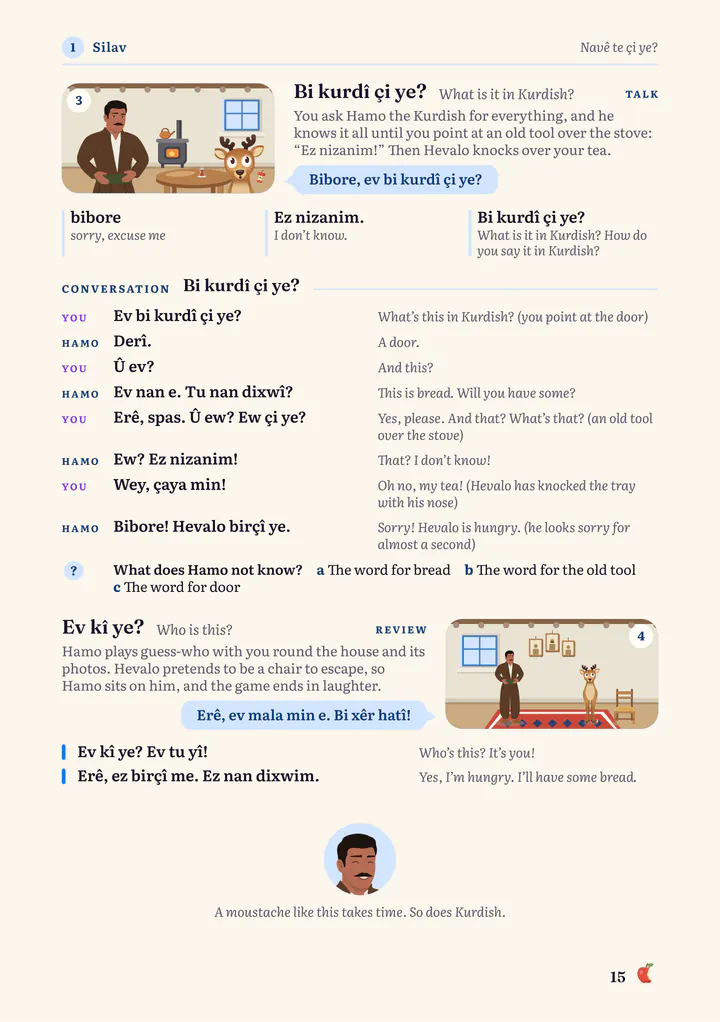
Bi kurdî çi ye? · What is it in Kurdish? · Talk
You ask Hamo the Kurdish for everything, and he knows it all until you point at an old tool over the stove: “Ez nizanim!” Then Hevalo knocks over your tea.
Bibore, ev bi kurdî çi ye?
bibore · sorry, excuse me
Ez nizanim. · I don’t know.
Bi kurdî çi ye? · What is it in Kurdish? How do you say it in Kurdish?
Conversation · Bi kurdî çi ye?
You: Ev bi kurdî çi ye? · What’s this in Kurdish? (you point at the door)
Hamo: Derî. · A door.
You: Û ev? · And this?
Hamo: Ev nan e. Tu nan dixwî? · This is bread. Will you have some?
You: Erê, spas. Û ew? Ew çi ye? · Yes, please. And that? What’s that? (an old tool over the stove)
Hamo: Ew? Ez nizanim! · That? I don’t know!
You: Wey, çaya min! · Oh no, my tea! (Hevalo has knocked the tray with his nose)
Hamo: Bibore! Hevalo birçî ye. · Sorry! Hevalo is hungry. (he looks sorry for almost a second)
What does Hamo not know? a The word for bread b The word for the old tool c The word for door
Ev kî ye? · Who is this? · Review
Hamo plays guess-who with you round the house and its photos. Hevalo pretends to be a chair to escape, so Hamo sits on him, and the game ends in laughter.
Erê, ev mala min e. Bi xêr hatî!
Ev kî ye? Ev tu yî! · Who’s this? It’s you!
Erê, ez birçî me. Ez nan dixwim. · Yes, I’m hungry. I’ll have some bread.
A moustache like this takes time. So does Kurdish.
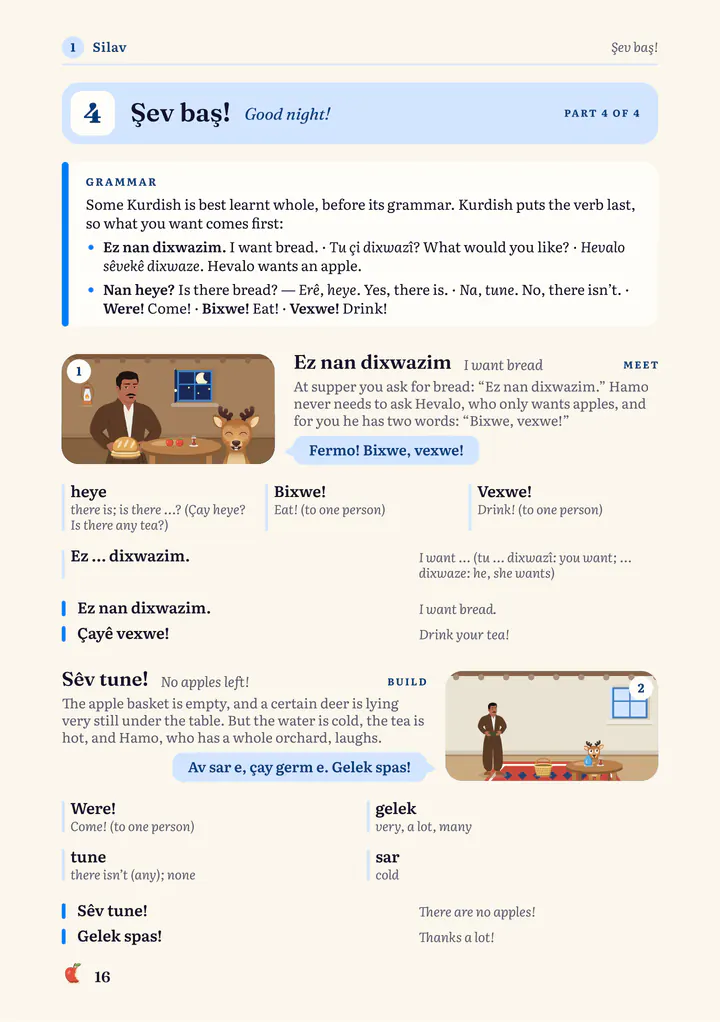
Good night! · Part 4 of 4
Grammar
Some Kurdish is best learnt whole, before its grammar. Kurdish puts the verb last, so what you want comes first:
Ez nan dixwazim. I want bread. · Tu çi dixwazî? What would you like? · Hevalo sêvekê dixwaze. Hevalo wants an apple.
Nan heye? Is there bread? — Erê, heye. Yes, there is. · Na, tune. No, there isn’t. · Were! Come! · Bixwe! Eat! · Vexwe! Drink!
Ez nan dixwazim · I want bread · Meet
At supper you ask for bread: “Ez nan dixwazim.” Hamo never needs to ask Hevalo, who only wants apples, and for you he has two words: “Bixwe, vexwe!”
Fermo! Bixwe, vexwe!
heye · there is; is there …? (Çay heye? Is there any tea?)
Bixwe! · Eat! (to one person)
Vexwe! · Drink! (to one person)
Ez … dixwazim. · I want … (tu … dixwazî: you want; … dixwaze: he, she wants)
Ez nan dixwazim. · I want bread.
Çayê vexwe! · Drink your tea!
Sêv tune! · No apples left! · Build
The apple basket is empty, and a certain deer is lying very still under the table. But the water is cold, the tea is hot, and Hamo, who has a whole orchard, laughs.
Av sar e, çay germ e. Gelek spas!
Were! · Come! (to one person)
gelek · very, a lot, many
tune · there isn’t (any); none
sar · cold
Sêv tune! · There are no apples!
Gelek spas! · Thanks a lot!
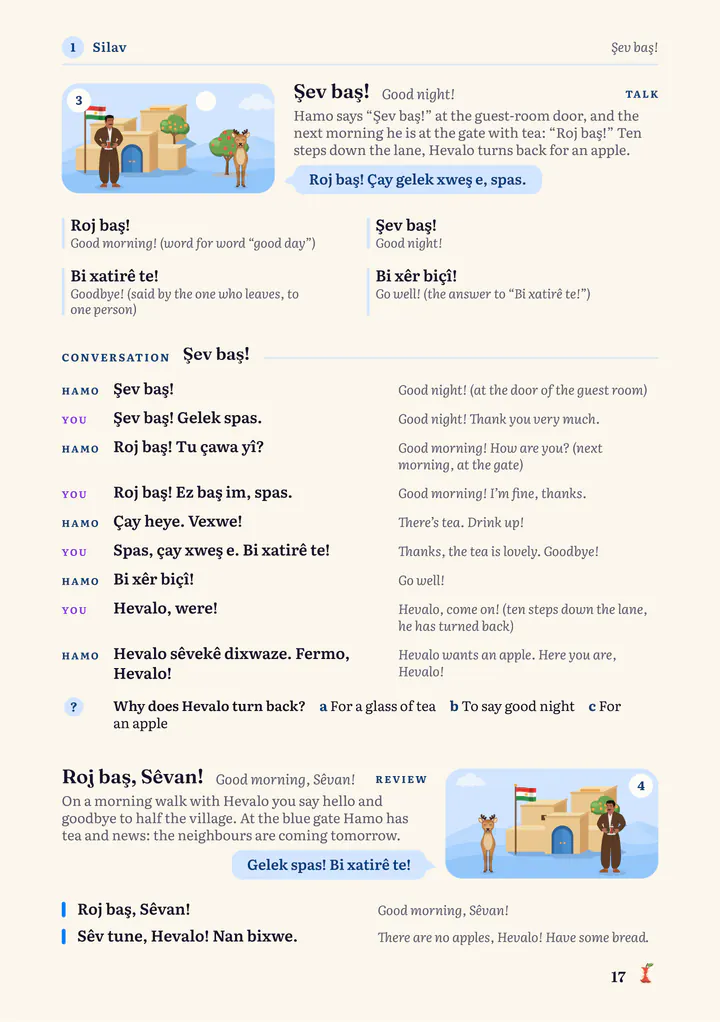
Şev baş! · Good night! · Talk
Hamo says “Şev baş!” at the guest-room door, and the next morning he is at the gate with tea: “Roj baş!” Ten steps down the lane, Hevalo turns back for an apple.
Roj baş! Çay gelek xweş e, spas.
Roj baş! · Good morning! (word for word “good day”)
Şev baş! · Good night!
Bi xatirê te! · Goodbye! (said by the one who leaves, to one person)
Bi xêr biçî! · Go well! (the answer to “Bi xatirê te!”)
Conversation · Şev baş!
Hamo: Şev baş! · Good night! (at the door of the guest room)
You: Şev baş! Gelek spas. · Good night! Thank you very much.
Hamo: Roj baş! Tu çawa yî? · Good morning! How are you? (next morning, at the gate)
You: Roj baş! Ez baş im, spas. · Good morning! I’m fine, thanks.
Hamo: Çay heye. Vexwe! · There’s tea. Drink up!
You: Spas, çay xweş e. Bi xatirê te! · Thanks, the tea is lovely. Goodbye!
Hamo: Bi xêr biçî! · Go well!
You: Hevalo, were! · Hevalo, come on! (ten steps down the lane, he has turned back)
Hamo: Hevalo sêvekê dixwaze. Fermo, Hevalo!
Hevalo wants an apple. Here you are, Hevalo!
Why does Hevalo turn back? a For a glass of tea b To say good night c For an apple
Roj baş, Sêvan! · Good morning, Sêvan! · Review
On a morning walk with Hevalo you say hello and goodbye to half the village. At the blue gate Hamo has tea and news: the neighbours are coming tomorrow.
Gelek spas! Bi xatirê te!
Roj baş, Sêvan! · Good morning, Sêvan!
Sêv tune, Hevalo! Nan bixwe. · There are no apples, Hevalo! Have some bread.
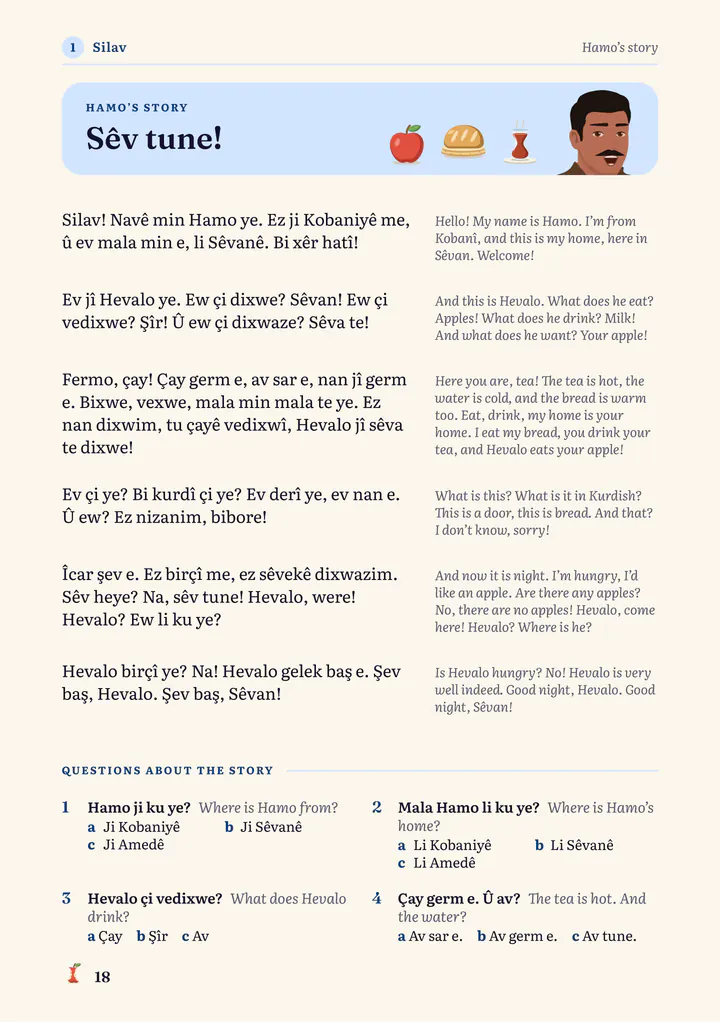
Hamo’s story
Silav! Navê min Hamo ye. Ez ji Kobaniyê me, û ev mala min e, li Sêvanê. Bi xêr hatî!
Hello! My name is Hamo. I’m from Kobanî, and this is my home, here in Sêvan. Welcome!
Ev jî Hevalo ye. Ew çi dixwe? Sêvan! Ew çi vedixwe? Şîr! Û ew çi dixwaze? Sêva te!
And this is Hevalo. What does he eat? Apples! What does he drink? Milk! And what does he want? Your apple!
Fermo, çay! Çay germ e, av sar e, nan jî germ e. Bixwe, vexwe, mala min mala te ye. Ez nan dixwim, tu çayê vedixwî, Hevalo jî sêva te dixwe!
Here you are, tea! The tea is hot, the water is cold, and the bread is warm too. Eat, drink, my home is your home. I eat my bread, you drink your tea, and Hevalo eats your apple!
Ev çi ye? Bi kurdî çi ye? Ev derî ye, ev nan e. Û ew? Ez nizanim, bibore!
What is this? What is it in Kurdish? This is a door, this is bread. And that? I don’t know, sorry!
Îcar şev e. Ez birçî me, ez sêvekê dixwazim. Sêv heye? Na, sêv tune! Hevalo, were! Hevalo? Ew li ku ye?
And now it is night. I’m hungry, I’d like an apple. Are there any apples? No, there are no apples! Hevalo, come here! Hevalo? Where is he?
Hevalo birçî ye? Na! Hevalo gelek baş e. Şev baş, Hevalo. Şev baş, Sêvan!
Is Hevalo hungry? No! Hevalo is very well indeed. Good night, Hevalo. Good night, Sêvan!
Questions about the story
1 · Hamo ji ku ye? Where is Hamo from?
a · Ji Kobaniyê · b · Ji Sêvanê
c · Ji Amedê
2 · Mala Hamo li ku ye? Where is Hamo’s home?
a · Li Kobaniyê · b · Li Sêvanê
c · Li Amedê
3 · Hevalo çi vedixwe? What does Hevalo drink?
a Çay b Şîr c Av
4 · Çay germ e. Û av? The tea is hot. And the water?
a Av sar e. b Av germ e. c Av tune.
5 · Hamo çi dixwe? What does Hamo eat?
a Sêv b Şîr c Nan
6 · Û ew? Bi kurdî çi ye? “And that? What is it in Kurdish?” What does Hamo answer?
a · Ev derî ye. · b · Ez nizanim!
c · Ev nan e.
7 · “Ez birçî me.” Hamo çi dixwaze? “Ez birçî me.” What does Hamo want?
a Sêvekê b Çayê c Derî
8 · Şev e. Sêv heye? It is night. Are there any apples?
a · Erê, sêv heye. · b · Erê, gelek sêv.
c · Na, sêv tune.
9 · Sêv tune. Hevalo birçî ye? There are no apples. Is Hevalo hungry?
a · Erê, gelek birçî ye.
b · Na! Ew gelek baş e.
c · Ez nizanim.
10 · Kî sêvan dixwe? Who eats the apples?
a Hevalo b Hamo c Tu
Hevalo has gone on ahead.
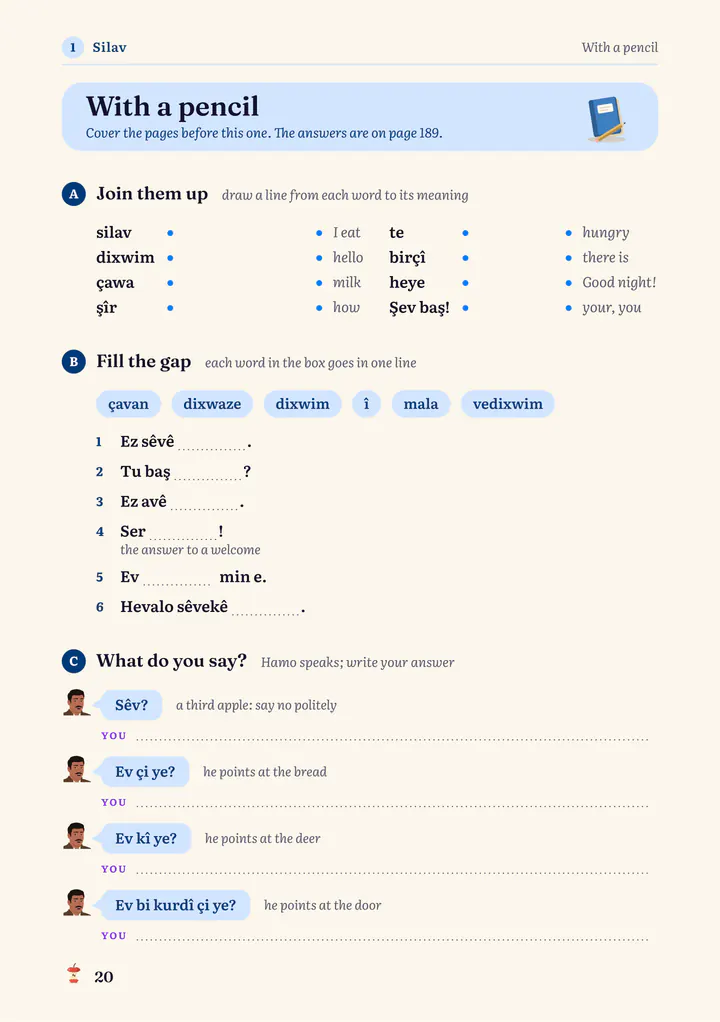
Cover the pages before this one. The answers are on page 189.
A · Join them up · draw a line from each word to its meaning
silav · I eat · te · hungry
dixwim · hello · birçî · there is
çawa · milk · heye · Good night!
şîr · how · Şev baş! · your, you
B · Fill the gap · each word in the box goes in one line
çavan · dixwaze · dixwim · î · mala · vedixwim
1 · Ez sêvê ….
2 · Tu baş …?
3 · Ez avê ….
4 · Ser …!
the answer to a welcome
5 · Ev … min e.
6 · Hevalo sêvekê ….
C · What do you say? · Hamo speaks; write your answer
Sêv? · a third apple: say no politely
You
Ev çi ye? · he points at the bread
You
Ev kî ye? · he points at the deer
You
Ev bi kurdî çi ye? · he points at the door
You
D · Put it into Kurdish · write it, then say it
1 · Hevalo is eating the apple!
2 · What is this?
3 · I’m hungry.
4 · Is there any bread?
E · Name the pictures · in Kurdish, of course
F · No English this time · Hevalo ate it. Read these aloud all the same
Wey, Hevalo sêvê dixwe!
Ez çayê vedixwim. Çay germ û xweş e.
Navê min Hamo ye. Tu kî yî?
Silav
Chapter 1 is yours
Cancel its stamp in your passport on page 4, then turn the page.
Hevalo, sêva min!
Hevalo, my apple!
Family
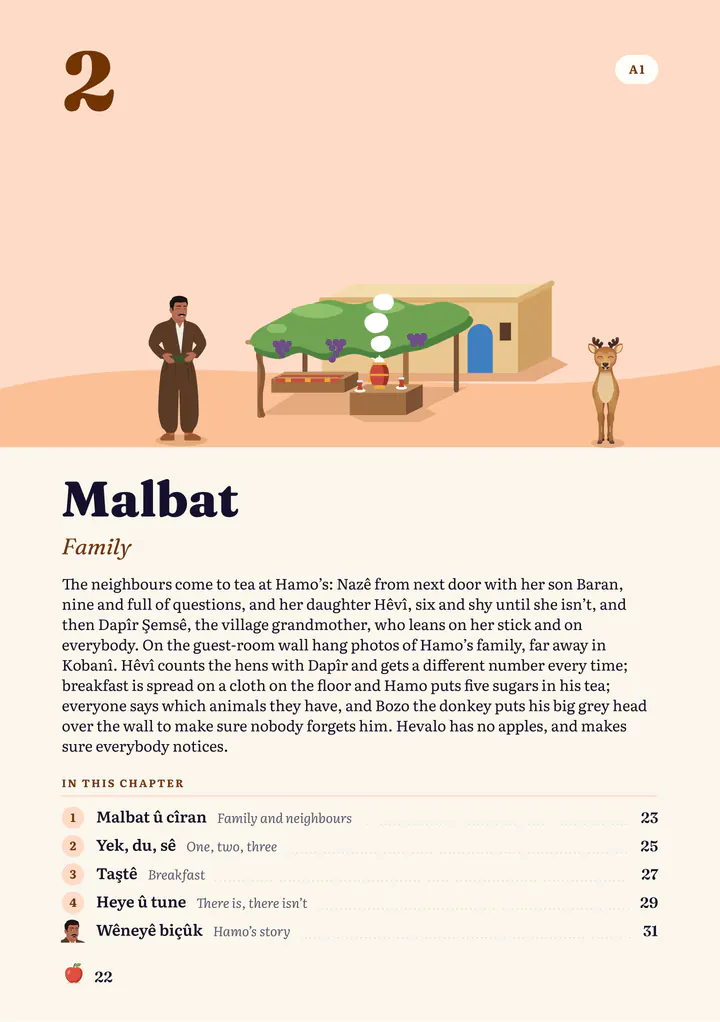
The neighbours come to tea at Hamo’s: Nazê from next door with her son Baran, nine and full of questions, and her daughter Hêvî, six and shy until she isn’t, and then Dapîr Şemsê, the village grandmother, who leans on her stick and on everybody. On the guest-room wall hang photos of Hamo’s family, far away in Kobanî. Hêvî counts the hens with Dapîr and gets a different number every time; breakfast is spread on a cloth on the floor and Hamo puts five sugars in his tea; everyone says which animals they have, and Bozo the donkey puts his big grey head over the wall to make sure nobody forgets him. Hevalo has no apples, and makes sure everybody notices.
In this chapter
1 · Malbat û cîran · Family and neighbours · 23
2 · Yek, du, sê · One, two, three · 25
3 · Taştê · Breakfast · 27
4 · Heye û tune · There is, there isn’t · 29
Wêneyê biçûk · Hamo’s story · 31
Family and neighbours · Part 1 of 4
Grammar
Bavê min, diya min. My father, my mother. A noun is joined to the word after it by a link: -ê for a masculine noun, -a for a feminine one: bavê min, birayê min, navê wê (her name); diya min, xwişka min (dê becomes diya; after a vowel a y slips in: birayê).
With em (we), hûn (you, more than one) and ew (they), “are” is in, or ne after a vowel: Em malbat in. · Hûn cîran in.
Ew li Kobaniyê ne. They are in Kobanî.
Bavê min · My father · Meet
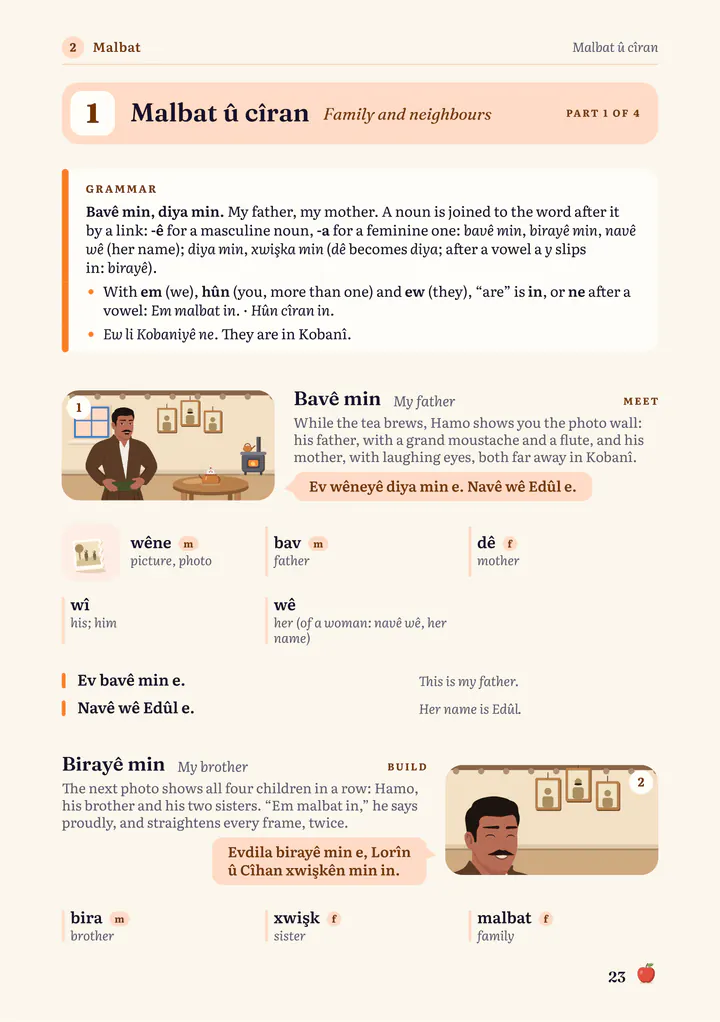
While the tea brews, Hamo shows you the photo wall: his father, with a grand moustache and a flute, and his mother, with laughing eyes, both far away in Kobanî.
Ev wêneyê diya min e. Navê wê Edûl e.
wêne (m) · picture, photo
bav (m) · father
dê (f) · mother
wî · his; him
wê · her (of a woman: navê wê, her name)
Ev bavê min e. · This is my father.
Navê wê Edûl e. · Her name is Edûl.
Birayê min · My brother · Build
The next photo shows all four children in a row: Hamo, his brother and his two sisters. “Em malbat in,” he says proudly, and straightens every frame, twice.
Evdila birayê min e, Lorîn û Cîhan xwişkên min in.
bira (m) · brother
xwişk (f) · sister
malbat (f) · family
em · we
in / ne · are (with em, hûn, ew: in after a consonant, ne after a vowel)
Ev birayê min e. · This is my brother.
Em malbat in! · We’re a family!
Hûn cîran in! · You’re neighbours! · Talk
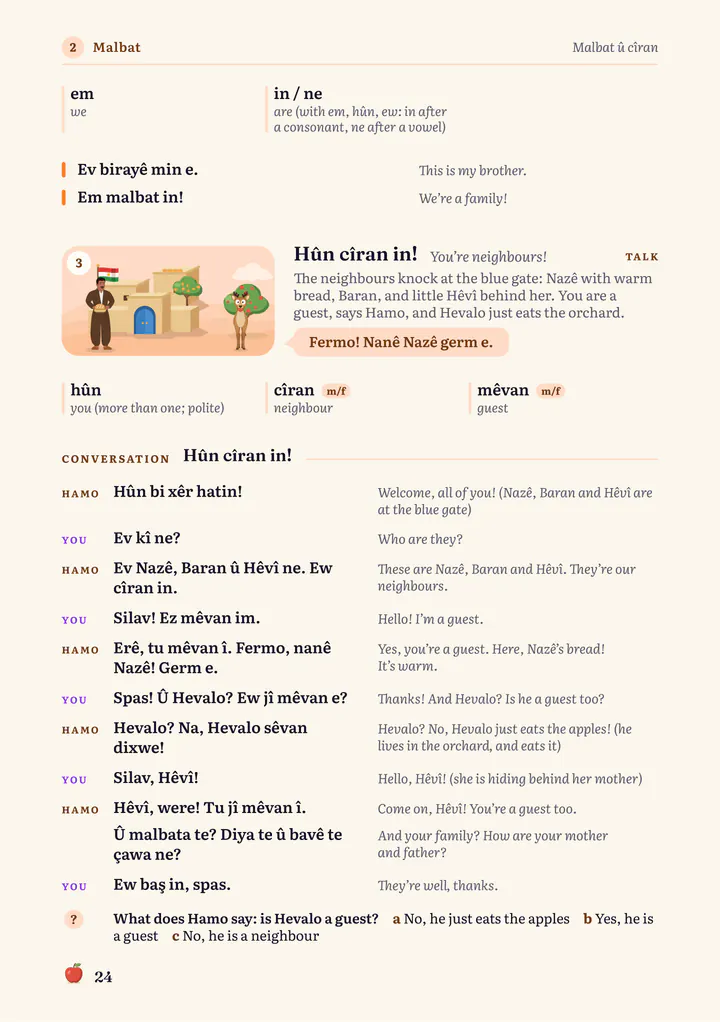
The neighbours knock at the blue gate: Nazê with warm bread, Baran, and little Hêvî behind her. You are a guest, says Hamo, and Hevalo just eats the orchard.
Fermo! Nanê Nazê germ e.
hûn · you (more than one; polite)
cîran · m/f · neighbour
mêvan · m/f · guest
Conversation · Hûn cîran in!
Hamo: Hûn bi xêr hatin! · Welcome, all of you! (Nazê, Baran and Hêvî are at the blue gate)
You: Ev kî ne? · Who are they?
Hamo: Ev Nazê, Baran û Hêvî ne. Ew cîran in.
These are Nazê, Baran and Hêvî. They’re our neighbours.
You: Silav! Ez mêvan im. · Hello! I’m a guest.
Hamo: Erê, tu mêvan î. Fermo, nanê Nazê! Germ e.
Yes, you’re a guest. Here, Nazê’s bread! It’s warm.
You: Spas! Û Hevalo? Ew jî mêvan e? · Thanks! And Hevalo? Is he a guest too?
Hamo: Hevalo? Na, Hevalo sêvan dixwe!
Hevalo? No, Hevalo just eats the apples! (he lives in the orchard, and eats it)
You: Silav, Hêvî! · Hello, Hêvî! (she is hiding behind her mother)
Hamo: Hêvî, were! Tu jî mêvan î. · Come on, Hêvî! You’re a guest too.
Û malbata te? Diya te û bavê te çawa ne?
And your family? How are your mother and father?
You: Ew baş in, spas. · They’re well, thanks.
What does Hamo say: is Hevalo a guest? a No, he just eats the apples b Yes, he is a guest c No, he is a neighbour
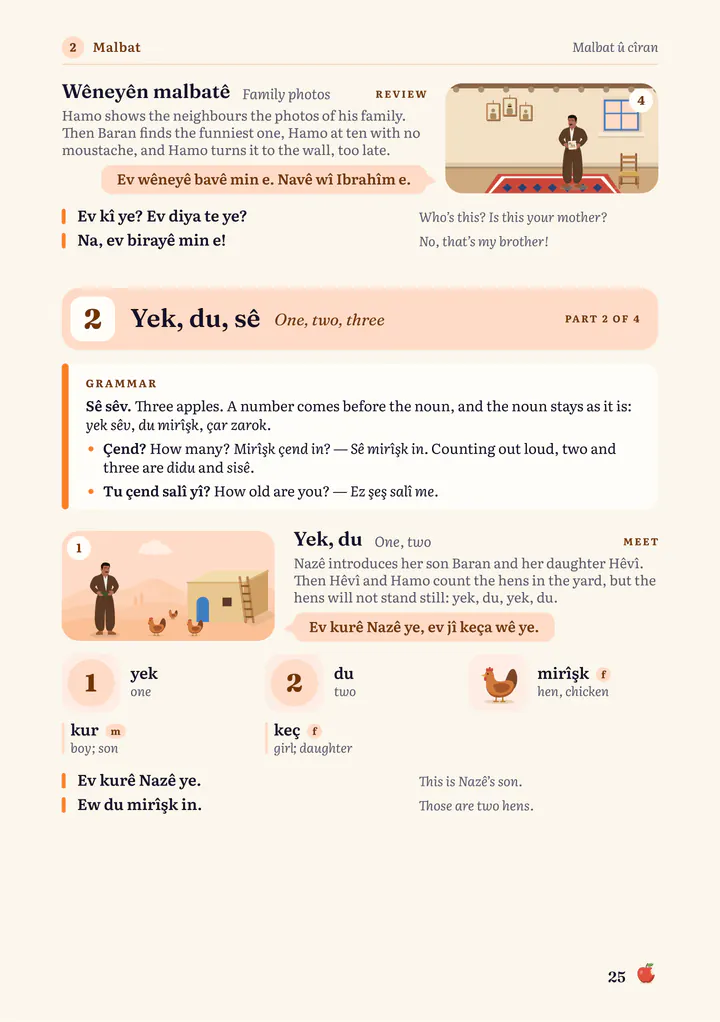
Wêneyên malbatê · Family photos · Review
Hamo shows the neighbours the photos of his family. Then Baran finds the funniest one, Hamo at ten with no moustache, and Hamo turns it to the wall, too late.
Ev wêneyê bavê min e. Navê wî Ibrahîm e.
Ev kî ye? Ev diya te ye? · Who’s this? Is this your mother?
Na, ev birayê min e! · No, that’s my brother!
One, two, three · Part 2 of 4
Grammar
Sê sêv. Three apples. A number comes before the noun, and the noun stays as it is: yek sêv, du mirîşk, çar zarok.
Çend? How many? Mirîşk çend in? — Sê mirîşk in. Counting out loud, two and three are didu and sisê.
Tu çend salî yî? How old are you? — Ez şeş salî me.
Yek, du · One, two · Meet
Nazê introduces her son Baran and her daughter Hêvî. Then Hêvî and Hamo count the hens in the yard, but the hens will not stand still: yek, du, yek, du.
Ev kurê Nazê ye, ev jî keça wê ye.
yek · one
du · two
mirîşk (f) · hen, chicken
kur (m) · boy; son
keç (f) · girl; daughter
Ev kurê Nazê ye. · This is Nazê’s son.
Ew du mirîşk in. · Those are two hens.
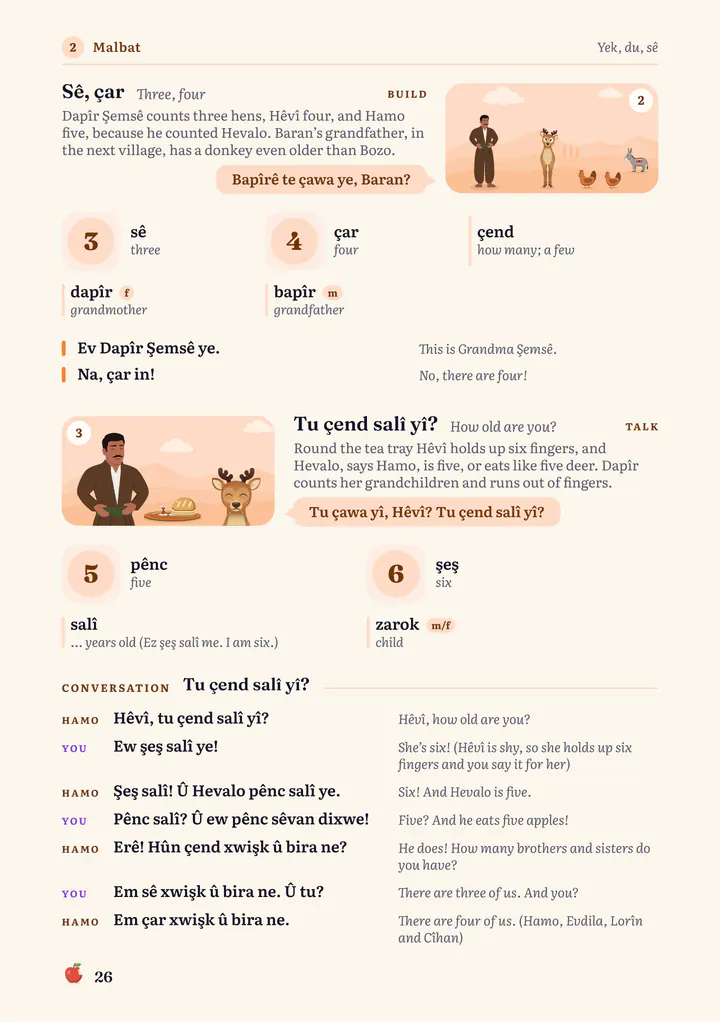
Sê, çar · Three, four · Build
Dapîr Şemsê counts three hens, Hêvî four, and Hamo five, because he counted Hevalo. Baran’s grandfather, in the next village, has a donkey even older than Bozo.
Bapîrê te çawa ye, Baran?
sê · three
çar · four
çend · how many; a few
dapîr (f) · grandmother
bapîr (m) · grandfather
Ev Dapîr Şemsê ye. · This is Grandma Şemsê.
Na, çar in! · No, there are four!
Tu çend salî yî? · How old are you? · Talk
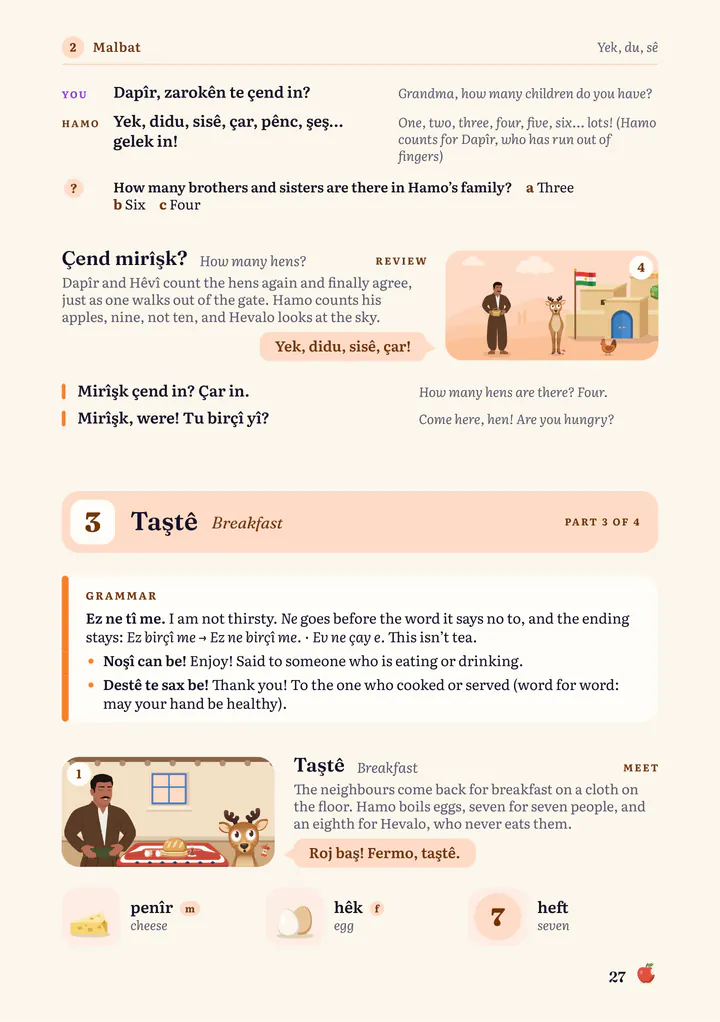
Round the tea tray Hêvî holds up six fingers, and Hevalo, says Hamo, is five, or eats like five deer. Dapîr counts her grandchildren and runs out of fingers.
Tu çawa yî, Hêvî? Tu çend salî yî?
pênc · five
şeş · six
salî · … years old (Ez şeş salî me. I am six.)
zarok · m/f · child
Conversation · Tu çend salî yî?
Hamo: Hêvî, tu çend salî yî? · Hêvî, how old are you?
You: Ew şeş salî ye! · She’s six! (Hêvî is shy, so she holds up six fingers and you say it for her)
Hamo: Şeş salî! Û Hevalo pênc salî ye. · Six! And Hevalo is five.
You: Pênc salî? Û ew pênc sêvan dixwe! · Five? And he eats five apples!
Hamo: Erê! Hûn çend xwişk û bira ne? · He does! How many brothers and sisters do you have?
You: Em sê xwişk û bira ne. Û tu? · There are three of us. And you?
Hamo: Em çar xwişk û bira ne. · There are four of us. (Hamo, Evdila, Lorîn and Cîhan)
You: Dapîr, zarokên te çend in? · Grandma, how many children do you have?
Hamo: Yek, didu, sisê, çar, pênc, şeş… gelek in!
One, two, three, four, five, six… lots! (Hamo counts for Dapîr, who has run out of fingers)
How many brothers and sisters are there in Hamo’s family? a Three b Six c Four
Çend mirîşk? · How many hens? · Review
Dapîr and Hêvî count the hens again and finally agree, just as one walks out of the gate. Hamo counts his apples, nine, not ten, and Hevalo looks at the sky.
Yek, didu, sisê, çar!
Mirîşk çend in? Çar in. · How many hens are there? Four.
Mirîşk, were! Tu birçî yî? · Come here, hen! Are you hungry?
Breakfast · Part 3 of 4
Grammar
Ez ne tî me. I am not thirsty. Ne goes before the word it says no to, and the ending stays: Ez birçî me → Ez ne birçî me. · Ev ne çay e. This isn’t tea.
Noşî can be! Enjoy! Said to someone who is eating or drinking.
Destê te sax be! Thank you! To the one who cooked or served (word for word: may your hand be healthy).
Taştê · Breakfast · Meet
The neighbours come back for breakfast on a cloth on the floor. Hamo boils eggs, seven for seven people, and an eighth for Hevalo, who never eats them.
Roj baş! Fermo, taştê.
penîr (m) · cheese
hêk (f) · egg
heft · seven
heşt · eight
taştê (f) · breakfast
Fermo, taştê! · Here’s breakfast!
Heşt hêk! Yek ji Hevalo re. · Eight eggs! One for Hevalo.
Ez ne zarok im! · I’m not a little kid! · Build
Baran says he is nine, nearly ten, so not a child, and drinks his milk to prove it. It leaves him a white moustache, which Hamo inspects like an expert.
Ez ne zarok im! Ez neh salî me.
neh · nine
deh · ten
mast (m) · yoghurt
ne · not (with the copula: ez ne … im)
Baran neh salî ye. · Baran is nine years old.
Hevalo deh sêvan dixwe! · Hevalo eats ten apples!
Destê te sax be! · Bless your hands! · Talk
Nazê made the bread, and Hamo teaches you what to say to her: “Destê te sax be!” You are thirsty, and every time you say thank you, he fills your glass again.
Destê te sax be! Nan gelek xweş e.
Noşî can be! · Enjoy! (to someone eating or drinking)
tî · thirsty
Destê te sax be! · Thank you! (for food or help; word for word: may your hand be healthy)
Conversation · Destê te sax be!
Hamo: Fermo, nan bixwe. Nanê Nazê ye.
Here you are, have some bread. It’s Nazê’s bread.
You: Spas! Nan gelek xweş e. · Thanks! The bread is really good.
Hamo: Erê! Destê wê sax be! · It is! Bless her hands!
You: Destê te sax be, Nazê! · Bless your hands, Nazê! (you say it to her, and she smiles)
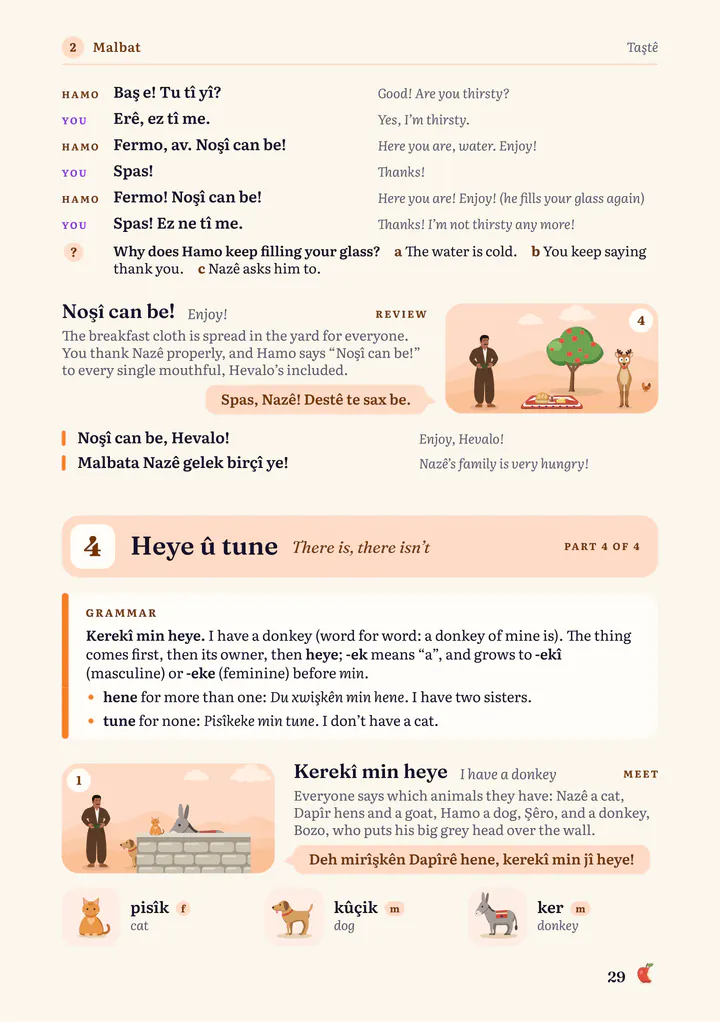
Hamo: Baş e! Tu tî yî? · Good! Are you thirsty?
You: Erê, ez tî me. · Yes, I’m thirsty.
Hamo: Fermo, av. Noşî can be! · Here you are, water. Enjoy!
You: Spas! · Thanks!
Hamo: Fermo! Noşî can be! · Here you are! Enjoy! (he fills your glass again)
You: Spas! Ez ne tî me. · Thanks! I’m not thirsty any more!
Why does Hamo keep filling your glass? a The water is cold. b You keep saying thank you. c Nazê asks him to.
Noşî can be! · Enjoy! · Review
The breakfast cloth is spread in the yard for everyone. You thank Nazê properly, and Hamo says “Noşî can be!” to every single mouthful, Hevalo’s included.
Spas, Nazê! Destê te sax be.
Noşî can be, Hevalo! · Enjoy, Hevalo!
Malbata Nazê gelek birçî ye! · Nazê’s family is very hungry!
There is, there isn’t · Part 4 of 4
Grammar
Kerekî min heye. I have a donkey (word for word: a donkey of mine is). The thing comes first, then its owner, then heye; -ek means “a”, and grows to -ekî (masculine) or -eke (feminine) before min.
hene for more than one: Du xwişkên min hene. I have two sisters.
tune for none: Pisîkeke min tune. I don’t have a cat.
Kerekî min heye · I have a donkey · Meet
Everyone says which animals they have: Nazê a cat, Dapîr hens and a goat, Hamo a dog, Şêro, and a donkey, Bozo, who puts his big grey head over the wall.
Deh mirîşkên Dapîrê hene, kerekî min jî heye!
pisîk (f) · cat
kûçik (m) · dog
ker (m) · donkey
hene · there are; (someone) has (more than one)
mezin · big; older, grown-up
Kerekî min heye. · I have a donkey.
Mirîşkên Dapîrê hene. · Grandma has hens.
Hevalo heval e! · Hevalo is a friend! · Build
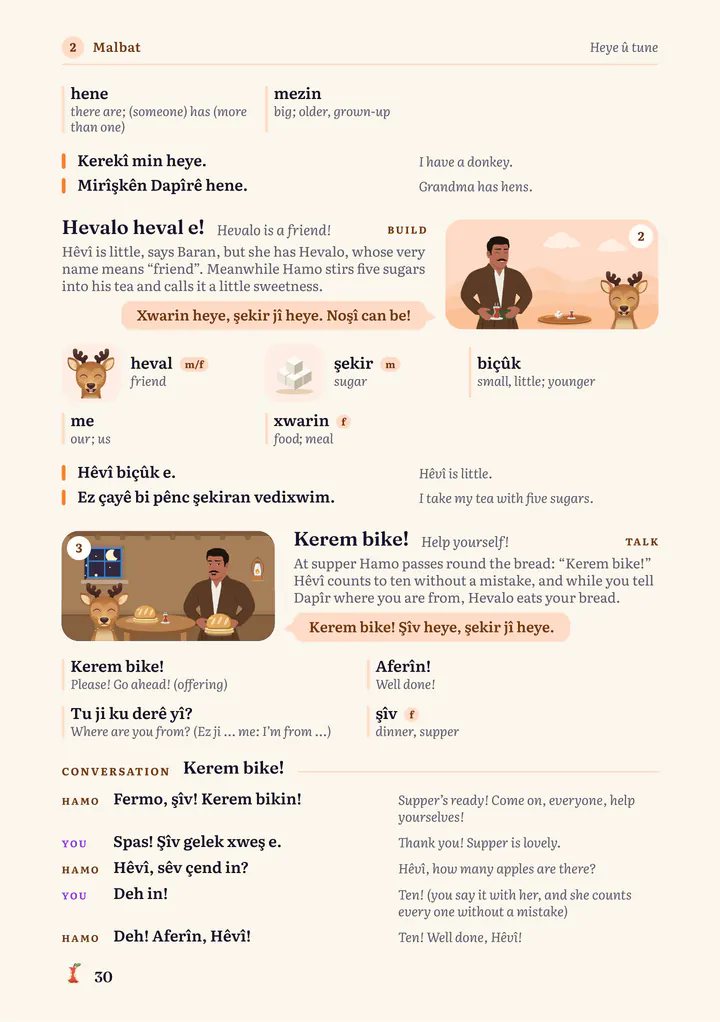
Hêvî is little, says Baran, but she has Hevalo, whose very name means “friend”. Meanwhile Hamo stirs five sugars into his tea and calls it a little sweetness.
Xwarin heye, şekir jî heye. Noşî can be!
heval · m/f · friend
şekir (m) · sugar
biçûk · small, little; younger
me · our; us
xwarin (f) · food; meal
Hêvî biçûk e. · Hêvî is little.
Ez çayê bi pênc şekiran vedixwim. · I take my tea with five sugars.
Kerem bike! · Help yourself! · Talk
At supper Hamo passes round the bread: “Kerem bike!” Hêvî counts to ten without a mistake, and while you tell Dapîr where you are from, Hevalo eats your bread.
Kerem bike! Şîv heye, şekir jî heye.
Kerem bike! · Please! Go ahead! (offering)
Aferîn! · Well done!
Tu ji ku derê yî? · Where are you from? (Ez ji … me: I’m from …)
şîv (f) · dinner, supper
Conversation · Kerem bike!
Hamo: Fermo, şîv! Kerem bikin! · Supper’s ready! Come on, everyone, help yourselves!
You: Spas! Şîv gelek xweş e. · Thank you! Supper is lovely.
Hamo: Hêvî, sêv çend in? · Hêvî, how many apples are there?
You: Deh in! · Ten! (you say it with her, and she counts every one without a mistake)
Hamo: Deh! Aferîn, Hêvî! · Ten! Well done, Hêvî!
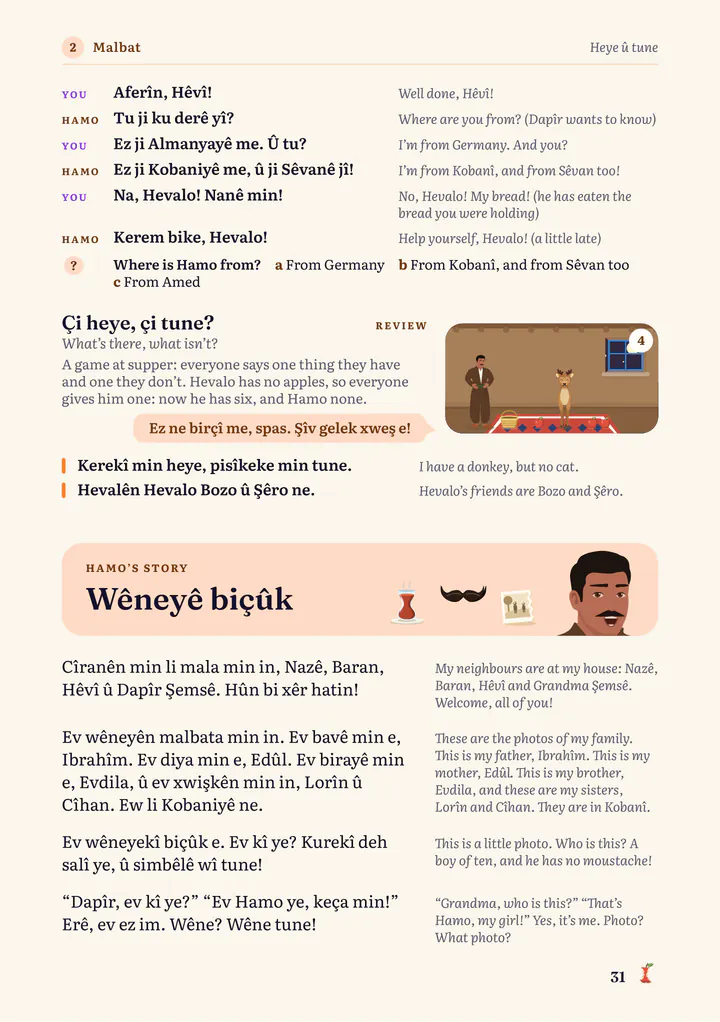
You: Aferîn, Hêvî! · Well done, Hêvî!
Hamo: Tu ji ku derê yî? · Where are you from? (Dapîr wants to know)
You: Ez ji Almanyayê me. Û tu? · I’m from Germany. And you?
Hamo: Ez ji Kobaniyê me, û ji Sêvanê jî! · I’m from Kobanî, and from Sêvan too!
You: Na, Hevalo! Nanê min! · No, Hevalo! My bread! (he has eaten the bread you were holding)
Hamo: Kerem bike, Hevalo! · Help yourself, Hevalo! (a little late)
Where is Hamo from? a From Germany b From Kobanî, and from Sêvan too c From Amed
Çi heye, çi tune?
What’s there, what isn’t?
Review
A game at supper: everyone says one thing they have and one they don’t. Hevalo has no apples, so everyone gives him one: now he has six, and Hamo none.
Ez ne birçî me, spas. Şîv gelek xweş e!
Kerekî min heye, pisîkeke min tune. · I have a donkey, but no cat.
Hevalên Hevalo Bozo û Şêro ne. · Hevalo’s friends are Bozo and Şêro.
Hamo’s story
Cîranên min li mala min in, Nazê, Baran, Hêvî û Dapîr Şemsê. Hûn bi xêr hatin!
My neighbours are at my house: Nazê, Baran, Hêvî and Grandma Şemsê. Welcome, all of you!
Ev wêneyên malbata min in. Ev bavê min e, Ibrahîm. Ev diya min e, Edûl. Ev birayê min e, Evdila, û ev xwişkên min in, Lorîn û Cîhan. Ew li Kobaniyê ne.
These are the photos of my family. This is my father, Ibrahîm. This is my mother, Edûl. This is my brother, Evdila, and these are my sisters, Lorîn and Cîhan. They are in Kobanî.
Ev wêneyekî biçûk e. Ev kî ye? Kurekî deh salî ye, û simbêlê wî tune!
This is a little photo. Who is this? A boy of ten, and he has no moustache!
“Dapîr, ev kî ye?” “Ev Hamo ye, keça min!” Erê, ev ez im. Wêne? Wêne tune!
“Grandma, who is this?” “That’s Hamo, my girl!” Yes, it’s me. Photo? What photo?
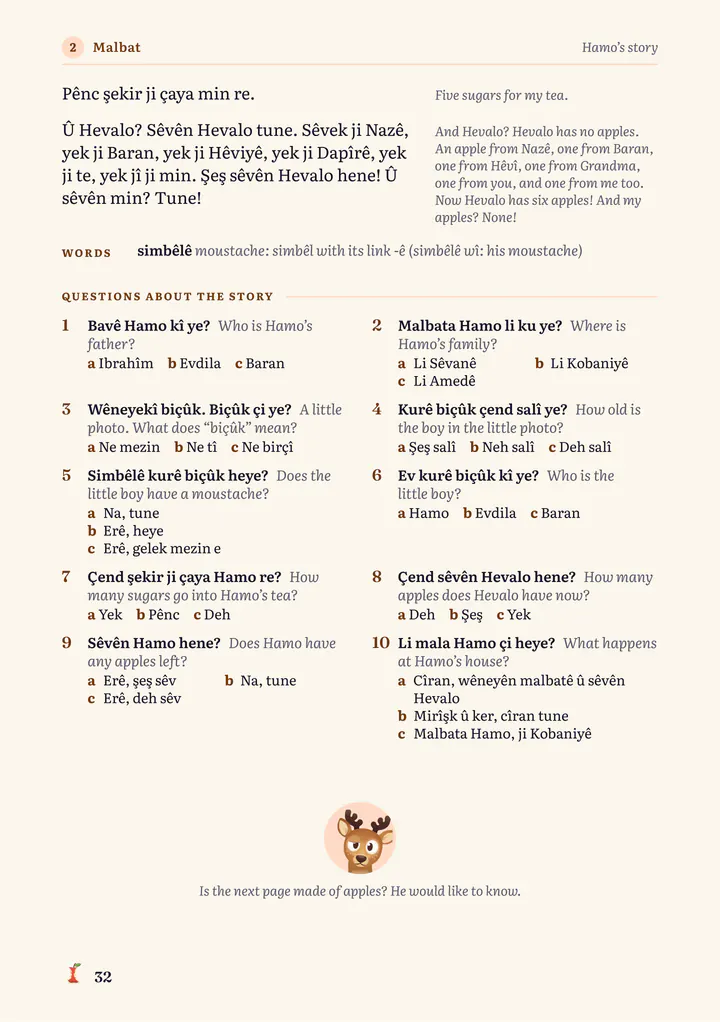
Pênc şekir ji çaya min re. · Five sugars for my tea.
Û Hevalo? Sêvên Hevalo tune. Sêvek ji Nazê, yek ji Baran, yek ji Hêviyê, yek ji Dapîrê, yek ji te, yek jî ji min. Şeş sêvên Hevalo hene! Û sêvên min? Tune!
And Hevalo? Hevalo has no apples. An apple from Nazê, one from Baran, one from Hêvî, one from Grandma, one from you, and one from me too. Now Hevalo has six apples! And my apples? None!
Words · simbêlê moustache: simbêl with its link -ê (simbêlê wî: his moustache)
Questions about the story
1 · Bavê Hamo kî ye? Who is Hamo’s father?
a Ibrahîm b Evdila c Baran
2 · Malbata Hamo li ku ye? Where is Hamo’s family?
a · Li Sêvanê · b · Li Kobaniyê
c · Li Amedê
3 · Wêneyekî biçûk. Biçûk çi ye? A little photo. What does “biçûk” mean?
a Ne mezin b Ne tî c Ne birçî
4 · Kurê biçûk çend salî ye? How old is the boy in the little photo?
a Şeş salî b Neh salî c Deh salî
5 · Simbêlê kurê biçûk heye? Does the little boy have a moustache?
a · Na, tune
b · Erê, heye
c · Erê, gelek mezin e
6 · Ev kurê biçûk kî ye? Who is the little boy?
a Hamo b Evdila c Baran
7 · Çend şekir ji çaya Hamo re? How many sugars go into Hamo’s tea?
a Yek b Pênc c Deh
8 · Çend sêvên Hevalo hene? How many apples does Hevalo have now?
a Deh b Şeş c Yek
9 · Sêvên Hamo hene? Does Hamo have any apples left?
a · Erê, şeş sêv · b · Na, tune
c · Erê, deh sêv
10 · Li mala Hamo çi heye? What happens at Hamo’s house?
a · Cîran, wêneyên malbatê û sêvên Hevalo
b · Mirîşk û ker, cîran tune
c · Malbata Hamo, ji Kobaniyê
Is the next page made of apples? He would like to know.
Cover the pages before this one. The answers are on page 189.
A · Join them up · draw a line from each word to its meaning
bav · her · şeş · seven
wê · one · heft · six
yek · girl; daughter · tî · big
keç · father · mezin · thirsty
B · Fill the gap · each word in the box goes in one line
bavê · hene · in · ne · salî · sisê
1 · Ev … min e.
2 · Hûn cîran ….
3 · Yek, didu, …, çar!
4 · Keça Nazê şeş … ye.
5 · Ev … çay e, ev şîr e.
6 · Deh mirîşkên Dapîrê ….
C · What do you say? · Hamo speaks; write your answer
Ev kî ye? · the woman in the photo
You
Hûn çawa ne? · you and Hevalo
You
Mirîşk çend in? · you count two in the yard
You
Ev bi kurdî çi ye? · a bowl of yoghurt
You
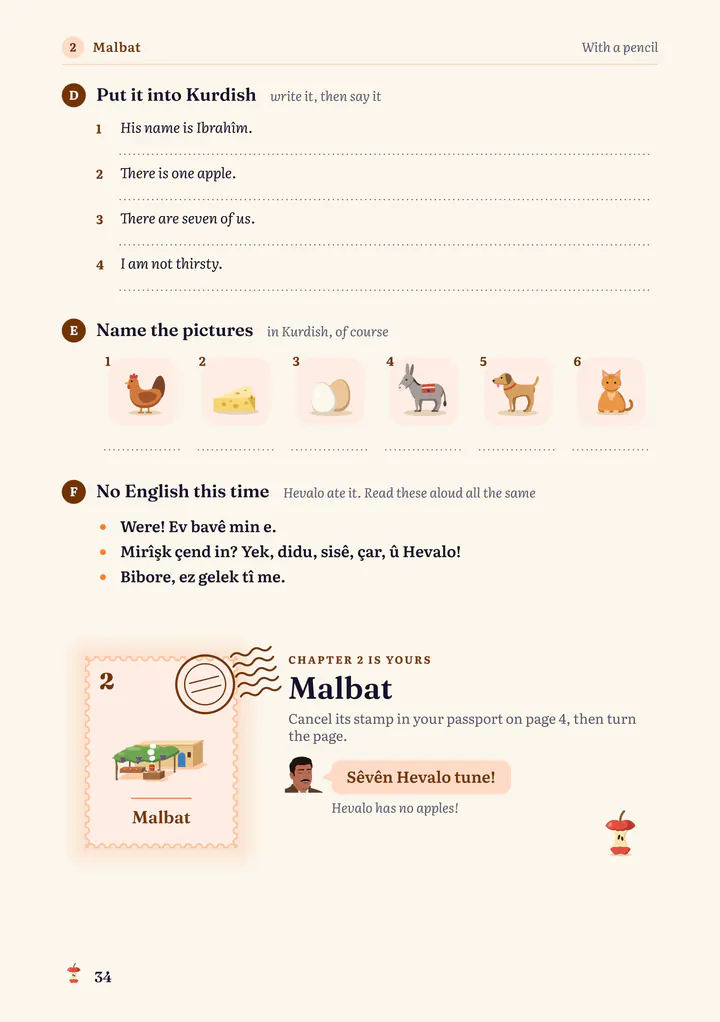
D · Put it into Kurdish · write it, then say it
1 · His name is Ibrahîm.
2 · There is one apple.
3 · There are seven of us.
4 · I am not thirsty.
E · Name the pictures · in Kurdish, of course
F · No English this time · Hevalo ate it. Read these aloud all the same
Were! Ev bavê min e.
Mirîşk çend in? Yek, didu, sisê, çar, û Hevalo!
Bibore, ez gelek tî me.
Malbat
Chapter 2 is yours
Cancel its stamp in your passport on page 4, then turn the page.
Sêvên Hevalo tune!
Hevalo has no apples!
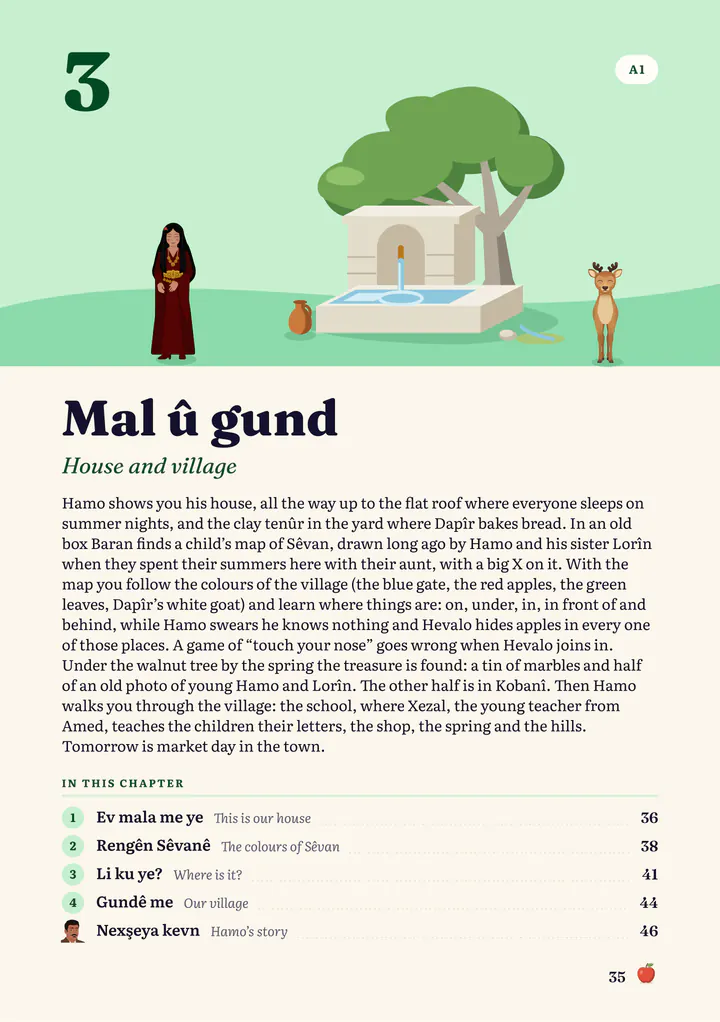
House and village
Hamo shows you his house, all the way up to the flat roof where everyone sleeps on summer nights, and the clay tenûr in the yard where Dapîr bakes bread. In an old box Baran finds a child’s map of Sêvan, drawn long ago by Hamo and his sister Lorîn when they spent their summers here with their aunt, with a big X on it. With the map you follow the colours of the village (the blue gate, the red apples, the green leaves, Dapîr’s white goat) and learn where things are: on, under, in, in front of and behind, while Hamo swears he knows nothing and Hevalo hides apples in every one of those places. A game of “touch your nose” goes wrong when Hevalo joins in. Under the walnut tree by the spring the treasure is found: a tin of marbles and half of an old photo of young Hamo and Lorîn. The other half is in Kobanî. Then Hamo walks you through the village: the school, where Xezal, the young teacher from Amed, teaches the children their letters, the shop, the spring and the hills. Tomorrow is market day in the town.
In this chapter
1 · Ev mala me ye · This is our house · 36
2 · Rengên Sêvanê · The colours of Sêvan · 38
3 · Li ku ye? · Where is it? · 41
4 · Gundê me · Our village · 44
Nexşeya kevn · Hamo’s story · 46
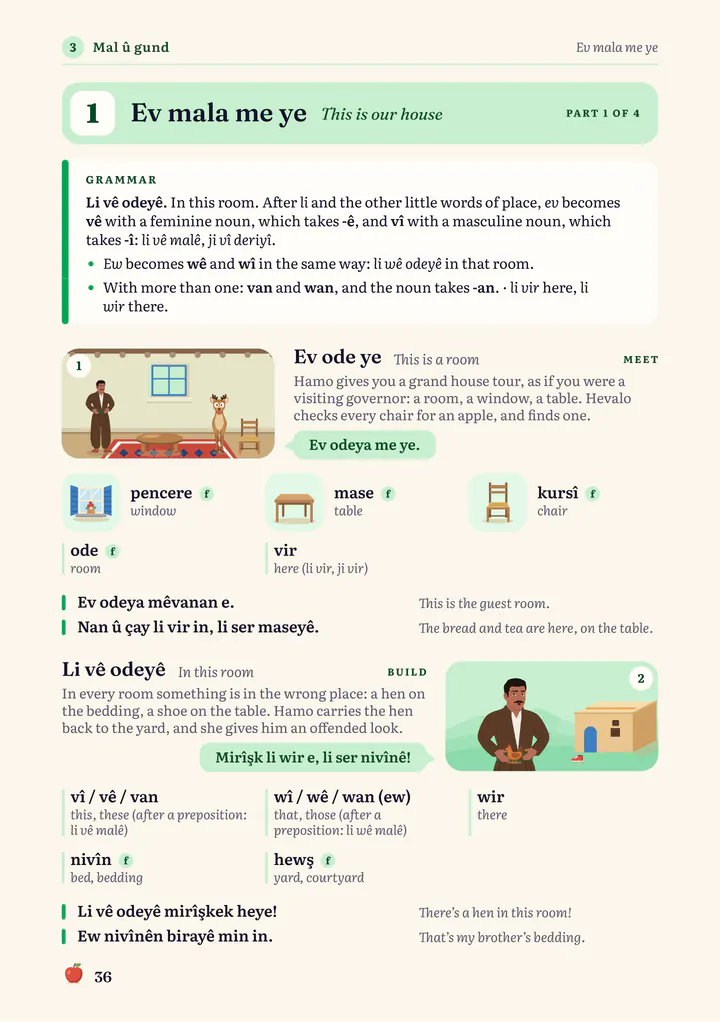
This is our house · Part 1 of 4
Grammar
Li vê odeyê. In this room. After li and the other little words of place, ev becomes vê with a feminine noun, which takes -ê, and vî with a masculine noun, which takes -î: li vê malê, ji vî deriyî.
Ew becomes wê and wî in the same way: li wê odeyê in that room.
With more than one: van and wan, and the noun takes -an. · li vir here, li wir there.
Ev ode ye · This is a room · Meet
Hamo gives you a grand house tour, as if you were a visiting governor: a room, a window, a table. Hevalo checks every chair for an apple, and finds one.
Ev odeya me ye.
pencere (f) · window
mase (f) · table
kursî (f) · chair
ode (f) · room
vir · here (li vir, ji vir)
Ev odeya mêvanan e. · This is the guest room.
Nan û çay li vir in, li ser maseyê. · The bread and tea are here, on the table.
Li vê odeyê · In this room · Build
In every room something is in the wrong place: a hen on the bedding, a shoe on the table. Hamo carries the hen back to the yard, and she gives him an offended look.
Mirîşk li wir e, li ser nivînê!
vî / vê / van · this, these (after a preposition: li vê malê)
wî / wê / wan (ew) · that, those (after a preposition: li wê malê)
wir · there
nivîn (f) · bed, bedding
hewş (f) · yard, courtyard
Li vê odeyê mirîşkek heye! · There’s a hen in this room!
Ew nivînên birayê min in. · That’s my brother’s bedding.
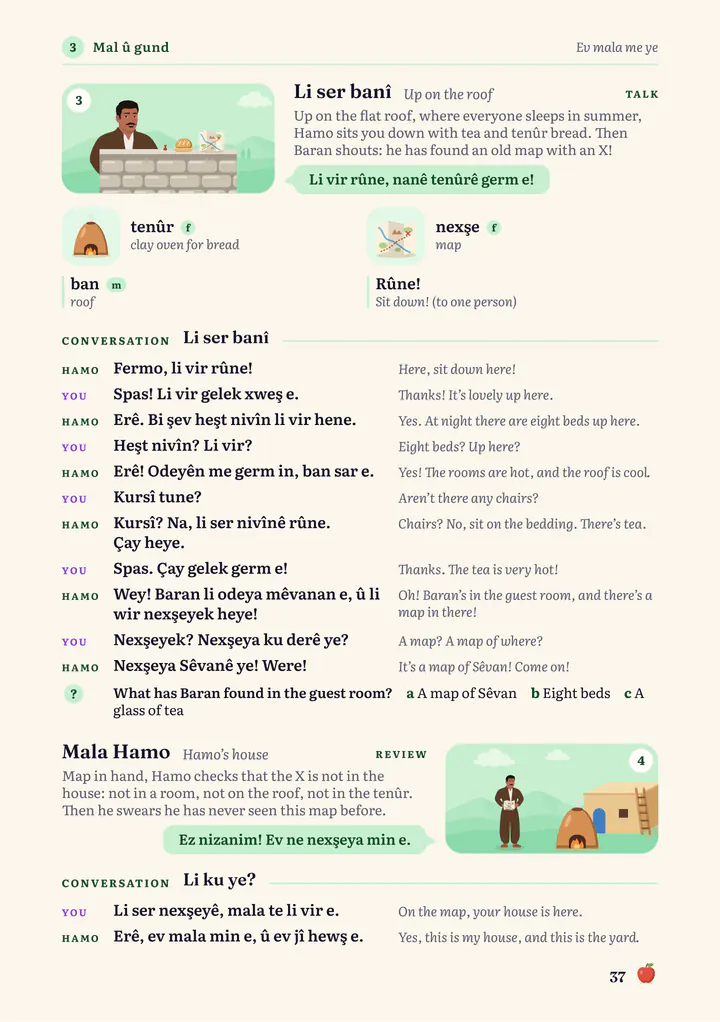
Li ser banî · Up on the roof · Talk
Up on the flat roof, where everyone sleeps in summer, Hamo sits you down with tea and tenûr bread. Then Baran shouts: he has found an old map with an X!
Li vir rûne, nanê tenûrê germ e!
tenûr (f) · clay oven for bread
nexşe (f) · map
ban (m) · roof
Rûne! · Sit down! (to one person)
Conversation · Li ser banî
Hamo: Fermo, li vir rûne! · Here, sit down here!
You: Spas! Li vir gelek xweş e. · Thanks! It’s lovely up here.
Hamo: Erê. Bi şev heşt nivîn li vir hene. · Yes. At night there are eight beds up here.
You: Heşt nivîn? Li vir? · Eight beds? Up here?
Hamo: Erê! Odeyên me germ in, ban sar e. · Yes! The rooms are hot, and the roof is cool.
You: Kursî tune? · Aren’t there any chairs?
Hamo: Kursî? Na, li ser nivînê rûne. Çay heye.
Chairs? No, sit on the bedding. There’s tea.
You: Spas. Çay gelek germ e! · Thanks. The tea is very hot!
Hamo: Wey! Baran li odeya mêvanan e, û li wir nexşeyek heye!
Oh! Baran’s in the guest room, and there’s a map in there!
You: Nexşeyek? Nexşeya ku derê ye? · A map? A map of where?
Hamo: Nexşeya Sêvanê ye! Were! · It’s a map of Sêvan! Come on!
What has Baran found in the guest room? a A map of Sêvan b Eight beds c A glass of tea
Mala Hamo · Hamo’s house · Review
Map in hand, Hamo checks that the X is not in the house: not in a room, not on the roof, not in the tenûr. Then he swears he has never seen this map before.
Ez nizanim! Ev ne nexşeya min e.
Conversation · Li ku ye?
You: Li ser nexşeyê, mala te li vir e. · On the map, your house is here.
Hamo: Erê, ev mala min e, û ev jî hewş e. · Yes, this is my house, and this is the yard.
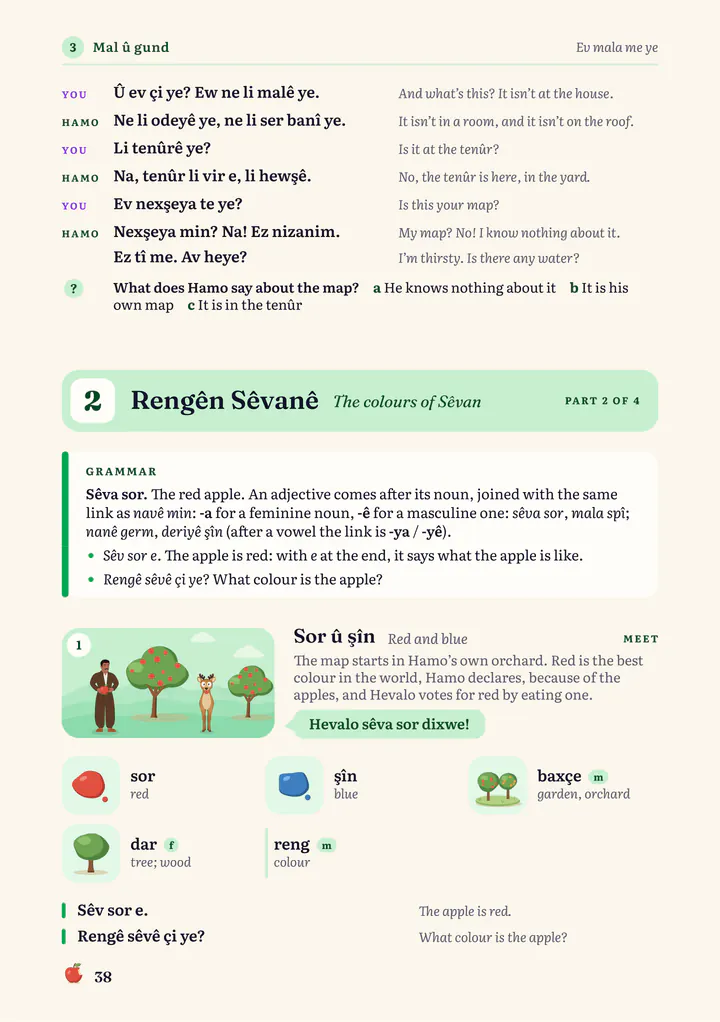
You: Û ev çi ye? Ew ne li malê ye. · And what’s this? It isn’t at the house.
Hamo: Ne li odeyê ye, ne li ser banî ye. · It isn’t in a room, and it isn’t on the roof.
You: Li tenûrê ye? · Is it at the tenûr?
Hamo: Na, tenûr li vir e, li hewşê. · No, the tenûr is here, in the yard.
You: Ev nexşeya te ye? · Is this your map?
Hamo: Nexşeya min? Na! Ez nizanim. · My map? No! I know nothing about it.
Ez tî me. Av heye? · I’m thirsty. Is there any water?
What does Hamo say about the map? a He knows nothing about it b It is his own map c It is in the tenûr
The colours of Sêvan · Part 2 of 4
Grammar
Sêva sor. The red apple. An adjective comes after its noun, joined with the same link as navê min: -a for a feminine noun, -ê for a masculine one: sêva sor, mala spî; nanê germ, deriyê şîn (after a vowel the link is -ya / -yê).
Sêv sor e. The apple is red: with e at the end, it says what the apple is like.
Rengê sêvê çi ye? What colour is the apple?
Sor û şîn · Red and blue · Meet
The map starts in Hamo’s own orchard. Red is the best colour in the world, Hamo declares, because of the apples, and Hevalo votes for red by eating one.
Hevalo sêva sor dixwe!
sor · red
şîn · blue
baxçe (m) · garden, orchard
dar (f) · tree; wood
reng (m) · colour
Sêv sor e. · The apple is red.
Rengê sêvê çi ye? · What colour is the apple?
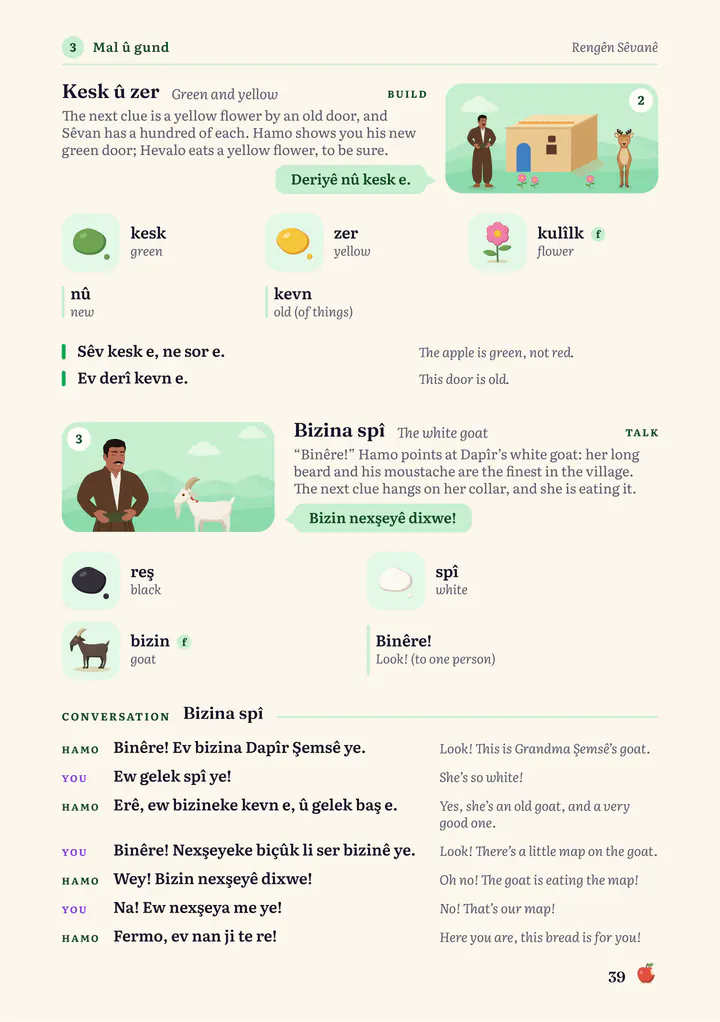
Kesk û zer · Green and yellow · Build
The next clue is a yellow flower by an old door, and Sêvan has a hundred of each. Hamo shows you his new green door; Hevalo eats a yellow flower, to be sure.
Deriyê nû kesk e.
kesk · green
zer · yellow
kulîlk (f) · flower
nû · new
kevn · old (of things)
Sêv kesk e, ne sor e. · The apple is green, not red.
Ev derî kevn e. · This door is old.
Bizina spî · The white goat · Talk
“Binêre!” Hamo points at Dapîr’s white goat: her long beard and his moustache are the finest in the village. The next clue hangs on her collar, and she is eating it.
Bizin nexşeyê dixwe!
reş · black
spî · white
bizin (f) · goat
Binêre! · Look! (to one person)
Conversation · Bizina spî
Hamo: Binêre! Ev bizina Dapîr Şemsê ye. · Look! This is Grandma Şemsê’s goat.
You: Ew gelek spî ye! · She’s so white!
Hamo: Erê, ew bizineke kevn e, û gelek baş e. · Yes, she’s an old goat, and a very good one.
You: Binêre! Nexşeyeke biçûk li ser bizinê ye. · Look! There’s a little map on the goat.
Hamo: Wey! Bizin nexşeyê dixwe! · Oh no! The goat is eating the map!
You: Na! Ew nexşeya me ye! · No! That’s our map!
Hamo: Fermo, ev nan ji te re! · Here you are, this bread is for you!
You: Aferîn! Nexşe li vir e. · Well done! We’ve got the map.
Hamo: Bizina spî nan dixwe, ne nexşe. · The white goat eats bread, not maps.
How does Hamo get the map back from the goat? a He gives her some milk. b He asks Şêro for help. c He gives her some bread.
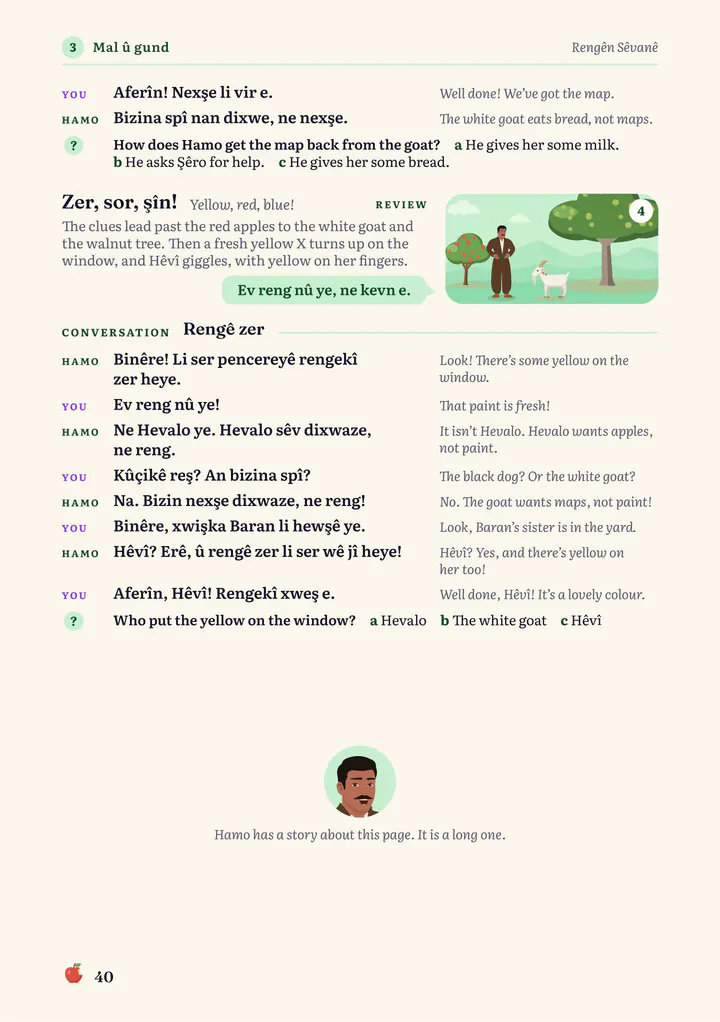
Zer, sor, şîn! · Yellow, red, blue! · Review
The clues lead past the red apples to the white goat and the walnut tree. Then a fresh yellow X turns up on the window, and Hêvî giggles, with yellow on her fingers.
Ev reng nû ye, ne kevn e.
Conversation · Rengê zer
Hamo: Binêre! Li ser pencereyê rengekî zer heye.
Look! There’s some yellow on the window.
You: Ev reng nû ye! · That paint is fresh!
Hamo: Ne Hevalo ye. Hevalo sêv dixwaze, ne reng.
It isn’t Hevalo. Hevalo wants apples, not paint.
You: Kûçikê reş? An bizina spî? · The black dog? Or the white goat?
Hamo: Na. Bizin nexşe dixwaze, ne reng! · No. The goat wants maps, not paint!
You: Binêre, xwişka Baran li hewşê ye. · Look, Baran’s sister is in the yard.
Hamo: Hêvî? Erê, û rengê zer li ser wê jî heye! · Hêvî? Yes, and there’s yellow on her too!
You: Aferîn, Hêvî! Rengekî xweş e. · Well done, Hêvî! It’s a lovely colour.
Who put the yellow on the window? a Hevalo b The white goat c Hêvî
Hamo has a story about this page. It is a long one.
Where is it? · Part 3 of 4
Grammar
Sêv li ser maseyê ye. The apple is on the table. The words of place come before the noun, and a feminine noun after them takes -ê: li ser maseyê, li bin dara gûzê under the walnut tree.
li ser on · li bin under · li ber in front of · li pişt behind · di … de in: Nan di tenûrê de ye.
Li ku ye? Where is it? — Li vir e. It’s here.
Li ser û li bin · On and under · Meet
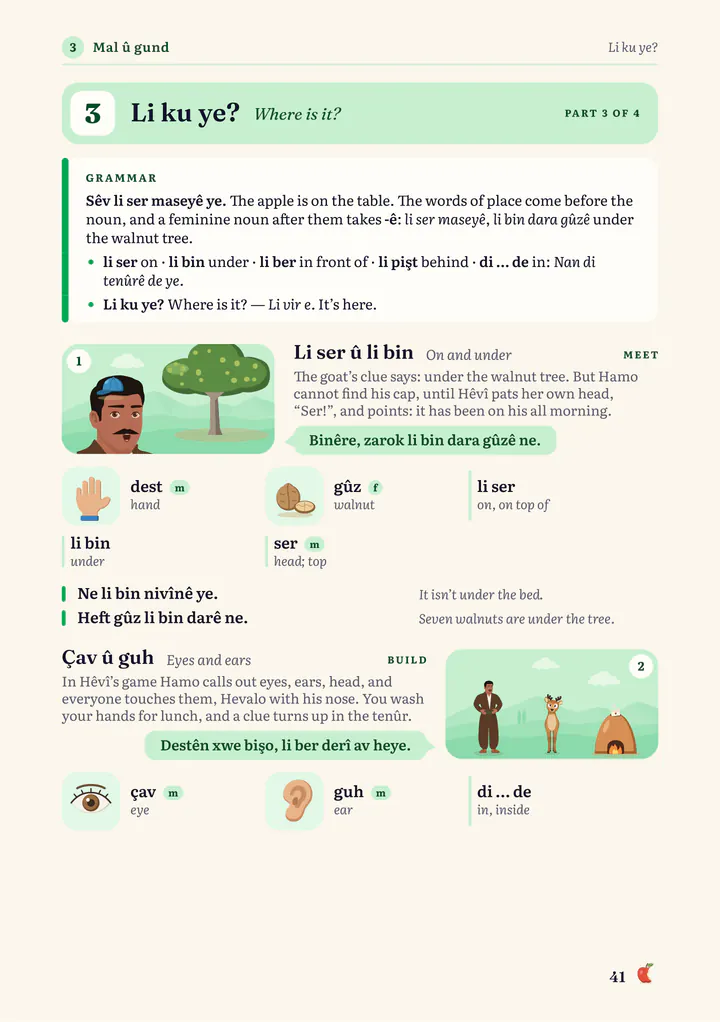
The goat’s clue says: under the walnut tree. But Hamo cannot find his cap, until Hêvî pats her own head, “Ser!”, and points: it has been on his all morning.
Binêre, zarok li bin dara gûzê ne.
dest (m) · hand
gûz (f) · walnut
li ser · on, on top of
li bin · under
ser (m) · head; top
Ne li bin nivînê ye. · It isn’t under the bed.
Heft gûz li bin darê ne. · Seven walnuts are under the tree.
Çav û guh · Eyes and ears · Build
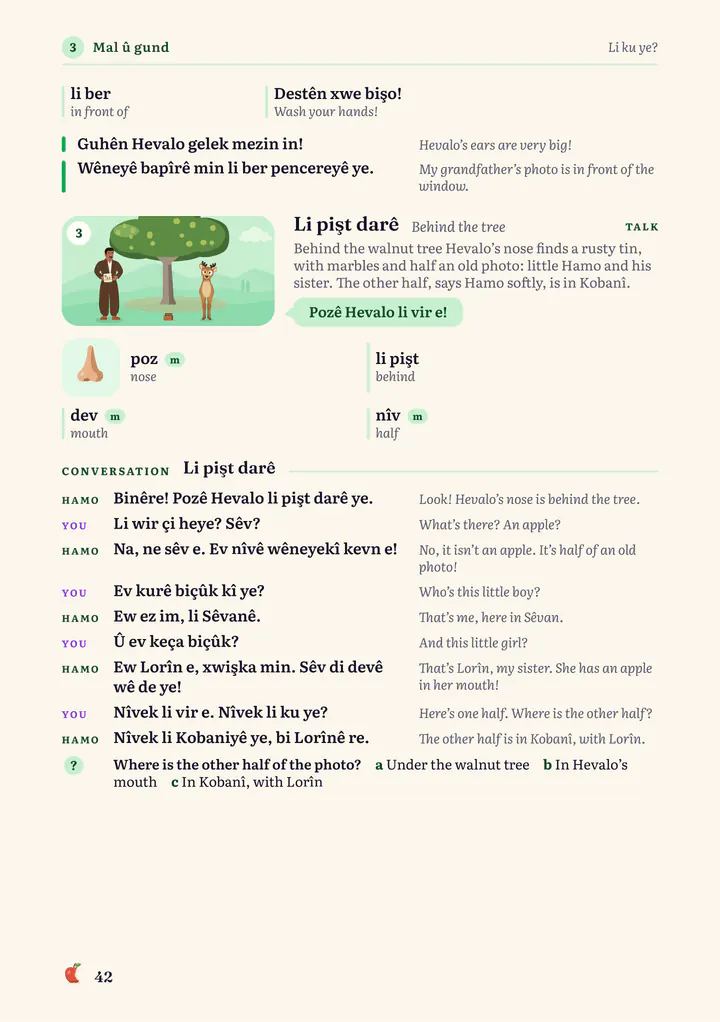
In Hêvî’s game Hamo calls out eyes, ears, head, and everyone touches them, Hevalo with his nose. You wash your hands for lunch, and a clue turns up in the tenûr.
Destên xwe bişo, li ber derî av heye.
çav (m) · eye
guh (m) · ear
di … de · in, inside
li ber · in front of
Destên xwe bişo! · Wash your hands!
Guhên Hevalo gelek mezin in! · Hevalo’s ears are very big!
Wêneyê bapîrê min li ber pencereyê ye. · My grandfather’s photo is in front of the window.
Li pişt darê · Behind the tree · Talk
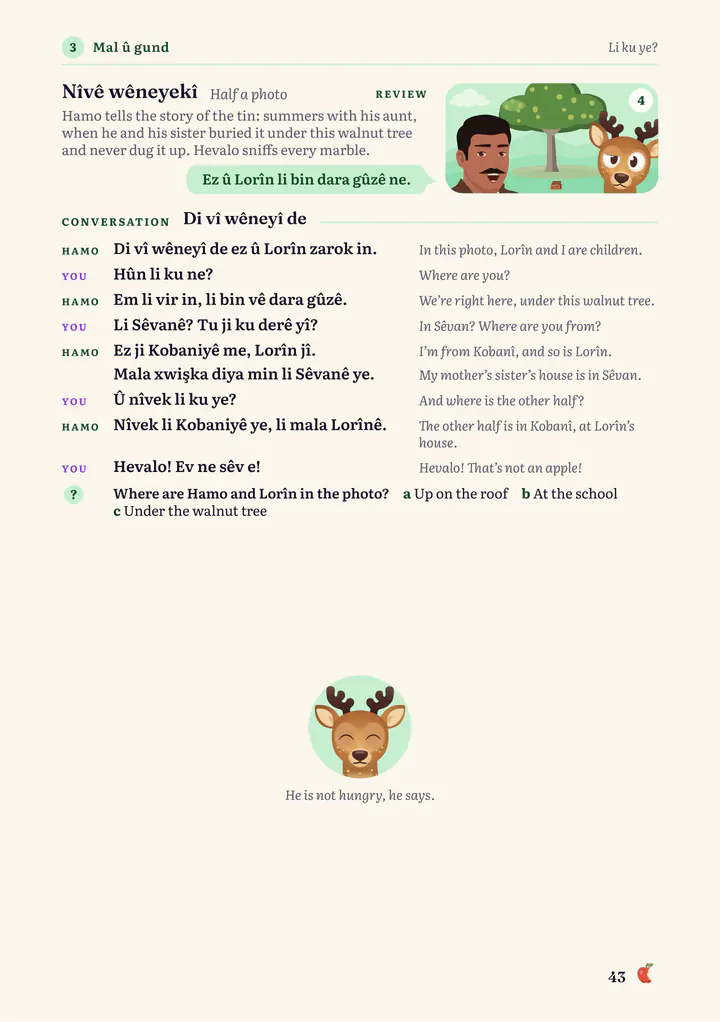
Behind the walnut tree Hevalo’s nose finds a rusty tin, with marbles and half an old photo: little Hamo and his sister. The other half, says Hamo softly, is in Kobanî.
Pozê Hevalo li vir e!
poz (m) · nose
li pişt · behind
dev (m) · mouth
nîv (m) · half
Conversation · Li pişt darê
Hamo: Binêre! Pozê Hevalo li pişt darê ye. · Look! Hevalo’s nose is behind the tree.
You: Li wir çi heye? Sêv? · What’s there? An apple?
Hamo: Na, ne sêv e. Ev nîvê wêneyekî kevn e! · No, it isn’t an apple. It’s half of an old photo!
You: Ev kurê biçûk kî ye? · Who’s this little boy?
Hamo: Ew ez im, li Sêvanê. · That’s me, here in Sêvan.
You: Û ev keça biçûk? · And this little girl?
Hamo: Ew Lorîn e, xwişka min. Sêv di devê wê de ye!
That’s Lorîn, my sister. She has an apple in her mouth!
You: Nîvek li vir e. Nîvek li ku ye? · Here’s one half. Where is the other half?
Hamo: Nîvek li Kobaniyê ye, bi Lorînê re. · The other half is in Kobanî, with Lorîn.
Where is the other half of the photo? a Under the walnut tree b In Hevalo’s mouth c In Kobanî, with Lorîn
Nîvê wêneyekî · Half a photo · Review
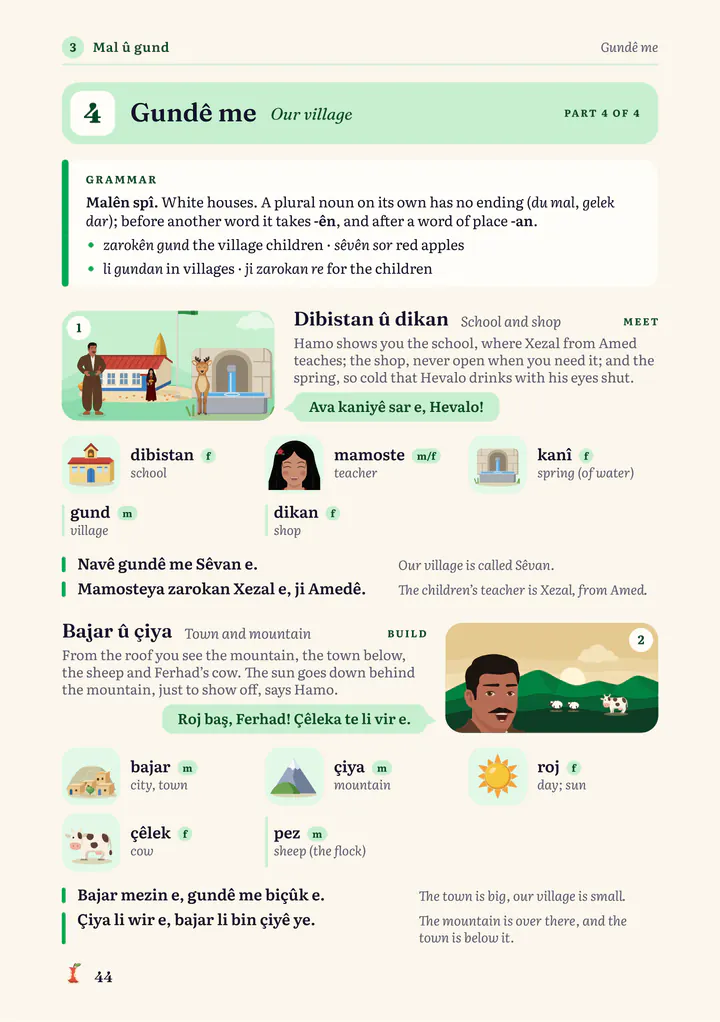
Hamo tells the story of the tin: summers with his aunt, when he and his sister buried it under this walnut tree and never dug it up. Hevalo sniffs every marble.
Ez û Lorîn li bin dara gûzê ne.
Conversation · Di vî wêneyî de
Hamo: Di vî wêneyî de ez û Lorîn zarok in. · In this photo, Lorîn and I are children.
You: Hûn li ku ne? · Where are you?
Hamo: Em li vir in, li bin vê dara gûzê. · We’re right here, under this walnut tree.
You: Li Sêvanê? Tu ji ku derê yî? · In Sêvan? Where are you from?
Hamo: Ez ji Kobaniyê me, Lorîn jî. · I’m from Kobanî, and so is Lorîn.
Mala xwişka diya min li Sêvanê ye. · My mother’s sister’s house is in Sêvan.
You: Û nîvek li ku ye? · And where is the other half?
Hamo: Nîvek li Kobaniyê ye, li mala Lorînê. · The other half is in Kobanî, at Lorîn’s house.
You: Hevalo! Ev ne sêv e! · Hevalo! That’s not an apple!
Where are Hamo and Lorîn in the photo? a Up on the roof b At the school c Under the walnut tree
He is not hungry, he says.
Our village · Part 4 of 4
Grammar
Malên spî. White houses. A plural noun on its own has no ending (du mal, gelek dar); before another word it takes -ên, and after a word of place -an.
zarokên gund the village children · sêvên sor red apples
li gundan in villages · ji zarokan re for the children
Dibistan û dikan · School and shop · Meet
Hamo shows you the school, where Xezal from Amed teaches; the shop, never open when you need it; and the spring, so cold that Hevalo drinks with his eyes shut.
Ava kaniyê sar e, Hevalo!
dibistan (f) · school
mamoste · m/f · teacher
kanî (f) · spring (of water)
gund (m) · village
dikan (f) · shop
Navê gundê me Sêvan e. · Our village is called Sêvan.
Mamosteya zarokan Xezal e, ji Amedê. · The children’s teacher is Xezal, from Amed.
Bajar û çiya · Town and mountain · Build
From the roof you see the mountain, the town below, the sheep and Ferhad’s cow. The sun goes down behind the mountain, just to show off, says Hamo.
Roj baş, Ferhad! Çêleka te li vir e.
bajar (m) · city, town
çiya (m) · mountain
roj (f) · day; sun
çêlek (f) · cow
pez (m) · sheep (the flock)
Bajar mezin e, gundê me biçûk e. · The town is big, our village is small.
Çiya li wir e, bajar li bin çiyê ye. · The mountain is over there, and the town is below it.
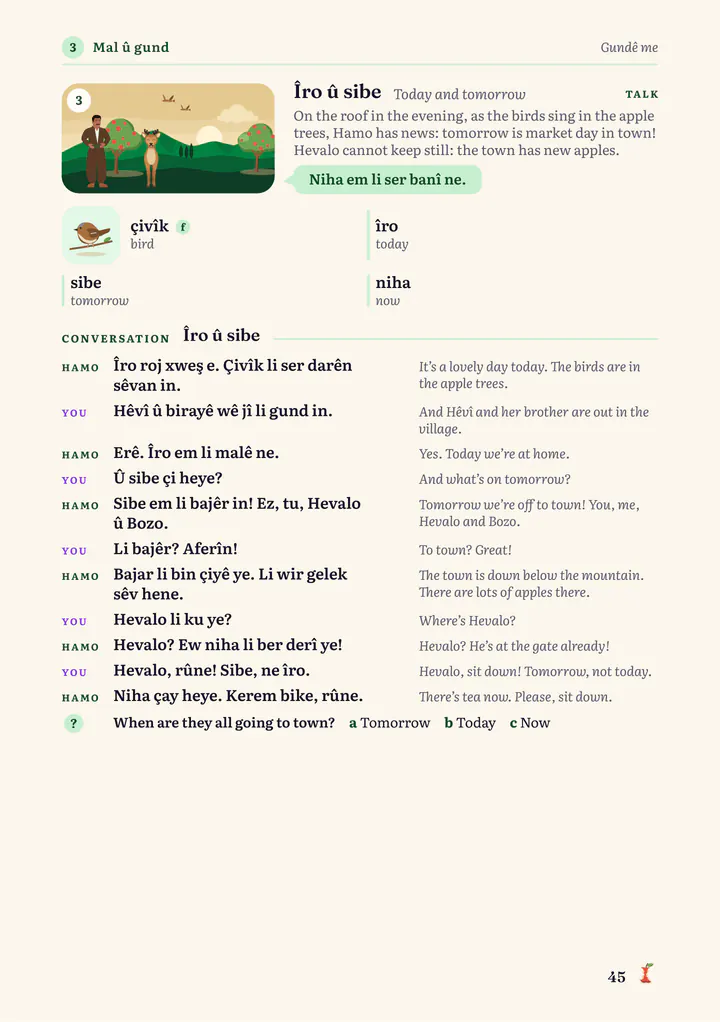
Îro û sibe · Today and tomorrow · Talk
On the roof in the evening, as the birds sing in the apple trees, Hamo has news: tomorrow is market day in town! Hevalo cannot keep still: the town has new apples.
Niha em li ser banî ne.
çivîk (f) · bird
îro · today
sibe · tomorrow
niha · now
Conversation · Îro û sibe
Hamo: Îro roj xweş e. Çivîk li ser darên sêvan in.
It’s a lovely day today. The birds are in the apple trees.
You: Hêvî û birayê wê jî li gund in. · And Hêvî and her brother are out in the village.
Hamo: Erê. Îro em li malê ne. · Yes. Today we’re at home.
You: Û sibe çi heye? · And what’s on tomorrow?
Hamo: Sibe em li bajêr in! Ez, tu, Hevalo û Bozo.
Tomorrow we’re off to town! You, me, Hevalo and Bozo.
You: Li bajêr? Aferîn! · To town? Great!
Hamo: Bajar li bin çiyê ye. Li wir gelek sêv hene.
The town is down below the mountain. There are lots of apples there.
You: Hevalo li ku ye? · Where’s Hevalo?
Hamo: Hevalo? Ew niha li ber derî ye! · Hevalo? He’s at the gate already!
You: Hevalo, rûne! Sibe, ne îro. · Hevalo, sit down! Tomorrow, not today.
Hamo: Niha çay heye. Kerem bike, rûne. · There’s tea now. Please, sit down.
When are they all going to town? a Tomorrow b Today c Now
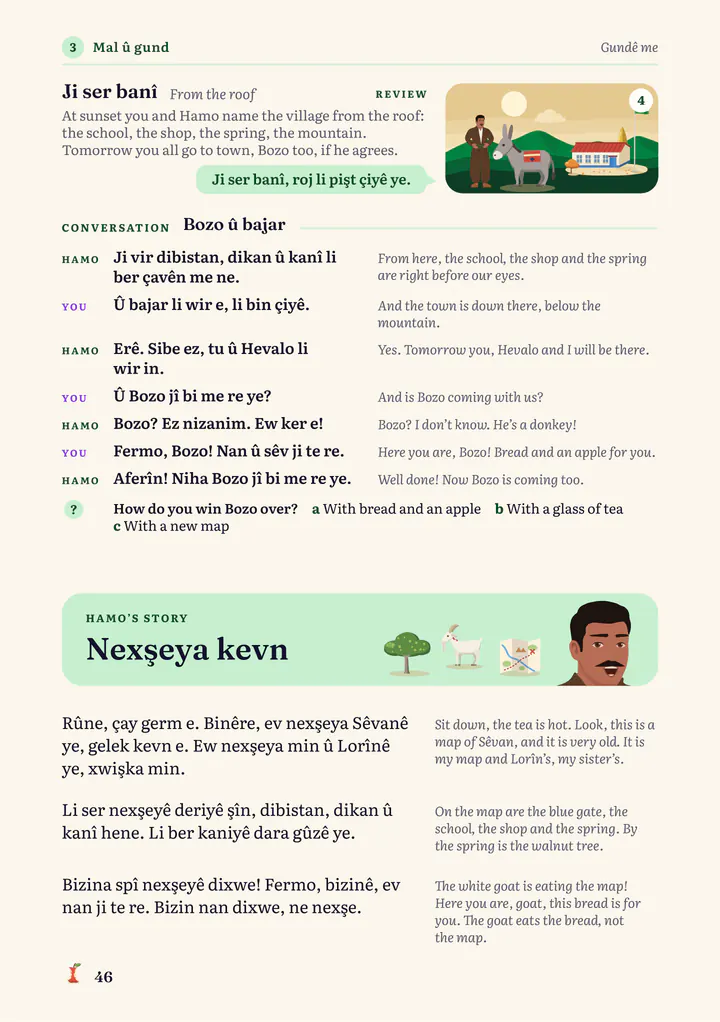
Ji ser banî · From the roof · Review
At sunset you and Hamo name the village from the roof: the school, the shop, the spring, the mountain. Tomorrow you all go to town, Bozo too, if he agrees.
Ji ser banî, roj li pişt çiyê ye.
Conversation · Bozo û bajar
Hamo: Ji vir dibistan, dikan û kanî li ber çavên me ne.
From here, the school, the shop and the spring are right before our eyes.
You: Û bajar li wir e, li bin çiyê. · And the town is down there, below the mountain.
Hamo: Erê. Sibe ez, tu û Hevalo li wir in.
Yes. Tomorrow you, Hevalo and I will be there.
You: Û Bozo jî bi me re ye? · And is Bozo coming with us?
Hamo: Bozo? Ez nizanim. Ew ker e! · Bozo? I don’t know. He’s a donkey!
You: Fermo, Bozo! Nan û sêv ji te re. · Here you are, Bozo! Bread and an apple for you.
Hamo: Aferîn! Niha Bozo jî bi me re ye. · Well done! Now Bozo is coming too.
How do you win Bozo over? a With bread and an apple b With a glass of tea c With a new map
Hamo’s story
Rûne, çay germ e. Binêre, ev nexşeya Sêvanê ye, gelek kevn e. Ew nexşeya min û Lorînê ye, xwişka min.
Sit down, the tea is hot. Look, this is a map of Sêvan, and it is very old. It is my map and Lorîn’s, my sister’s.
Li ser nexşeyê deriyê şîn, dibistan, dikan û kanî hene. Li ber kaniyê dara gûzê ye.
On the map are the blue gate, the school, the shop and the spring. By the spring is the walnut tree.
Bizina spî nexşeyê dixwe! Fermo, bizinê, ev nan ji te re. Bizin nan dixwe, ne nexşe.
The white goat is eating the map! Here you are, goat, this bread is for you. The goat eats the bread, not the map.
Pozê Hevalo li pişt dara gûzê ye. Li wir nîvê wêneyekî kevn heye. Di wêneyî de ez û Lorîn zarok in. Sêv di devê Lorînê de ye! Nîvek li vir e, nîvek li Kobaniyê ye, li mala Lorînê.
Hevalo’s nose is behind the walnut tree. There is half of an old photo there. In the photo Lorîn and I are children. Lorîn has an apple in her mouth! One half is here, the other half is in Kobanî, at Lorîn’s house.
Îro li ser pencereyê rengekî zer heye. Destên Hêviyê jî zer in! Û Hevalo sêv dixwaze, ne reng.
Today there is some yellow on the window. Hêvî’s hands are yellow too! And Hevalo wants apples, not paint.
Sibe em li bajêr in. Niha çaya xwe vexwe. Şev baş!
Tomorrow we go to town. Now drink your tea. Good night!
Questions about the story
1 · Nexşe gelek kevn e. “Kevn” çi ye? The map is very old. What does “kevn” mean?
a Ne nû ye b Ne mezin e c Ne sor e
2 · Lorîn kî ye? Who is Lorîn?
a · Keça Hamo
b · Xwişka Hamo
c · Mamosteya dibistanê
3 · “Li ber kaniyê dara gûzê ye.” Gûz çi ye? “By the spring is the walnut tree.” What is a gûz?
a · Li ser darê ye · b · Kulîlkek e
c · Çivîkek e
4 · Bizina spî çi dixwe? What does the white goat eat?
a Nan b Sêv c Kulîlk
5 · Nîvê wêneyê li ku ye? Where is the half of the photo?
a · Li ser banî · b · Di tenûrê de
c · Li pişt dara gûzê
6 · Nîvek li vir e. Nîvek li ku ye? One half is here. Where is the other half?
a · Li dikanê · b · Li Kobaniyê
c · Li dibistanê
7 · Li ser pencereyê rengekî zer heye. Kî? There is some yellow on the window. Who did it?
a Hêvî b Hevalo c Lorîn
8 · Hevalo çi dixwaze? What does Hevalo want?
a Reng b Sêv c Nan
9 · Sibe Hamo li ku ye? Where will Hamo be tomorrow?
a · Li Kobaniyê · b · Li bajêr
c · Li dibistanê
10 · Ev nexşeya ku derê ye? What is this a map of?
a · Nexşeya Sêvanê
b · Nexşeya Amedê
c · Nexşeya Kobaniyê
Cover the pages before this one. The answers are on page 189.
A · Join them up · draw a line from each word to its meaning
pencere · door · gûz · half
derî · window · nîv · walnut
nivîn · blue · gund · donkey
şîn · bed, bedding · ker · village
B · Fill the gap · each word in the box goes in one line
di · gûzê · îro · maseyê · vir · wê
1 · Wêneyê bavê min li … e.
2 · Mirîşk ne li vê odeyê ye, li … odeyê ye.
The hen is in that room.
3 · Mirîşkek li hewşê ye, yek jî li ser …!
4 · Nexşe … tenûrê de ye!
5 · Ez û Lorîn li bin dara … ne.
Under the walnut tree
6 · Em … li malê ne, sibe li bajêr.
Today at home, tomorrow in town.
C · What do you say? · Hamo speaks; write your answer
Ode xweş e?
You
Bi xatirê te!
You
Penîr an hêk?
You
Hevalo sêvek dixwaze. Tu çi dixwazî?
You
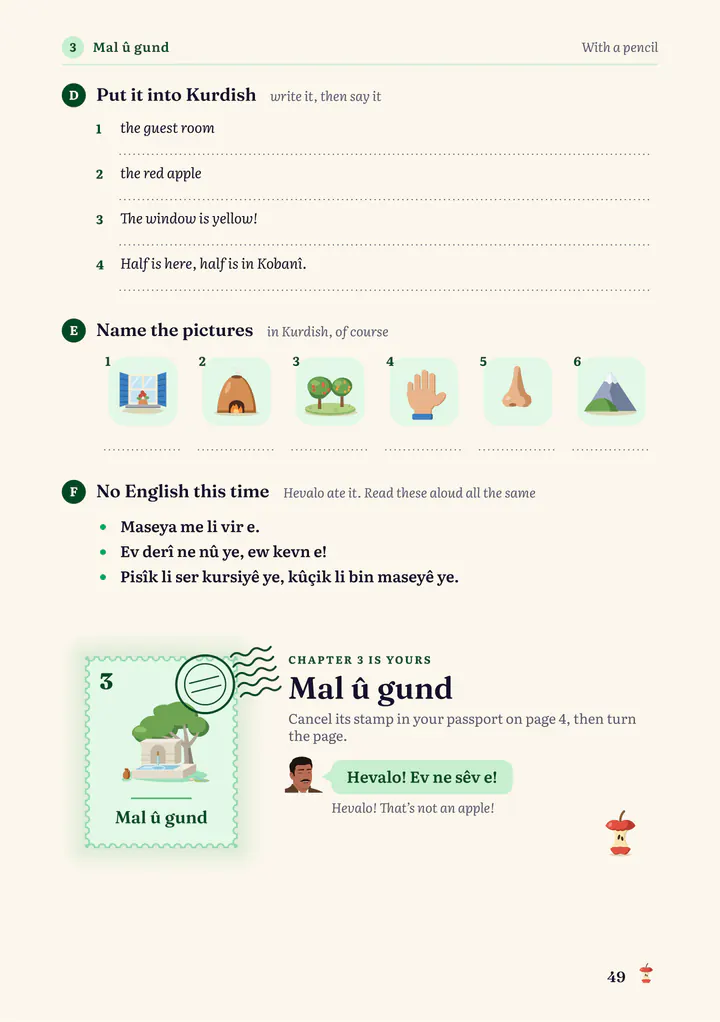
D · Put it into Kurdish · write it, then say it
1 · the guest room
2 · the red apple
3 · The window is yellow!
4 · Half is here, half is in Kobanî.
E · Name the pictures · in Kurdish, of course
F · No English this time · Hevalo ate it. Read these aloud all the same
Maseya me li vir e.
Ev derî ne nû ye, ew kevn e!
Pisîk li ser kursiyê ye, kûçik li bin maseyê ye.
Mal û gund
Chapter 3 is yours
Cancel its stamp in your passport on page 4, then turn the page.
Hevalo! Ev ne sêv e!
Hevalo! That’s not an apple!
The market
Market day in the town below the village. Hamo, Hevalo and you go down the road with Bozo, who carries the empty baskets and stops at every flower. Now the verbs come alive in the present tense: going, coming, seeing, saying, knowing, wanting, eating. At the market Hamo knows every seller, and Mîrza the fruit seller best of all: they haggle like the old friends they are, and Mîrza always wins. Hamo buys what is on his list and several things that are not, takes far too much sugar in Mîrza’s tea, and gets his numbers in a muddle once the prices pass a hundred. Then Mîrza’s apple basket is found empty, every witness says “Ez nizanim”, and a certain deer has a very round belly. On the way home Hamo’s phone rings: it is his sister Lorîn in Kobanî. Come for the weekend, all of you.
In this chapter
1 · Em diçin bazarê · We’re off to market · 51
2 · Çi dixwazî? · What would you like? · 53
3 · Bi çend e? · How much is it? · 55
4 · Na, naxwazim · No, I don’t want any · 58
Selika vala · Hamo’s story · 60
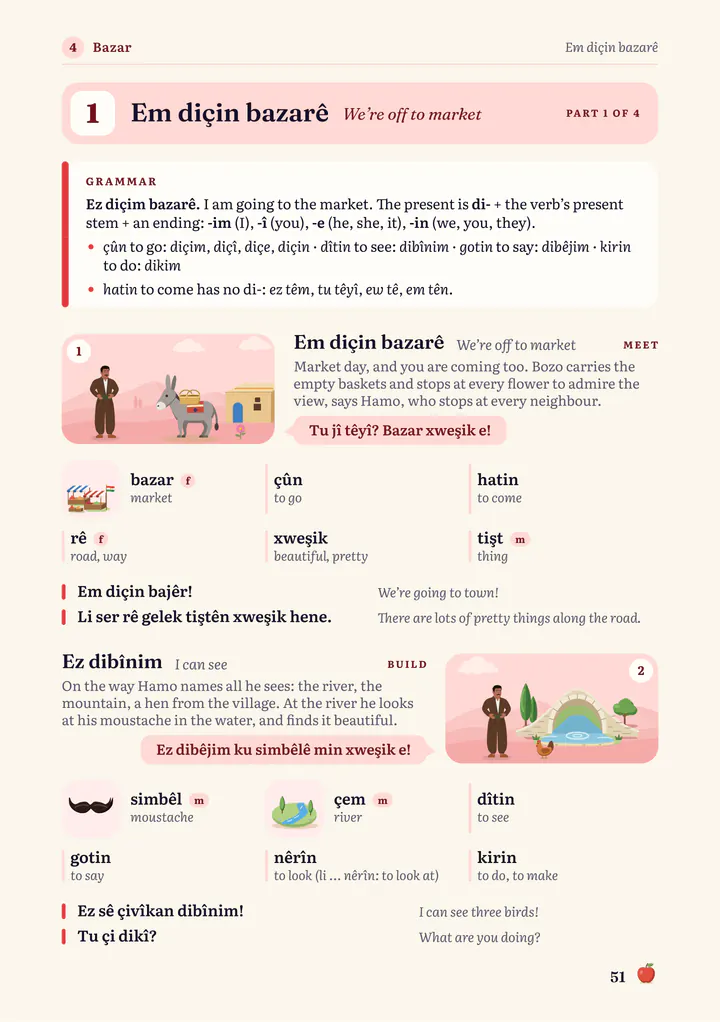
We’re off to market · Part 1 of 4
Grammar
Ez diçim bazarê. I am going to the market. The present is di- + the verb’s present stem + an ending: -im (I), -î (you), -e (he, she, it), -in (we, you, they).
çûn to go: diçim, diçî, diçe, diçin · dîtin to see: dibînim · gotin to say: dibêjim · kirin to do: dikim
hatin to come has no di-: ez têm, tu têyî, ew tê, em tên.
Em diçin bazarê · We’re off to market · Meet
Market day, and you are coming too. Bozo carries the empty baskets and stops at every flower to admire the view, says Hamo, who stops at every neighbour.
Tu jî têyî? Bazar xweşik e!
bazar (f) · market
çûn · to go
hatin · to come
rê (f) · road, way
xweşik · beautiful, pretty
tişt (m) · thing
Em diçin bajêr! · We’re going to town!
Li ser rê gelek tiştên xweşik hene. · There are lots of pretty things along the road.
Ez dibînim · I can see · Build
On the way Hamo names all he sees: the river, the mountain, a hen from the village. At the river he looks at his moustache in the water, and finds it beautiful.
Ez dibêjim ku simbêlê min xweşik e!
simbêl (m) · moustache
çem (m) · river
dîtin · to see
gotin · to say
nêrîn · to look (li … nêrîn: to look at)
kirin · to do, to make
Ez sê çivîkan dibînim! · I can see three birds!
Tu çi dikî? · What are you doing?
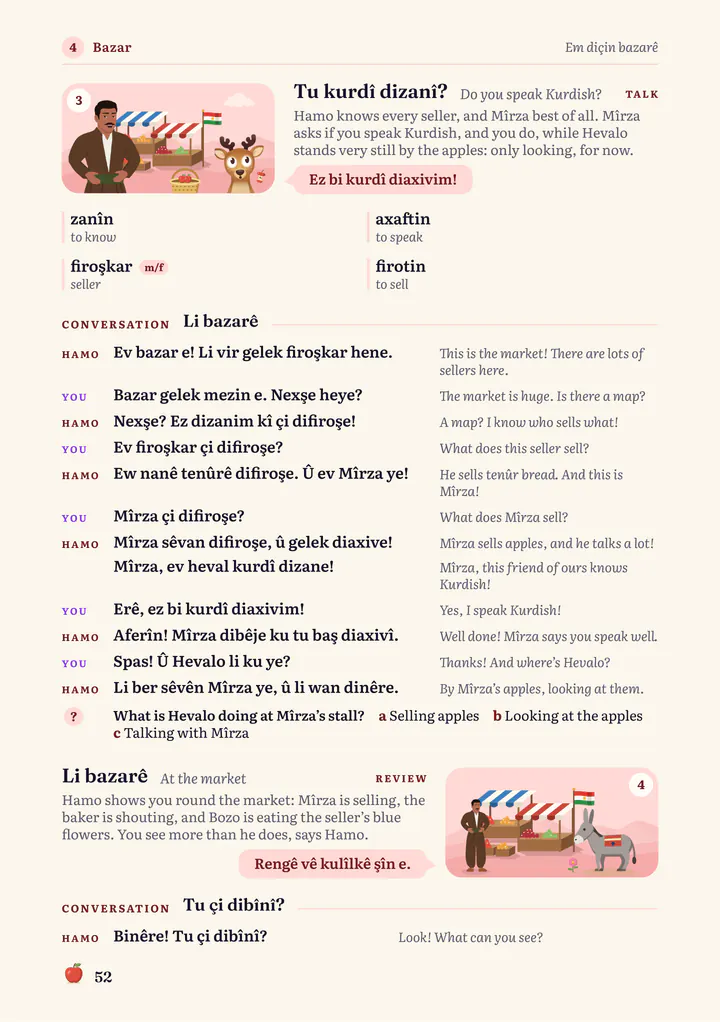
Tu kurdî dizanî? · Do you speak Kurdish? · Talk
Hamo knows every seller, and Mîrza best of all. Mîrza asks if you speak Kurdish, and you do, while Hevalo stands very still by the apples: only looking, for now.
Ez bi kurdî diaxivim!
zanîn · to know
axaftin · to speak
firoşkar · m/f · seller
firotin · to sell
Conversation · Li bazarê
Hamo: Ev bazar e! Li vir gelek firoşkar hene. · This is the market! There are lots of sellers here.
You: Bazar gelek mezin e. Nexşe heye? · The market is huge. Is there a map?
Hamo: Nexşe? Ez dizanim kî çi difiroşe! · A map? I know who sells what!
You: Ev firoşkar çi difiroşe? · What does this seller sell?
Hamo: Ew nanê tenûrê difiroşe. Û ev Mîrza ye! · He sells tenûr bread. And this is Mîrza!
You: Mîrza çi difiroşe? · What does Mîrza sell?
Hamo: Mîrza sêvan difiroşe, û gelek diaxive! · Mîrza sells apples, and he talks a lot!
Mîrza, ev heval kurdî dizane! · Mîrza, this friend of ours knows Kurdish!
You: Erê, ez bi kurdî diaxivim! · Yes, I speak Kurdish!
Hamo: Aferîn! Mîrza dibêje ku tu baş diaxivî. · Well done! Mîrza says you speak well.
You: Spas! Û Hevalo li ku ye? · Thanks! And where’s Hevalo?
Hamo: Li ber sêvên Mîrza ye, û li wan dinêre. · By Mîrza’s apples, looking at them.
What is Hevalo doing at Mîrza’s stall? a Selling apples b Looking at the apples c Talking with Mîrza
Li bazarê · At the market · Review
Hamo shows you round the market: Mîrza is selling, the baker is shouting, and Bozo is eating the seller’s blue flowers. You see more than he does, says Hamo.
Rengê vê kulîlkê şîn e.
Conversation · Tu çi dibînî?
Hamo: Binêre! Tu çi dibînî? · Look! What can you see?
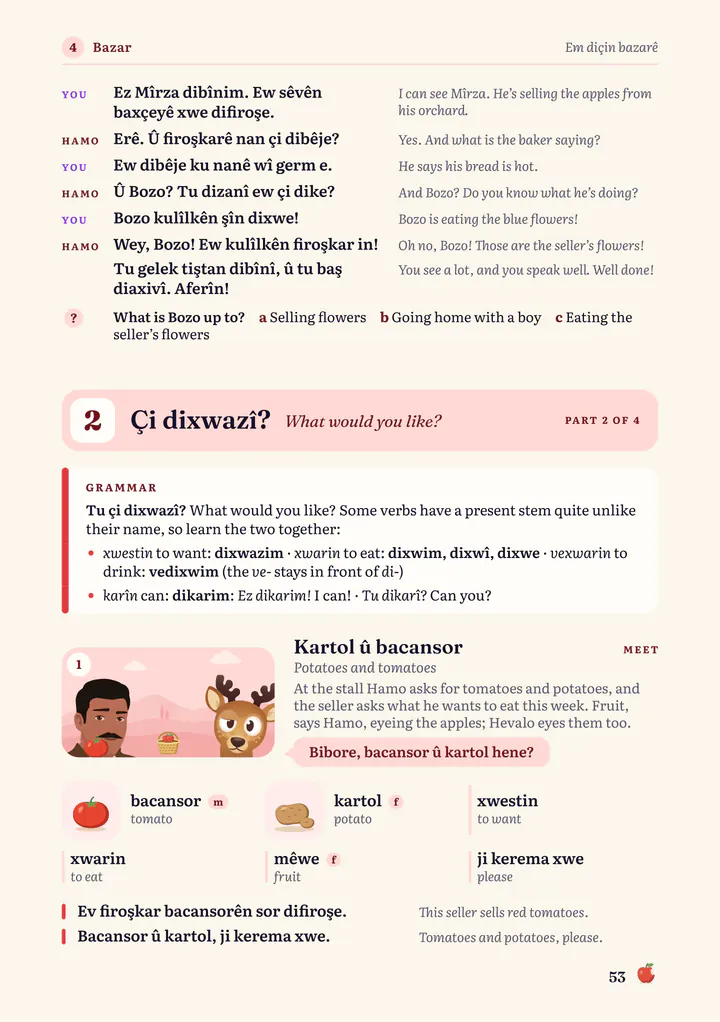
You: Ez Mîrza dibînim. Ew sêvên baxçeyê xwe difiroşe.
I can see Mîrza. He’s selling the apples from his orchard.
Hamo: Erê. Û firoşkarê nan çi dibêje? · Yes. And what is the baker saying?
You: Ew dibêje ku nanê wî germ e. · He says his bread is hot.
Hamo: Û Bozo? Tu dizanî ew çi dike? · And Bozo? Do you know what he’s doing?
You: Bozo kulîlkên şîn dixwe! · Bozo is eating the blue flowers!
Hamo: Wey, Bozo! Ew kulîlkên firoşkar in! · Oh no, Bozo! Those are the seller’s flowers!
Tu gelek tiştan dibînî, û tu baş diaxivî. Aferîn!
You see a lot, and you speak well. Well done!
What is Bozo up to? a Selling flowers b Going home with a boy c Eating the seller’s flowers
What would you like? · Part 2 of 4
Grammar
Tu çi dixwazî? What would you like? Some verbs have a present stem quite unlike their name, so learn the two together:
xwestin to want: dixwazim · xwarin to eat: dixwim, dixwî, dixwe · vexwarin to drink: vedixwim (the ve- stays in front of di-)
karîn can: dikarim: Ez dikarim! I can! · Tu dikarî? Can you?
Kartol û bacansor
Potatoes and tomatoes
Meet
At the stall Hamo asks for tomatoes and potatoes, and the seller asks what he wants to eat this week. Fruit, says Hamo, eyeing the apples; Hevalo eyes them too.
Bibore, bacansor û kartol hene?
bacansor (m) · tomato
kartol (f) · potato
xwestin · to want
xwarin · to eat
mêwe (f) · fruit
ji kerema xwe · please
Ev firoşkar bacansorên sor difiroşe. · This seller sells red tomatoes.
Bacansor û kartol, ji kerema xwe. · Tomatoes and potatoes, please.
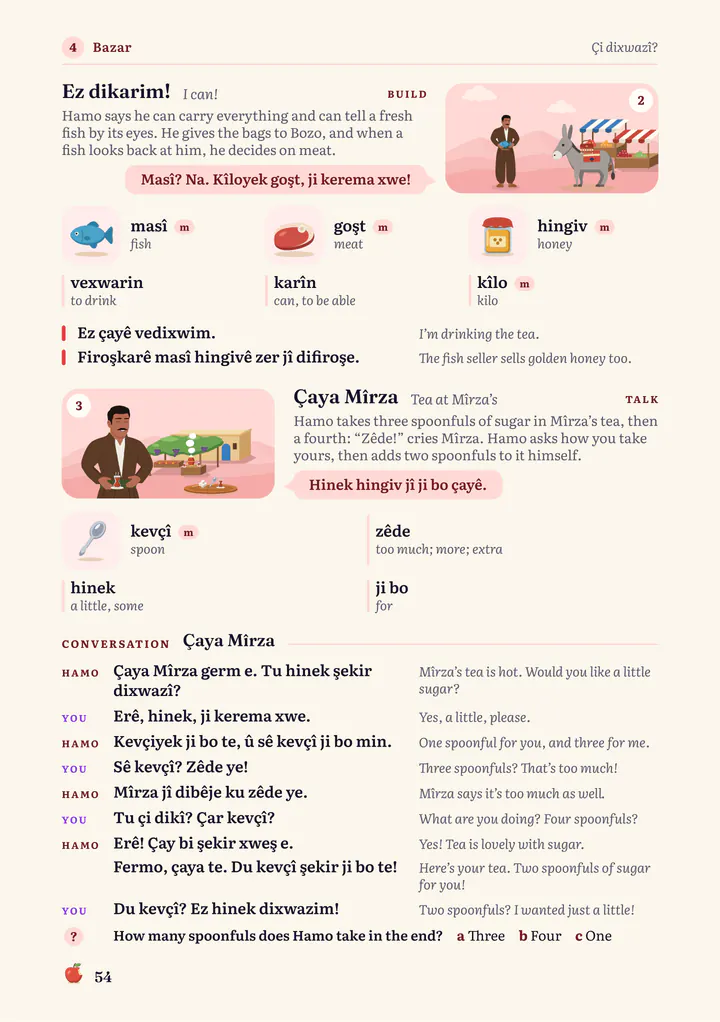
Ez dikarim! · I can! · Build
Hamo says he can carry everything and can tell a fresh fish by its eyes. He gives the bags to Bozo, and when a fish looks back at him, he decides on meat.
Masî? Na. Kîloyek goşt, ji kerema xwe!
masî (m) · fish
goşt (m) · meat
hingiv (m) · honey
vexwarin · to drink
karîn · can, to be able
kîlo (m) · kilo
Ez çayê vedixwim. · I’m drinking the tea.
Firoşkarê masî hingivê zer jî difiroşe. · The fish seller sells golden honey too.
Çaya Mîrza · Tea at Mîrza’s · Talk
Hamo takes three spoonfuls of sugar in Mîrza’s tea, then a fourth: “Zêde!” cries Mîrza. Hamo asks how you take yours, then adds two spoonfuls to it himself.
Hinek hingiv jî ji bo çayê.
kevçî (m) · spoon
zêde · too much; more; extra
hinek · a little, some
ji bo · for
Conversation · Çaya Mîrza
Hamo: Çaya Mîrza germ e. Tu hinek şekir dixwazî?
Mîrza’s tea is hot. Would you like a little sugar?
You: Erê, hinek, ji kerema xwe. · Yes, a little, please.
Hamo: Kevçiyek ji bo te, û sê kevçî ji bo min. · One spoonful for you, and three for me.
You: Sê kevçî? Zêde ye! · Three spoonfuls? That’s too much!
Hamo: Mîrza jî dibêje ku zêde ye. · Mîrza says it’s too much as well.
You: Tu çi dikî? Çar kevçî? · What are you doing? Four spoonfuls?
Hamo: Erê! Çay bi şekir xweş e. · Yes! Tea is lovely with sugar.
Fermo, çaya te. Du kevçî şekir ji bo te! · Here’s your tea. Two spoonfuls of sugar for you!
You: Du kevçî? Ez hinek dixwazim! · Two spoonfuls? I wanted just a little!
How many spoonfuls does Hamo take in the end? a Three b Four c One
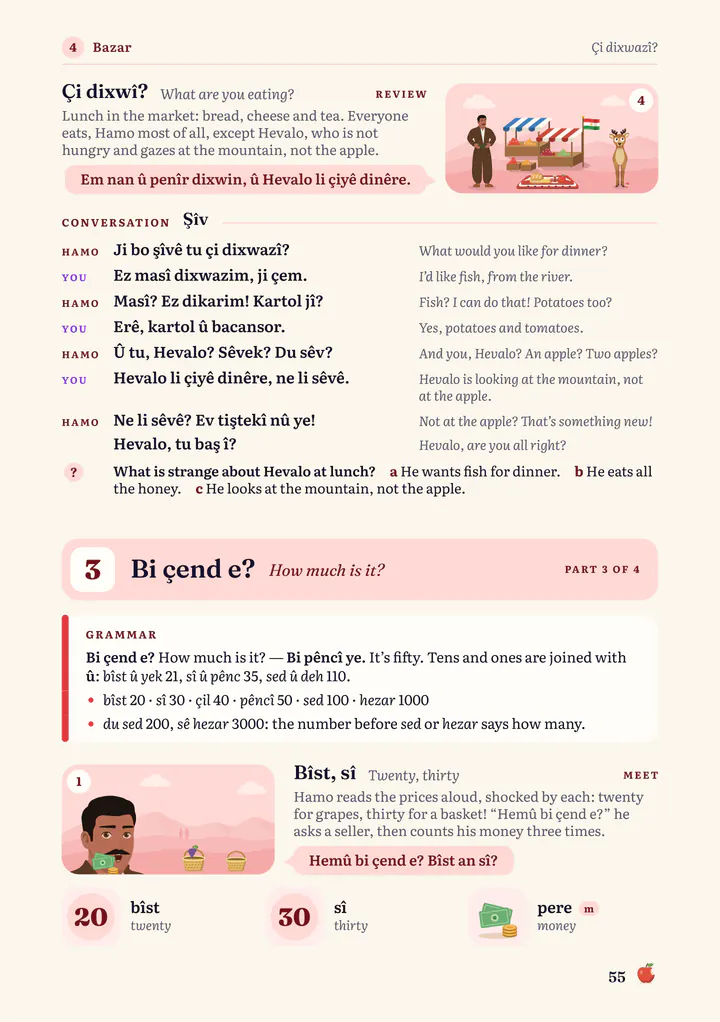
Çi dixwî? · What are you eating? · Review
Lunch in the market: bread, cheese and tea. Everyone eats, Hamo most of all, except Hevalo, who is not hungry and gazes at the mountain, not the apple.
Em nan û penîr dixwin, û Hevalo li çiyê dinêre.
Conversation · Şîv
Hamo: Ji bo şîvê tu çi dixwazî? · What would you like for dinner?
You: Ez masî dixwazim, ji çem. · I’d like fish, from the river.
Hamo: Masî? Ez dikarim! Kartol jî? · Fish? I can do that! Potatoes too?
You: Erê, kartol û bacansor. · Yes, potatoes and tomatoes.
Hamo: Û tu, Hevalo? Sêvek? Du sêv? · And you, Hevalo? An apple? Two apples?
You: Hevalo li çiyê dinêre, ne li sêvê. · Hevalo is looking at the mountain, not at the apple.
Hamo: Ne li sêvê? Ev tiştekî nû ye! · Not at the apple? That’s something new!
Hevalo, tu baş î? · Hevalo, are you all right?
What is strange about Hevalo at lunch? a He wants fish for dinner. b He eats all the honey. c He looks at the mountain, not the apple.
How much is it? · Part 3 of 4
Grammar
Bi çend e? How much is it? — Bi pêncî ye. It’s fifty. Tens and ones are joined with û: bîst û yek 21, sî û pênc 35, sed û deh 110.
bîst 20 · sî 30 · çil 40 · pêncî 50 · sed 100 · hezar 1000
du sed 200, sê hezar 3000: the number before sed or hezar says how many.
Bîst, sî · Twenty, thirty · Meet
Hamo reads the prices aloud, shocked by each: twenty for grapes, thirty for a basket! “Hemû bi çend e?” he asks a seller, then counts his money three times.
Hemû bi çend e? Bîst an sî?
bîst · twenty
sî · thirty
pere (m) · money
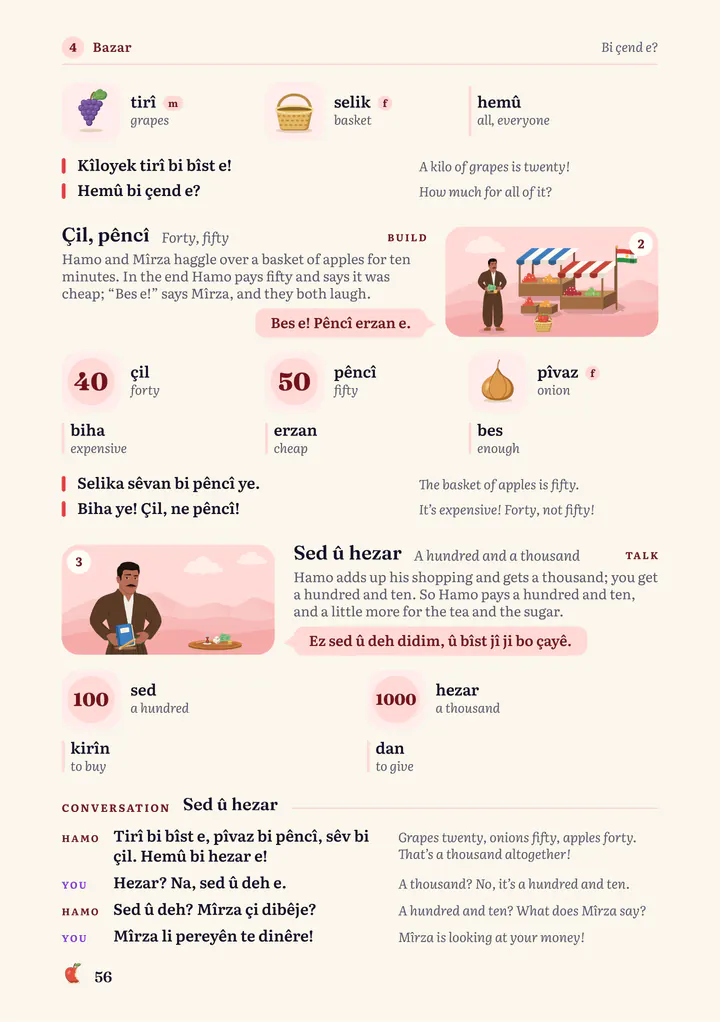
tirî (m) · grapes
selik (f) · basket
hemû · all, everyone
Kîloyek tirî bi bîst e! · A kilo of grapes is twenty!
Hemû bi çend e? · How much for all of it?
Çil, pêncî · Forty, fifty · Build
Hamo and Mîrza haggle over a basket of apples for ten minutes. In the end Hamo pays fifty and says it was cheap; “Bes e!” says Mîrza, and they both laugh.
Bes e! Pêncî erzan e.
çil · forty
pêncî · fifty
pîvaz (f) · onion
biha · expensive
erzan · cheap
bes · enough
Selika sêvan bi pêncî ye. · The basket of apples is fifty.
Biha ye! Çil, ne pêncî! · It’s expensive! Forty, not fifty!
Sed û hezar · A hundred and a thousand · Talk
Hamo adds up his shopping and gets a thousand; you get a hundred and ten. So Hamo pays a hundred and ten, and a little more for the tea and the sugar.
Ez sed û deh didim, û bîst jî ji bo çayê.
sed · a hundred
hezar · a thousand
kirîn · to buy
dan · to give
Conversation · Sed û hezar
Hamo: Tirî bi bîst e, pîvaz bi pêncî, sêv bi çil. Hemû bi hezar e!
Grapes twenty, onions fifty, apples forty. That’s a thousand altogether!
You: Hezar? Na, sed û deh e. · A thousand? No, it’s a hundred and ten.
Hamo: Sed û deh? Mîrza çi dibêje? · A hundred and ten? What does Mîrza say?
You: Mîrza li pereyên te dinêre! · Mîrza is looking at your money!
Hamo: Wey! Mîrza hemû pereyên min dixwaze!
Oh dear! Mîrza wants all my money!
You: Na, tu sed û deh didî. · No, you give him a hundred and ten.
Hamo: Baş e. Fermo Mîrza, sed û deh, û bîst jî ji bo çayê.
All right. Here you are, Mîrza: a hundred and ten, and twenty for the tea.
You: Û ji bo şekir? · And for the sugar?
Hamo: Erê, deh jî ji bo şekir! · Yes, and ten for the sugar too!
How much does Hamo give Mîrza in all? a A hundred and forty b A thousand c A hundred and ten
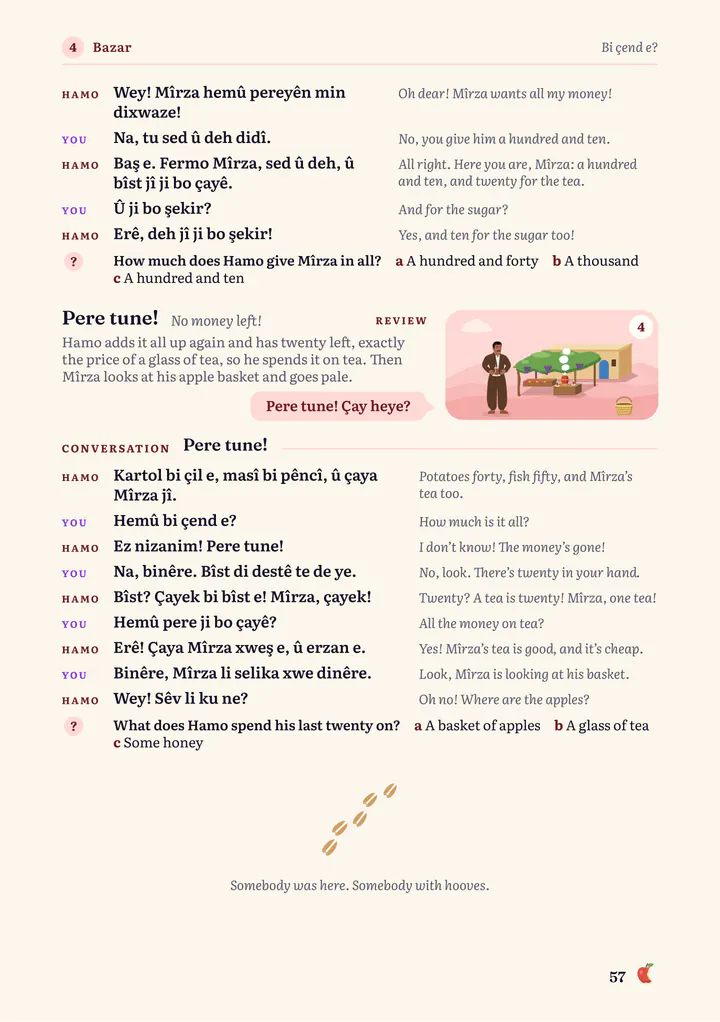
Pere tune! · No money left! · Review
Hamo adds it all up again and has twenty left, exactly the price of a glass of tea, so he spends it on tea. Then Mîrza looks at his apple basket and goes pale.
Pere tune! Çay heye?
Conversation · Pere tune!
Hamo: Kartol bi çil e, masî bi pêncî, û çaya Mîrza jî.
Potatoes forty, fish fifty, and Mîrza’s tea too.
You: Hemû bi çend e? · How much is it all?
Hamo: Ez nizanim! Pere tune! · I don’t know! The money’s gone!
You: Na, binêre. Bîst di destê te de ye. · No, look. There’s twenty in your hand.
Hamo: Bîst? Çayek bi bîst e! Mîrza, çayek! · Twenty? A tea is twenty! Mîrza, one tea!
You: Hemû pere ji bo çayê? · All the money on tea?
Hamo: Erê! Çaya Mîrza xweş e, û erzan e. · Yes! Mîrza’s tea is good, and it’s cheap.
You: Binêre, Mîrza li selika xwe dinêre. · Look, Mîrza is looking at his basket.
Hamo: Wey! Sêv li ku ne? · Oh no! Where are the apples?
What does Hamo spend his last twenty on? a A basket of apples b A glass of tea c Some honey
Somebody was here. Somebody with hooves.
No, I don’t want any · Part 4 of 4
Grammar
Ez naxwazim. I don’t want it. In the present, na- takes the place of di-: diçim → naçim, dixwim → naxwim, têm → nayêm.
zanîn and karîn take ni-: nizanim I don’t know, nikarim I can’t.
Kes nizane! Nobody knows! Hîç makes it stronger: Ez hîç nizanim. I have no idea at all.
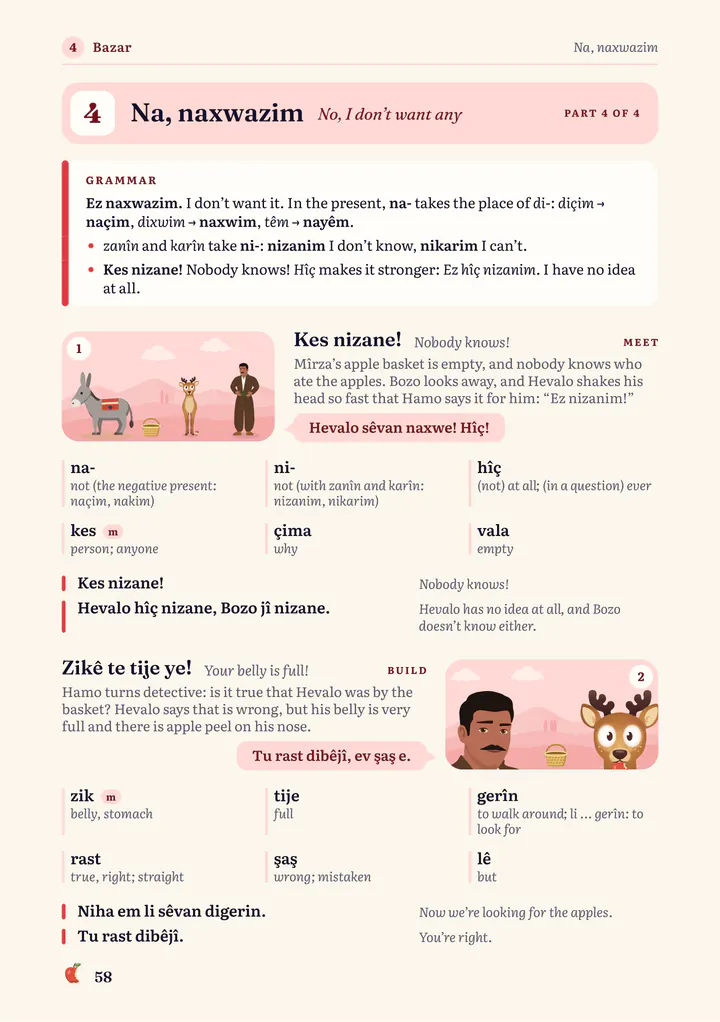
Kes nizane! · Nobody knows! · Meet
Mîrza’s apple basket is empty, and nobody knows who ate the apples. Bozo looks away, and Hevalo shakes his head so fast that Hamo says it for him: “Ez nizanim!”
Hevalo sêvan naxwe! Hîç!
na- · not (the negative present: naçim, nakim)
ni- · not (with zanîn and karîn: nizanim, nikarim)
hîç · (not) at all; (in a question) ever
kes (m) · person; anyone
çima · why
vala · empty
Kes nizane! · Nobody knows!
Hevalo hîç nizane, Bozo jî nizane. · Hevalo has no idea at all, and Bozo doesn’t know either.
Zikê te tije ye! · Your belly is full! · Build
Hamo turns detective: is it true that Hevalo was by the basket? Hevalo says that is wrong, but his belly is very full and there is apple peel on his nose.
Tu rast dibêjî, ev şaş e.
zik (m) · belly, stomach
tije · full
gerîn · to walk around; li … gerîn: to look for
rast · true, right; straight
şaş · wrong; mistaken
lê · but
Niha em li sêvan digerin. · Now we’re looking for the apples.
Tu rast dibêjî. · You’re right.
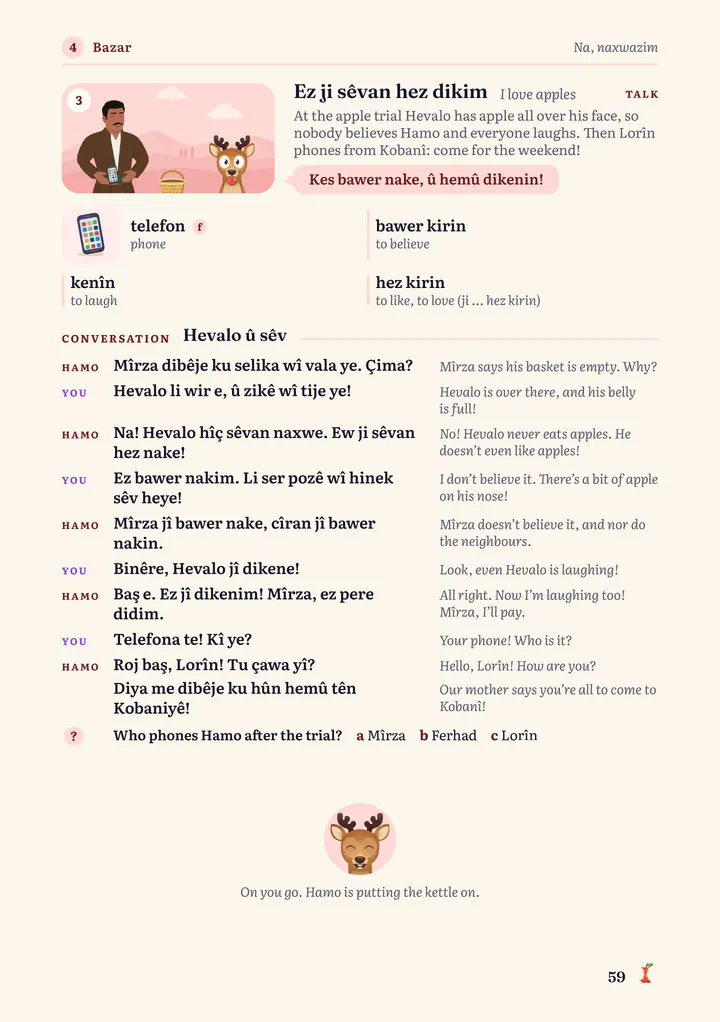
Ez ji sêvan hez dikim · I love apples · Talk
At the apple trial Hevalo has apple all over his face, so nobody believes Hamo and everyone laughs. Then Lorîn phones from Kobanî: come for the weekend!
Kes bawer nake, û hemû dikenin!
telefon (f) · phone
bawer kirin · to believe
kenîn · to laugh
hez kirin · to like, to love (ji … hez kirin)
Conversation · Hevalo û sêv
Hamo: Mîrza dibêje ku selika wî vala ye. Çima? · Mîrza says his basket is empty. Why?
You: Hevalo li wir e, û zikê wî tije ye! · Hevalo is over there, and his belly is full!
Hamo: Na! Hevalo hîç sêvan naxwe. Ew ji sêvan hez nake!
No! Hevalo never eats apples. He doesn’t even like apples!
You: Ez bawer nakim. Li ser pozê wî hinek sêv heye!
I don’t believe it. There’s a bit of apple on his nose!
Hamo: Mîrza jî bawer nake, cîran jî bawer nakin.
Mîrza doesn’t believe it, and nor do the neighbours.
You: Binêre, Hevalo jî dikene! · Look, even Hevalo is laughing!
Hamo: Baş e. Ez jî dikenim! Mîrza, ez pere didim.
All right. Now I’m laughing too! Mîrza, I’ll pay.
You: Telefona te! Kî ye? · Your phone! Who is it?
Hamo: Roj baş, Lorîn! Tu çawa yî? · Hello, Lorîn! How are you?
Diya me dibêje ku hûn hemû tên Kobaniyê!
Our mother says you’re all to come to Kobanî!
Who phones Hamo after the trial? a Mîrza b Ferhad c Lorîn
On you go. Hamo is putting the kettle on.
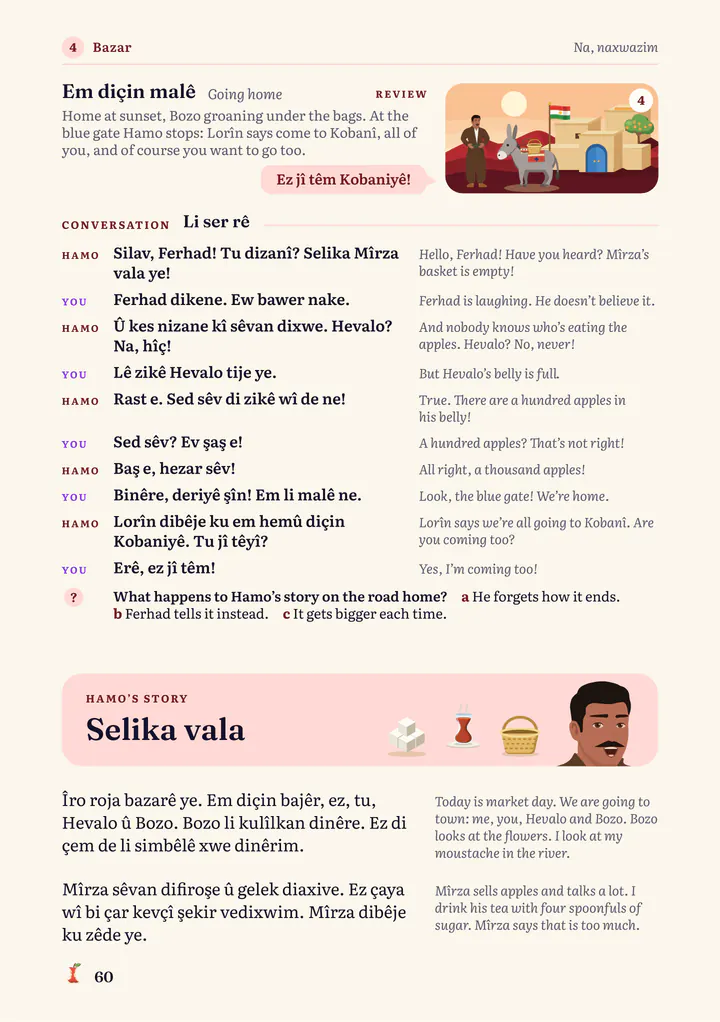
Em diçin malê · Going home · Review
Home at sunset, Bozo groaning under the bags. At the blue gate Hamo stops: Lorîn says come to Kobanî, all of you, and of course you want to go too.
Ez jî têm Kobaniyê!
Conversation · Li ser rê
Hamo: Silav, Ferhad! Tu dizanî? Selika Mîrza vala ye!
Hello, Ferhad! Have you heard? Mîrza’s basket is empty!
You: Ferhad dikene. Ew bawer nake. · Ferhad is laughing. He doesn’t believe it.
Hamo: Û kes nizane kî sêvan dixwe. Hevalo? Na, hîç!
And nobody knows who’s eating the apples. Hevalo? No, never!
You: Lê zikê Hevalo tije ye. · But Hevalo’s belly is full.
Hamo: Rast e. Sed sêv di zikê wî de ne! · True. There are a hundred apples in his belly!
You: Sed sêv? Ev şaş e! · A hundred apples? That’s not right!
Hamo: Baş e, hezar sêv! · All right, a thousand apples!
You: Binêre, deriyê şîn! Em li malê ne. · Look, the blue gate! We’re home.
Hamo: Lorîn dibêje ku em hemû diçin Kobaniyê. Tu jî têyî?
Lorîn says we’re all going to Kobanî. Are you coming too?
You: Erê, ez jî têm! · Yes, I’m coming too!
What happens to Hamo’s story on the road home? a He forgets how it ends. b Ferhad tells it instead. c It gets bigger each time.
Hamo’s story
Îro roja bazarê ye. Em diçin bajêr, ez, tu, Hevalo û Bozo. Bozo li kulîlkan dinêre. Ez di çem de li simbêlê xwe dinêrim.
Today is market day. We are going to town: me, you, Hevalo and Bozo. Bozo looks at the flowers. I look at my moustache in the river.
Mîrza sêvan difiroşe û gelek diaxive. Ez çaya wî bi çar kevçî şekir vedixwim. Mîrza dibêje ku zêde ye.
Mîrza sells apples and talks a lot. I drink his tea with four spoonfuls of sugar. Mîrza says that is too much.
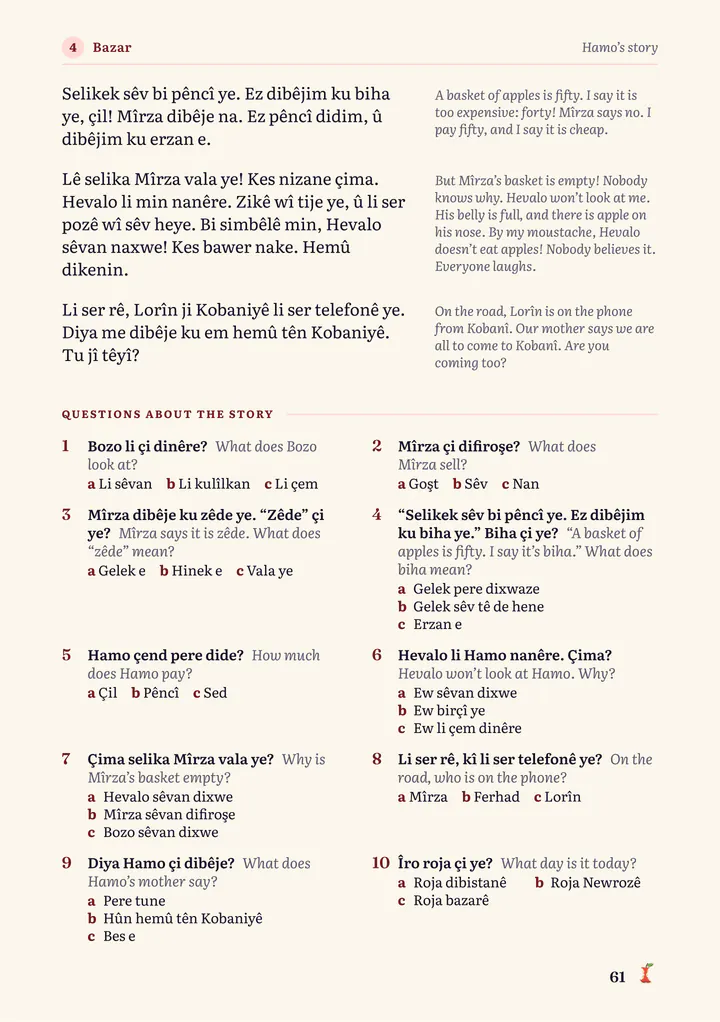
Selikek sêv bi pêncî ye. Ez dibêjim ku biha ye, çil! Mîrza dibêje na. Ez pêncî didim, û dibêjim ku erzan e.
A basket of apples is fifty. I say it is too expensive: forty! Mîrza says no. I pay fifty, and I say it is cheap.
Lê selika Mîrza vala ye! Kes nizane çima. Hevalo li min nanêre. Zikê wî tije ye, û li ser pozê wî sêv heye. Bi simbêlê min, Hevalo sêvan naxwe! Kes bawer nake. Hemû dikenin.
But Mîrza’s basket is empty! Nobody knows why. Hevalo won’t look at me. His belly is full, and there is apple on his nose. By my moustache, Hevalo doesn’t eat apples! Nobody believes it. Everyone laughs.
Li ser rê, Lorîn ji Kobaniyê li ser telefonê ye. Diya me dibêje ku em hemû tên Kobaniyê. Tu jî têyî?
On the road, Lorîn is on the phone from Kobanî. Our mother says we are all to come to Kobanî. Are you coming too?
Questions about the story
1 · Bozo li çi dinêre? What does Bozo look at?
a Li sêvan b Li kulîlkan c Li çem
2 · Mîrza çi difiroşe? What does Mîrza sell?
a Goşt b Sêv c Nan
3 · Mîrza dibêje ku zêde ye. “Zêde” çi ye? Mîrza says it is zêde. What does “zêde” mean?
a Gelek e b Hinek e c Vala ye
4 · “Selikek sêv bi pêncî ye. Ez dibêjim ku biha ye.” Biha çi ye? “A basket of apples is fifty. I say it’s biha.” What does biha mean?
a · Gelek pere dixwaze
b · Gelek sêv tê de hene
c · Erzan e
5 · Hamo çend pere dide? How much does Hamo pay?
a Çil b Pêncî c Sed
6 · Hevalo li Hamo nanêre. Çima? Hevalo won’t look at Hamo. Why?
a · Ew sêvan dixwe
b · Ew birçî ye
c · Ew li çem dinêre
7 · Çima selika Mîrza vala ye? Why is Mîrza’s basket empty?
a · Hevalo sêvan dixwe
b · Mîrza sêvan difiroşe
c · Bozo sêvan dixwe
8 · Li ser rê, kî li ser telefonê ye? On the road, who is on the phone?
a Mîrza b Ferhad c Lorîn
9 · Diya Hamo çi dibêje? What does Hamo’s mother say?
a · Pere tune
b · Hûn hemû tên Kobaniyê
c · Bes e
10 · Îro roja çi ye? What day is it today?
a · Roja dibistanê · b · Roja Newrozê
c · Roja bazarê
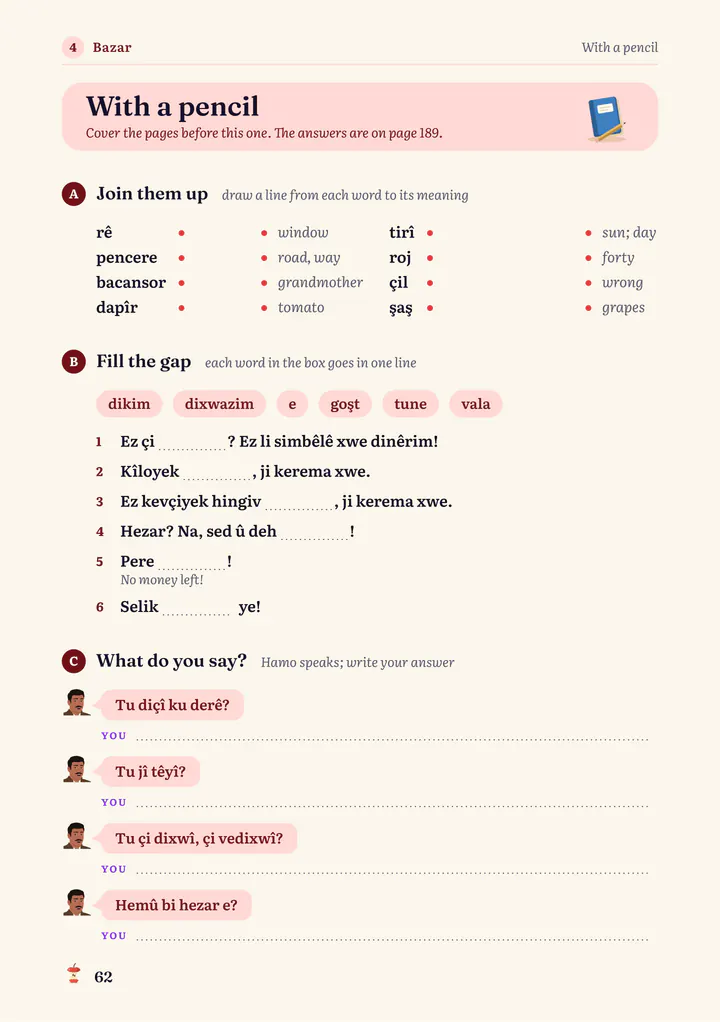
Cover the pages before this one. The answers are on page 189.
A · Join them up · draw a line from each word to its meaning
rê · window · tirî · sun; day
pencere · road, way · roj · forty
bacansor · grandmother · çil · wrong
dapîr · tomato · şaş · grapes
B · Fill the gap · each word in the box goes in one line
dikim · dixwazim · e · goşt · tune · vala
1 · Ez çi …? Ez li simbêlê xwe dinêrim!
2 · Kîloyek …, ji kerema xwe.
3 · Ez kevçiyek hingiv …, ji kerema xwe.
4 · Hezar? Na, sed û deh …!
5 · Pere …!
No money left!
6 · Selik … ye!
C · What do you say? · Hamo speaks; write your answer
Tu diçî ku derê?
You
Tu jî têyî?
You
Tu çi dixwî, çi vedixwî?
You
Hemû bi hezar e?
You
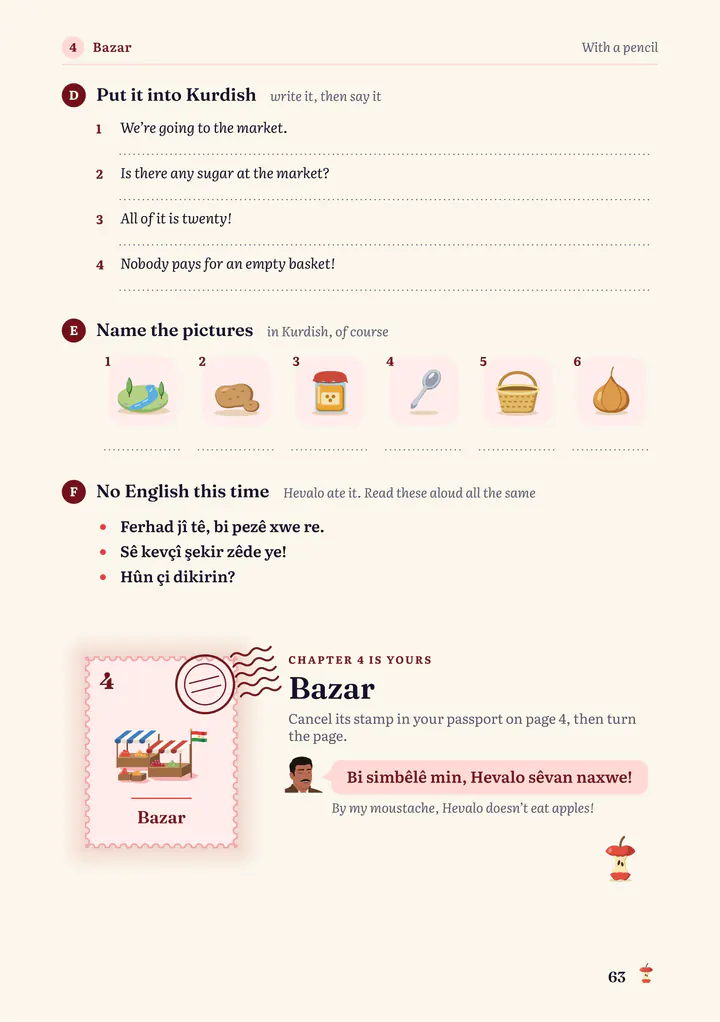
D · Put it into Kurdish · write it, then say it
1 · We’re going to the market.
2 · Is there any sugar at the market?
3 · All of it is twenty!
4 · Nobody pays for an empty basket!
E · Name the pictures · in Kurdish, of course
F · No English this time · Hevalo ate it. Read these aloud all the same
Ferhad jî tê, bi pezê xwe re.
Sê kevçî şekir zêde ye!
Hûn çi dikirin?
Bazar
Chapter 4 is yours
Cancel its stamp in your passport on page 4, then turn the page.
Bi simbêlê min, Hevalo sêvan naxwe!
By my moustache, Hevalo doesn’t eat apples!
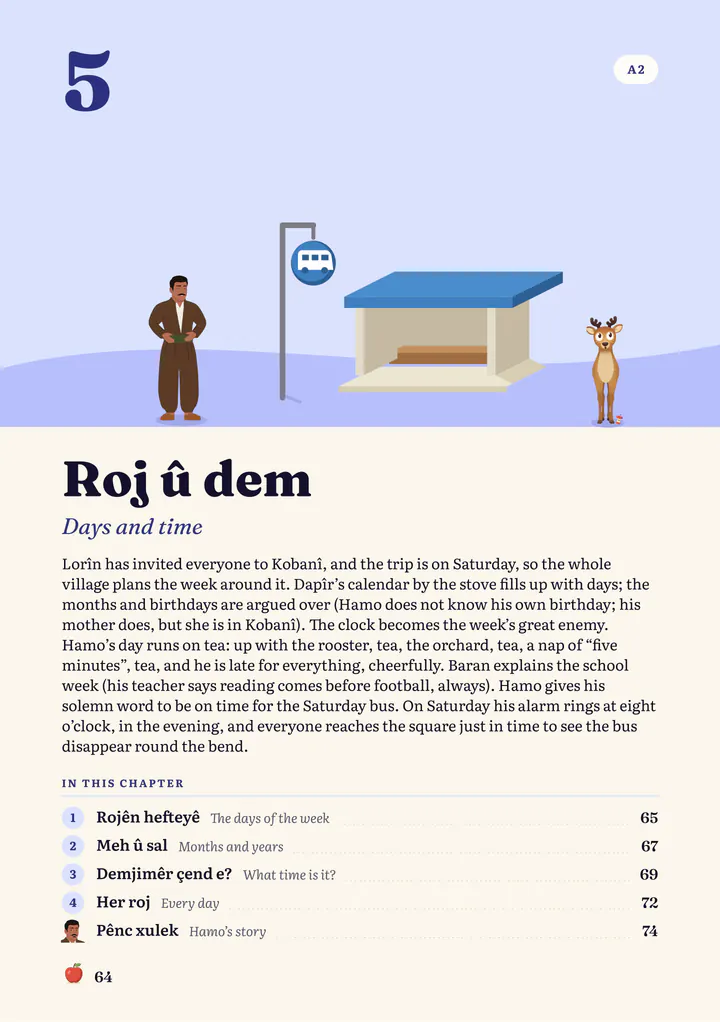
Days and time
Lorîn has invited everyone to Kobanî, and the trip is on Saturday, so the whole village plans the week around it. Dapîr’s calendar by the stove fills up with days; the months and birthdays are argued over (Hamo does not know his own birthday; his mother does, but she is in Kobanî). The clock becomes the week’s great enemy. Hamo’s day runs on tea: up with the rooster, tea, the orchard, tea, a nap of “five minutes”, tea, and he is late for everything, cheerfully. Baran explains the school week (his teacher says reading comes before football, always). Hamo gives his solemn word to be on time for the Saturday bus. On Saturday his alarm rings at eight o’clock, in the evening, and everyone reaches the square just in time to see the bus disappear round the bend.
In this chapter
1 · Rojên hefteyê · The days of the week · 65
2 · Meh û sal · Months and years · 67
3 · Demjimêr çend e? · What time is it? · 69
4 · Her roj · Every day · 72
Pênc xulek · Hamo’s story · 74
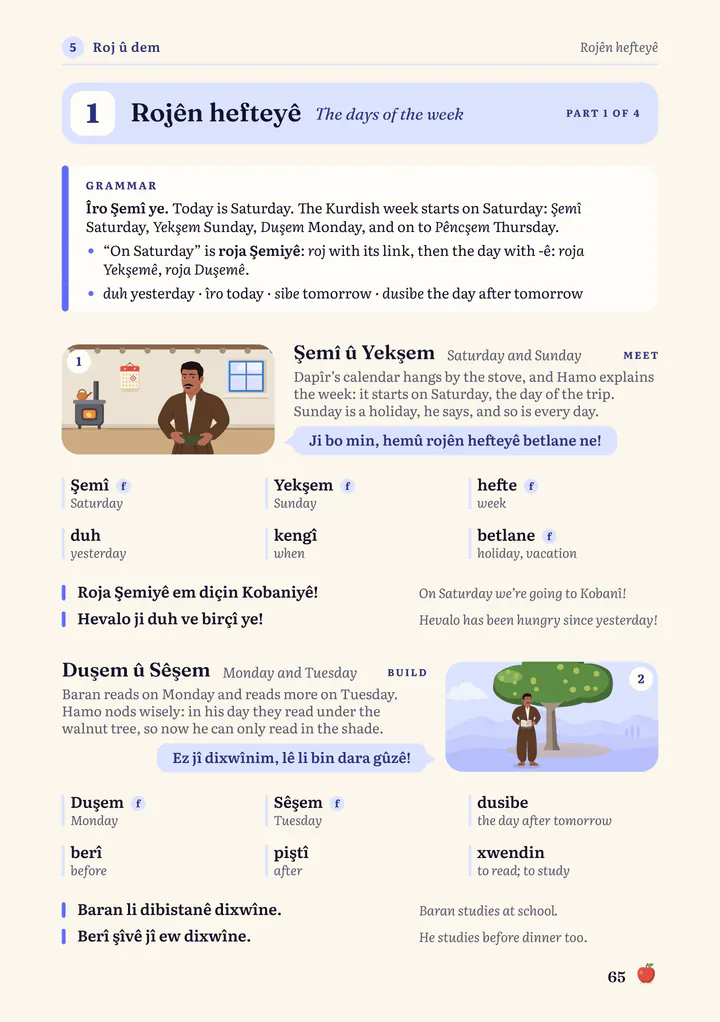
The days of the week · Part 1 of 4
Grammar
Îro Şemî ye. Today is Saturday. The Kurdish week starts on Saturday: Şemî Saturday, Yekşem Sunday, Duşem Monday, and on to Pêncşem Thursday.
“On Saturday” is roja Şemiyê: roj with its link, then the day with -ê: roja Yekşemê, roja Duşemê.
duh yesterday · îro today · sibe tomorrow · dusibe the day after tomorrow
Şemî û Yekşem · Saturday and Sunday · Meet
Dapîr’s calendar hangs by the stove, and Hamo explains the week: it starts on Saturday, the day of the trip. Sunday is a holiday, he says, and so is every day.
Ji bo min, hemû rojên hefteyê betlane ne!
Şemî (f) · Saturday
Yekşem (f) · Sunday
hefte (f) · week
duh · yesterday
kengî · when
betlane (f) · holiday, vacation
Roja Şemiyê em diçin Kobaniyê! · On Saturday we’re going to Kobanî!
Hevalo ji duh ve birçî ye! · Hevalo has been hungry since yesterday!
Duşem û Sêşem · Monday and Tuesday · Build
Baran reads on Monday and reads more on Tuesday. Hamo nods wisely: in his day they read under the walnut tree, so now he can only read in the shade.
Ez jî dixwînim, lê li bin dara gûzê!
Duşem (f) · Monday
Sêşem (f) · Tuesday
dusibe · the day after tomorrow
berî · before
piştî · after
xwendin · to read; to study
Baran li dibistanê dixwîne. · Baran studies at school.
Berî şîvê jî ew dixwîne. · He studies before dinner too.
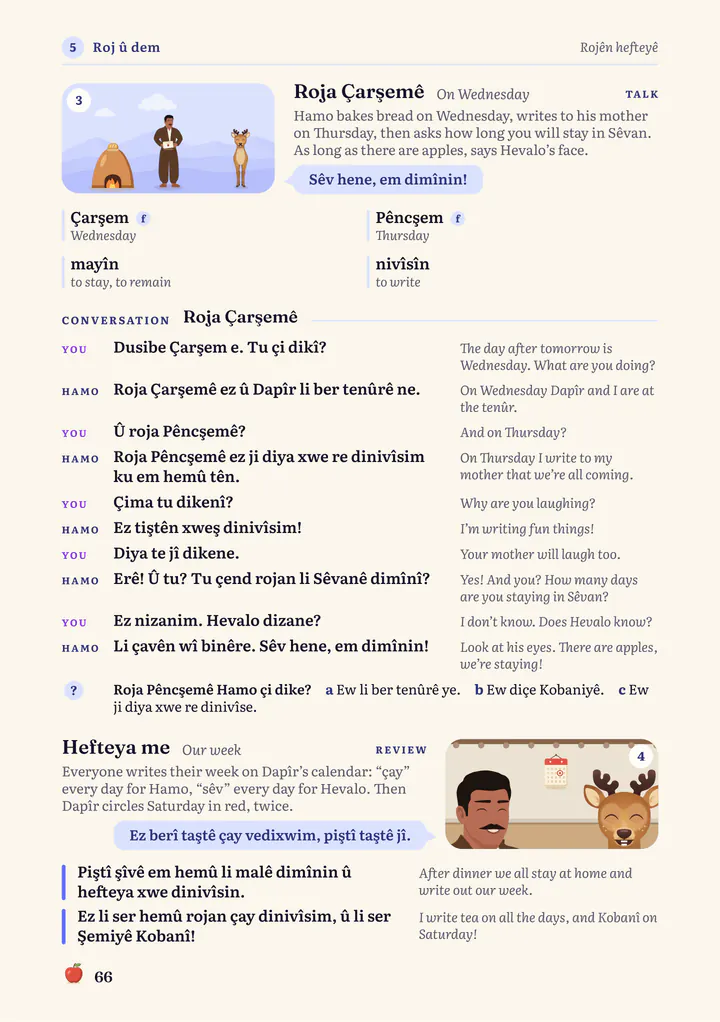
Roja Çarşemê · On Wednesday · Talk
Hamo bakes bread on Wednesday, writes to his mother on Thursday, then asks how long you will stay in Sêvan. As long as there are apples, says Hevalo’s face.
Sêv hene, em dimînin!
Çarşem (f) · Wednesday
Pêncşem (f) · Thursday
mayîn · to stay, to remain
nivîsîn · to write
Conversation · Roja Çarşemê
You: Dusibe Çarşem e. Tu çi dikî? · The day after tomorrow is Wednesday. What are you doing?
Hamo: Roja Çarşemê ez û Dapîr li ber tenûrê ne. · On Wednesday Dapîr and I are at the tenûr.
You: Û roja Pêncşemê? · And on Thursday?
Hamo: Roja Pêncşemê ez ji diya xwe re dinivîsim ku em hemû tên.
On Thursday I write to my mother that we’re all coming.
You: Çima tu dikenî? · Why are you laughing?
Hamo: Ez tiştên xweş dinivîsim! · I’m writing fun things!
You: Diya te jî dikene. · Your mother will laugh too.
Hamo: Erê! Û tu? Tu çend rojan li Sêvanê dimînî? · Yes! And you? How many days are you staying in Sêvan?
You: Ez nizanim. Hevalo dizane? · I don’t know. Does Hevalo know?
Hamo: Li çavên wî binêre. Sêv hene, em dimînin! · Look at his eyes. There are apples, we’re staying!
Roja Pêncşemê Hamo çi dike? a Ew li ber tenûrê ye. b Ew diçe Kobaniyê. c Ew ji diya xwe re dinivîse.
Hefteya me · Our week · Review
Everyone writes their week on Dapîr’s calendar: “çay” every day for Hamo, “sêv” every day for Hevalo. Then Dapîr circles Saturday in red, twice.
Ez berî taştê çay vedixwim, piştî taştê jî.
Piştî şîvê em hemû li malê dimînin û hefteya xwe dinivîsin.
After dinner we all stay at home and write out our week.
Ez li ser hemû rojan çay dinivîsim, û li ser Şemiyê Kobanî!
I write tea on all the days, and Kobanî on Saturday!
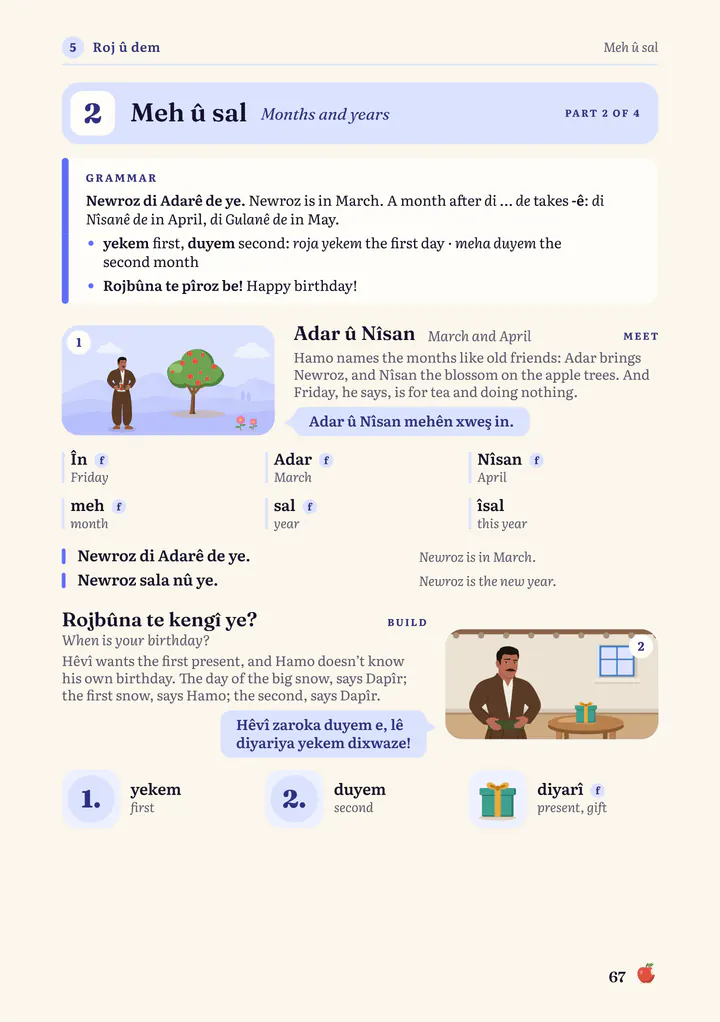
Months and years · Part 2 of 4
Grammar
Newroz di Adarê de ye. Newroz is in March. A month after di … de takes -ê: di Nîsanê de in April, di Gulanê de in May.
yekem first, duyem second: roja yekem the first day · meha duyem the second month
Rojbûna te pîroz be! Happy birthday!
Adar û Nîsan · March and April · Meet
Hamo names the months like old friends: Adar brings Newroz, and Nîsan the blossom on the apple trees. And Friday, he says, is for tea and doing nothing.
Adar û Nîsan mehên xweş in.
În (f) · Friday
Adar (f) · March
Nîsan (f) · April
meh (f) · month
sal (f) · year
îsal · this year
Newroz di Adarê de ye. · Newroz is in March.
Newroz sala nû ye. · Newroz is the new year.
Rojbûna te kengî ye?
When is your birthday?
Build
Hêvî wants the first present, and Hamo doesn’t know his own birthday. The day of the big snow, says Dapîr; the first snow, says Hamo; the second, says Dapîr.
Hêvî zaroka duyem e, lê diyariya yekem dixwaze!
yekem · first
duyem · second
diyarî (f) · present, gift
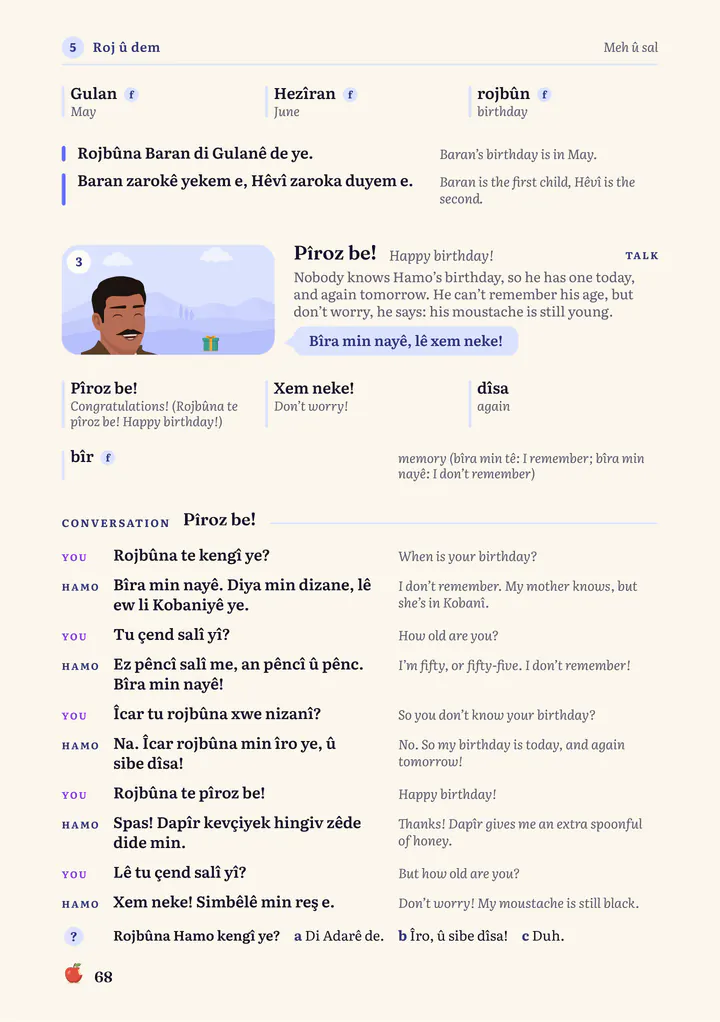
Gulan (f) · May
Hezîran (f) · June
rojbûn (f) · birthday
Rojbûna Baran di Gulanê de ye. · Baran’s birthday is in May.
Baran zarokê yekem e, Hêvî zaroka duyem e. · Baran is the first child, Hêvî is the second.
Pîroz be! · Happy birthday! · Talk
Nobody knows Hamo’s birthday, so he has one today, and again tomorrow. He can’t remember his age, but don’t worry, he says: his moustache is still young.
Bîra min nayê, lê xem neke!
Pîroz be! · Congratulations! (Rojbûna te pîroz be! Happy birthday!)
Xem neke! · Don’t worry!
dîsa · again
bîr (f) · memory (bîra min tê: I remember; bîra min nayê: I don’t remember)
Conversation · Pîroz be!
You: Rojbûna te kengî ye? · When is your birthday?
Hamo: Bîra min nayê. Diya min dizane, lê ew li Kobaniyê ye.
I don’t remember. My mother knows, but she’s in Kobanî.
You: Tu çend salî yî? · How old are you?
Hamo: Ez pêncî salî me, an pêncî û pênc. Bîra min nayê!
I’m fifty, or fifty-five. I don’t remember!
You: Îcar tu rojbûna xwe nizanî? · So you don’t know your birthday?
Hamo: Na. Îcar rojbûna min îro ye, û sibe dîsa!
No. So my birthday is today, and again tomorrow!
You: Rojbûna te pîroz be! · Happy birthday!
Hamo: Spas! Dapîr kevçiyek hingiv zêde dide min.
Thanks! Dapîr gives me an extra spoonful of honey.
You: Lê tu çend salî yî? · But how old are you?
Hamo: Xem neke! Simbêlê min reş e. · Don’t worry! My moustache is still black.
Rojbûna Hamo kengî ye? a Di Adarê de. b Îro, û sibe dîsa! c Duh.
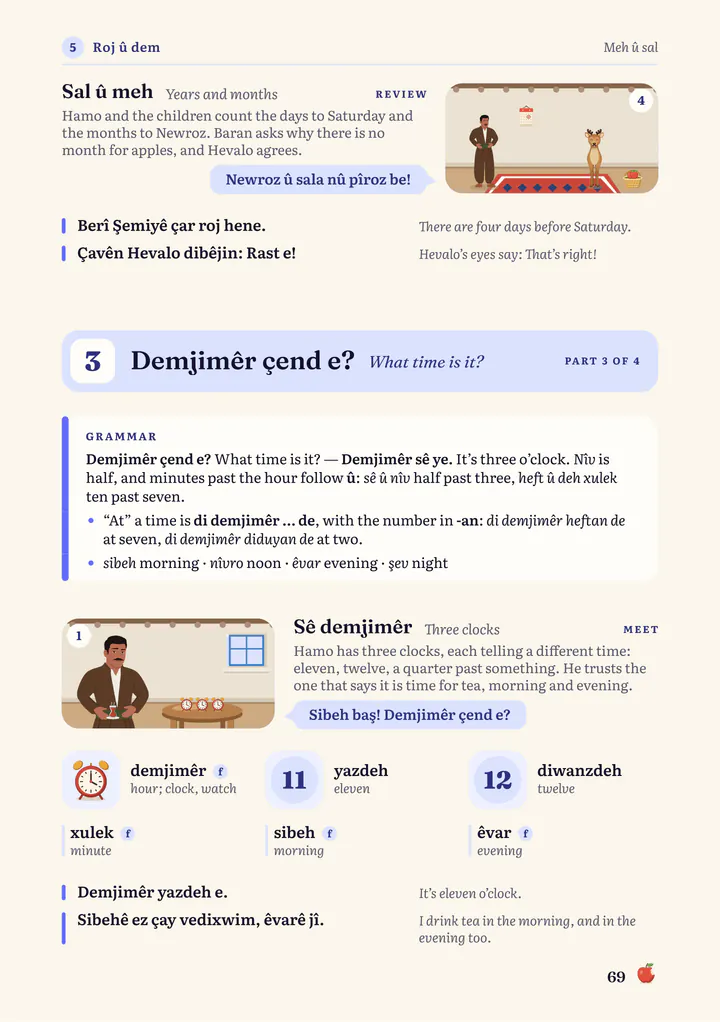
Sal û meh · Years and months · Review
Hamo and the children count the days to Saturday and the months to Newroz. Baran asks why there is no month for apples, and Hevalo agrees.
Newroz û sala nû pîroz be!
Berî Şemiyê çar roj hene. · There are four days before Saturday.
Çavên Hevalo dibêjin: Rast e! · Hevalo’s eyes say: That’s right!
What time is it? · Part 3 of 4
Grammar
Demjimêr çend e? What time is it? — Demjimêr sê ye. It’s three o’clock. Nîv is half, and minutes past the hour follow û: sê û nîv half past three, heft û deh xulek ten past seven.
“At” a time is di demjimêr … de, with the number in -an: di demjimêr heftan de at seven, di demjimêr diduyan de at two.
sibeh morning · nîvro noon · êvar evening · şev night
Sê demjimêr · Three clocks · Meet
Hamo has three clocks, each telling a different time: eleven, twelve, a quarter past something. He trusts the one that says it is time for tea, morning and evening.
Sibeh baş! Demjimêr çend e?
demjimêr (f) · hour; clock, watch
yazdeh · eleven
diwanzdeh · twelve
xulek (f) · minute
sibeh (f) · morning
êvar (f) · evening
Demjimêr yazdeh e. · It’s eleven o’clock.
Sibehê ez çay vedixwim, êvarê jî. · I drink tea in the morning, and in the evening too.
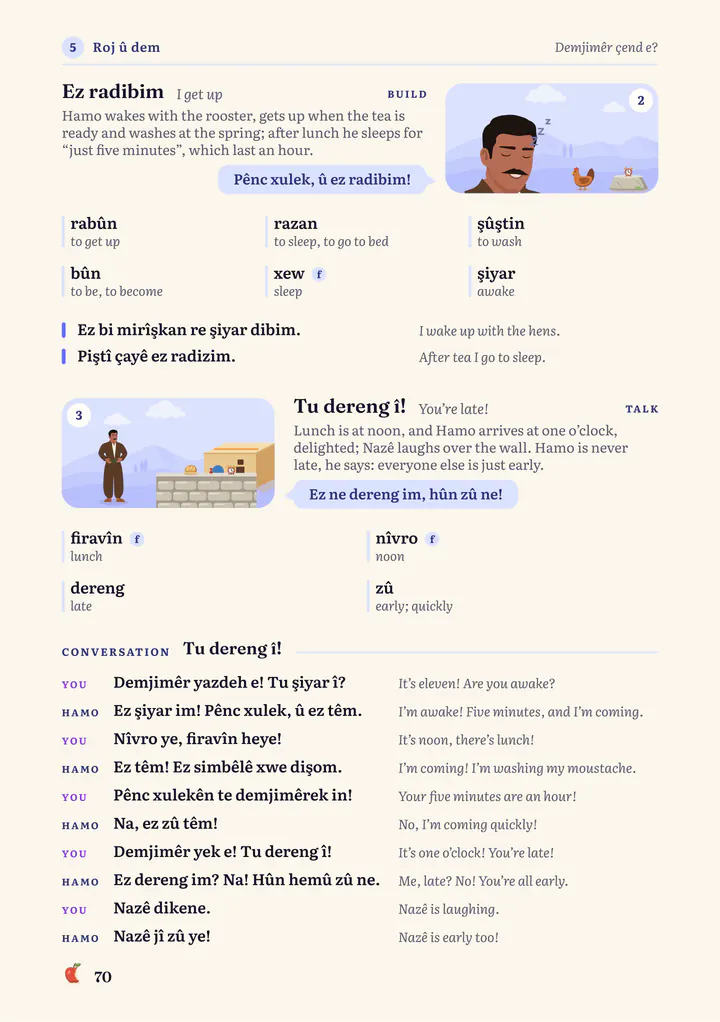
Ez radibim · I get up · Build
Hamo wakes with the rooster, gets up when the tea is ready and washes at the spring; after lunch he sleeps for “just five minutes”, which last an hour.
Pênc xulek, û ez radibim!
rabûn · to get up
razan · to sleep, to go to bed
şûştin · to wash
bûn · to be, to become
xew (f) · sleep
şiyar · awake
Ez bi mirîşkan re şiyar dibim. · I wake up with the hens.
Piştî çayê ez radizim. · After tea I go to sleep.
Tu dereng î! · You’re late! · Talk
Lunch is at noon, and Hamo arrives at one o’clock, delighted; Nazê laughs over the wall. Hamo is never late, he says: everyone else is just early.
Ez ne dereng im, hûn zû ne!
firavîn (f) · lunch
nîvro (f) · noon
dereng · late
zû · early; quickly
Conversation · Tu dereng î!
You: Demjimêr yazdeh e! Tu şiyar î? · It’s eleven! Are you awake?
Hamo: Ez şiyar im! Pênc xulek, û ez têm. · I’m awake! Five minutes, and I’m coming.
You: Nîvro ye, firavîn heye! · It’s noon, there’s lunch!
Hamo: Ez têm! Ez simbêlê xwe dişom. · I’m coming! I’m washing my moustache.
You: Pênc xulekên te demjimêrek in! · Your five minutes are an hour!
Hamo: Na, ez zû têm! · No, I’m coming quickly!
You: Demjimêr yek e! Tu dereng î! · It’s one o’clock! You’re late!
Hamo: Ez dereng im? Na! Hûn hemû zû ne. · Me, late? No! You’re all early.
You: Nazê dikene. · Nazê is laughing.
Hamo: Nazê jî zû ye! · Nazê is early too!
You: Rûne! Firavîn sar e. · Sit down! The lunch is cold.
Hamo: Destê te sax be! Ez ji firavîna sar jî hez dikim.
Thank you! I like a cold lunch too.
Hamo kengî tê firavînê? a Di demjimêr diwanzdehan de. b Di demjimêr yekê de. c Di demjimêr yazdehan de.
Roja Hamo · Hamo’s day · Review
Hamo’s day runs from tea at seven to tea at nine at night, with a short nap that is not short. Then he sets his alarm for the bus: eight o’clock, but which eight?
Heşt, sibehê an êvarê?
Conversation · Heşt, sibehê an êvarê?
You: Roja Şemiyê tu kengî şiyar dibî? · On Saturday, when do you wake up?
Hamo: Zû! Telefona min di demjimêr heştan de min şiyar dike.
Early! My phone wakes me at eight.
You: Heşt? Sibehê an êvarê? · Eight? Morning or evening?
Hamo: Sibehê, xem neke! Ez ne zarok im. · In the morning, don’t worry! I’m not a child.
You: Ez li telefona te dinêrim. · I’m having a look at your phone.
Hamo: Fermo, binêre. Heşt e, ne? · Go on, look. It’s eight, isn’t it?
You: Erê, heşt e… · Yes, it’s eight…
Telefona Hamo kengî wî şiyar dike? a Di demjimêr nehan de. b Di demjimêr diwanzdehan de. c Di demjimêr heştan de.
Hamo has read this page twice. He laughed both times.
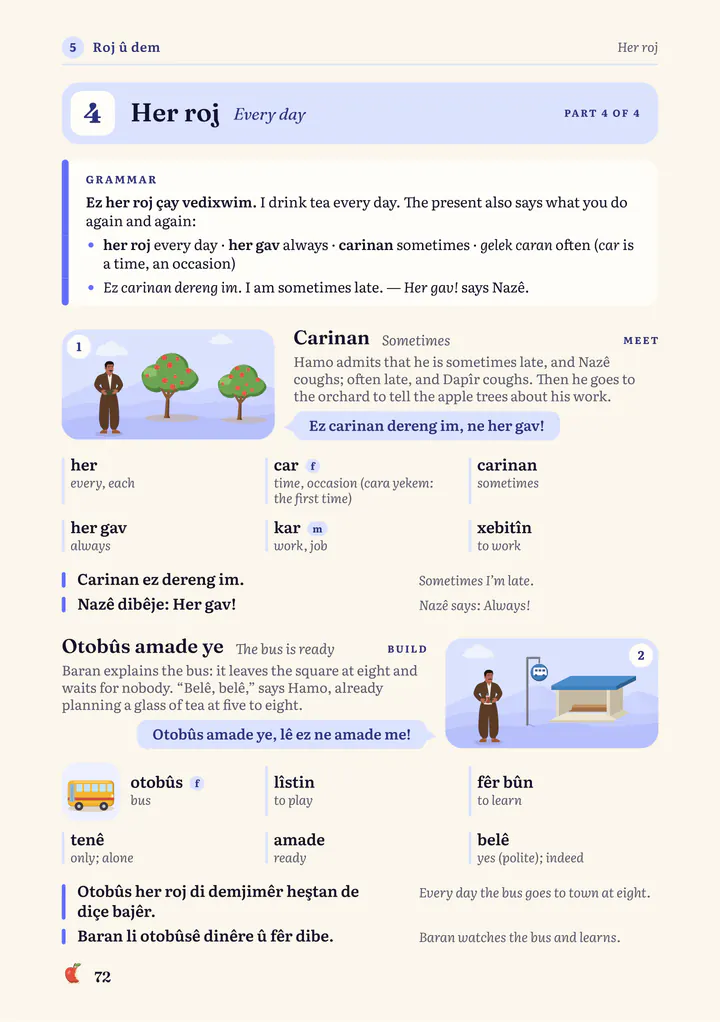
Every day · Part 4 of 4
Grammar
Ez her roj çay vedixwim. I drink tea every day. The present also says what you do again and again:
her roj every day · her gav always · carinan sometimes · gelek caran often (car is a time, an occasion)
Ez carinan dereng im. I am sometimes late. — Her gav! says Nazê.
Carinan · Sometimes · Meet
Hamo admits that he is sometimes late, and Nazê coughs; often late, and Dapîr coughs. Then he goes to the orchard to tell the apple trees about his work.
Ez carinan dereng im, ne her gav!
her · every, each
car (f) · time, occasion (cara yekem: the first time)
carinan · sometimes
her gav · always
kar (m) · work, job
xebitîn · to work
Carinan ez dereng im. · Sometimes I’m late.
Nazê dibêje: Her gav! · Nazê says: Always!
Otobûs amade ye · The bus is ready · Build
Baran explains the bus: it leaves the square at eight and waits for nobody. “Belê, belê,” says Hamo, already planning a glass of tea at five to eight.
Otobûs amade ye, lê ez ne amade me!
otobûs (f) · bus
lîstin · to play
fêr bûn · to learn
tenê · only; alone
amade · ready
belê · yes (polite); indeed
Otobûs her roj di demjimêr heştan de diçe bajêr.
Every day the bus goes to town at eight.
Baran li otobûsê dinêre û fêr dibe. · Baran watches the bus and learns.
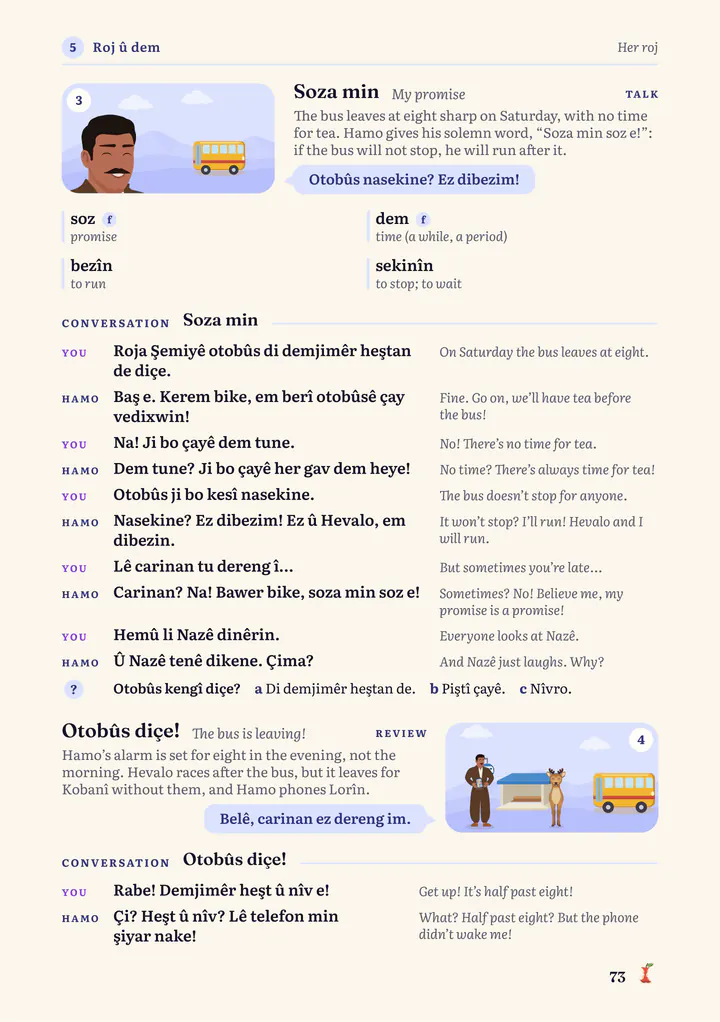
Soza min · My promise · Talk
The bus leaves at eight sharp on Saturday, with no time for tea. Hamo gives his solemn word, “Soza min soz e!”: if the bus will not stop, he will run after it.
Otobûs nasekine? Ez dibezim!
soz (f) · promise
dem (f) · time (a while, a period)
bezîn · to run
sekinîn · to stop; to wait
Conversation · Soza min
You: Roja Şemiyê otobûs di demjimêr heştan de diçe.
On Saturday the bus leaves at eight.
Hamo: Baş e. Kerem bike, em berî otobûsê çay vedixwin!
Fine. Go on, we’ll have tea before the bus!
You: Na! Ji bo çayê dem tune. · No! There’s no time for tea.
Hamo: Dem tune? Ji bo çayê her gav dem heye! · No time? There’s always time for tea!
You: Otobûs ji bo kesî nasekine. · The bus doesn’t stop for anyone.
Hamo: Nasekine? Ez dibezim! Ez û Hevalo, em dibezin.
It won’t stop? I’ll run! Hevalo and I will run.
You: Lê carinan tu dereng î… · But sometimes you’re late…
Hamo: Carinan? Na! Bawer bike, soza min soz e! · Sometimes? No! Believe me, my promise is a promise!
You: Hemû li Nazê dinêrin. · Everyone looks at Nazê.
Hamo: Û Nazê tenê dikene. Çima? · And Nazê just laughs. Why?
Otobûs kengî diçe? a Di demjimêr heştan de. b Piştî çayê. c Nîvro.
Otobûs diçe! · The bus is leaving! · Review
Hamo’s alarm is set for eight in the evening, not the morning. Hevalo races after the bus, but it leaves for Kobanî without them, and Hamo phones Lorîn.
Belê, carinan ez dereng im.
Conversation · Otobûs diçe!
You: Rabe! Demjimêr heşt û nîv e! · Get up! It’s half past eight!
Hamo: Çi? Heşt û nîv? Lê telefon min şiyar nake!
What? Half past eight? But the phone didn’t wake me!
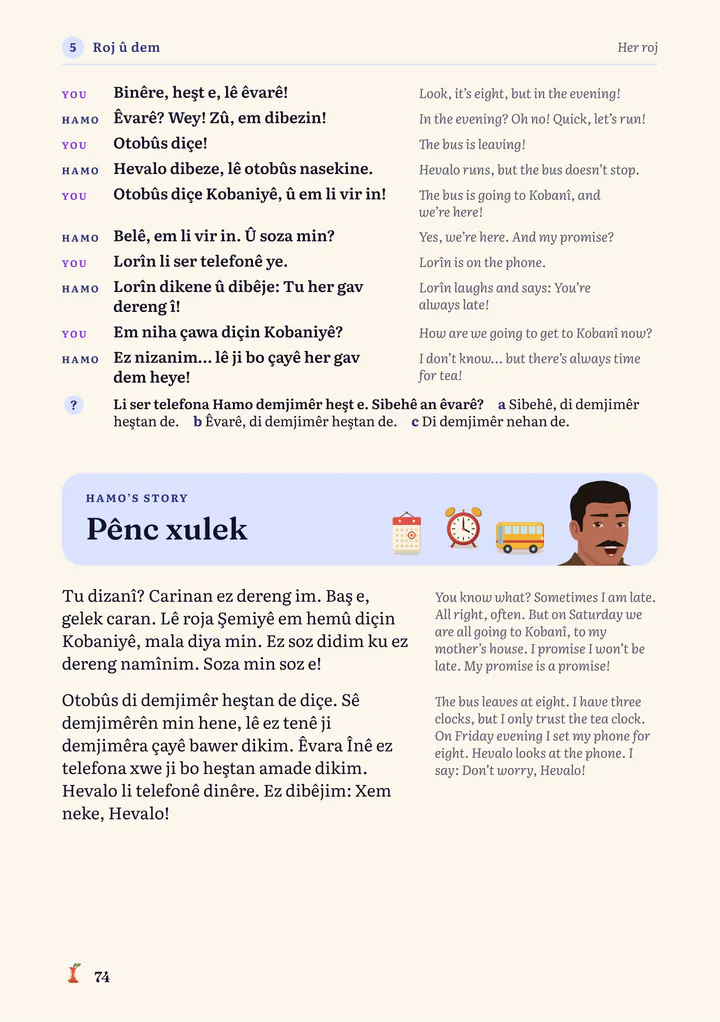
You: Binêre, heşt e, lê êvarê! · Look, it’s eight, but in the evening!
Hamo: Êvarê? Wey! Zû, em dibezin! · In the evening? Oh no! Quick, let’s run!
You: Otobûs diçe! · The bus is leaving!
Hamo: Hevalo dibeze, lê otobûs nasekine. · Hevalo runs, but the bus doesn’t stop.
You: Otobûs diçe Kobaniyê, û em li vir in! · The bus is going to Kobanî, and we’re here!
Hamo: Belê, em li vir in. Û soza min? · Yes, we’re here. And my promise?
You: Lorîn li ser telefonê ye. · Lorîn is on the phone.
Hamo: Lorîn dikene û dibêje: Tu her gav dereng î!
Lorîn laughs and says: You’re always late!
You: Em niha çawa diçin Kobaniyê? · How are we going to get to Kobanî now?
Hamo: Ez nizanim… lê ji bo çayê her gav dem heye!
I don’t know… but there’s always time for tea!
Li ser telefona Hamo demjimêr heşt e. Sibehê an êvarê? a Sibehê, di demjimêr heştan de. b Êvarê, di demjimêr heştan de. c Di demjimêr nehan de.
Hamo’s story
Tu dizanî? Carinan ez dereng im. Baş e, gelek caran. Lê roja Şemiyê em hemû diçin Kobaniyê, mala diya min. Ez soz didim ku ez dereng namînim. Soza min soz e!
You know what? Sometimes I am late. All right, often. But on Saturday we are all going to Kobanî, to my mother’s house. I promise I won’t be late. My promise is a promise!
Otobûs di demjimêr heştan de diçe. Sê demjimêrên min hene, lê ez tenê ji demjimêra çayê bawer dikim. Êvara Înê ez telefona xwe ji bo heştan amade dikim. Hevalo li telefonê dinêre. Ez dibêjim: Xem neke, Hevalo!
The bus leaves at eight. I have three clocks, but I only trust the tea clock. On Friday evening I set my phone for eight. Hevalo looks at the phone. I say: Don’t worry, Hevalo!
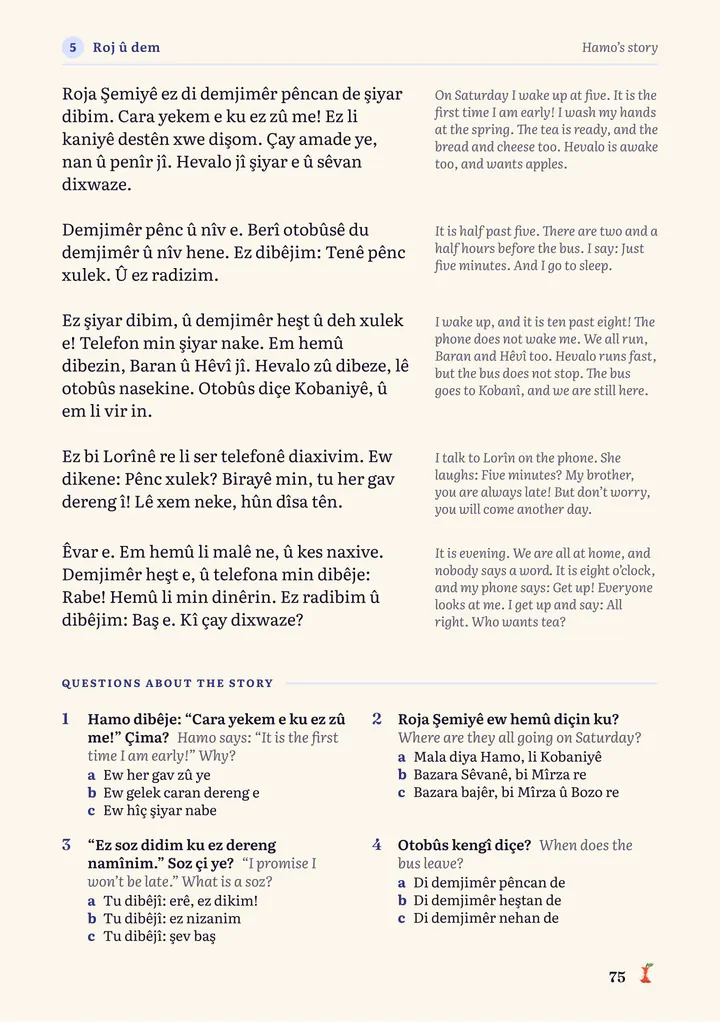
Roja Şemiyê ez di demjimêr pêncan de şiyar dibim. Cara yekem e ku ez zû me! Ez li kaniyê destên xwe dişom. Çay amade ye, nan û penîr jî. Hevalo jî şiyar e û sêvan dixwaze.
On Saturday I wake up at five. It is the first time I am early! I wash my hands at the spring. The tea is ready, and the bread and cheese too. Hevalo is awake too, and wants apples.
Demjimêr pênc û nîv e. Berî otobûsê du demjimêr û nîv hene. Ez dibêjim: Tenê pênc xulek. Û ez radizim.
It is half past five. There are two and a half hours before the bus. I say: Just five minutes. And I go to sleep.
Ez şiyar dibim, û demjimêr heşt û deh xulek e! Telefon min şiyar nake. Em hemû dibezin, Baran û Hêvî jî. Hevalo zû dibeze, lê otobûs nasekine. Otobûs diçe Kobaniyê, û em li vir in.
I wake up, and it is ten past eight! The phone does not wake me. We all run, Baran and Hêvî too. Hevalo runs fast, but the bus does not stop. The bus goes to Kobanî, and we are still here.
Ez bi Lorînê re li ser telefonê diaxivim. Ew dikene: Pênc xulek? Birayê min, tu her gav dereng î! Lê xem neke, hûn dîsa tên.
I talk to Lorîn on the phone. She laughs: Five minutes? My brother, you are always late! But don’t worry, you will come another day.
Êvar e. Em hemû li malê ne, û kes naxive. Demjimêr heşt e, û telefona min dibêje: Rabe! Hemû li min dinêrin. Ez radibim û dibêjim: Baş e. Kî çay dixwaze?
It is evening. We are all at home, and nobody says a word. It is eight o’clock, and my phone says: Get up! Everyone looks at me. I get up and say: All right. Who wants tea?
Questions about the story
1 · Hamo dibêje: “Cara yekem e ku ez zû me!” Çima? Hamo says: “It is the first time I am early!” Why?
a · Ew her gav zû ye
b · Ew gelek caran dereng e
c · Ew hîç şiyar nabe
2 · Roja Şemiyê ew hemû diçin ku? Where are they all going on Saturday?
a · Mala diya Hamo, li Kobaniyê
b · Bazara Sêvanê, bi Mîrza re
c · Bazara bajêr, bi Mîrza û Bozo re
3 · “Ez soz didim ku ez dereng namînim.” Soz çi ye? “I promise I won’t be late.” What is a soz?
a · Tu dibêjî: erê, ez dikim!
b · Tu dibêjî: ez nizanim
c · Tu dibêjî: şev baş
4 · Otobûs kengî diçe? When does the bus leave?
a · Di demjimêr pêncan de
b · Di demjimêr heştan de
c · Di demjimêr nehan de
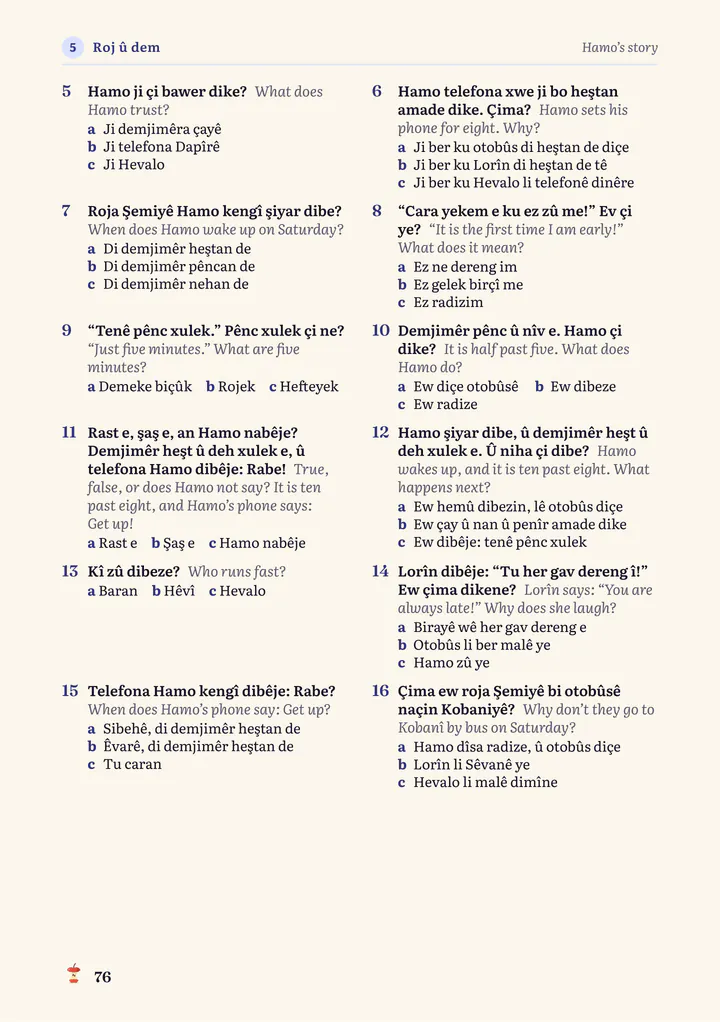
5 · Hamo ji çi bawer dike? What does Hamo trust?
a · Ji demjimêra çayê
b · Ji telefona Dapîrê
c · Ji Hevalo
6 · Hamo telefona xwe ji bo heştan amade dike. Çima? Hamo sets his phone for eight. Why?
a · Ji ber ku otobûs di heştan de diçe
b · Ji ber ku Lorîn di heştan de tê
c · Ji ber ku Hevalo li telefonê dinêre
7 · Roja Şemiyê Hamo kengî şiyar dibe? When does Hamo wake up on Saturday?
a · Di demjimêr heştan de
b · Di demjimêr pêncan de
c · Di demjimêr nehan de
8 · “Cara yekem e ku ez zû me!” Ev çi ye? “It is the first time I am early!” What does it mean?
a · Ez ne dereng im
b · Ez gelek birçî me
c · Ez radizim
9 · “Tenê pênc xulek.” Pênc xulek çi ne? “Just five minutes.” What are five minutes?
a Demeke biçûk b Rojek c Hefteyek
10 · Demjimêr pênc û nîv e. Hamo çi dike? It is half past five. What does Hamo do?
a · Ew diçe otobûsê · b · Ew dibeze
c · Ew radize
11 · Rast e, şaş e, an Hamo nabêje? Demjimêr heşt û deh xulek e, û telefona Hamo dibêje: Rabe! True, false, or does Hamo not say? It is ten past eight, and Hamo’s phone says: Get up!
a Rast e b Şaş e c Hamo nabêje
12 · Hamo şiyar dibe, û demjimêr heşt û deh xulek e. Û niha çi dibe? Hamo wakes up, and it is ten past eight. What happens next?
a · Ew hemû dibezin, lê otobûs diçe
b · Ew çay û nan û penîr amade dike
c · Ew dibêje: tenê pênc xulek
13 · Kî zû dibeze? Who runs fast?
a Baran b Hêvî c Hevalo
14 · Lorîn dibêje: “Tu her gav dereng î!” Ew çima dikene? Lorîn says: “You are always late!” Why does she laugh?
a · Birayê wê her gav dereng e
b · Otobûs li ber malê ye
c · Hamo zû ye
15 · Telefona Hamo kengî dibêje: Rabe? When does Hamo’s phone say: Get up?
a · Sibehê, di demjimêr heştan de
b · Êvarê, di demjimêr heştan de
c · Tu caran
16 · Çima ew roja Şemiyê bi otobûsê naçin Kobaniyê? Why don’t they go to Kobanî by bus on Saturday?
a · Hamo dîsa radize, û otobûs diçe
b · Lorîn li Sêvanê ye
c · Hevalo li malê dimîne
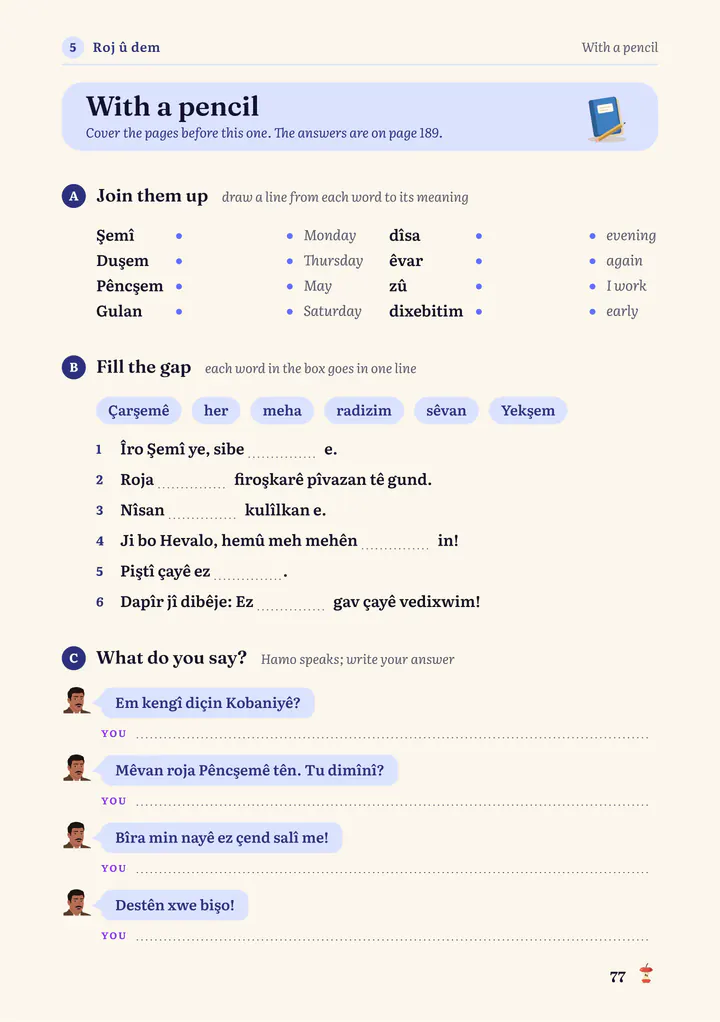
Cover the pages before this one. The answers are on page 189.
A · Join them up · draw a line from each word to its meaning
Şemî · Monday · dîsa · evening
Duşem · Thursday · êvar · again
Pêncşem · May · zû · I work
Gulan · Saturday · dixebitim · early
B · Fill the gap · each word in the box goes in one line
Çarşemê · her · meha · radizim · sêvan · Yekşem
1 · Îro Şemî ye, sibe … e.
2 · Roja … firoşkarê pîvazan tê gund.
3 · Nîsan … kulîlkan e.
4 · Ji bo Hevalo, hemû meh mehên … in!
5 · Piştî çayê ez ….
6 · Dapîr jî dibêje: Ez … gav çayê vedixwim!
C · What do you say? · Hamo speaks; write your answer
Em kengî diçin Kobaniyê?
You
Mêvan roja Pêncşemê tên. Tu dimînî?
You
Bîra min nayê ez çend salî me!
You
Destên xwe bişo!
You
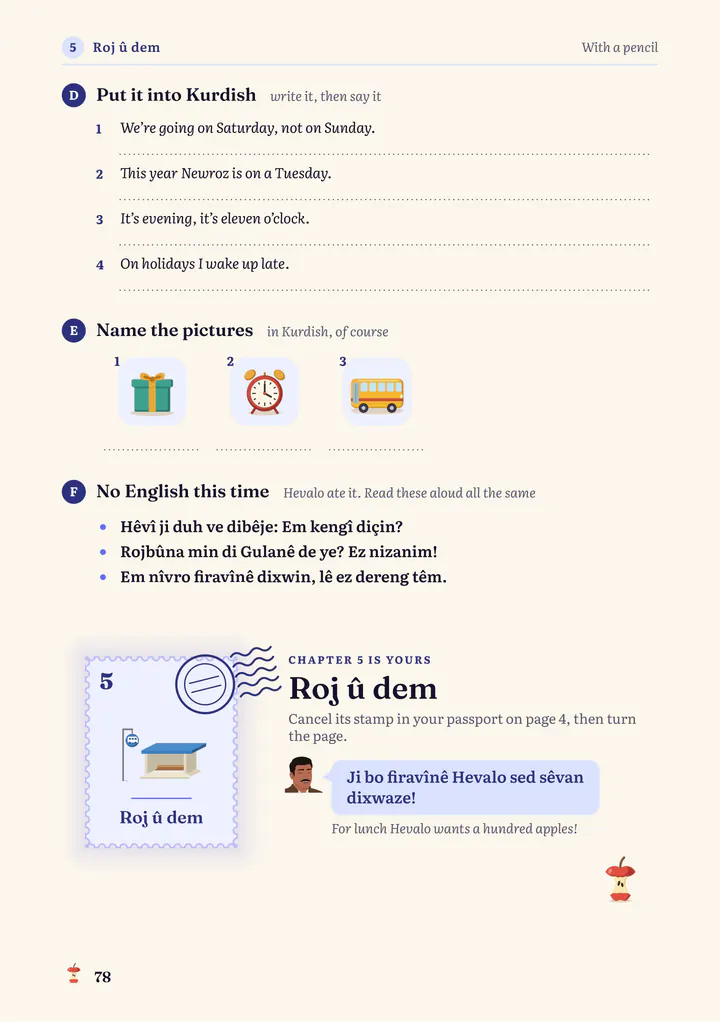
D · Put it into Kurdish · write it, then say it
1 · We’re going on Saturday, not on Sunday.
2 · This year Newroz is on a Tuesday.
3 · It’s evening, it’s eleven o’clock.
4 · On holidays I wake up late.
E · Name the pictures · in Kurdish, of course
F · No English this time · Hevalo ate it. Read these aloud all the same
Hêvî ji duh ve dibêje: Em kengî diçin?
Rojbûna min di Gulanê de ye? Ez nizanim!
Em nîvro firavînê dixwin, lê ez dereng têm.
Roj û dem
Chapter 5 is yours
Cancel its stamp in your passport on page 4, then turn the page.
Ji bo firavînê Hevalo sed sêvan dixwaze!
For lunch Hevalo wants a hundred apples!
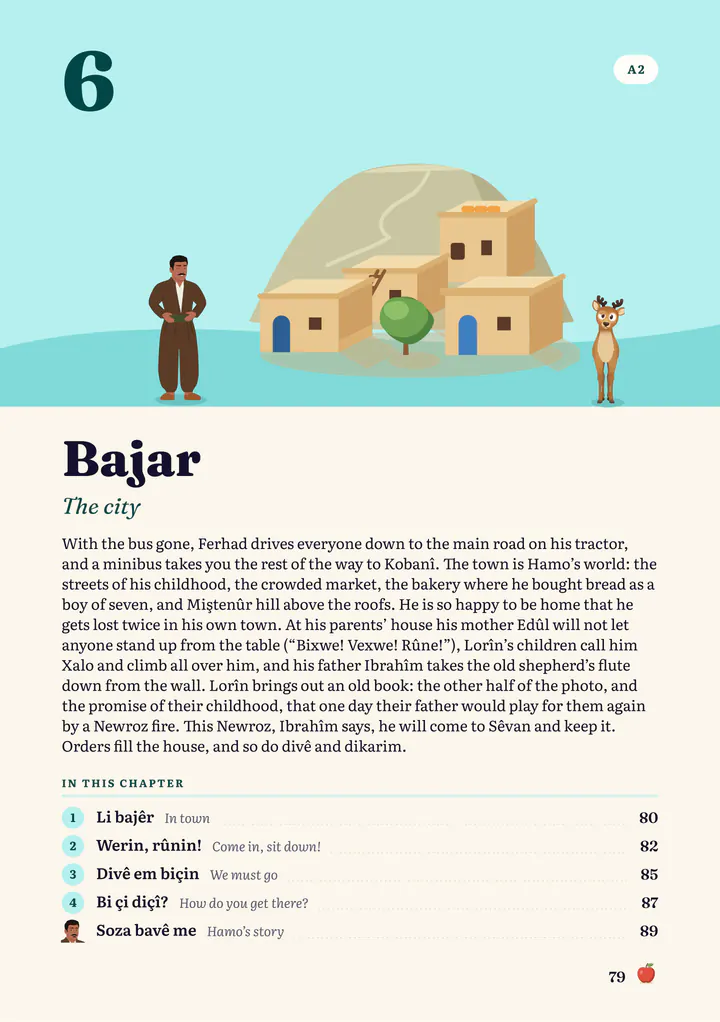
The city
With the bus gone, Ferhad drives everyone down to the main road on his tractor, and a minibus takes you the rest of the way to Kobanî. The town is Hamo’s world: the streets of his childhood, the crowded market, the bakery where he bought bread as a boy of seven, and Miştenûr hill above the roofs. He is so happy to be home that he gets lost twice in his own town. At his parents’ house his mother Edûl will not let anyone stand up from the table (“Bixwe! Vexwe! Rûne!”), Lorîn’s children call him Xalo and climb all over him, and his father Ibrahîm takes the old shepherd’s flute down from the wall. Lorîn brings out an old book: the other half of the photo, and the promise of their childhood, that one day their father would play for them again by a Newroz fire. This Newroz, Ibrahîm says, he will come to Sêvan and keep it. Orders fill the house, and so do divê and dikarim.
In this chapter
1 · Li bajêr · In town · 80
2 · Werin, rûnin! · Come in, sit down! · 82
3 · Divê em biçin · We must go · 85
4 · Bi çi diçî? · How do you get there? · 87
Soza bavê me · Hamo’s story · 89
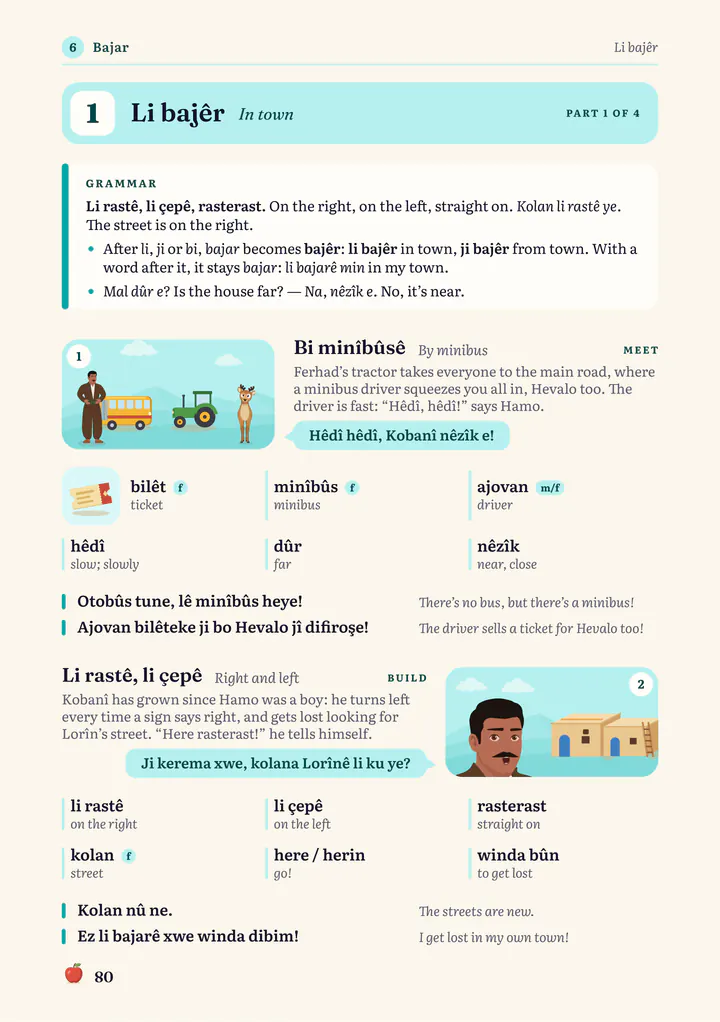
In town · Part 1 of 4
Grammar
Li rastê, li çepê, rasterast. On the right, on the left, straight on. Kolan li rastê ye. The street is on the right.
After li, ji or bi, bajar becomes bajêr: li bajêr in town, ji bajêr from town. With a word after it, it stays bajar: li bajarê min in my town.
Mal dûr e? Is the house far? — Na, nêzîk e. No, it’s near.
Bi minîbûsê · By minibus · Meet
Ferhad’s tractor takes everyone to the main road, where a minibus driver squeezes you all in, Hevalo too. The driver is fast: “Hêdî, hêdî!” says Hamo.
Hêdî hêdî, Kobanî nêzîk e!
bilêt (f) · ticket
minîbûs (f) · minibus
ajovan · m/f · driver
hêdî · slow; slowly
dûr · far
nêzîk · near, close
Otobûs tune, lê minîbûs heye! · There’s no bus, but there’s a minibus!
Ajovan bilêteke ji bo Hevalo jî difiroşe! · The driver sells a ticket for Hevalo too!
Li rastê, li çepê · Right and left · Build
Kobanî has grown since Hamo was a boy: he turns left every time a sign says right, and gets lost looking for Lorîn’s street. “Here rasterast!” he tells himself.
Ji kerema xwe, kolana Lorînê li ku ye?
li rastê · on the right
li çepê · on the left
rasterast · straight on
kolan (f) · street
here / herin · go!
winda bûn · to get lost
Kolan nû ne. · The streets are new.
Ez li bajarê xwe winda dibim! · I get lost in my own town!
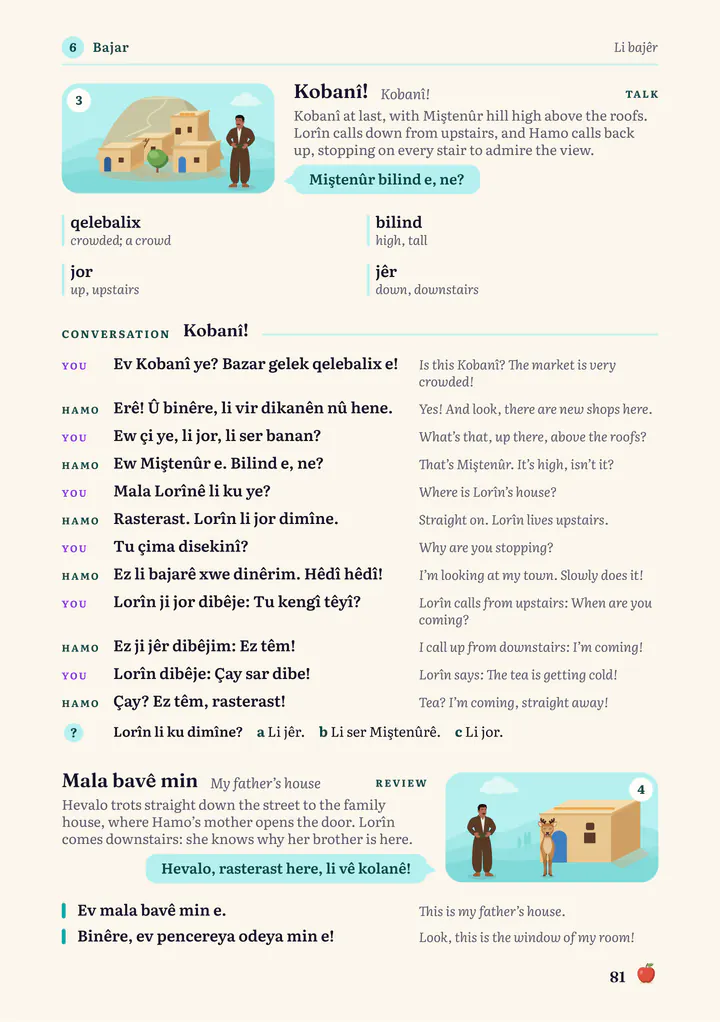
Kobanî! · Kobanî! · Talk
Kobanî at last, with Miştenûr hill high above the roofs. Lorîn calls down from upstairs, and Hamo calls back up, stopping on every stair to admire the view.
Miştenûr bilind e, ne?
qelebalix · crowded; a crowd
bilind · high, tall
jor · up, upstairs
jêr · down, downstairs
Conversation · Kobanî!
You: Ev Kobanî ye? Bazar gelek qelebalix e! · Is this Kobanî? The market is very crowded!
Hamo: Erê! Û binêre, li vir dikanên nû hene. · Yes! And look, there are new shops here.
You: Ew çi ye, li jor, li ser banan? · What’s that, up there, above the roofs?
Hamo: Ew Miştenûr e. Bilind e, ne? · That’s Miştenûr. It’s high, isn’t it?
You: Mala Lorînê li ku ye? · Where is Lorîn’s house?
Hamo: Rasterast. Lorîn li jor dimîne. · Straight on. Lorîn lives upstairs.
You: Tu çima disekinî? · Why are you stopping?
Hamo: Ez li bajarê xwe dinêrim. Hêdî hêdî! · I’m looking at my town. Slowly does it!
You: Lorîn ji jor dibêje: Tu kengî têyî? · Lorîn calls from upstairs: When are you coming?
Hamo: Ez ji jêr dibêjim: Ez têm! · I call up from downstairs: I’m coming!
You: Lorîn dibêje: Çay sar dibe! · Lorîn says: The tea is getting cold!
Hamo: Çay? Ez têm, rasterast! · Tea? I’m coming, straight away!
Lorîn li ku dimîne? a Li jêr. b Li ser Miştenûrê. c Li jor.
Mala bavê min · My father’s house · Review
Hevalo trots straight down the street to the family house, where Hamo’s mother opens the door. Lorîn comes downstairs: she knows why her brother is here.
Hevalo, rasterast here, li vê kolanê!
Ev mala bavê min e. · This is my father’s house.
Binêre, ev pencereya odeya min e! · Look, this is the window of my room!
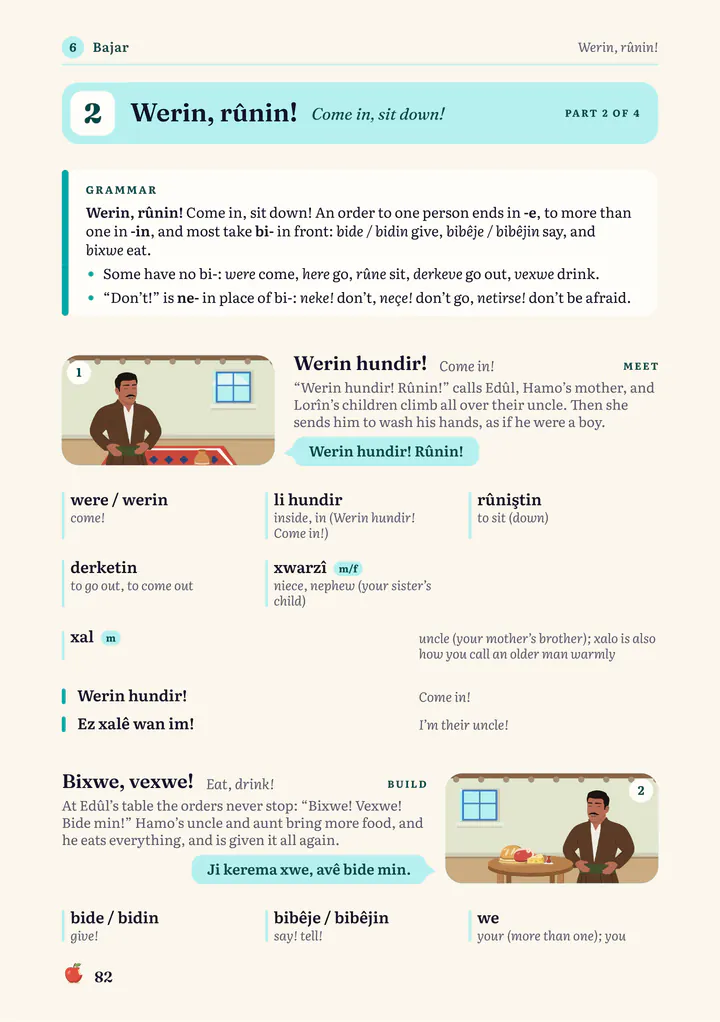
Come in, sit down! · Part 2 of 4
Grammar
Werin, rûnin! Come in, sit down! An order to one person ends in -e, to more than one in -in, and most take bi- in front: bide / bidin give, bibêje / bibêjin say, and bixwe eat.
Some have no bi-: were come, here go, rûne sit, derkeve go out, vexwe drink.
“Don’t!” is ne- in place of bi-: neke! don’t, neçe! don’t go, netirse! don’t be afraid.
Werin hundir! · Come in! · Meet
“Werin hundir! Rûnin!” calls Edûl, Hamo’s mother, and Lorîn’s children climb all over their uncle. Then she sends him to wash his hands, as if he were a boy.
Werin hundir! Rûnin!
were / werin · come!
li hundir · inside, in (Werin hundir! Come in!)
rûniştin · to sit (down)
derketin · to go out, to come out
xwarzî · m/f · niece, nephew (your sister’s child)
xal (m) · uncle (your mother’s brother); xalo is also how you call an older man warmly
Werin hundir! · Come in!
Ez xalê wan im! · I’m their uncle!
Bixwe, vexwe! · Eat, drink! · Build
At Edûl’s table the orders never stop: “Bixwe! Vexwe! Bide min!” Hamo’s uncle and aunt bring more food, and he eats everything, and is given it all again.
Ji kerema xwe, avê bide min.
bide / bidin · give!
bibêje / bibêjin · say! tell!
we · your (more than one); you
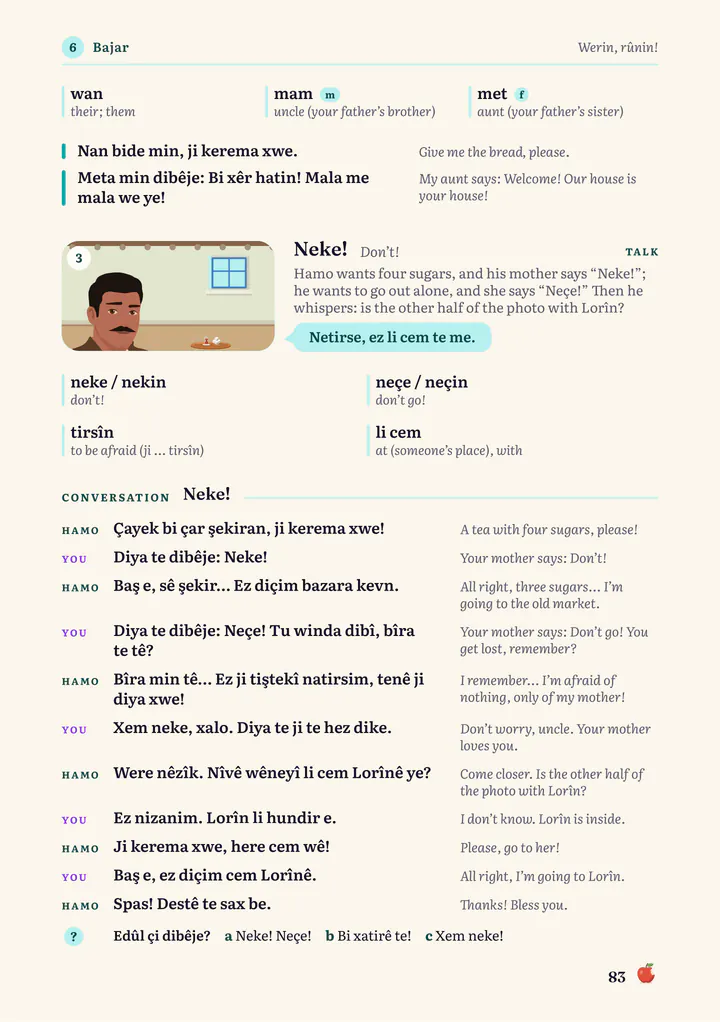
wan · their; them
mam (m) · uncle (your father’s brother)
met (f) · aunt (your father’s sister)
Nan bide min, ji kerema xwe. · Give me the bread, please.
Meta min dibêje: Bi xêr hatin! Mala me mala we ye!
My aunt says: Welcome! Our house is your house!
Neke! · Don’t! · Talk
Hamo wants four sugars, and his mother says “Neke!”; he wants to go out alone, and she says “Neçe!” Then he whispers: is the other half of the photo with Lorîn?
Netirse, ez li cem te me.
neke / nekin · don’t!
neçe / neçin · don’t go!
tirsîn · to be afraid (ji … tirsîn)
li cem · at (someone’s place), with
Conversation · Neke!
Hamo: Çayek bi çar şekiran, ji kerema xwe! · A tea with four sugars, please!
You: Diya te dibêje: Neke! · Your mother says: Don’t!
Hamo: Baş e, sê şekir… Ez diçim bazara kevn. · All right, three sugars… I’m going to the old market.
You: Diya te dibêje: Neçe! Tu winda dibî, bîra te tê?
Your mother says: Don’t go! You get lost, remember?
Hamo: Bîra min tê… Ez ji tiştekî natirsim, tenê ji diya xwe!
I remember… I’m afraid of nothing, only of my mother!
You: Xem neke, xalo. Diya te ji te hez dike. · Don’t worry, uncle. Your mother loves you.
Hamo: Were nêzîk. Nîvê wêneyî li cem Lorînê ye? · Come closer. Is the other half of the photo with Lorîn?
You: Ez nizanim. Lorîn li hundir e. · I don’t know. Lorîn is inside.
Hamo: Ji kerema xwe, here cem wê! · Please, go to her!
You: Baş e, ez diçim cem Lorînê. · All right, I’m going to Lorîn.
Hamo: Spas! Destê te sax be. · Thanks! Bless you.
Edûl çi dibêje? a Neke! Neçe! b Bi xatirê te! c Xem neke!
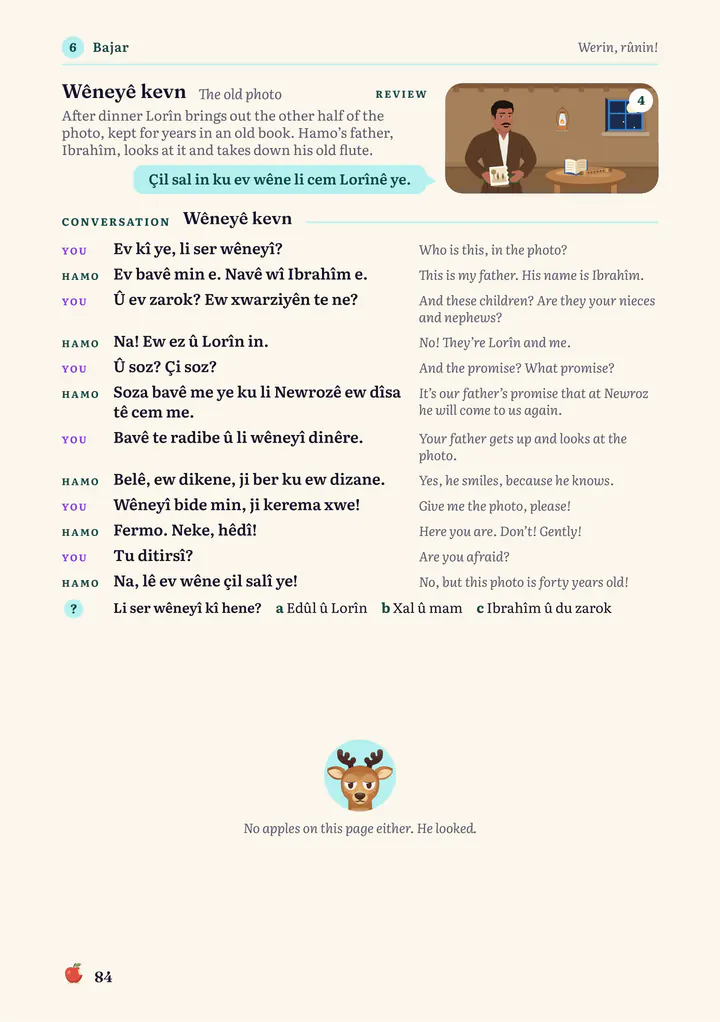
Wêneyê kevn · The old photo · Review
After dinner Lorîn brings out the other half of the photo, kept for years in an old book. Hamo’s father, Ibrahîm, looks at it and takes down his old flute.
Çil sal in ku ev wêne li cem Lorînê ye.
Conversation · Wêneyê kevn
You: Ev kî ye, li ser wêneyî? · Who is this, in the photo?
Hamo: Ev bavê min e. Navê wî Ibrahîm e. · This is my father. His name is Ibrahîm.
You: Û ev zarok? Ew xwarziyên te ne? · And these children? Are they your nieces and nephews?
Hamo: Na! Ew ez û Lorîn in. · No! They’re Lorîn and me.
You: Û soz? Çi soz? · And the promise? What promise?
Hamo: Soza bavê me ye ku li Newrozê ew dîsa tê cem me.
It’s our father’s promise that at Newroz he will come to us again.
You: Bavê te radibe û li wêneyî dinêre. · Your father gets up and looks at the photo.
Hamo: Belê, ew dikene, ji ber ku ew dizane. · Yes, he smiles, because he knows.
You: Wêneyî bide min, ji kerema xwe! · Give me the photo, please!
Hamo: Fermo. Neke, hêdî! · Here you are. Don’t! Gently!
You: Tu ditirsî? · Are you afraid?
Hamo: Na, lê ev wêne çil salî ye! · No, but this photo is forty years old!
Li ser wêneyî kî hene? a Edûl û Lorîn b Xal û mam c Ibrahîm û du zarok
No apples on this page either. He looked.
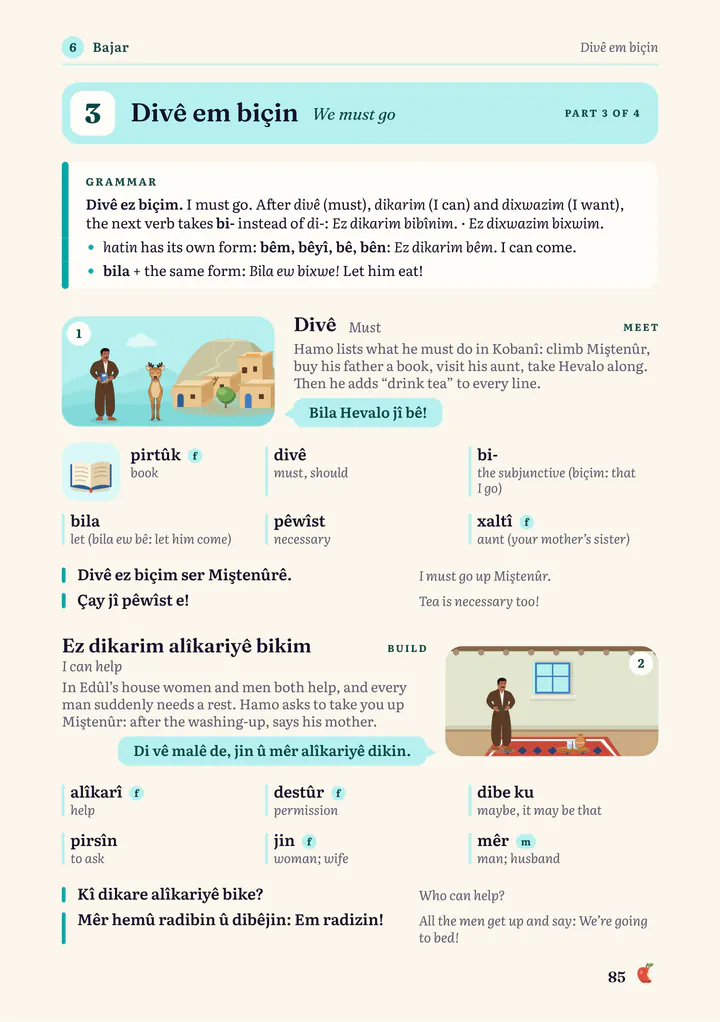
We must go · Part 3 of 4
Grammar
Divê ez biçim. I must go. After divê (must), dikarim (I can) and dixwazim (I want), the next verb takes bi- instead of di-: Ez dikarim bibînim. · Ez dixwazim bixwim.
hatin has its own form: bêm, bêyî, bê, bên: Ez dikarim bêm. I can come.
bila + the same form: Bila ew bixwe! Let him eat!
Divê · Must · Meet
Hamo lists what he must do in Kobanî: climb Miştenûr, buy his father a book, visit his aunt, take Hevalo along. Then he adds “drink tea” to every line.
Bila Hevalo jî bê!
pirtûk (f) · book
divê · must, should
bi- · the subjunctive (biçim: that I go)
bila · let (bila ew bê: let him come)
pêwîst · necessary
xaltî (f) · aunt (your mother’s sister)
Divê ez biçim ser Miştenûrê. · I must go up Miştenûr.
Çay jî pêwîst e! · Tea is necessary too!
Ez dikarim alîkariyê bikim
I can help
Build
In Edûl’s house women and men both help, and every man suddenly needs a rest. Hamo asks to take you up Miştenûr: after the washing-up, says his mother.
Di vê malê de, jin û mêr alîkariyê dikin.
alîkarî (f) · help
destûr (f) · permission
dibe ku · maybe, it may be that
pirsîn · to ask
jin (f) · woman; wife
mêr (m) · man; husband
Kî dikare alîkariyê bike? · Who can help?
Mêr hemû radibin û dibêjin: Em radizin! · All the men get up and say: We’re going to bed!
Derî veke! · Open the door! · Talk
The bookseller is closing, but he opens the door for Ibrahîm’s boy, and laughs at Hamo’s order, a book of proverbs for his father: they came from Ibrahîm.
Ji kerema xwe, derî veke!
çîrok (f) · story, tale
gotina pêşiyan · proverb
vekirin · to open
girtin · to take, to hold; to close
Conversation · Derî veke!
You: Dereng e. Firoşkar derî digire. · It’s late. The bookseller is closing the door.
Hamo: Dereng? Na! Pênc xulek, ji kerema xwe, derî veke!
Late? No! Five minutes, please, open the door!
You: Firoşkar derî vedike û dibêje: Kurê Ibrahîm?
The bookseller opens the door and says: Ibrahîm’s boy?
Hamo: Erê, ez im! Hemû çîrokên min ji vê dikanê ne!
Yes, it’s me! All my stories come from this shop!
You: Tu îro çi dixwazî? · What would you like today?
Hamo: Pirtûkeke gotinên pêşiyan, ji bo bavê min. · A book of proverbs, for my father.
You: Firoşkar dikene. Çima? · The bookseller laughs. Why?
Hamo: Ew dibêje: Gotinên vê pirtûkê ji bavê te ne! · He says: The sayings in this book come from your father!
You: Bavê te hemû gotinên pêşiyan dizane? · Does your father know all the proverbs?
Hamo: Belê! Bavê min bi xwe pirtûkek e! · Yes! My father is a book himself!
You: Îcar pirtûk ne pêwîst e! · So the book isn’t necessary!
Hamo: Pêwîst e! Bila ew bixwîne û bikene. · It is! Let him read it and laugh.
Gotinên pirtûkê ji ku ne? a Ji firoşkar. b Ji bavê Hamo. c Ji Lorînê.
Pirtûka bavê min · My father’s book · Review
Hamo gives his father the book of proverbs, and Ibrahîm laughs: half of them are his. It is late, says Edûl; one more, says Ibrahîm, and reads ten.
Gotina mêran yek e!
Ez pirtûkê vedikim û didim bavê xwe. · I open the book and give it to my father.
Xaltiya min di pirtûkê de digere û dipirse: Ev ji ku ye?
My aunt looks through the book and asks: Where is this from?
How do you get there? · Part 4 of 4
Grammar
Bi trênê diçim. I go by train. Bi + a feminine noun with -ê says how you travel: bi minîbûsê, bi taksiyê, and on foot is bi peyatî.
Kîjan? Which? Kîjan kolan? · Çiqas? How much, how far? Çiqas dûr e?
ya / yê + owner: Ev ya min e. This is mine. · Ya kê ye? Whose is it?
Bi trênê · By train · Meet
The old baker remembers Hamo as the boy who ate the crusts on the way home. The children argue about train, plane or taxi, and Hevalo votes for on foot.
Çavên Hevalo dibêjin: Bi peyatî herin!
trên (f) · train
balafir (f) · aeroplane
taksî (f) · taxi
bi peyatî · on foot
firne (f) · bakery
nanpêj · m/f · baker
Firne li pişt dibistanê ye. · The bakery is behind the school.
Na, bi balafirê! · No, by plane!
Ya kê ye? · Whose is it? · Build
Packing: a heap of shoes, bags and parcels. Hamo sorts it all out: this bag is his, that one is yours, and nothing belongs to Hevalo except the apples.
Çiqas tişt! Kîjan ya min e?
çiqas · how much, how far
kîjan · which
nas kirin · to know (a person), to recognise
telefon kirin · to phone (telefonî … kirin)
yê / ya / yên · the one of (ya min: mine)
kê · whose; whom (kî after a preposition or the ezafe)
Ev pirtûka çîrokan ya kê ye? · Whose storybook is this?
Mêrek li kolanê min nas dike. · A man in the street recognises me.
Rê girtî ye? · Is the road closed? · Talk
On the last evening Ibrahîm promises to come for Newroz, but snow is coming and the road may close, so Hamo sets three alarms and asks you to check them.
Em hinek nan û penîr digirin û vedigerin.
vegerîn · to go back, to return
nûçe (f) · news
girtî · closed
vekirî · open
Conversation · Rê girtî ye?
You: Nûçe çi dibêjin? · What does the news say?
Hamo: Nûçe dibêjin ku sibe rêya çiyê girtî dibe. · The news says the mountain road will close tomorrow.
You: Îcar em çawa vedigerin? · So how do we get back?
Hamo: Divê em zû vegerin, berî ku rê girtî be. · We must go back early, before the road is closed.
You: Bi trênê, an bi taksiyê? · By train, or by taxi?
Hamo: Bi minîbûsê. Trên tune, û taksî biha ye. · By minibus. There’s no train, and a taxi is expensive.
You: Em kengî diçin? · When do we leave?
Hamo: Di demjimêr şeşan de. Ji bo xewê dem tune! · At six o’clock. There’s no time for sleep!
You: Tu dikarî zû şiyar bibî? · Can you wake up early?
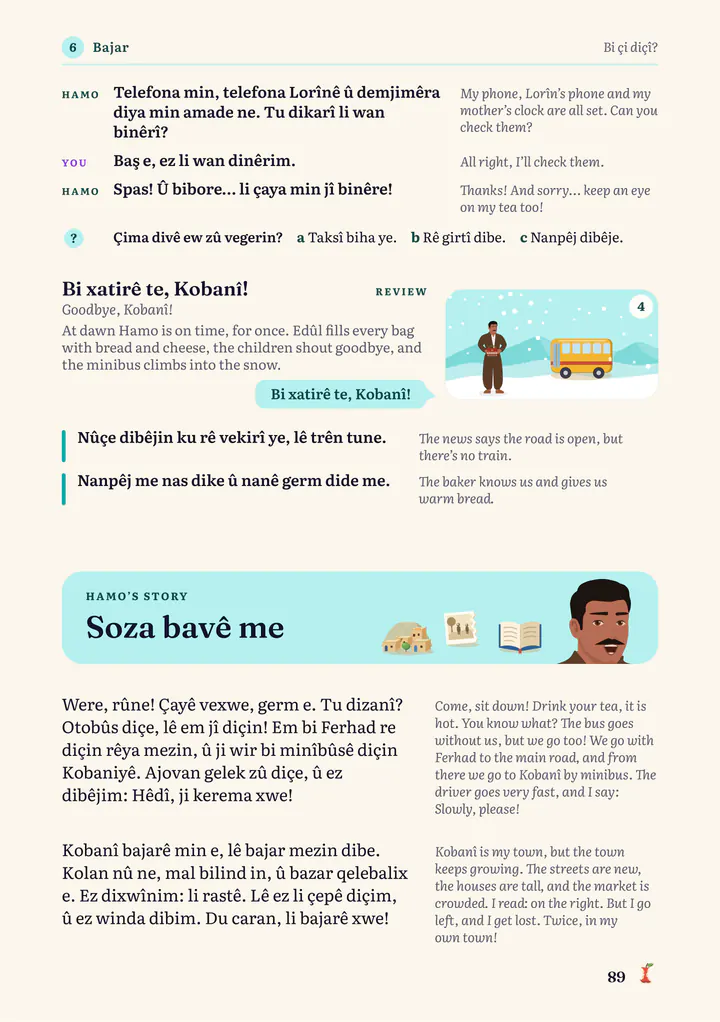
Hamo: Telefona min, telefona Lorînê û demjimêra diya min amade ne. Tu dikarî li wan binêrî?
My phone, Lorîn’s phone and my mother’s clock are all set. Can you check them?
You: Baş e, ez li wan dinêrim. · All right, I’ll check them.
Hamo: Spas! Û bibore… li çaya min jî binêre! · Thanks! And sorry… keep an eye on my tea too!
Çima divê ew zû vegerin? a Taksî biha ye. b Rê girtî dibe. c Nanpêj dibêje.
Bi xatirê te, Kobanî!
Goodbye, Kobanî!
Review
At dawn Hamo is on time, for once. Edûl fills every bag with bread and cheese, the children shout goodbye, and the minibus climbs into the snow.
Bi xatirê te, Kobanî!
Nûçe dibêjin ku rê vekirî ye, lê trên tune. · The news says the road is open, but there’s no train.
Nanpêj me nas dike û nanê germ dide me. · The baker knows us and gives us warm bread.
Hamo’s story
Were, rûne! Çayê vexwe, germ e. Tu dizanî? Otobûs diçe, lê em jî diçin! Em bi Ferhad re diçin rêya mezin, û ji wir bi minîbûsê diçin Kobaniyê. Ajovan gelek zû diçe, û ez dibêjim: Hêdî, ji kerema xwe!
Come, sit down! Drink your tea, it is hot. You know what? The bus goes without us, but we go too! We go with Ferhad to the main road, and from there we go to Kobanî by minibus. The driver goes very fast, and I say: Slowly, please!
Kobanî bajarê min e, lê bajar mezin dibe. Kolan nû ne, mal bilind in, û bazar qelebalix e. Ez dixwînim: li rastê. Lê ez li çepê diçim, û ez winda dibim. Du caran, li bajarê xwe!
Kobanî is my town, but the town keeps growing. The streets are new, the houses are tall, and the market is crowded. I read: on the right. But I go left, and I get lost. Twice, in my own town!
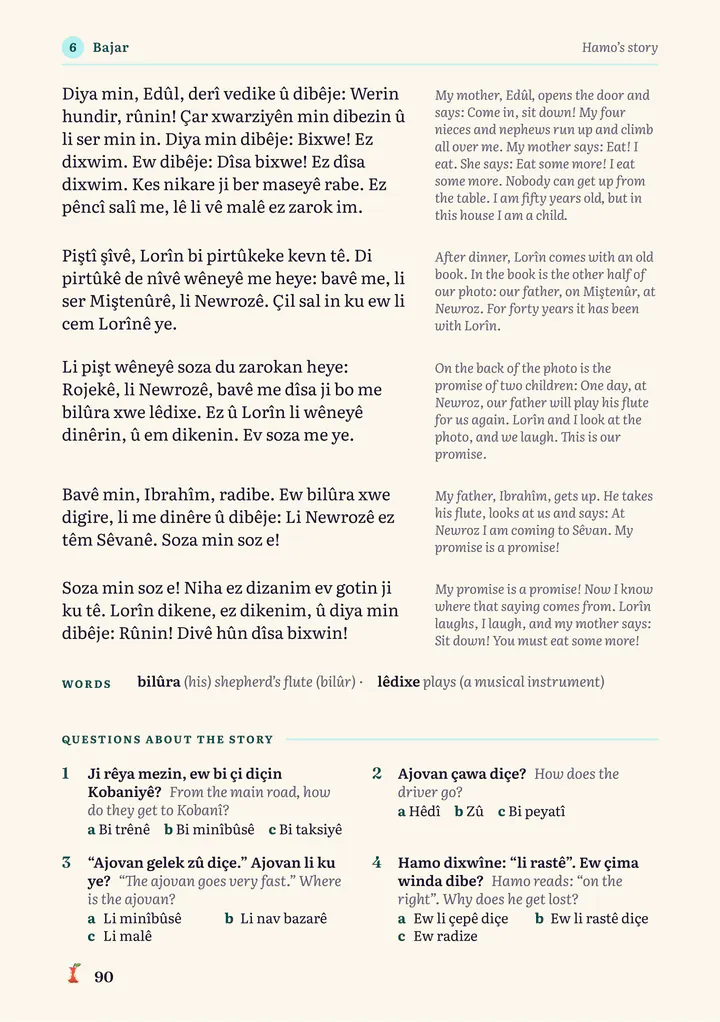
Diya min, Edûl, derî vedike û dibêje: Werin hundir, rûnin! Çar xwarziyên min dibezin û li ser min in. Diya min dibêje: Bixwe! Ez dixwim. Ew dibêje: Dîsa bixwe! Ez dîsa dixwim. Kes nikare ji ber maseyê rabe. Ez pêncî salî me, lê li vê malê ez zarok im.
My mother, Edûl, opens the door and says: Come in, sit down! My four nieces and nephews run up and climb all over me. My mother says: Eat! I eat. She says: Eat some more! I eat some more. Nobody can get up from the table. I am fifty years old, but in this house I am a child.
Piştî şîvê, Lorîn bi pirtûkeke kevn tê. Di pirtûkê de nîvê wêneyê me heye: bavê me, li ser Miştenûrê, li Newrozê. Çil sal in ku ew li cem Lorînê ye.
After dinner, Lorîn comes with an old book. In the book is the other half of our photo: our father, on Miştenûr, at Newroz. For forty years it has been with Lorîn.
Li pişt wêneyê soza du zarokan heye: Rojekê, li Newrozê, bavê me dîsa ji bo me bilûra xwe lêdixe. Ez û Lorîn li wêneyê dinêrin, û em dikenin. Ev soza me ye.
On the back of the photo is the promise of two children: One day, at Newroz, our father will play his flute for us again. Lorîn and I look at the photo, and we laugh. This is our promise.
Bavê min, Ibrahîm, radibe. Ew bilûra xwe digire, li me dinêre û dibêje: Li Newrozê ez têm Sêvanê. Soza min soz e!
My father, Ibrahîm, gets up. He takes his flute, looks at us and says: At Newroz I am coming to Sêvan. My promise is a promise!
Soza min soz e! Niha ez dizanim ev gotin ji ku tê. Lorîn dikene, ez dikenim, û diya min dibêje: Rûnin! Divê hûn dîsa bixwin!
My promise is a promise! Now I know where that saying comes from. Lorîn laughs, I laugh, and my mother says: Sit down! You must eat some more!
Words · bilûra (his) shepherd’s flute (bilûr) · lêdixe plays (a musical instrument)
Questions about the story
1 · Ji rêya mezin, ew bi çi diçin Kobaniyê? From the main road, how do they get to Kobanî?
a Bi trênê b Bi minîbûsê c Bi taksiyê
2 · Ajovan çawa diçe? How does the driver go?
a Hêdî b Zû c Bi peyatî
3 · “Ajovan gelek zû diçe.” Ajovan li ku ye? “The ajovan goes very fast.” Where is the ajovan?
a · Li minîbûsê · b · Li nav bazarê
c · Li malê
4 · Hamo dixwîne: “li rastê”. Ew çima winda dibe? Hamo reads: “on the right”. Why does he get lost?
a · Ew li çepê diçe · b · Ew li rastê diçe
c · Ew radize
5 · Hamo li Kobaniyê çend caran winda dibe? How many times does Hamo get lost in Kobanî?
a Carekê b Du caran c Sê caran
6 · Kî derî vedike? Who opens the door?
a · Lorîn
b · Edûl, diya Hamo
c · Ibrahîm
7 · “Kes nikare ji ber maseyê rabe.” Ev çi ye? “Nobody can get up from the table.” What does it mean?
a · Hemû li ber maseyê dimînin
b · Hemû diçin bazarê
c · Kes naxwe
8 · Hamo dibêje: “Li vê malê ez zarok im.” Çima? Hamo says: “In this house I am a child.” Why?
a · Ew pêncî salî ye
b · Diya wî dibêje ew çi bike
c · Ew biçûk e
9 · Lorîn kengî bi pirtûka kevn tê? When does Lorîn come with the old book?
a Berî şîvê b Piştî şîvê c Sibehê
10 · Di pirtûkê de çi heye? What is in the book?
a · Nîvê wêneyê wan
b · Bilêteke kevn
c · Nanê germ
11 · Li ser wêneyê kî heye? Who is in the photo?
a · Bavê Hamo · b · Ferhad
c · Baran û Hêvî
12 · Ibrahîm çi digire? What does Ibrahîm take?
a · Wêneyekî · b · Bilûra xwe
c · Pirtûkeke kevn
13 · Hamo dibêje: “Niha ez dizanim ev gotin ji ku tê.” Gotin ji ku tê? Hamo says: “Now I know where that saying comes from.” Where does it come from?
a Ji bavê wî b Ji Lorînê c Ji pirtûkê
14 · Li Kobaniyê, çi tê bîra Hamo? In Kobanî, what does Hamo remember?
a · Soza bavê wî ya kevn
b · Rojbûna xwe
c · Demjimêra otobûsê
This way. There may be apples.
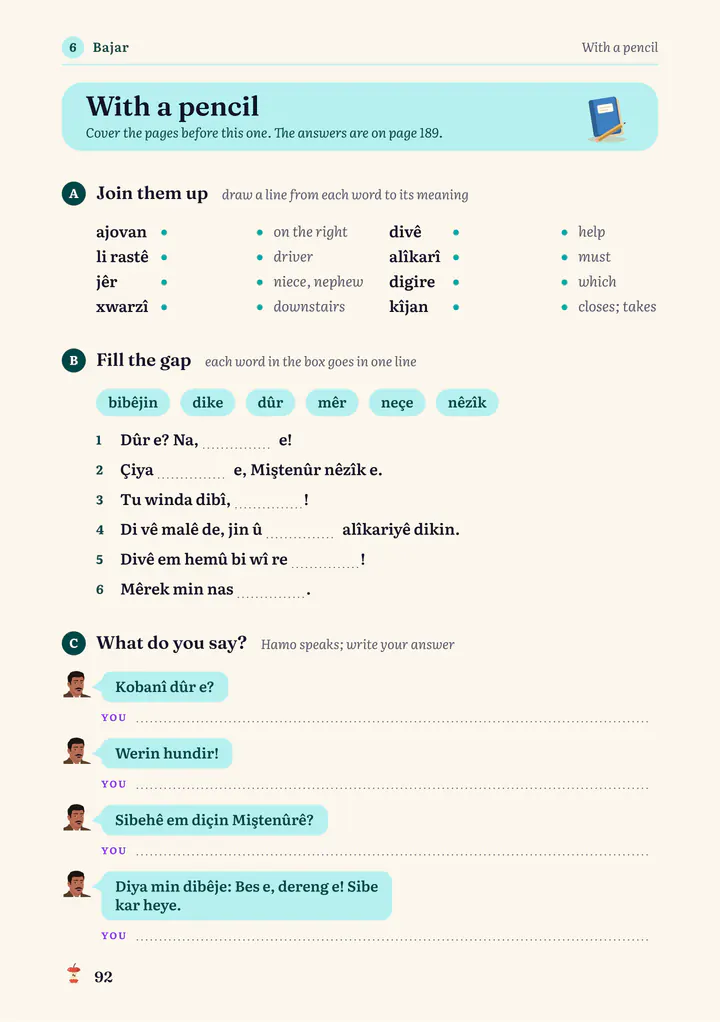
Cover the pages before this one. The answers are on page 189.
A · Join them up · draw a line from each word to its meaning
ajovan · on the right · divê · help
li rastê · driver · alîkarî · must
jêr · niece, nephew · digire · which
xwarzî · downstairs · kîjan · closes; takes
B · Fill the gap · each word in the box goes in one line
bibêjin · dike · dûr · mêr · neçe · nêzîk
1 · Dûr e? Na, … e!
2 · Çiya … e, Miştenûr nêzîk e.
3 · Tu winda dibî, …!
4 · Di vê malê de, jin û … alîkariyê dikin.
5 · Divê em hemû bi wî re …!
6 · Mêrek min nas ….
C · What do you say? · Hamo speaks; write your answer
Kobanî dûr e?
You
Werin hundir!
You
Sibehê em diçin Miştenûrê?
You
Diya min dibêje: Bes e, dereng e! Sibe kar heye.
You
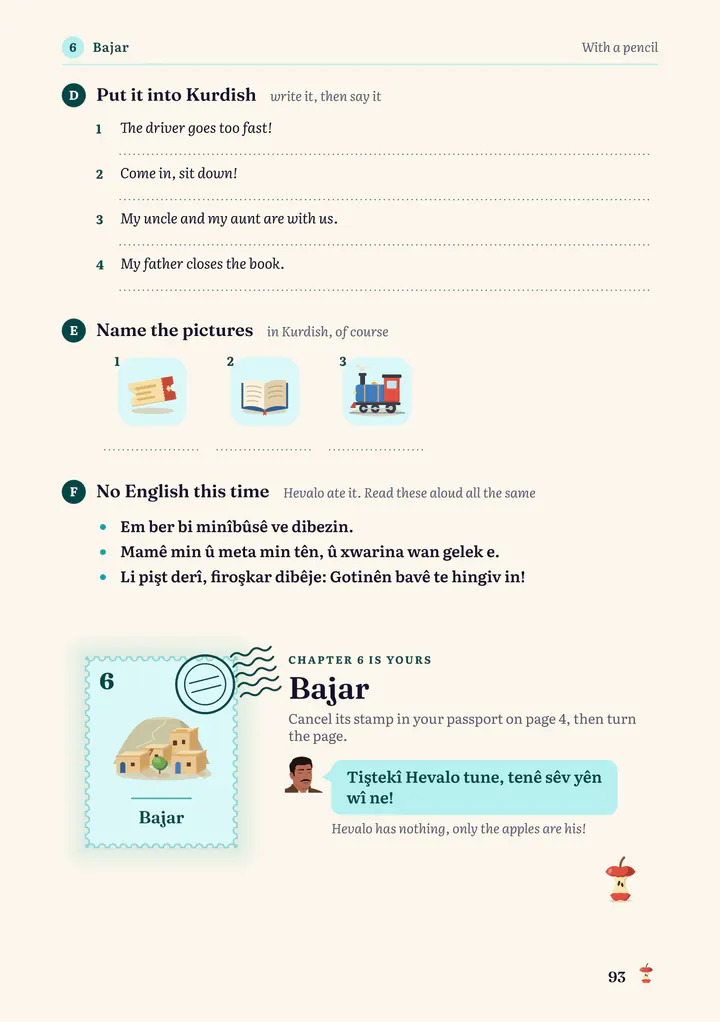
D · Put it into Kurdish · write it, then say it
1 · The driver goes too fast!
2 · Come in, sit down!
3 · My uncle and my aunt are with us.
4 · My father closes the book.
E · Name the pictures · in Kurdish, of course
F · No English this time · Hevalo ate it. Read these aloud all the same
Em ber bi minîbûsê ve dibezin.
Mamê min û meta min tên, û xwarina wan gelek e.
Li pişt derî, firoşkar dibêje: Gotinên bavê te hingiv in!
Bajar
Chapter 6 is yours
Cancel its stamp in your passport on page 4, then turn the page.
Tiştekî Hevalo tune, tenê sêv yên wî ne!
Hevalo has nothing, only the apples are his!
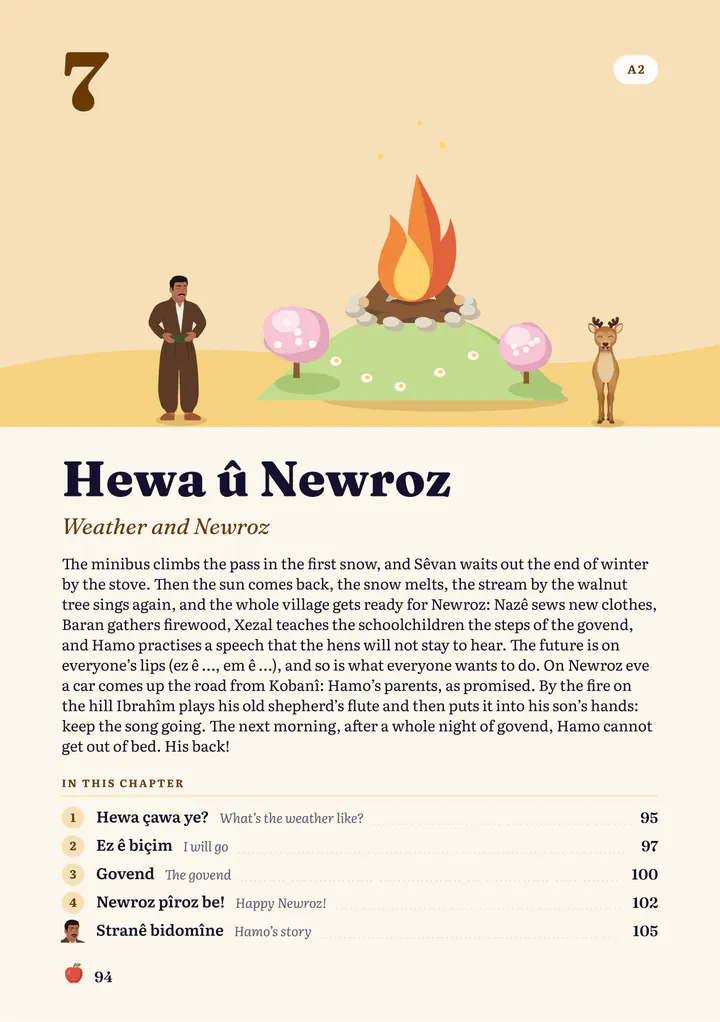
Weather and Newroz
The minibus climbs the pass in the first snow, and Sêvan waits out the end of winter by the stove. Then the sun comes back, the snow melts, the stream by the walnut tree sings again, and the whole village gets ready for Newroz: Nazê sews new clothes, Baran gathers firewood, Xezal teaches the schoolchildren the steps of the govend, and Hamo practises a speech that the hens will not stay to hear. The future is on everyone’s lips (ez ê …, em ê …), and so is what everyone wants to do. On Newroz eve a car comes up the road from Kobanî: Hamo’s parents, as promised. By the fire on the hill Ibrahîm plays his old shepherd’s flute and then puts it into his son’s hands: keep the song going. The next morning, after a whole night of govend, Hamo cannot get out of bed. His back!
In this chapter
1 · Hewa çawa ye? · What’s the weather like? · 95
2 · Ez ê biçim · I will go · 97
3 · Govend · The govend · 100
4 · Newroz pîroz be! · Happy Newroz! · 102
Stranê bidomîne · Hamo’s story · 105
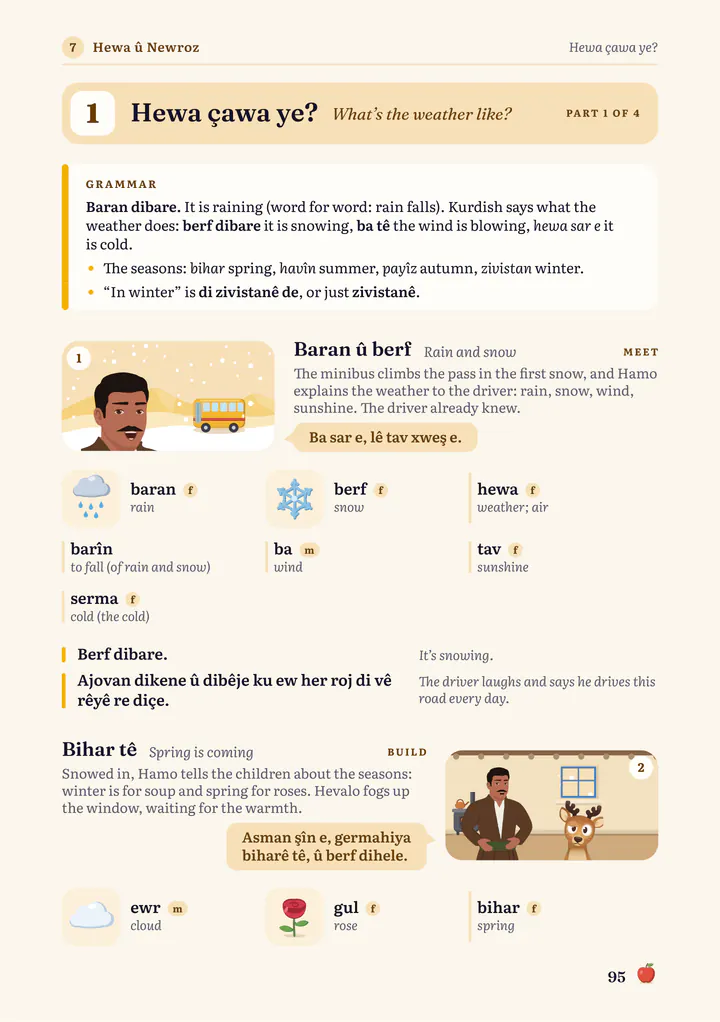
What’s the weather like? · Part 1 of 4
Grammar
Baran dibare. It is raining (word for word: rain falls). Kurdish says what the weather does: berf dibare it is snowing, ba tê the wind is blowing, hewa sar e it is cold.
The seasons: bihar spring, havîn summer, payîz autumn, zivistan winter.
“In winter” is di zivistanê de, or just zivistanê.
Baran û berf · Rain and snow · Meet
The minibus climbs the pass in the first snow, and Hamo explains the weather to the driver: rain, snow, wind, sunshine. The driver already knew.
Ba sar e, lê tav xweş e.
baran (f) · rain
berf (f) · snow
hewa (f) · weather; air
barîn · to fall (of rain and snow)
ba (m) · wind
tav (f) · sunshine
serma (f) · cold (the cold)
Berf dibare. · It’s snowing.
Ajovan dikene û dibêje ku ew her roj di vê rêyê re diçe.
The driver laughs and says he drives this road every day.
Bihar tê · Spring is coming · Build
Snowed in, Hamo tells the children about the seasons: winter is for soup and spring for roses. Hevalo fogs up the window, waiting for the warmth.
Asman şîn e, germahiya biharê tê, û berf dihele.
ewr (m) · cloud
gul (f) · rose
bihar (f) · spring
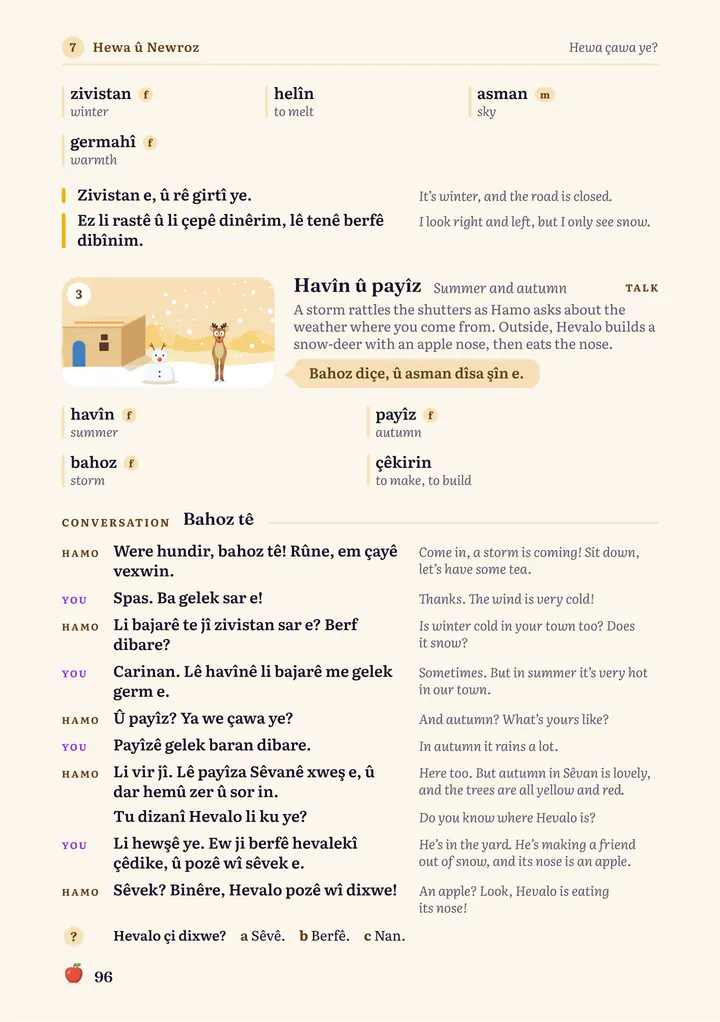
zivistan (f) · winter
helîn · to melt
asman (m) · sky
germahî (f) · warmth
Zivistan e, û rê girtî ye. · It’s winter, and the road is closed.
Ez li rastê û li çepê dinêrim, lê tenê berfê dibînim.
I look right and left, but I only see snow.
Havîn û payîz · Summer and autumn · Talk
A storm rattles the shutters as Hamo asks about the weather where you come from. Outside, Hevalo builds a snow-deer with an apple nose, then eats the nose.
Bahoz diçe, û asman dîsa şîn e.
havîn (f) · summer
payîz (f) · autumn
bahoz (f) · storm
çêkirin · to make, to build
Conversation · Bahoz tê
Hamo: Were hundir, bahoz tê! Rûne, em çayê vexwin.
Come in, a storm is coming! Sit down, let’s have some tea.
You: Spas. Ba gelek sar e! · Thanks. The wind is very cold!
Hamo: Li bajarê te jî zivistan sar e? Berf dibare?
Is winter cold in your town too? Does it snow?
You: Carinan. Lê havînê li bajarê me gelek germ e.
Sometimes. But in summer it’s very hot in our town.
Hamo: Û payîz? Ya we çawa ye? · And autumn? What’s yours like?
You: Payîzê gelek baran dibare. · In autumn it rains a lot.
Hamo: Li vir jî. Lê payîza Sêvanê xweş e, û dar hemû zer û sor in.
Here too. But autumn in Sêvan is lovely, and the trees are all yellow and red.
Tu dizanî Hevalo li ku ye? · Do you know where Hevalo is?
You: Li hewşê ye. Ew ji berfê hevalekî çêdike, û pozê wî sêvek e.
He’s in the yard. He’s making a friend out of snow, and its nose is an apple.
Hamo: Sêvek? Binêre, Hevalo pozê wî dixwe! · An apple? Look, Hevalo is eating its nose!
Hevalo çi dixwe? a Sêvê. b Berfê. c Nan.
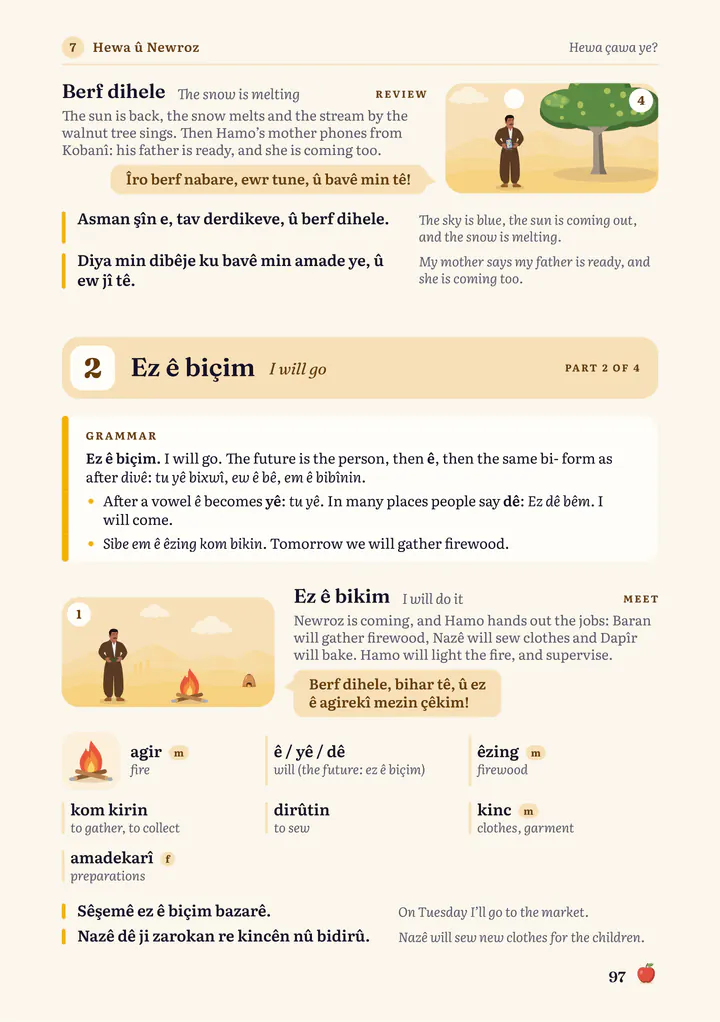
Berf dihele · The snow is melting · Review
The sun is back, the snow melts and the stream by the walnut tree sings. Then Hamo’s mother phones from Kobanî: his father is ready, and she is coming too.
Îro berf nabare, ewr tune, û bavê min tê!
Asman şîn e, tav derdikeve, û berf dihele. · The sky is blue, the sun is coming out, and the snow is melting.
Diya min dibêje ku bavê min amade ye, û ew jî tê.
My mother says my father is ready, and she is coming too.
I will go · Part 2 of 4
Grammar
Ez ê biçim. I will go. The future is the person, then ê, then the same bi- form as after divê: tu yê bixwî, ew ê bê, em ê bibînin.
After a vowel ê becomes yê: tu yê. In many places people say dê: Ez dê bêm. I will come.
Sibe em ê êzing kom bikin. Tomorrow we will gather firewood.
Ez ê bikim · I will do it · Meet
Newroz is coming, and Hamo hands out the jobs: Baran will gather firewood, Nazê will sew clothes and Dapîr will bake. Hamo will light the fire, and supervise.
Berf dihele, bihar tê, û ez ê agirekî mezin çêkim!
agir (m) · fire
ê / yê / dê · will (the future: ez ê biçim)
êzing (m) · firewood
kom kirin · to gather, to collect
dirûtin · to sew
kinc (m) · clothes, garment
amadekarî (f) · preparations
Sêşemê ez ê biçim bazarê. · On Tuesday I’ll go to the market.
Nazê dê ji zarokan re kincên nû bidirû. · Nazê will sew new clothes for the children.
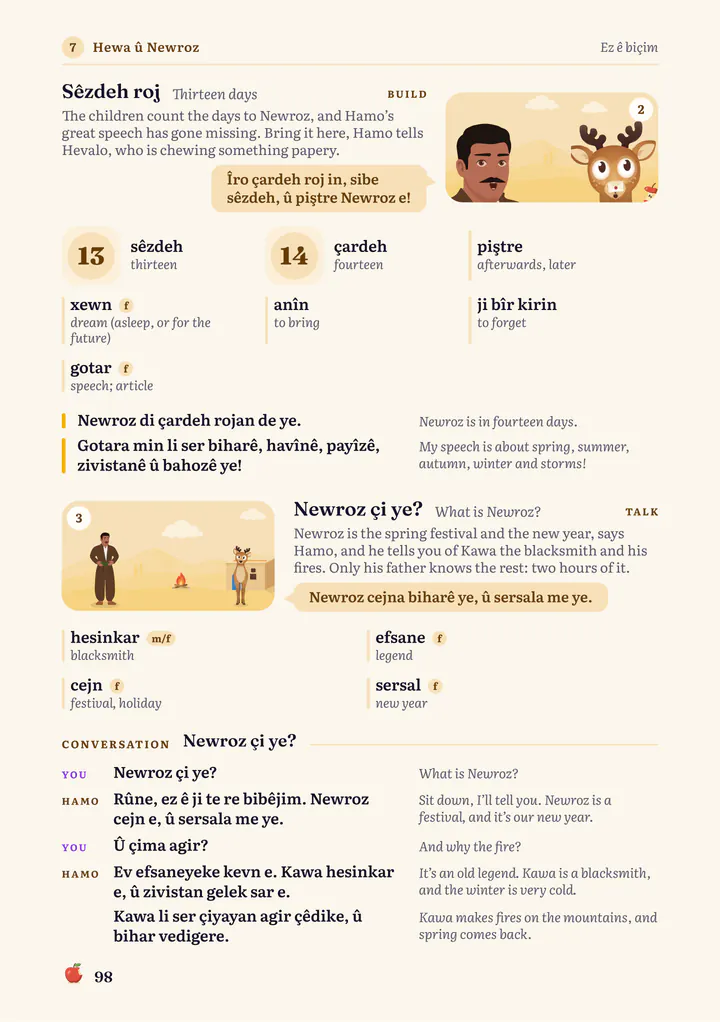
Sêzdeh roj · Thirteen days · Build
The children count the days to Newroz, and Hamo’s great speech has gone missing. Bring it here, Hamo tells Hevalo, who is chewing something papery.
Îro çardeh roj in, sibe sêzdeh, û piştre Newroz e!
sêzdeh · thirteen
çardeh · fourteen
piştre · afterwards, later
xewn (f) · dream (asleep, or for the future)
anîn · to bring
ji bîr kirin · to forget
gotar (f) · speech; article
Newroz di çardeh rojan de ye. · Newroz is in fourteen days.
Gotara min li ser biharê, havînê, payîzê, zivistanê û bahozê ye!
My speech is about spring, summer, autumn, winter and storms!
Newroz çi ye? · What is Newroz? · Talk
Newroz is the spring festival and the new year, says Hamo, and he tells you of Kawa the blacksmith and his fires. Only his father knows the rest: two hours of it.
Newroz cejna biharê ye, û sersala me ye.
hesinkar · m/f · blacksmith
efsane (f) · legend
cejn (f) · festival, holiday
sersal (f) · new year
Conversation · Newroz çi ye?
You: Newroz çi ye? · What is Newroz?
Hamo: Rûne, ez ê ji te re bibêjim. Newroz cejn e, û sersala me ye.
Sit down, I’ll tell you. Newroz is a festival, and it’s our new year.
You: Û çima agir? · And why the fire?
Hamo: Ev efsaneyeke kevn e. Kawa hesinkar e, û zivistan gelek sar e.
It’s an old legend. Kawa is a blacksmith, and the winter is very cold.
Kawa li ser çiyayan agir çêdike, û bihar vedigere.
Kawa makes fires on the mountains, and spring comes back.
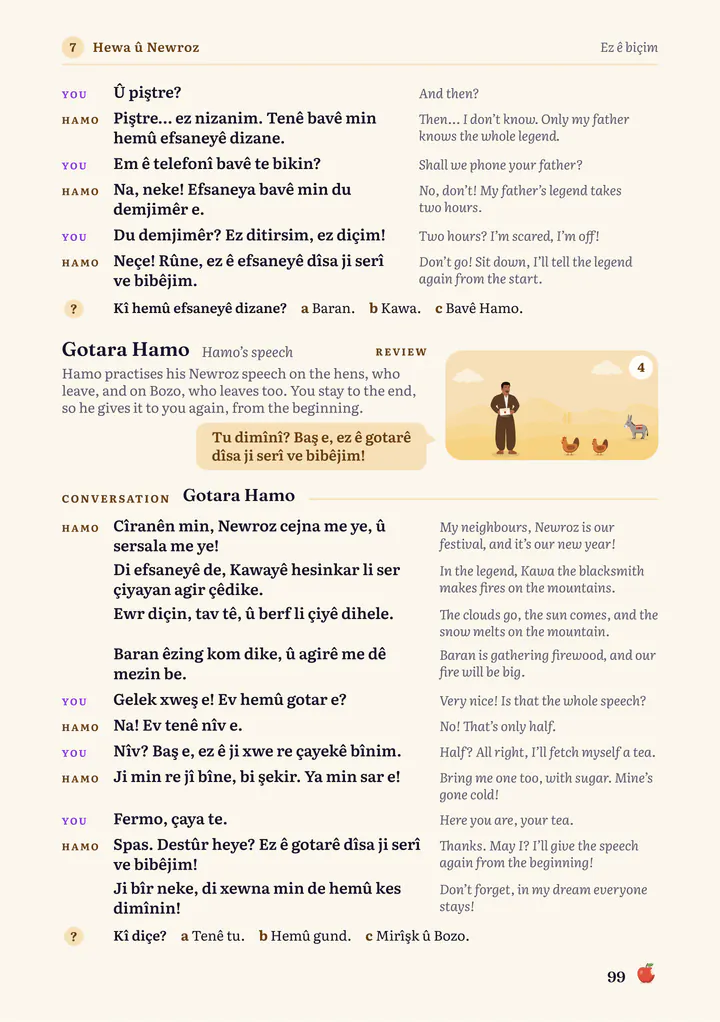
You: Û piştre? · And then?
Hamo: Piştre… ez nizanim. Tenê bavê min hemû efsaneyê dizane.
Then… I don’t know. Only my father knows the whole legend.
You: Em ê telefonî bavê te bikin? · Shall we phone your father?
Hamo: Na, neke! Efsaneya bavê min du demjimêr e.
No, don’t! My father’s legend takes two hours.
You: Du demjimêr? Ez ditirsim, ez diçim! · Two hours? I’m scared, I’m off!
Hamo: Neçe! Rûne, ez ê efsaneyê dîsa ji serî ve bibêjim.
Don’t go! Sit down, I’ll tell the legend again from the start.
Kî hemû efsaneyê dizane? a Baran. b Kawa. c Bavê Hamo.
Gotara Hamo · Hamo’s speech · Review
Hamo practises his Newroz speech on the hens, who leave, and on Bozo, who leaves too. You stay to the end, so he gives it to you again, from the beginning.
Tu dimînî? Baş e, ez ê gotarê dîsa ji serî ve bibêjim!
Conversation · Gotara Hamo
Hamo: Cîranên min, Newroz cejna me ye, û sersala me ye!
My neighbours, Newroz is our festival, and it’s our new year!
Di efsaneyê de, Kawayê hesinkar li ser çiyayan agir çêdike.
In the legend, Kawa the blacksmith makes fires on the mountains.
Ewr diçin, tav tê, û berf li çiyê dihele. · The clouds go, the sun comes, and the snow melts on the mountain.
Baran êzing kom dike, û agirê me dê mezin be.
Baran is gathering firewood, and our fire will be big.
You: Gelek xweş e! Ev hemû gotar e? · Very nice! Is that the whole speech?
Hamo: Na! Ev tenê nîv e. · No! That’s only half.
You: Nîv? Baş e, ez ê ji xwe re çayekê bînim. · Half? All right, I’ll fetch myself a tea.
Hamo: Ji min re jî bîne, bi şekir. Ya min sar e! · Bring me one too, with sugar. Mine’s gone cold!
You: Fermo, çaya te. · Here you are, your tea.
Hamo: Spas. Destûr heye? Ez ê gotarê dîsa ji serî ve bibêjim!
Thanks. May I? I’ll give the speech again from the beginning!
Ji bîr neke, di xewna min de hemû kes dimînin!
Don’t forget, in my dream everyone stays!
Kî diçe? a Tenê tu. b Hemû gund. c Mirîşk û Bozo.
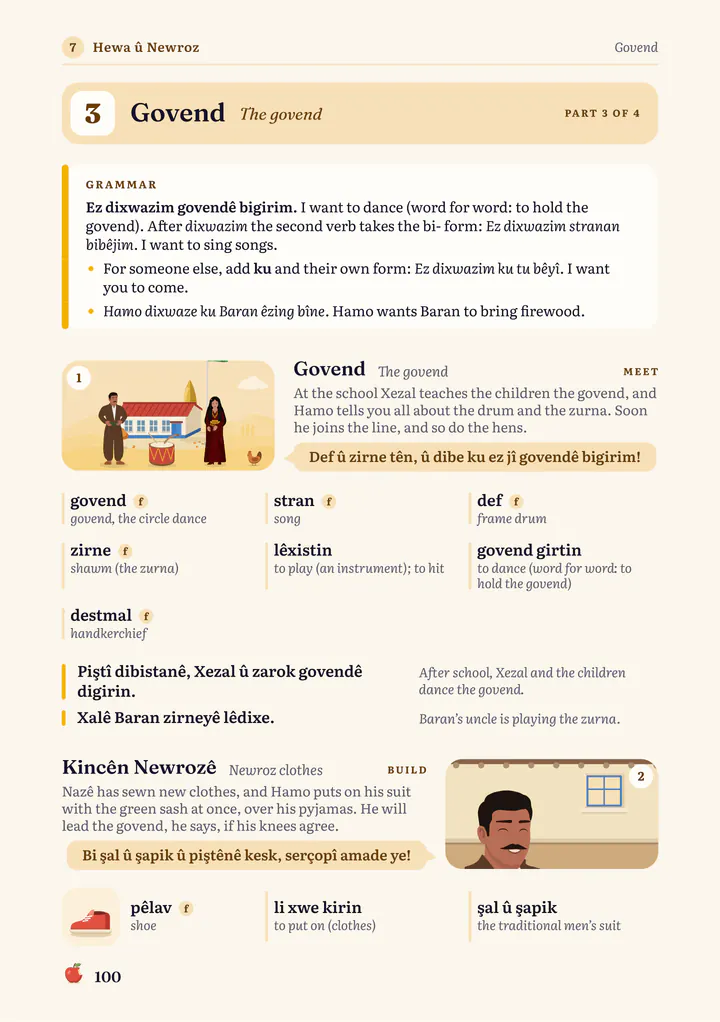
The govend · Part 3 of 4
Grammar
Ez dixwazim govendê bigirim. I want to dance (word for word: to hold the govend). After dixwazim the second verb takes the bi- form: Ez dixwazim stranan bibêjim. I want to sing songs.
For someone else, add ku and their own form: Ez dixwazim ku tu bêyî. I want you to come.
Hamo dixwaze ku Baran êzing bîne. Hamo wants Baran to bring firewood.
Govend · The govend · Meet
At the school Xezal teaches the children the govend, and Hamo tells you all about the drum and the zurna. Soon he joins the line, and so do the hens.
Def û zirne tên, û dibe ku ez jî govendê bigirim!
govend (f) · govend, the circle dance
stran (f) · song
def (f) · frame drum
zirne (f) · shawm (the zurna)
lêxistin · to play (an instrument); to hit
govend girtin · to dance (word for word: to hold the govend)
destmal (f) · handkerchief
Piştî dibistanê, Xezal û zarok govendê digirin.
After school, Xezal and the children dance the govend.
Xalê Baran zirneyê lêdixe. · Baran’s uncle is playing the zurna.
Kincên Newrozê · Newroz clothes · Build
Nazê has sewn new clothes, and Hamo puts on his suit with the green sash at once, over his pyjamas. He will lead the govend, he says, if his knees agree.
Bi şal û şapik û piştênê kesk, serçopî amade ye!
pêlav (f) · shoe
li xwe kirin · to put on (clothes)
şal û şapik · the traditional men’s suit
piştên (m) · sash (worn at the waist)
kiras (m) · dress; shirt
serçopî · m/f · leader of the govend (at the head of the line)
çok (f) · knee
Nazê ji Hêviyê re kirasekî nû didirû. · Nazê is sewing a new dress for Hêvî.
Nazê alîkariya min dike, û ez şal û şapik li ser kincên xewê li xwe dikim!
Nazê helps me, and I put the suit on over my pyjamas!
Stêrk û heyv · Stars and moon · Talk
The night before Newroz, Hamo shows you a full moon and a thousand stars. Then two lights come up the road from Kobanî: Hamo’s parents are here.
Heyv û stêrk li asman in, û Newroz nêzîk e.
stêrk (f) · star
heyv (f) · moon
çira (f) · lamp
bereket (f) · blessing, plenty
Conversation · Li ber pencereyê
Hamo: Were, li asman binêre! Heyv çiqas mezin e!
Come, look at the sky! How big the moon is!
You: Li asman ne sed, hezar stêrk hene! · There aren’t a hundred stars in the sky, there are a thousand!
Hamo: Bavê min çîrokên stêrkan dizane. · My father knows the stories of the stars.
You: Sibe Newroz e. Her tişt ji bo govendê amade ye?
Tomorrow is Newroz. Is everything ready for the govend?
Hamo: Erê. Def, zirne û destmal amade ne, û kirasê Hêviyê jî.
Yes. The drum, the zurna and the handkerchief are ready, and Hêvî’s dress too.
You: Lê nûçe dibêje ku sibe baran dibare. · But the news says it’ll rain tomorrow.
Hamo: Xem neke. Ev baran bereket e. · Don’t worry. This rain is a blessing.
You: Binêre, li ser rê çirayek heye… niha du çira!
Look, there’s a light on the road… now two!
Hamo: Ew ji Kobaniyê tên! Ez ê derî vekim. · They’re coming from Kobanî! I’ll open the gate.
Bavê min û diya min li vir in! · My father and my mother are here!
Çira ji ku tên? a Ji Kobaniyê. b Ji asman. c Ji dibistanê.
Berî Newrozê · Before Newroz · Review
Hamo’s parents are at the table and the firewood is on the hill. Tomorrow Baran will play the drum, his uncle the zurna, and Hamo will lead the govend.
Sibe Baran dê defê lêxe, xalê wî dê zirneyê lêxe, û ez ê govendê bigirim!
Bavê min bi minîbûsê tê, ji ber ku ew ji trên û balafirê hez nake.
My father comes by minibus, because he doesn’t like trains or planes.
Firne sibe girtî ye, lê Dapîr dê nan çêke. · The bakery is closed tomorrow, but Dapîr will make bread.
Happy Newroz! · Part 4 of 4
Grammar
Newroza we pîroz be! Happy Newroz to you all! Be is the bi- form of “to be”, and it makes a wish: … pîroz be may … be blessed.
Cejna te pîroz be! Happy holiday! · Destê te sax be! Thank you for the food (may your hand be healthy).
Em ji te re tenduristî û serkeftin dixwazin. We wish you health and success.
Agirê Newrozê · The Newroz fire · Meet
The whole village picnics on the hill for Newroz. At dusk Hamo lights the fire, and everyone jumps over it for good health, Hamo holding his moustache.
Îro seyran e! Em ji ser agir baz didin, û ez ji we re tenduristiyê dixwazim.
vêxistin · to light (a fire), to switch on
baz dan · to jump
dûman (f) · smoke
seyran (f) · outing, picnic in the open
gir (m) · hill
pîrozbahî (f) · celebration
tenduristî (f) · health
Îro hemû gund diçe seyranê. · Today the whole village is going on a picnic.
Gelek dûman heye! · There’s a lot of smoke!
Bilûra bavê min · My father’s flute · Build
By the dying fire Hamo’s father plays his old flute, then gives it to Hamo: keep the song going. Hamo’s first squeak sends Hevalo bolting, and everyone laughs.
Ez bilûrê lêdixim. Ev jiyan e, û em stranê didomînin!
bilûr (f) · shepherd’s flute
serkeftin (f) · success
jiyan (f) · life
domandin · to continue, to keep going
girîn · to cry
hêsir (m) · tear
xweşî (f) · joy, pleasure
Bavê min bilûra xwe ya kevn digire. Ew çiqas kevn e!
My father takes out his old flute. How old it is!
Hêsir di çavên wê de ne, lê ew dibêje ku ev dûman e.
There are tears in her eyes, but she says it’s the smoke.
Pişta min! · My back! · Talk
The morning after the govend, Hamo cannot get out of bed: “Pişta min diêşe!” His back is very bad, he says, and he asks for tea, honey and sympathy, in that order.
Hêsir di çavên min de ne, pişta min gelek diêşe!
pişt (f) · back (of the body)
êş (f) · pain
êşîn · to hurt
nebaş · bad, not good
Conversation · Pişta min!
Hamo: Wey, pişta min diêşe! · Ow, my back hurts!
You: Tu şiyar î? Bavê te û diya te vedigerin Kobaniyê.
Are you awake? Your father and mother are going back to Kobanî.
Hamo: Ez şiyar im, lê nikarim rabim. Ji wan re bibêje, bi xêr biçin!
I’m awake, but I can’t get up. Tell them to have a safe journey!
You: Êş li ku ye? · Where is the pain?
Hamo: Li her derê. Pişta min, çokên min, serê min…
Everywhere. My back, my knees, my head…
You: Ev ji govendê ye! · That’s from the govend!
Hamo: Na, ev ji agir e. Ez gelek ji ser agir baz didim!
No, it’s from the fire. I jump over the fire a lot!
You: Gelek nebaş e? · Is it very bad?
Hamo: Gelek nebaş e. Ji kerema xwe, çayeke germ bîne, û hinek hingiv.
Very bad. Please bring me a hot tea, and some honey.
Û piştre, li cem min rûne. · And then, sit with me.
Hamo çi dixwaze? a Govend û agir. b Çay û hingiv. c Nan û penîr.
Newroz pîroz be! · Happy Newroz! · Review
From his bed Hamo tells everyone about Newroz: the fire, the flute, the speech nobody heard. When his mother phones, he says his back is a little better.
Newroza we pîroz be! Ez ji we re tenduristiyê, xweşiyê û serkeftinê dixwazim.
Conversation · Ji nivînê
You: Newroza te pîroz be! Pişta te çawa ye?
Happy Newroz! How’s your back?
Hamo: Spas. Hinek baş e. Rûne, ez ê ji te re bibêjim.
Thanks. A little better. Sit down, I’ll tell you.
Seyran li ser gir e, û hemû gund li wir e.
The picnic is on the hill, and the whole village is there.
Ez serçopî me, û piştre bavê min bilûrê lêdixe.
I lead the govend, and then my father plays the flute.
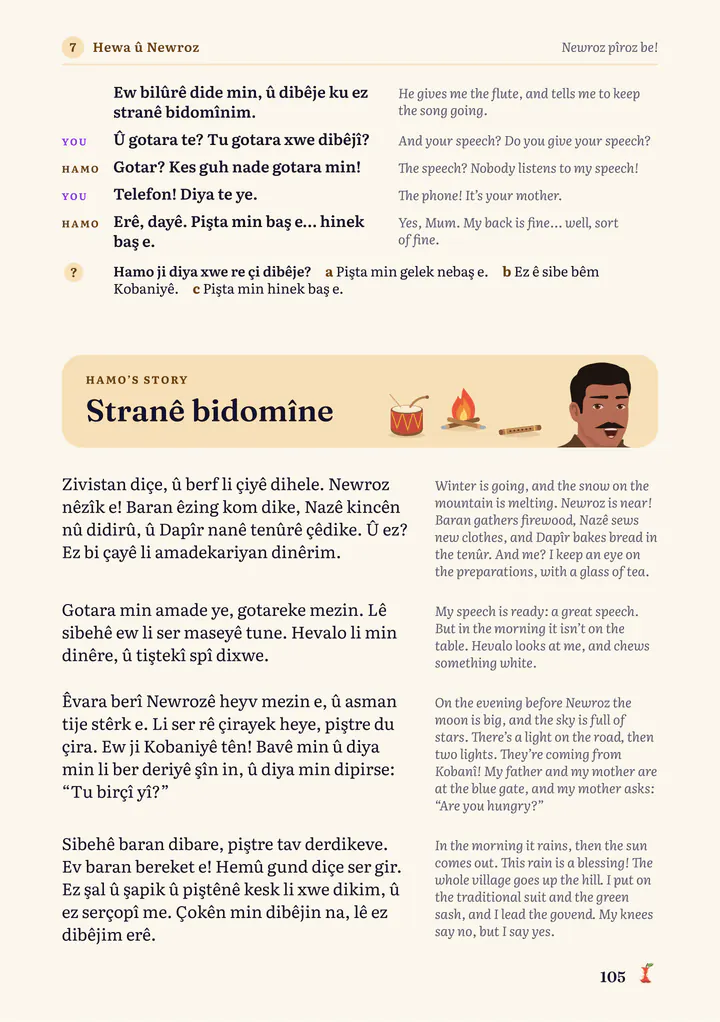
Ew bilûrê dide min, û dibêje ku ez stranê bidomînim.
He gives me the flute, and tells me to keep the song going.
You: Û gotara te? Tu gotara xwe dibêjî? · And your speech? Do you give your speech?
Hamo: Gotar? Kes guh nade gotara min! · The speech? Nobody listens to my speech!
You: Telefon! Diya te ye. · The phone! It’s your mother.
Hamo: Erê, dayê. Pişta min baş e… hinek baş e.
Yes, Mum. My back is fine… well, sort of fine.
Hamo ji diya xwe re çi dibêje? a Pişta min gelek nebaş e. b Ez ê sibe bêm Kobaniyê. c Pişta min hinek baş e.
Hamo’s story
Zivistan diçe, û berf li çiyê dihele. Newroz nêzîk e! Baran êzing kom dike, Nazê kincên nû didirû, û Dapîr nanê tenûrê çêdike. Û ez? Ez bi çayê li amadekariyan dinêrim.
Winter is going, and the snow on the mountain is melting. Newroz is near! Baran gathers firewood, Nazê sews new clothes, and Dapîr bakes bread in the tenûr. And me? I keep an eye on the preparations, with a glass of tea.
Gotara min amade ye, gotareke mezin. Lê sibehê ew li ser maseyê tune. Hevalo li min dinêre, û tiştekî spî dixwe.
My speech is ready: a great speech. But in the morning it isn’t on the table. Hevalo looks at me, and chews something white.
Êvara berî Newrozê heyv mezin e, û asman tije stêrk e. Li ser rê çirayek heye, piştre du çira. Ew ji Kobaniyê tên! Bavê min û diya min li ber deriyê şîn in, û diya min dipirse: “Tu birçî yî?”
On the evening before Newroz the moon is big, and the sky is full of stars. There’s a light on the road, then two lights. They’re coming from Kobanî! My father and my mother are at the blue gate, and my mother asks: “Are you hungry?”
Sibehê baran dibare, piştre tav derdikeve. Ev baran bereket e! Hemû gund diçe ser gir. Ez şal û şapik û piştênê kesk li xwe dikim, û ez serçopî me. Çokên min dibêjin na, lê ez dibêjim erê.
In the morning it rains, then the sun comes out. This rain is a blessing! The whole village goes up the hill. I put on the traditional suit and the green sash, and I lead the govend. My knees say no, but I say yes.
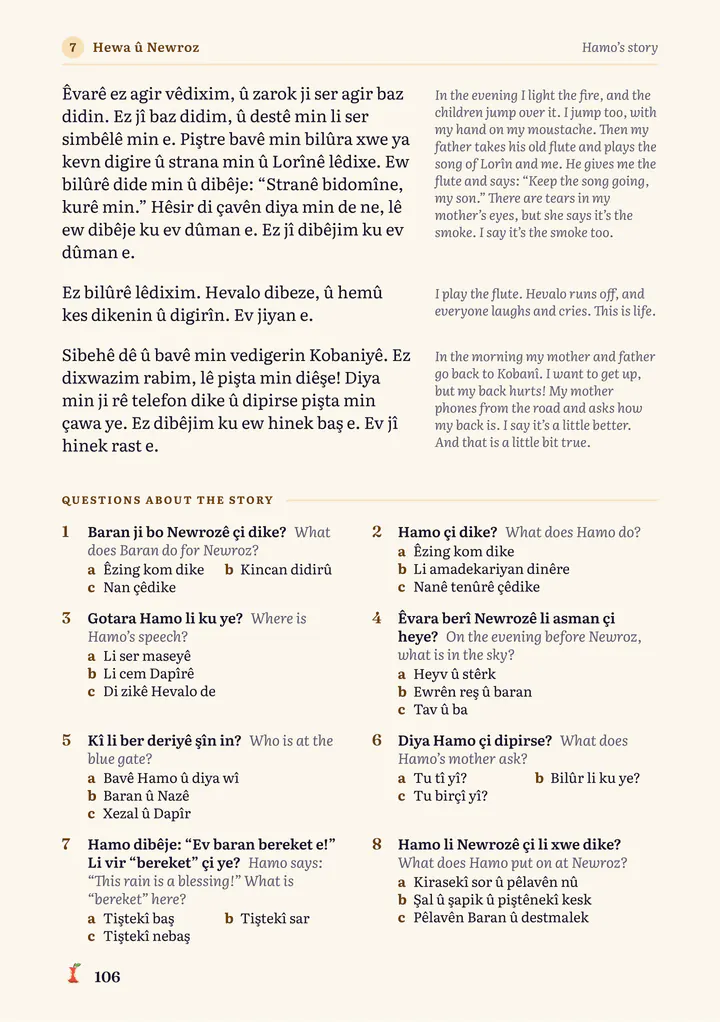
Êvarê ez agir vêdixim, û zarok ji ser agir baz didin. Ez jî baz didim, û destê min li ser simbêlê min e. Piştre bavê min bilûra xwe ya kevn digire û strana min û Lorînê lêdixe. Ew bilûrê dide min û dibêje: “Stranê bidomîne, kurê min.” Hêsir di çavên diya min de ne, lê ew dibêje ku ev dûman e. Ez jî dibêjim ku ev dûman e.
In the evening I light the fire, and the children jump over it. I jump too, with my hand on my moustache. Then my father takes his old flute and plays the song of Lorîn and me. He gives me the flute and says: “Keep the song going, my son.” There are tears in my mother’s eyes, but she says it’s the smoke. I say it’s the smoke too.
Ez bilûrê lêdixim. Hevalo dibeze, û hemû kes dikenin û digirîn. Ev jiyan e.
I play the flute. Hevalo runs off, and everyone laughs and cries. This is life.
Sibehê dê û bavê min vedigerin Kobaniyê. Ez dixwazim rabim, lê pişta min diêşe! Diya min ji rê telefon dike û dipirse pişta min çawa ye. Ez dibêjim ku ew hinek baş e. Ev jî hinek rast e.
In the morning my mother and father go back to Kobanî. I want to get up, but my back hurts! My mother phones from the road and asks how my back is. I say it’s a little better. And that is a little bit true.
Questions about the story
1 · Baran ji bo Newrozê çi dike? What does Baran do for Newroz?
a · Êzing kom dike · b · Kincan didirû
c · Nan çêdike
2 · Hamo çi dike? What does Hamo do?
a · Êzing kom dike
b · Li amadekariyan dinêre
c · Nanê tenûrê çêdike
3 · Gotara Hamo li ku ye? Where is Hamo’s speech?
a · Li ser maseyê
b · Li cem Dapîrê
c · Di zikê Hevalo de
4 · Êvara berî Newrozê li asman çi heye? On the evening before Newroz, what is in the sky?
a · Heyv û stêrk
b · Ewrên reş û baran
c · Tav û ba
5 · Kî li ber deriyê şîn in? Who is at the blue gate?
a · Bavê Hamo û diya wî
b · Baran û Nazê
c · Xezal û Dapîr
6 · Diya Hamo çi dipirse? What does Hamo’s mother ask?
a · Tu tî yî? · b · Bilûr li ku ye?
c · Tu birçî yî?
7 · Hamo dibêje: “Ev baran bereket e!” Li vir “bereket” çi ye? Hamo says: “This rain is a blessing!” What is “bereket” here?
a · Tiştekî baş · b · Tiştekî sar
c · Tiştekî nebaş
8 · Hamo li Newrozê çi li xwe dike? What does Hamo put on at Newroz?
a · Kirasekî sor û pêlavên nû
b · Şal û şapik û piştênekî kesk
c · Pêlavên Baran û destmalek
9 · Çima destê Hamo li ser simbêlê wî ye? Why is Hamo’s hand on his moustache?
a · Ji ber ku agir germ e
b · Ji ber ku ew stranê dibêje
c · Ji ber ku ew sar e
10 · Kî berî Hamo bilûrê lêdixe? Who plays the flute before Hamo does?
a Diya Hamo b Bavê Hamo c Hevalo
11 · Bavê Hamo çi dide kurê xwe? What does Hamo’s father give his son?
a · Gotara xwe · b · Destmala xwe
c · Bilûra xwe
12 · Diya Hamo dibêje ku ev dûman e. Lê ew çi dike? Hamo’s mother says it’s the smoke. But what is she doing?
a Ew digirî b Ew dikene c Ew radize
13 · “Hêsir di çavên diya min de ne.” Hêsir çi ne? “There are hêsir in my mother’s eyes.” What are hêsir?
a · Ava ku ji çavan tê
b · Rengê çavan ê kesk
c · Dûmana agirê Newrozê
14 · Çima Hamo sibehê ranabe? Why doesn’t Hamo get up in the morning?
a · Ew birçî ye · b · Berf dibare
c · Pişta wî diêşe
15 · Ev çîrok li ser çi ye? What is this story about?
a · Zivistan û berfa çiyê
b · Newroz, malbat û bilûra bavê Hamo
c · Bazar û sêvên Mîrza
It was like that when he found it.
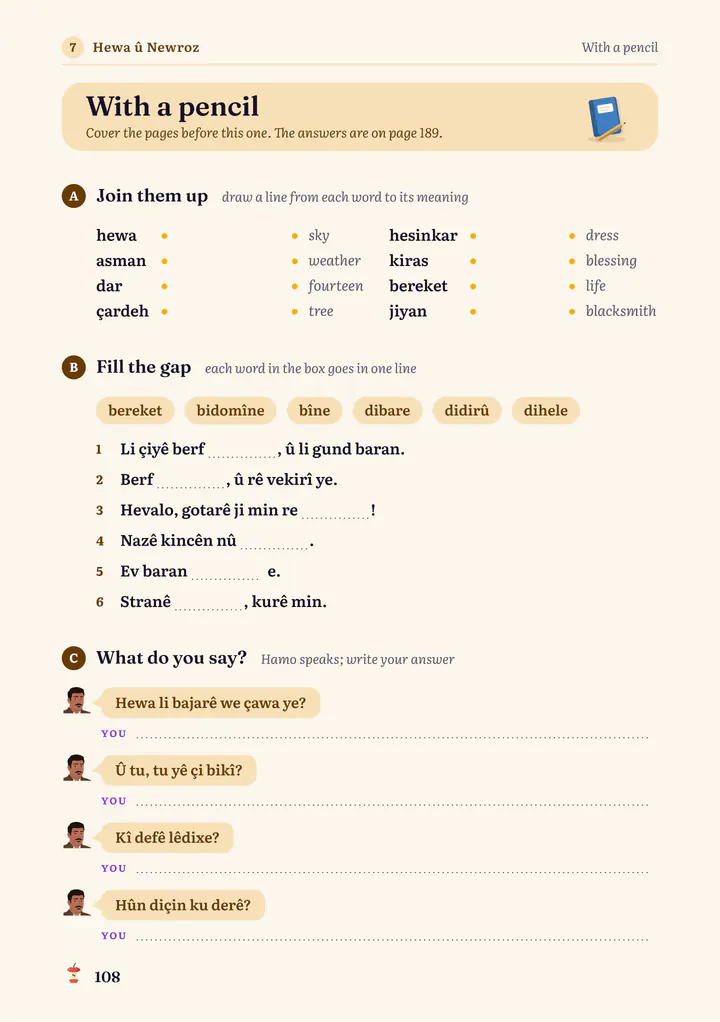
Cover the pages before this one. The answers are on page 189.
A · Join them up · draw a line from each word to its meaning
hewa · sky · hesinkar · dress
asman · weather · kiras · blessing
dar · fourteen · bereket · life
çardeh · tree · jiyan · blacksmith
B · Fill the gap · each word in the box goes in one line
bereket · bidomîne · bîne · dibare · didirû · dihele
1 · Li çiyê berf …, û li gund baran.
2 · Berf …, û rê vekirî ye.
3 · Hevalo, gotarê ji min re …!
4 · Nazê kincên nû ….
5 · Ev baran … e.
6 · Stranê …, kurê min.
C · What do you say? · Hamo speaks; write your answer
Hewa li bajarê we çawa ye?
You
Û tu, tu yê çi bikî?
You
Kî defê lêdixe?
You
Hûn diçin ku derê?
You
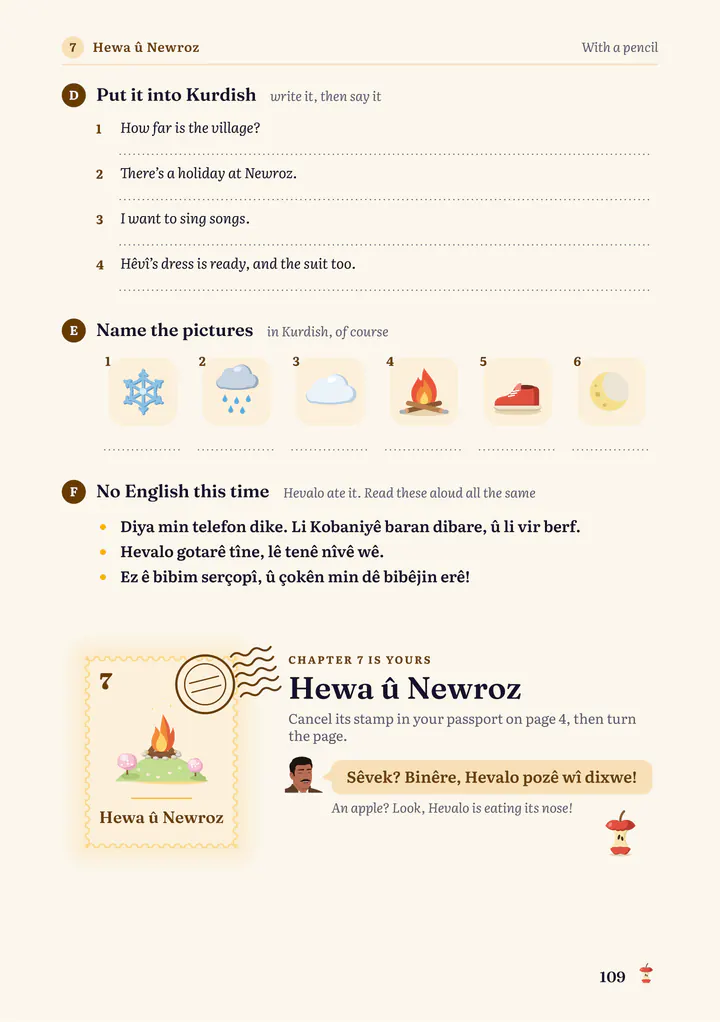
D · Put it into Kurdish · write it, then say it
1 · How far is the village?
2 · There’s a holiday at Newroz.
3 · I want to sing songs.
4 · Hêvî’s dress is ready, and the suit too.
E · Name the pictures · in Kurdish, of course
F · No English this time · Hevalo ate it. Read these aloud all the same
Diya min telefon dike. Li Kobaniyê baran dibare, û li vir berf.
Hevalo gotarê tîne, lê tenê nîvê wê.
Ez ê bibim serçopî, û çokên min dê bibêjin erê!
Hewa û Newroz
Chapter 7 is yours
Cancel its stamp in your passport on page 4, then turn the page.
Sêvek? Binêre, Hevalo pozê wî dixwe!
An apple? Look, Hevalo is eating its nose!
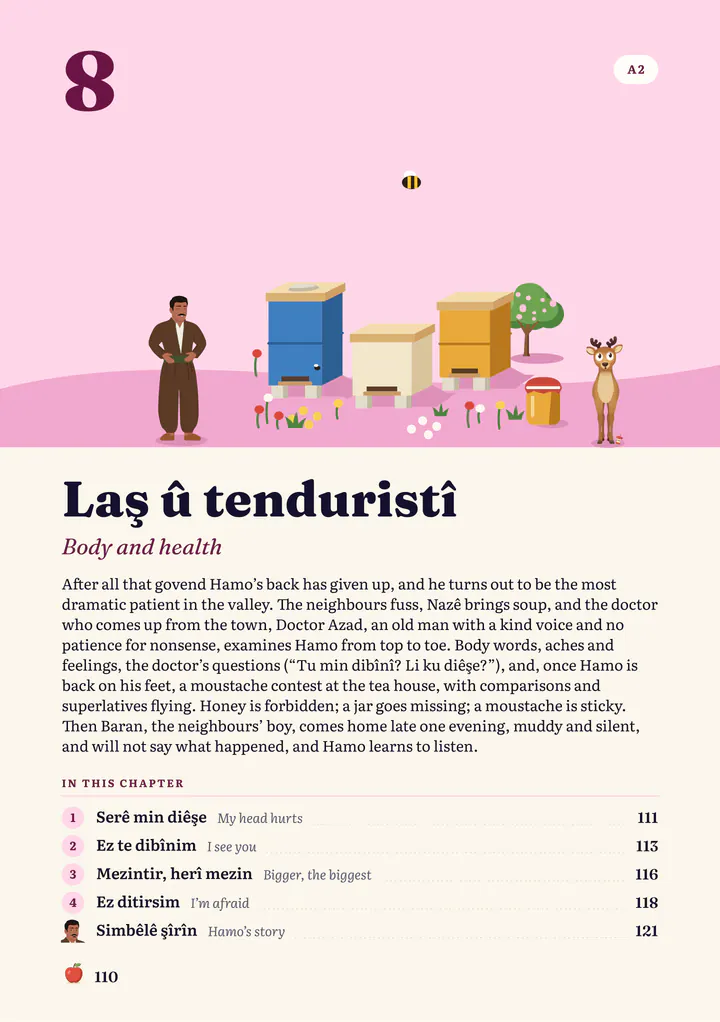
Body and health
After all that govend Hamo’s back has given up, and he turns out to be the most dramatic patient in the valley. The neighbours fuss, Nazê brings soup, and the doctor who comes up from the town, Doctor Azad, an old man with a kind voice and no patience for nonsense, examines Hamo from top to toe. Body words, aches and feelings, the doctor’s questions (“Tu min dibînî? Li ku diêşe?”), and, once Hamo is back on his feet, a moustache contest at the tea house, with comparisons and superlatives flying. Honey is forbidden; a jar goes missing; a moustache is sticky. Then Baran, the neighbours’ boy, comes home late one evening, muddy and silent, and will not say what happened, and Hamo learns to listen.
In this chapter
1 · Serê min diêşe · My head hurts · 111
2 · Ez te dibînim · I see you · 113
3 · Mezintir, herî mezin · Bigger, the biggest · 116
4 · Ez ditirsim · I’m afraid · 118
Simbêlê şîrîn · Hamo’s story · 121
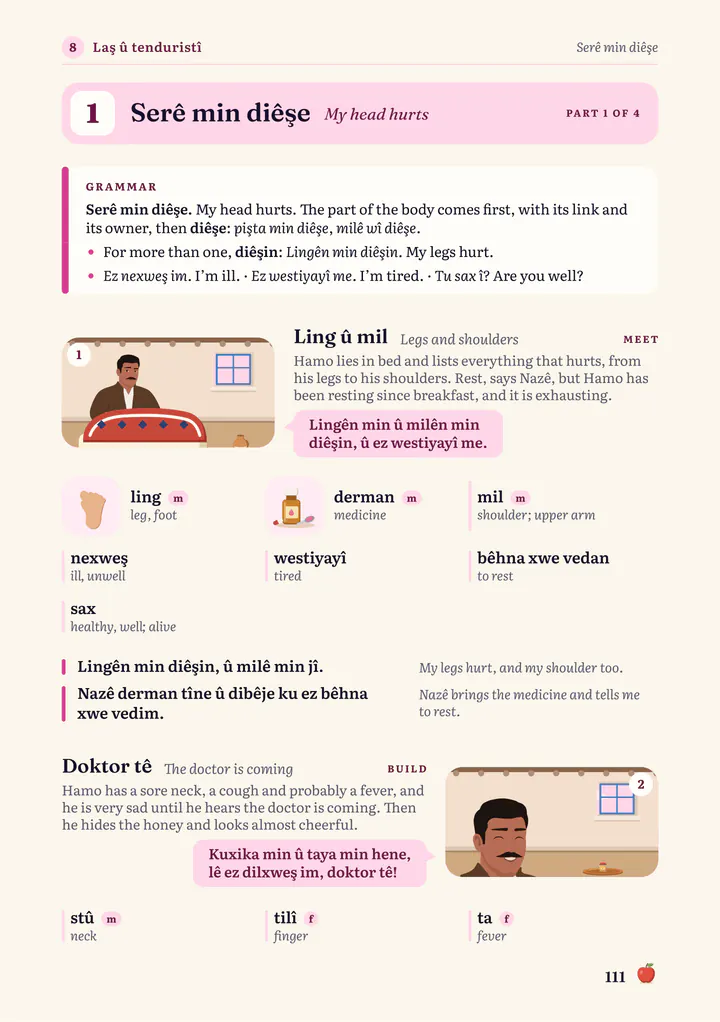
My head hurts · Part 1 of 4
Grammar
Serê min diêşe. My head hurts. The part of the body comes first, with its link and its owner, then diêşe: pişta min diêşe, milê wî diêşe.
For more than one, diêşin: Lingên min diêşin. My legs hurt.
Ez nexweş im. I’m ill. · Ez westiyayî me. I’m tired. · Tu sax î? Are you well?
Ling û mil · Legs and shoulders · Meet
Hamo lies in bed and lists everything that hurts, from his legs to his shoulders. Rest, says Nazê, but Hamo has been resting since breakfast, and it is exhausting.
Lingên min û milên min diêşin, û ez westiyayî me.
ling (m) · leg, foot
derman (m) · medicine
mil (m) · shoulder; upper arm
nexweş · ill, unwell
westiyayî · tired
bêhna xwe vedan · to rest
sax · healthy, well; alive
Lingên min diêşin, û milê min jî. · My legs hurt, and my shoulder too.
Nazê derman tîne û dibêje ku ez bêhna xwe vedim.
Nazê brings the medicine and tells me to rest.
Doktor tê · The doctor is coming · Build
Hamo has a sore neck, a cough and probably a fever, and he is very sad until he hears the doctor is coming. Then he hides the honey and looks almost cheerful.
Kuxika min û taya min hene, lê ez dilxweş im, doktor tê!
stû (m) · neck
tilî (f) · finger
ta (f) · fever
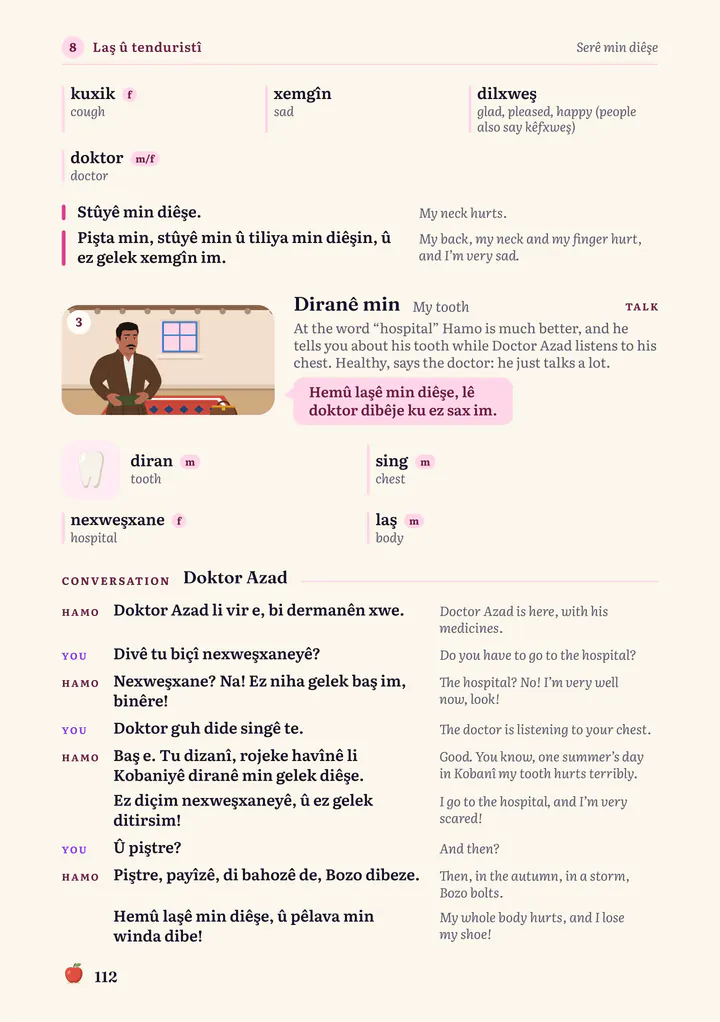
kuxik (f) · cough
xemgîn · sad
dilxweş · glad, pleased, happy (people also say kêfxweş)
doktor · m/f · doctor
Stûyê min diêşe. · My neck hurts.
Pişta min, stûyê min û tiliya min diêşin, û ez gelek xemgîn im.
My back, my neck and my finger hurt, and I’m very sad.
Diranê min · My tooth · Talk
At the word “hospital” Hamo is much better, and he tells you about his tooth while Doctor Azad listens to his chest. Healthy, says the doctor: he just talks a lot.
Hemû laşê min diêşe, lê doktor dibêje ku ez sax im.
diran (m) · tooth
sing (m) · chest
nexweşxane (f) · hospital
laş (m) · body
Conversation · Doktor Azad
Hamo: Doktor Azad li vir e, bi dermanên xwe. · Doctor Azad is here, with his medicines.
You: Divê tu biçî nexweşxaneyê? · Do you have to go to the hospital?
Hamo: Nexweşxane? Na! Ez niha gelek baş im, binêre!
The hospital? No! I’m very well now, look!
You: Doktor guh dide singê te. · The doctor is listening to your chest.
Hamo: Baş e. Tu dizanî, rojeke havînê li Kobaniyê diranê min gelek diêşe.
Good. You know, one summer’s day in Kobanî my tooth hurts terribly.
Ez diçim nexweşxaneyê, û ez gelek ditirsim!
I go to the hospital, and I’m very scared!
You: Û piştre? · And then?
Hamo: Piştre, payîzê, di bahozê de, Bozo dibeze. · Then, in the autumn, in a storm, Bozo bolts.
Hemû laşê min diêşe, û pêlava min winda dibe!
My whole body hurts, and I lose my shoe!
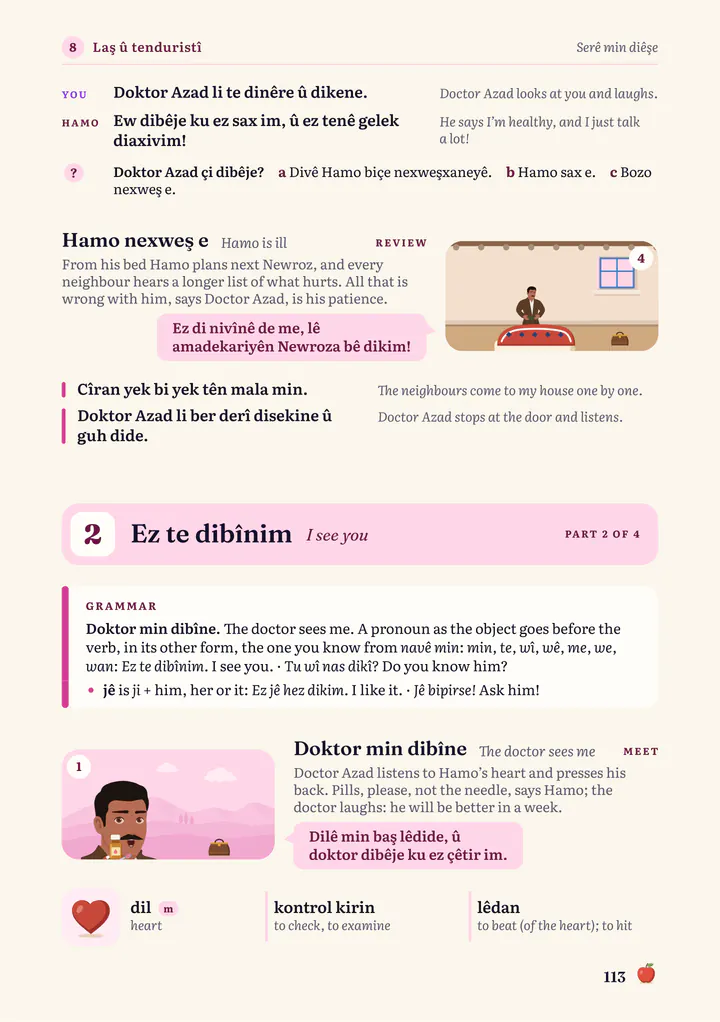
You: Doktor Azad li te dinêre û dikene. · Doctor Azad looks at you and laughs.
Hamo: Ew dibêje ku ez sax im, û ez tenê gelek diaxivim!
He says I’m healthy, and I just talk a lot!
Doktor Azad çi dibêje? a Divê Hamo biçe nexweşxaneyê. b Hamo sax e. c Bozo nexweş e.
Hamo nexweş e · Hamo is ill · Review
From his bed Hamo plans next Newroz, and every neighbour hears a longer list of what hurts. All that is wrong with him, says Doctor Azad, is his patience.
Ez di nivînê de me, lê amadekariyên Newroza bê dikim!
Cîran yek bi yek tên mala min. · The neighbours come to my house one by one.
Doktor Azad li ber derî disekine û guh dide.
Doctor Azad stops at the door and listens.
I see you · Part 2 of 4
Grammar
Doktor min dibîne. The doctor sees me. A pronoun as the object goes before the verb, in its other form, the one you know from navê min: min, te, wî, wê, me, we, wan: Ez te dibînim. I see you. · Tu wî nas dikî? Do you know him?
jê is ji + him, her or it: Ez jê hez dikim. I like it. · Jê bipirse! Ask him!
Doktor min dibîne · The doctor sees me · Meet
Doctor Azad listens to Hamo’s heart and presses his back. Pills, please, not the needle, says Hamo; the doctor laughs: he will be better in a week.
Dilê min baş lêdide, û doktor dibêje ku ez çêtir im.
dil (m) · heart
kontrol kirin · to check, to examine
lêdan · to beat (of the heart); to hit
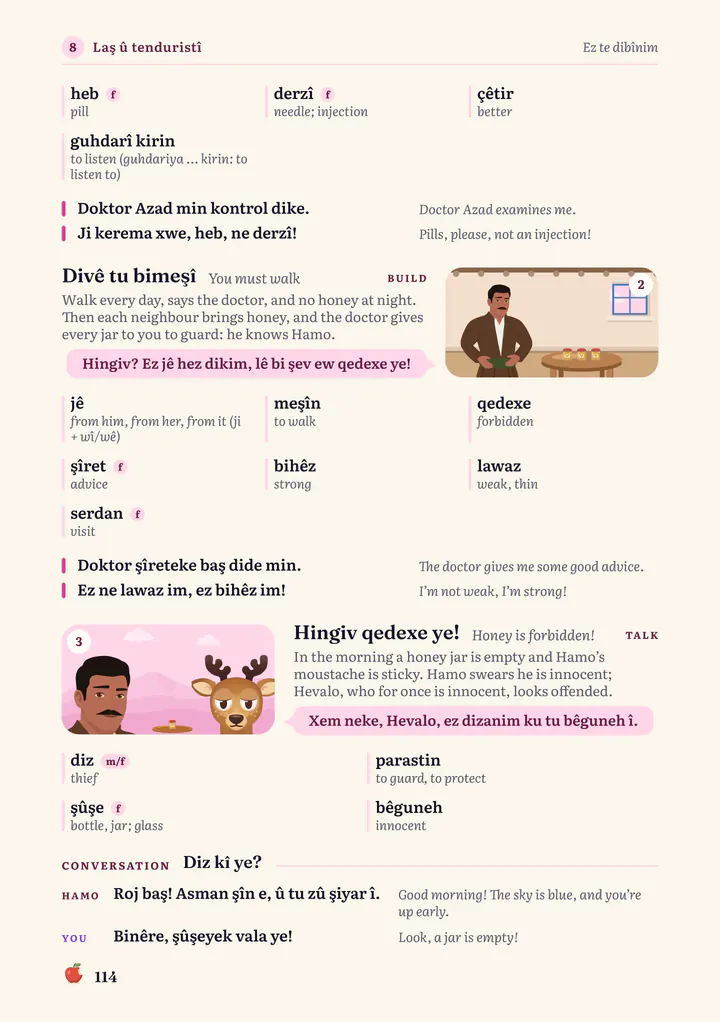
heb (f) · pill
derzî (f) · needle; injection
çêtir · better
guhdarî kirin · to listen (guhdariya … kirin: to listen to)
Doktor Azad min kontrol dike. · Doctor Azad examines me.
Ji kerema xwe, heb, ne derzî! · Pills, please, not an injection!
Divê tu bimeşî · You must walk · Build
Walk every day, says the doctor, and no honey at night. Then each neighbour brings honey, and the doctor gives every jar to you to guard: he knows Hamo.
Hingiv? Ez jê hez dikim, lê bi şev ew qedexe ye!
jê · from him, from her, from it (ji + wî/wê)
meşîn · to walk
qedexe · forbidden
şîret (f) · advice
bihêz · strong
lawaz · weak, thin
serdan (f) · visit
Doktor şîreteke baş dide min. · The doctor gives me some good advice.
Ez ne lawaz im, ez bihêz im! · I’m not weak, I’m strong!
Hingiv qedexe ye! · Honey is forbidden! · Talk
In the morning a honey jar is empty and Hamo’s moustache is sticky. Hamo swears he is innocent; Hevalo, who for once is innocent, looks offended.
Xem neke, Hevalo, ez dizanim ku tu bêguneh î.
diz · m/f · thief
parastin · to guard, to protect
şûşe (f) · bottle, jar; glass
bêguneh · innocent
Conversation · Diz kî ye?
Hamo: Roj baş! Asman şîn e, û tu zû şiyar î. · Good morning! The sky is blue, and you’re up early.
You: Binêre, şûşeyek vala ye! · Look, a jar is empty!
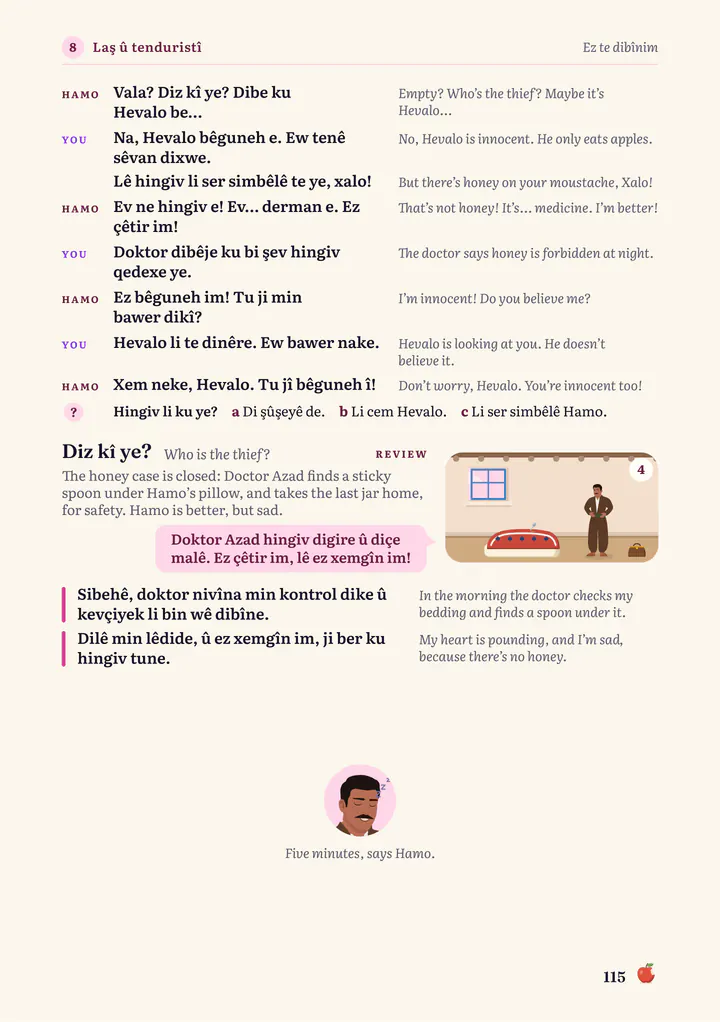
Hamo: Vala? Diz kî ye? Dibe ku Hevalo be…
Empty? Who’s the thief? Maybe it’s Hevalo…
You: Na, Hevalo bêguneh e. Ew tenê sêvan dixwe.
No, Hevalo is innocent. He only eats apples.
Lê hingiv li ser simbêlê te ye, xalo! · But there’s honey on your moustache, Xalo!
Hamo: Ev ne hingiv e! Ev… derman e. Ez çêtir im!
That’s not honey! It’s… medicine. I’m better!
You: Doktor dibêje ku bi şev hingiv qedexe ye.
The doctor says honey is forbidden at night.
Hamo: Ez bêguneh im! Tu ji min bawer dikî?
I’m innocent! Do you believe me?
You: Hevalo li te dinêre. Ew bawer nake. · Hevalo is looking at you. He doesn’t believe it.
Hamo: Xem neke, Hevalo. Tu jî bêguneh î! · Don’t worry, Hevalo. You’re innocent too!
Hingiv li ku ye? a Di şûşeyê de. b Li cem Hevalo. c Li ser simbêlê Hamo.
Diz kî ye? · Who is the thief? · Review
The honey case is closed: Doctor Azad finds a sticky spoon under Hamo’s pillow, and takes the last jar home, for safety. Hamo is better, but sad.
Doktor Azad hingiv digire û diçe malê. Ez çêtir im, lê ez xemgîn im!
Sibehê, doktor nivîna min kontrol dike û kevçiyek li bin wê dibîne.
In the morning the doctor checks my bedding and finds a spoon under it.
Dilê min lêdide, û ez xemgîn im, ji ber ku hingiv tune.
My heart is pounding, and I’m sad, because there’s no honey.
Five minutes, says Hamo.
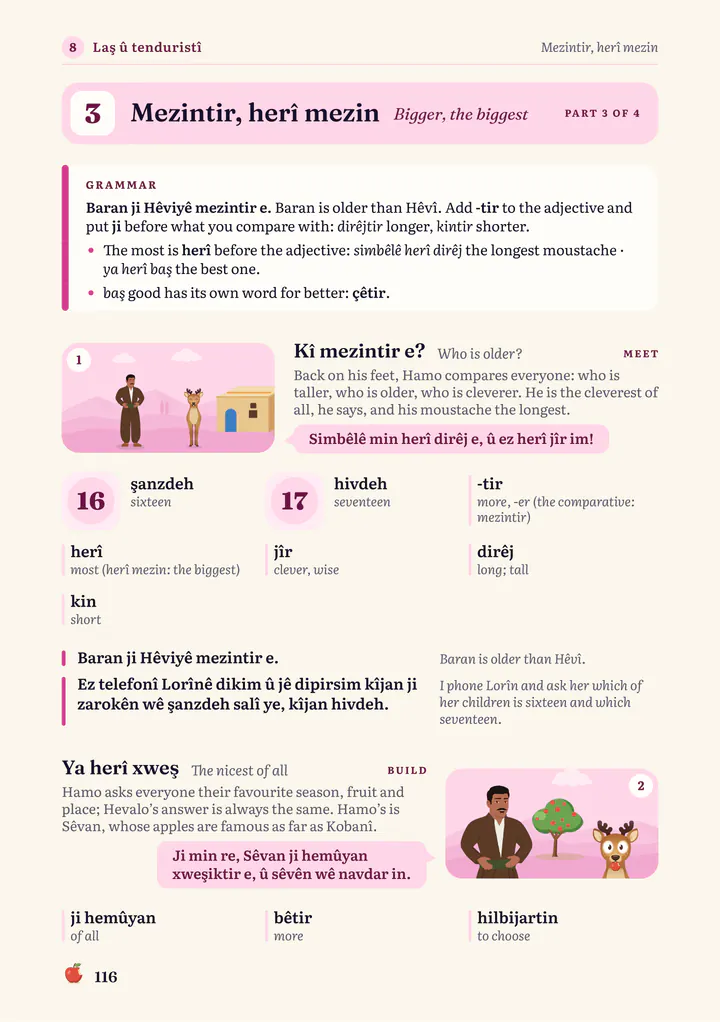
Bigger, the biggest · Part 3 of 4
Grammar
Baran ji Hêviyê mezintir e. Baran is older than Hêvî. Add -tir to the adjective and put ji before what you compare with: dirêjtir longer, kintir shorter.
The most is herî before the adjective: simbêlê herî dirêj the longest moustache · ya herî baş the best one.
baş good has its own word for better: çêtir.
Kî mezintir e? · Who is older? · Meet
Back on his feet, Hamo compares everyone: who is taller, who is older, who is cleverer. He is the cleverest of all, he says, and his moustache the longest.
Simbêlê min herî dirêj e, û ez herî jîr im!
şanzdeh · sixteen · 17
hivdeh · seventeen
-tir · more, -er (the comparative: mezintir)
herî · most (herî mezin: the biggest)
jîr · clever, wise
dirêj · long; tall
kin · short
Baran ji Hêviyê mezintir e. · Baran is older than Hêvî.
Ez telefonî Lorînê dikim û jê dipirsim kîjan ji zarokên wê şanzdeh salî ye, kîjan hivdeh.
I phone Lorîn and ask her which of her children is sixteen and which seventeen.
Ya herî xweş · The nicest of all · Build
Hamo asks everyone their favourite season, fruit and place; Hevalo’s answer is always the same. Hamo’s is Sêvan, whose apples are famous as far as Kobanî.
Ji min re, Sêvan ji hemûyan xweşiktir e, û sêvên wê navdar in.
ji hemûyan · of all
bêtir · more
hilbijartin · to choose
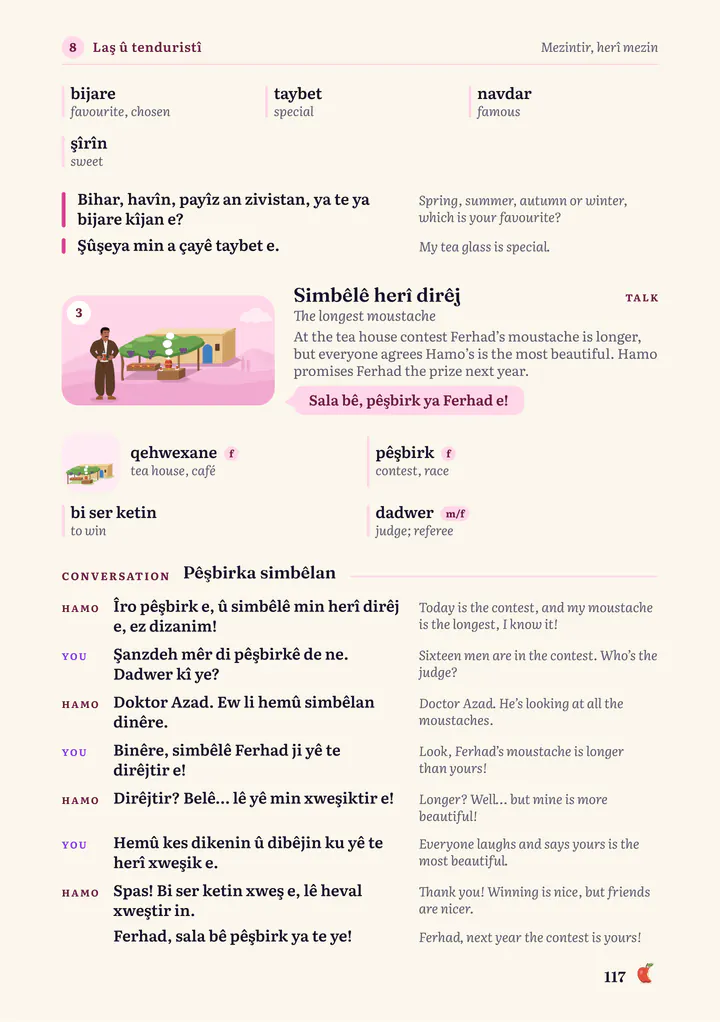
bijare · favourite, chosen
taybet · special
navdar · famous
şîrîn · sweet
Bihar, havîn, payîz an zivistan, ya te ya bijare kîjan e?
Spring, summer, autumn or winter, which is your favourite?
Şûşeya min a çayê taybet e. · My tea glass is special.
Simbêlê herî dirêj
The longest moustache
Talk
At the tea house contest Ferhad’s moustache is longer, but everyone agrees Hamo’s is the most beautiful. Hamo promises Ferhad the prize next year.
Sala bê, pêşbirk ya Ferhad e!
qehwexane (f) · tea house, café
pêşbirk (f) · contest, race
bi ser ketin · to win
dadwer · m/f · judge; referee
Conversation · Pêşbirka simbêlan
Hamo: Îro pêşbirk e, û simbêlê min herî dirêj e, ez dizanim!
Today is the contest, and my moustache is the longest, I know it!
You: Şanzdeh mêr di pêşbirkê de ne. Dadwer kî ye?
Sixteen men are in the contest. Who’s the judge?
Hamo: Doktor Azad. Ew li hemû simbêlan dinêre.
Doctor Azad. He’s looking at all the moustaches.
You: Binêre, simbêlê Ferhad ji yê te dirêjtir e!
Look, Ferhad’s moustache is longer than yours!
Hamo: Dirêjtir? Belê… lê yê min xweşiktir e! · Longer? Well… but mine is more beautiful!
You: Hemû kes dikenin û dibêjin ku yê te herî xweşik e.
Everyone laughs and says yours is the most beautiful.
Hamo: Spas! Bi ser ketin xweş e, lê heval xweştir in.
Thank you! Winning is nice, but friends are nicer.
Ferhad, sala bê pêşbirk ya te ye! · Ferhad, next year the contest is yours!
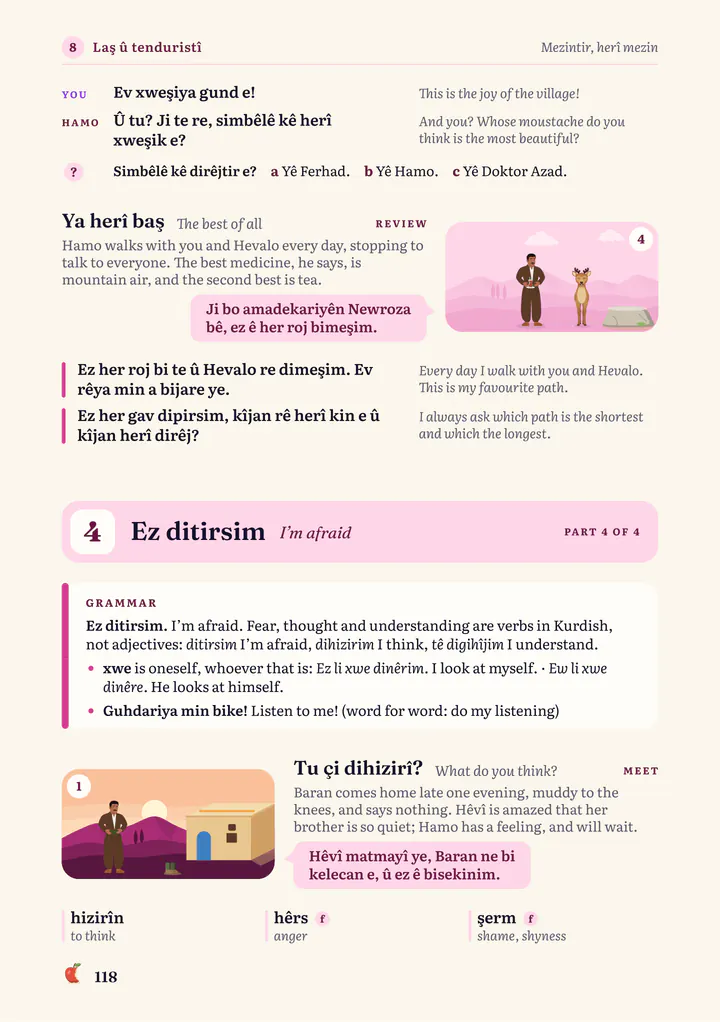
You: Ev xweşiya gund e! · This is the joy of the village!
Hamo: Û tu? Ji te re, simbêlê kê herî xweşik e?
And you? Whose moustache do you think is the most beautiful?
Simbêlê kê dirêjtir e? a Yê Ferhad. b Yê Hamo. c Yê Doktor Azad.
Ya herî baş · The best of all · Review
Hamo walks with you and Hevalo every day, stopping to talk to everyone. The best medicine, he says, is mountain air, and the second best is tea.
Ji bo amadekariyên Newroza bê, ez ê her roj bimeşim.
Ez her roj bi te û Hevalo re dimeşim. Ev rêya min a bijare ye.
Every day I walk with you and Hevalo. This is my favourite path.
Ez her gav dipirsim, kîjan rê herî kin e û kîjan herî dirêj?
I always ask which path is the shortest and which the longest.
I’m afraid · Part 4 of 4
Grammar
Ez ditirsim. I’m afraid. Fear, thought and understanding are verbs in Kurdish, not adjectives: ditirsim I’m afraid, dihizirim I think, tê digihîjim I understand.
xwe is oneself, whoever that is: Ez li xwe dinêrim. I look at myself. · Ew li xwe dinêre. He looks at himself.
Guhdariya min bike! Listen to me! (word for word: do my listening)
Tu çi dihizirî? · What do you think? · Meet
Baran comes home late one evening, muddy to the knees, and says nothing. Hêvî is amazed that her brother is so quiet; Hamo has a feeling, and will wait.
Hêvî matmayî ye, Baran ne bi kelecan e, û ez ê bisekinim.
hizirîn · to think
hêrs (f) · anger
şerm (f) · shame, shyness
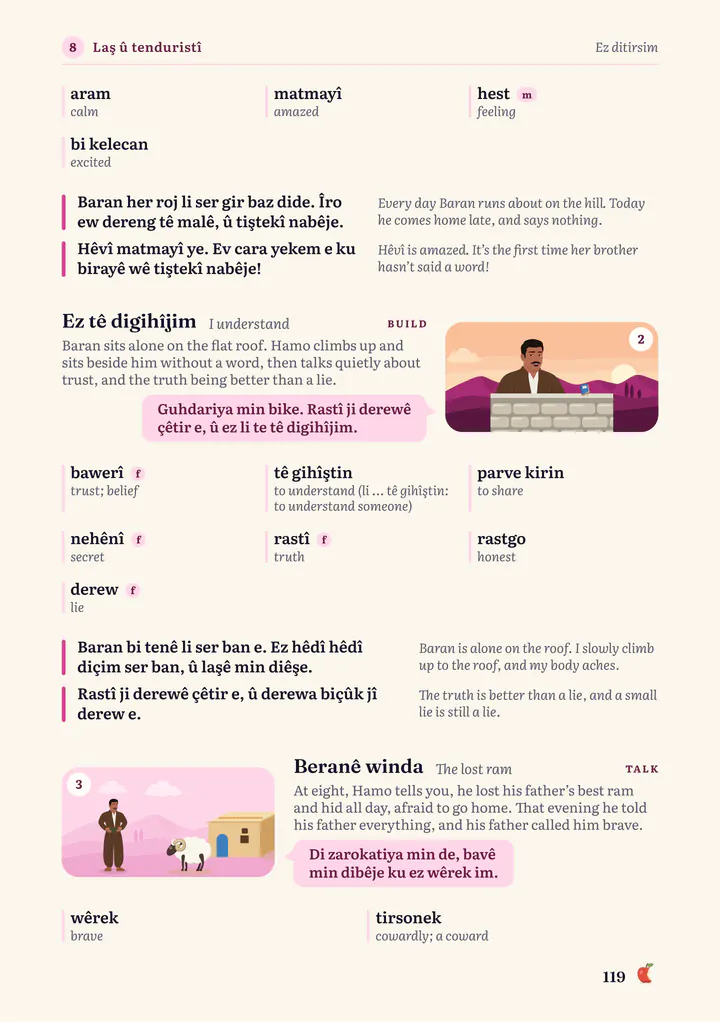
aram · calm
matmayî · amazed
hest (m) · feeling
bi kelecan · excited
Baran her roj li ser gir baz dide. Îro ew dereng tê malê, û tiştekî nabêje.
Every day Baran runs about on the hill. Today he comes home late, and says nothing.
Hêvî matmayî ye. Ev cara yekem e ku birayê wê tiştekî nabêje!
Hêvî is amazed. It’s the first time her brother hasn’t said a word!
Ez tê digihîjim · I understand · Build
Baran sits alone on the flat roof. Hamo climbs up and sits beside him without a word, then talks quietly about trust, and the truth being better than a lie.
Guhdariya min bike. Rastî ji derewê çêtir e, û ez li te tê digihîjim.
bawerî (f) · trust; belief
tê gihîştin · to understand (li … tê gihîştin: to understand someone)
parve kirin · to share
nehênî (f) · secret
rastî (f) · truth
rastgo · honest
derew (f) · lie
Baran bi tenê li ser ban e. Ez hêdî hêdî diçim ser ban, û laşê min diêşe.
Baran is alone on the roof. I slowly climb up to the roof, and my body aches.
Rastî ji derewê çêtir e, û derewa biçûk jî derew e.
The truth is better than a lie, and a small lie is still a lie.
Beranê winda · The lost ram · Talk
At eight, Hamo tells you, he lost his father’s best ram and hid all day, afraid to go home. That evening he told his father everything, and his father called him brave.
Di zarokatiya min de, bavê min dibêje ku ez wêrek im.
wêrek · brave
tirsonek · cowardly; a coward
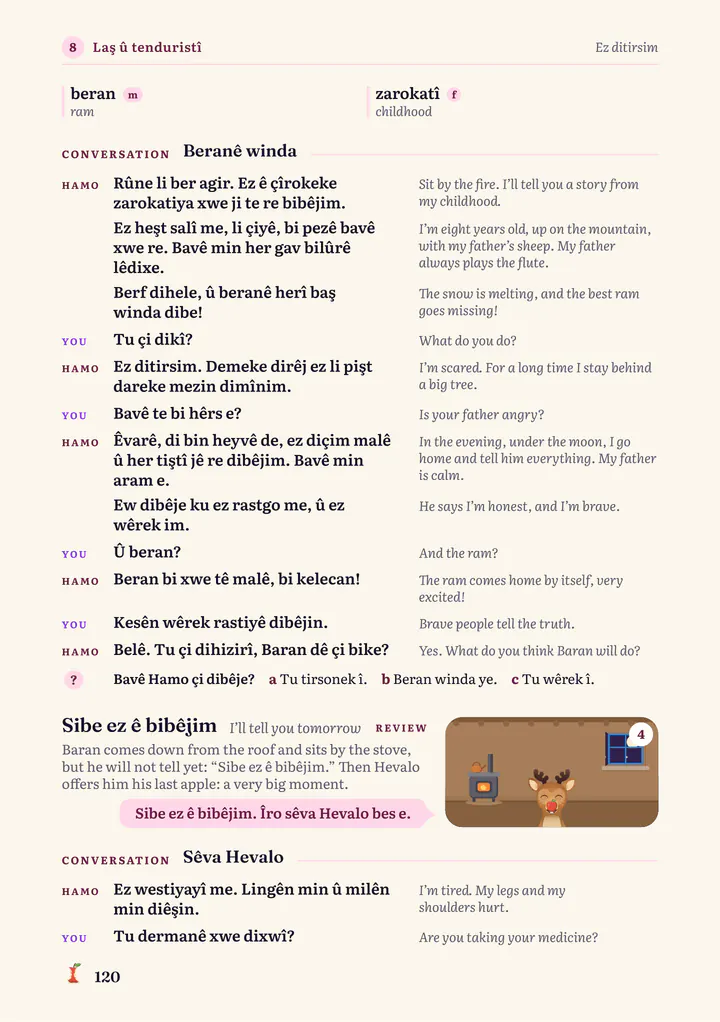
beran (m) · ram
zarokatî (f) · childhood
Conversation · Beranê winda
Hamo: Rûne li ber agir. Ez ê çîrokeke zarokatiya xwe ji te re bibêjim.
Sit by the fire. I’ll tell you a story from my childhood.
Ez heşt salî me, li çiyê, bi pezê bavê xwe re. Bavê min her gav bilûrê lêdixe.
I’m eight years old, up on the mountain, with my father’s sheep. My father always plays the flute.
Berf dihele, û beranê herî baş winda dibe!
The snow is melting, and the best ram goes missing!
You: Tu çi dikî? · What do you do?
Hamo: Ez ditirsim. Demeke dirêj ez li pişt dareke mezin dimînim.
I’m scared. For a long time I stay behind a big tree.
You: Bavê te bi hêrs e? · Is your father angry?
Hamo: Êvarê, di bin heyvê de, ez diçim malê û her tiştî jê re dibêjim. Bavê min aram e.
In the evening, under the moon, I go home and tell him everything. My father is calm.
Ew dibêje ku ez rastgo me, û ez wêrek im.
He says I’m honest, and I’m brave.
You: Û beran? · And the ram?
Hamo: Beran bi xwe tê malê, bi kelecan! · The ram comes home by itself, very excited!
You: Kesên wêrek rastiyê dibêjin. · Brave people tell the truth.
Hamo: Belê. Tu çi dihizirî, Baran dê çi bike? · Yes. What do you think Baran will do?
Bavê Hamo çi dibêje? a Tu tirsonek î. b Beran winda ye. c Tu wêrek î.
Sibe ez ê bibêjim · I’ll tell you tomorrow · Review
Baran comes down from the roof and sits by the stove, but he will not tell yet: “Sibe ez ê bibêjim.” Then Hevalo offers him his last apple: a very big moment.
Sibe ez ê bibêjim. Îro sêva Hevalo bes e.
Conversation · Sêva Hevalo
Hamo: Ez westiyayî me. Lingên min û milên min diêşin.
I’m tired. My legs and my shoulders hurt.
You: Tu dermanê xwe dixwî? · Are you taking your medicine?
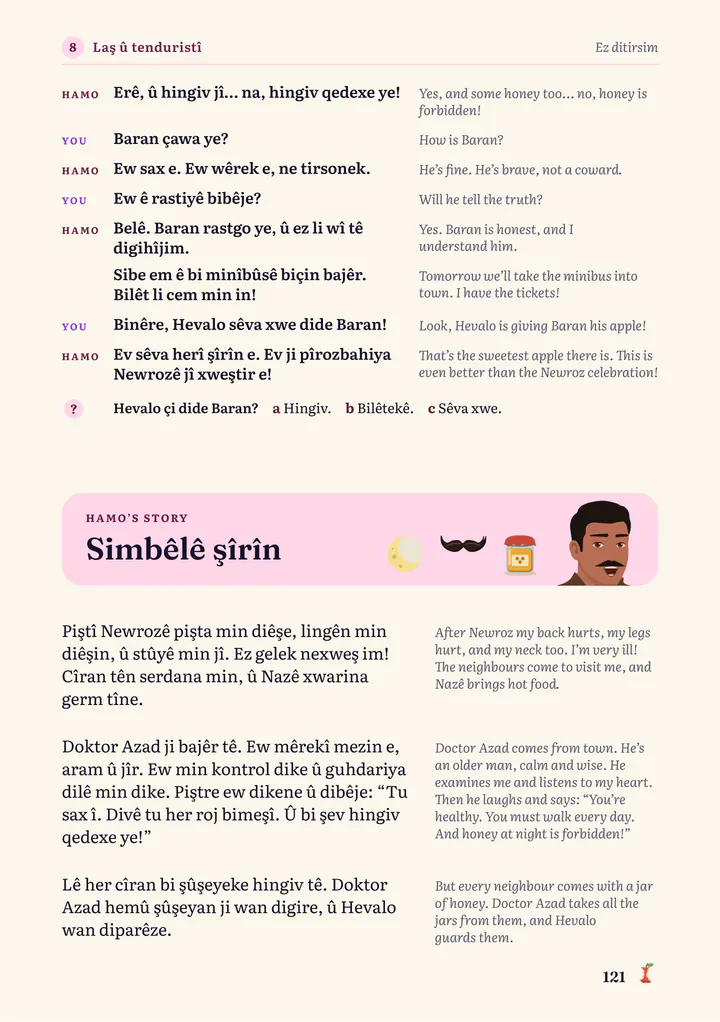
Hamo: Erê, û hingiv jî… na, hingiv qedexe ye! · Yes, and some honey too… no, honey is forbidden!
You: Baran çawa ye? · How is Baran?
Hamo: Ew sax e. Ew wêrek e, ne tirsonek. · He’s fine. He’s brave, not a coward.
You: Ew ê rastiyê bibêje? · Will he tell the truth?
Hamo: Belê. Baran rastgo ye, û ez li wî tê digihîjim.
Yes. Baran is honest, and I understand him.
Sibe em ê bi minîbûsê biçin bajêr. Bilêt li cem min in!
Tomorrow we’ll take the minibus into town. I have the tickets!
You: Binêre, Hevalo sêva xwe dide Baran! · Look, Hevalo is giving Baran his apple!
Hamo: Ev sêva herî şîrîn e. Ev ji pîrozbahiya Newrozê jî xweştir e!
That’s the sweetest apple there is. This is even better than the Newroz celebration!
Hevalo çi dide Baran? a Hingiv. b Bilêtekê. c Sêva xwe.
Hamo’s story
Piştî Newrozê pişta min diêşe, lingên min diêşin, û stûyê min jî. Ez gelek nexweş im! Cîran tên serdana min, û Nazê xwarina germ tîne.
After Newroz my back hurts, my legs hurt, and my neck too. I’m very ill! The neighbours come to visit me, and Nazê brings hot food.
Doktor Azad ji bajêr tê. Ew mêrekî mezin e, aram û jîr. Ew min kontrol dike û guhdariya dilê min dike. Piştre ew dikene û dibêje: “Tu sax î. Divê tu her roj bimeşî. Û bi şev hingiv qedexe ye!”
Doctor Azad comes from town. He’s an older man, calm and wise. He examines me and listens to my heart. Then he laughs and says: “You’re healthy. You must walk every day. And honey at night is forbidden!”
Lê her cîran bi şûşeyeke hingiv tê. Doktor Azad hemû şûşeyan ji wan digire, û Hevalo wan diparêze.
But every neighbour comes with a jar of honey. Doctor Azad takes all the jars from them, and Hevalo guards them.
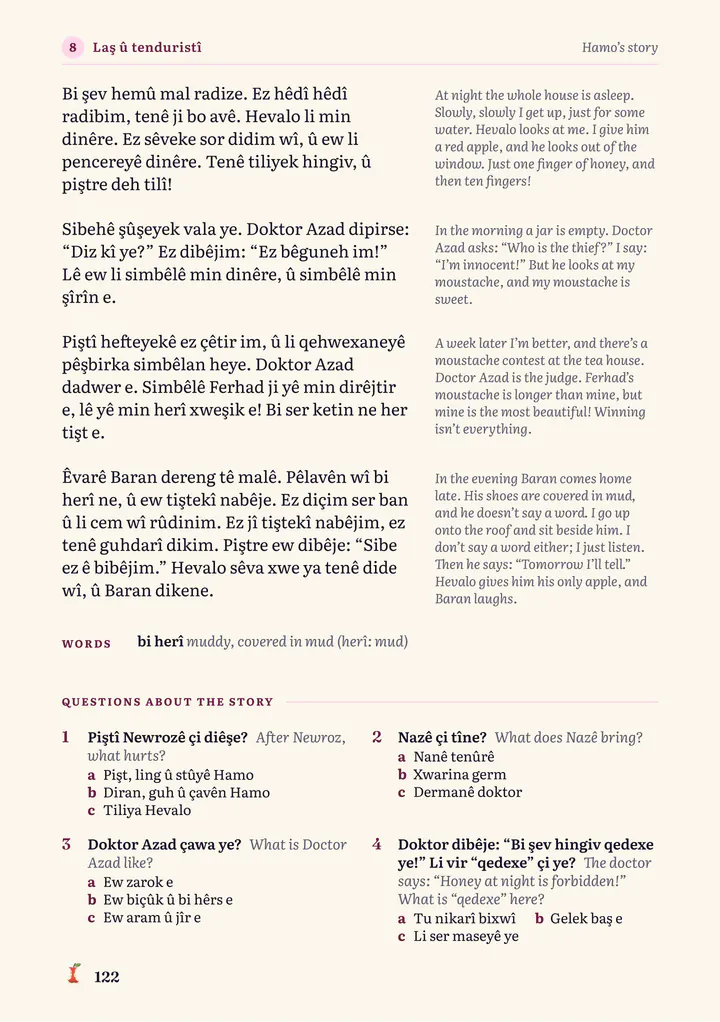
Bi şev hemû mal radize. Ez hêdî hêdî radibim, tenê ji bo avê. Hevalo li min dinêre. Ez sêveke sor didim wî, û ew li pencereyê dinêre. Tenê tiliyek hingiv, û piştre deh tilî!
At night the whole house is asleep. Slowly, slowly I get up, just for some water. Hevalo looks at me. I give him a red apple, and he looks out of the window. Just one finger of honey, and then ten fingers!
Sibehê şûşeyek vala ye. Doktor Azad dipirse: “Diz kî ye?” Ez dibêjim: “Ez bêguneh im!” Lê ew li simbêlê min dinêre, û simbêlê min şîrîn e.
In the morning a jar is empty. Doctor Azad asks: “Who is the thief?” I say: “I’m innocent!” But he looks at my moustache, and my moustache is sweet.
Piştî hefteyekê ez çêtir im, û li qehwexaneyê pêşbirka simbêlan heye. Doktor Azad dadwer e. Simbêlê Ferhad ji yê min dirêjtir e, lê yê min herî xweşik e! Bi ser ketin ne her tişt e.
A week later I’m better, and there’s a moustache contest at the tea house. Doctor Azad is the judge. Ferhad’s moustache is longer than mine, but mine is the most beautiful! Winning isn’t everything.
Êvarê Baran dereng tê malê. Pêlavên wî bi herî ne, û ew tiştekî nabêje. Ez diçim ser ban û li cem wî rûdinim. Ez jî tiştekî nabêjim, ez tenê guhdarî dikim. Piştre ew dibêje: “Sibe ez ê bibêjim.” Hevalo sêva xwe ya tenê dide wî, û Baran dikene.
In the evening Baran comes home late. His shoes are covered in mud, and he doesn’t say a word. I go up onto the roof and sit beside him. I don’t say a word either; I just listen. Then he says: “Tomorrow I’ll tell.” Hevalo gives him his only apple, and Baran laughs.
Words · bi herî muddy, covered in mud (herî: mud)
Questions about the story
1 · Piştî Newrozê çi diêşe? After Newroz, what hurts?
a · Pişt, ling û stûyê Hamo
b · Diran, guh û çavên Hamo
c · Tiliya Hevalo
2 · Nazê çi tîne? What does Nazê bring?
a · Nanê tenûrê
b · Xwarina germ
c · Dermanê doktor
3 · Doktor Azad çawa ye? What is Doctor Azad like?
a · Ew zarok e
b · Ew biçûk û bi hêrs e
c · Ew aram û jîr e
4 · Doktor dibêje: “Bi şev hingiv qedexe ye!” Li vir “qedexe” çi ye? The doctor says: “Honey at night is forbidden!” What is “qedexe” here?
a · Tu nikarî bixwî · b · Gelek baş e
c · Li ser maseyê ye
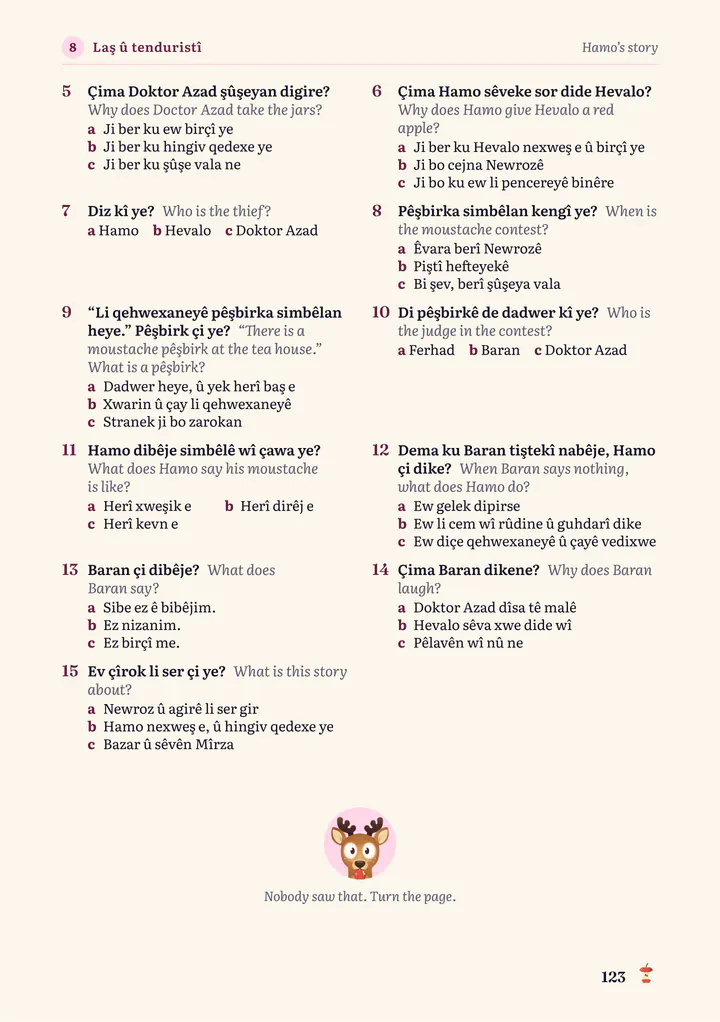
5 · Çima Doktor Azad şûşeyan digire? Why does Doctor Azad take the jars?
a · Ji ber ku ew birçî ye
b · Ji ber ku hingiv qedexe ye
c · Ji ber ku şûşe vala ne
6 · Çima Hamo sêveke sor dide Hevalo? Why does Hamo give Hevalo a red apple?
a · Ji ber ku Hevalo nexweş e û birçî ye
b · Ji bo cejna Newrozê
c · Ji bo ku ew li pencereyê binêre
7 · Diz kî ye? Who is the thief?
a Hamo b Hevalo c Doktor Azad
8 · Pêşbirka simbêlan kengî ye? When is the moustache contest?
a · Êvara berî Newrozê
b · Piştî hefteyekê
c · Bi şev, berî şûşeya vala
9 · “Li qehwexaneyê pêşbirka simbêlan heye.” Pêşbirk çi ye? “There is a moustache pêşbirk at the tea house.” What is a pêşbirk?
a · Dadwer heye, û yek herî baş e
b · Xwarin û çay li qehwexaneyê
c · Stranek ji bo zarokan
10 · Di pêşbirkê de dadwer kî ye? Who is the judge in the contest?
a Ferhad b Baran c Doktor Azad
11 · Hamo dibêje simbêlê wî çawa ye? What does Hamo say his moustache is like?
a · Herî xweşik e · b · Herî dirêj e
c · Herî kevn e
12 · Dema ku Baran tiştekî nabêje, Hamo çi dike? When Baran says nothing, what does Hamo do?
a · Ew gelek dipirse
b · Ew li cem wî rûdine û guhdarî dike
c · Ew diçe qehwexaneyê û çayê vedixwe
13 · Baran çi dibêje? What does Baran say?
a · Sibe ez ê bibêjim.
b · Ez nizanim.
c · Ez birçî me.
14 · Çima Baran dikene? Why does Baran laugh?
a · Doktor Azad dîsa tê malê
b · Hevalo sêva xwe dide wî
c · Pêlavên wî nû ne
15 · Ev çîrok li ser çi ye? What is this story about?
a · Newroz û agirê li ser gir
b · Hamo nexweş e, û hingiv qedexe ye
c · Bazar û sêvên Mîrza
Nobody saw that. Turn the page.
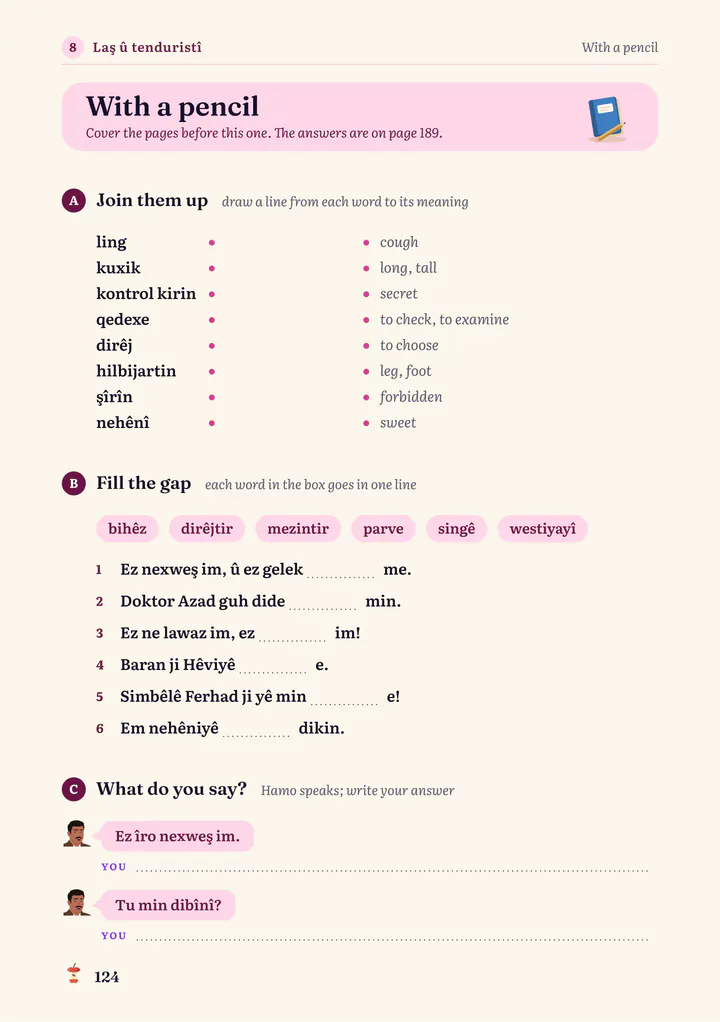
Cover the pages before this one. The answers are on page 189.
A · Join them up · draw a line from each word to its meaning
ling · cough
kuxik · long, tall
kontrol kirin · secret
qedexe · to check, to examine
dirêj · to choose
hilbijartin · leg, foot
şîrîn · forbidden
nehênî · sweet
B · Fill the gap · each word in the box goes in one line
bihêz · dirêjtir · mezintir · parve · singê · westiyayî
1 · Ez nexweş im, û ez gelek … me.
2 · Doktor Azad guh dide … min.
3 · Ez ne lawaz im, ez … im!
4 · Baran ji Hêviyê … e.
5 · Simbêlê Ferhad ji yê min … e!
6 · Em nehêniyê … dikin.
C · What do you say? · Hamo speaks; write your answer
Ez îro nexweş im.
You
Tu min dibînî?
You
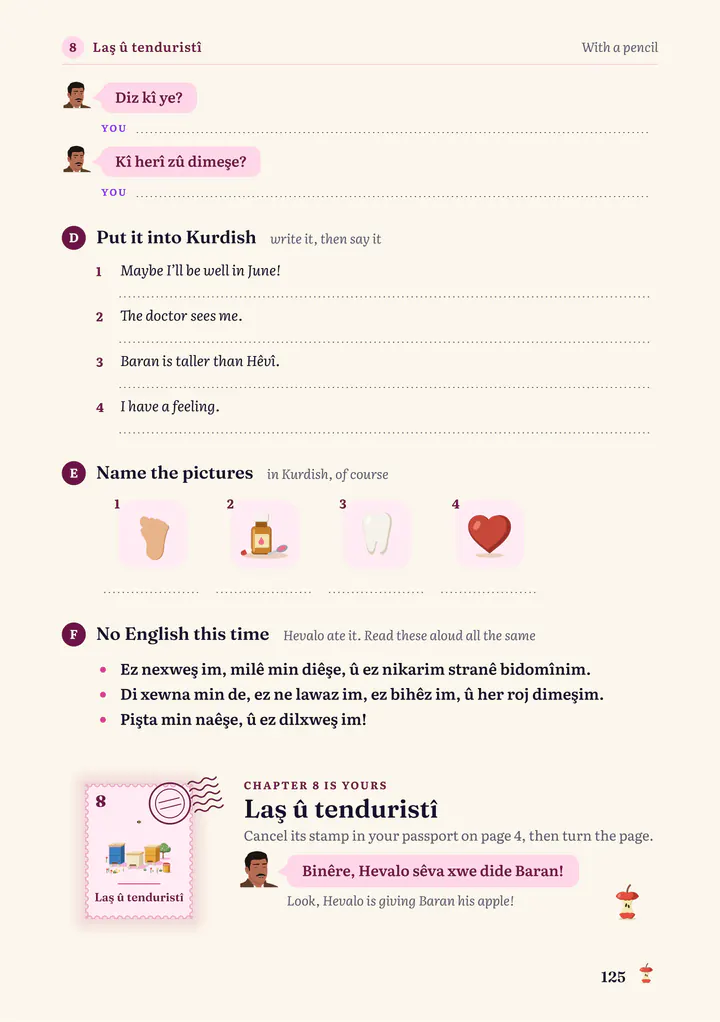
Diz kî ye?
You
Kî herî zû dimeşe?
You
D · Put it into Kurdish · write it, then say it
1 · Maybe I’ll be well in June!
2 · The doctor sees me.
3 · Baran is taller than Hêvî.
4 · I have a feeling.
E · Name the pictures · in Kurdish, of course
F · No English this time · Hevalo ate it. Read these aloud all the same
Ez nexweş im, milê min diêşe, û ez nikarim stranê bidomînim.
Di xewna min de, ez ne lawaz im, ez bihêz im, û her roj dimeşim.
Pişta min naêşe, û ez dilxweş im!
Laş û tenduristî
Chapter 8 is yours
Cancel its stamp in your passport on page 4, then turn the page.
Binêre, Hevalo sêva xwe dide Baran!
Look, Hevalo is giving Baran his apple!
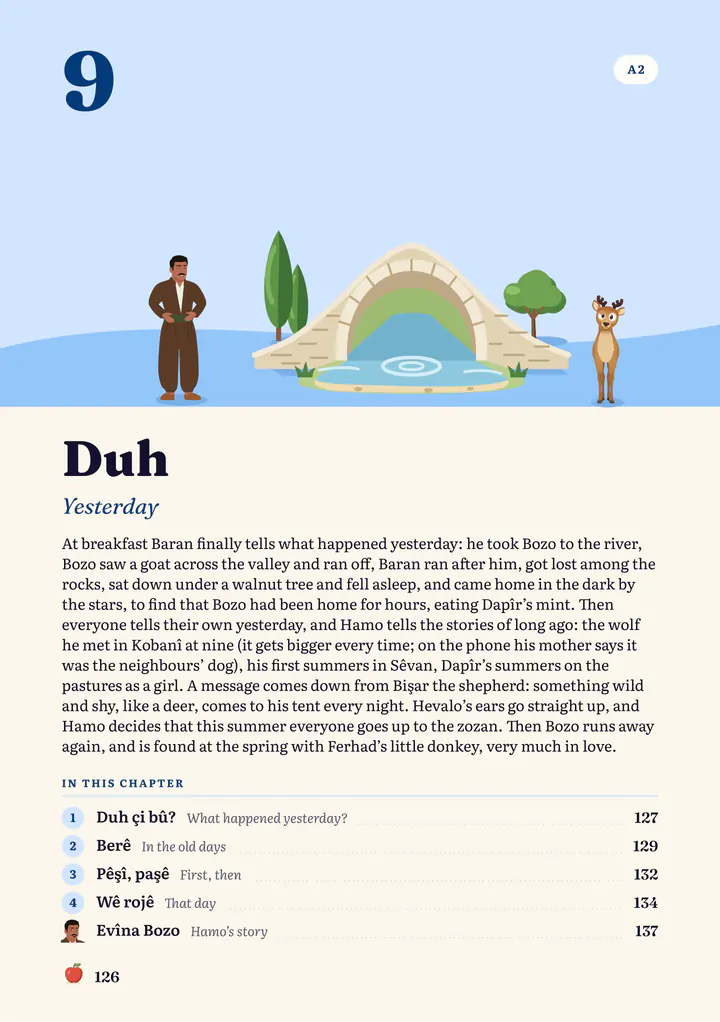
Yesterday
At breakfast Baran finally tells what happened yesterday: he took Bozo to the river, Bozo saw a goat across the valley and ran off, Baran ran after him, got lost among the rocks, sat down under a walnut tree and fell asleep, and came home in the dark by the stars, to find that Bozo had been home for hours, eating Dapîr’s mint. Then everyone tells their own yesterday, and Hamo tells the stories of long ago: the wolf he met in Kobanî at nine (it gets bigger every time; on the phone his mother says it was the neighbours’ dog), his first summers in Sêvan, Dapîr’s summers on the pastures as a girl. A message comes down from Bişar the shepherd: something wild and shy, like a deer, comes to his tent every night. Hevalo’s ears go straight up, and Hamo decides that this summer everyone goes up to the zozan. Then Bozo runs away again, and is found at the spring with Ferhad’s little donkey, very much in love.
In this chapter
1 · Duh çi bû? · What happened yesterday? · 127
2 · Berê · In the old days · 129
3 · Pêşî, paşê · First, then · 132
4 · Wê rojê · That day · 134
Evîna Bozo · Hamo’s story · 137
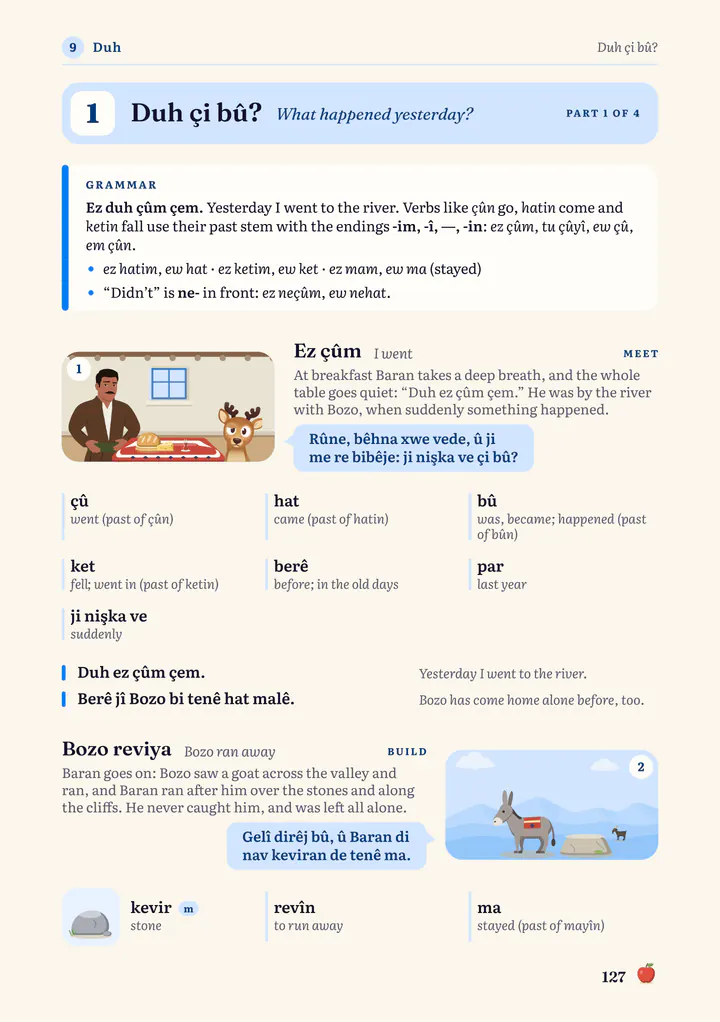
What happened yesterday? · Part 1 of 4
Grammar
Ez duh çûm çem. Yesterday I went to the river. Verbs like çûn go, hatin come and ketin fall use their past stem with the endings -im, -î, —, -in: ez çûm, tu çûyî, ew çû, em çûn.
ez hatim, ew hat · ez ketim, ew ket · ez mam, ew ma (stayed)
“Didn’t” is ne- in front: ez neçûm, ew nehat.
Ez çûm · I went · Meet
At breakfast Baran takes a deep breath, and the whole table goes quiet: “Duh ez çûm çem.” He was by the river with Bozo, when suddenly something happened.
Rûne, bêhna xwe vede, û ji me re bibêje: ji nişka ve çi bû?
çû · went (past of çûn)
hat · came (past of hatin)
bû · was, became; happened (past of bûn)
ket · fell; went in (past of ketin)
berê · before; in the old days
par · last year
ji nişka ve · suddenly
Duh ez çûm çem. · Yesterday I went to the river.
Berê jî Bozo bi tenê hat malê. · Bozo has come home alone before, too.
Bozo reviya · Bozo ran away · Build
Baran goes on: Bozo saw a goat across the valley and ran, and Baran ran after him over the stones and along the cliffs. He never caught him, and was left all alone.
Gelî dirêj bû, û Baran di nav keviran de tenê ma.
kevir (m) · stone
revîn · to run away
ma · stayed (past of mayîn)
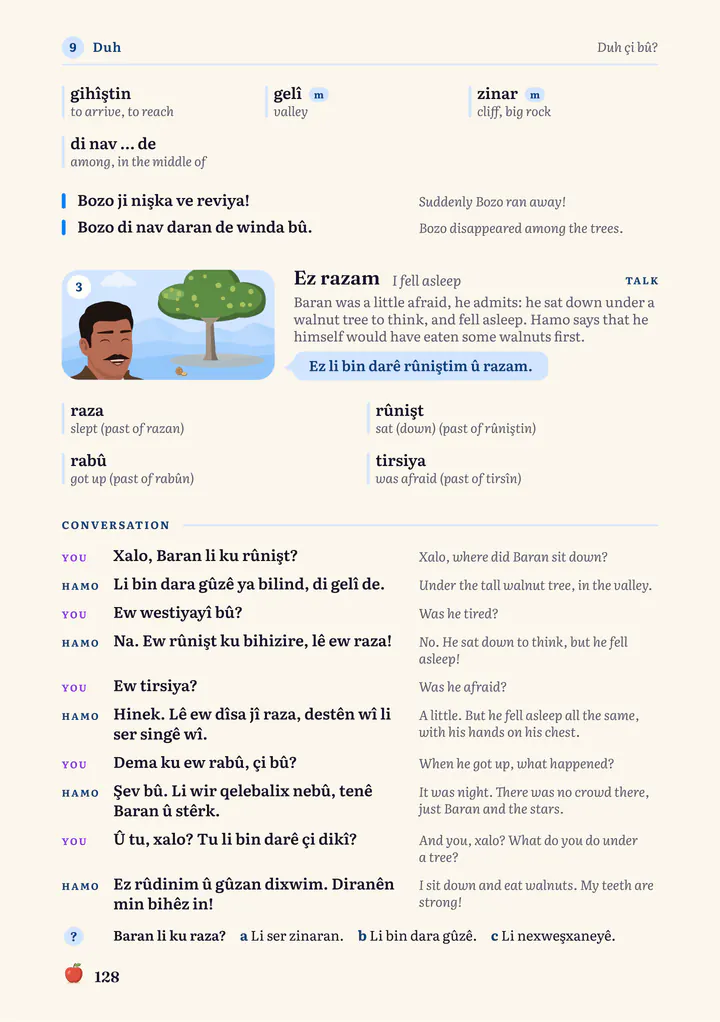
gihîştin · to arrive, to reach
gelî (m) · valley
zinar (m) · cliff, big rock
di nav … de · among, in the middle of
Bozo ji nişka ve reviya! · Suddenly Bozo ran away!
Bozo di nav daran de winda bû. · Bozo disappeared among the trees.
Ez razam · I fell asleep · Talk
Baran was a little afraid, he admits: he sat down under a walnut tree to think, and fell asleep. Hamo says that he himself would have eaten some walnuts first.
Ez li bin darê rûniştim û razam.
raza · slept (past of razan)
rûnişt · sat (down) (past of rûniştin)
rabû · got up (past of rabûn)
tirsiya · was afraid (past of tirsîn)
Conversation
You: Xalo, Baran li ku rûnişt? · Xalo, where did Baran sit down?
Hamo: Li bin dara gûzê ya bilind, di gelî de. · Under the tall walnut tree, in the valley.
You: Ew westiyayî bû? · Was he tired?
Hamo: Na. Ew rûnişt ku bihizire, lê ew raza! · No. He sat down to think, but he fell asleep!
You: Ew tirsiya? · Was he afraid?
Hamo: Hinek. Lê ew dîsa jî raza, destên wî li ser singê wî.
A little. But he fell asleep all the same, with his hands on his chest.
You: Dema ku ew rabû, çi bû? · When he got up, what happened?
Hamo: Şev bû. Li wir qelebalix nebû, tenê Baran û stêrk.
It was night. There was no crowd there, just Baran and the stars.
You: Û tu, xalo? Tu li bin darê çi dikî? · And you, xalo? What do you do under a tree?
Hamo: Ez rûdinim û gûzan dixwim. Diranên min bihêz in!
I sit down and eat walnuts. My teeth are strong!
Baran li ku raza? a Li ser zinaran. b Li bin dara gûzê. c Li nexweşxaneyê.
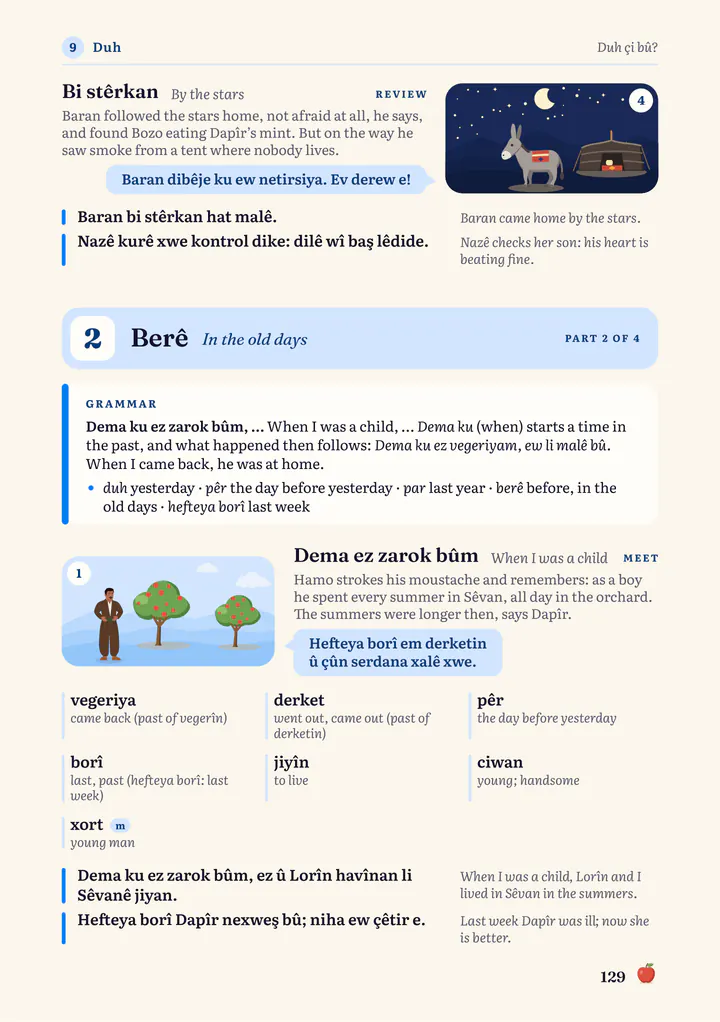
Bi stêrkan · By the stars · Review
Baran followed the stars home, not afraid at all, he says, and found Bozo eating Dapîr’s mint. But on the way he saw smoke from a tent where nobody lives.
Baran dibêje ku ew netirsiya. Ev derew e!
Baran bi stêrkan hat malê. · Baran came home by the stars.
Nazê kurê xwe kontrol dike: dilê wî baş lêdide. · Nazê checks her son: his heart is beating fine.
In the old days · Part 2 of 4
Grammar
Dema ku ez zarok bûm, … When I was a child, … Dema ku (when) starts a time in the past, and what happened then follows: Dema ku ez vegeriyam, ew li malê bû. When I came back, he was at home.
duh yesterday · pêr the day before yesterday · par last year · berê before, in the old days · hefteya borî last week
Dema ez zarok bûm · When I was a child · Meet
Hamo strokes his moustache and remembers: as a boy he spent every summer in Sêvan, all day in the orchard. The summers were longer then, says Dapîr.
Hefteya borî em derketin û çûn serdana xalê xwe.
vegeriya · came back (past of vegerîn)
derket · went out, came out (past of derketin)
pêr · the day before yesterday
borî · last, past (hefteya borî: last week)
jiyîn · to live
ciwan · young; handsome
xort (m) · young man
Dema ku ez zarok bûm, ez û Lorîn havînan li Sêvanê jiyan.
When I was a child, Lorîn and I lived in Sêvan in the summers.
Hefteya borî Dapîr nexweş bû; niha ew çêtir e. · Last week Dapîr was ill; now she is better.
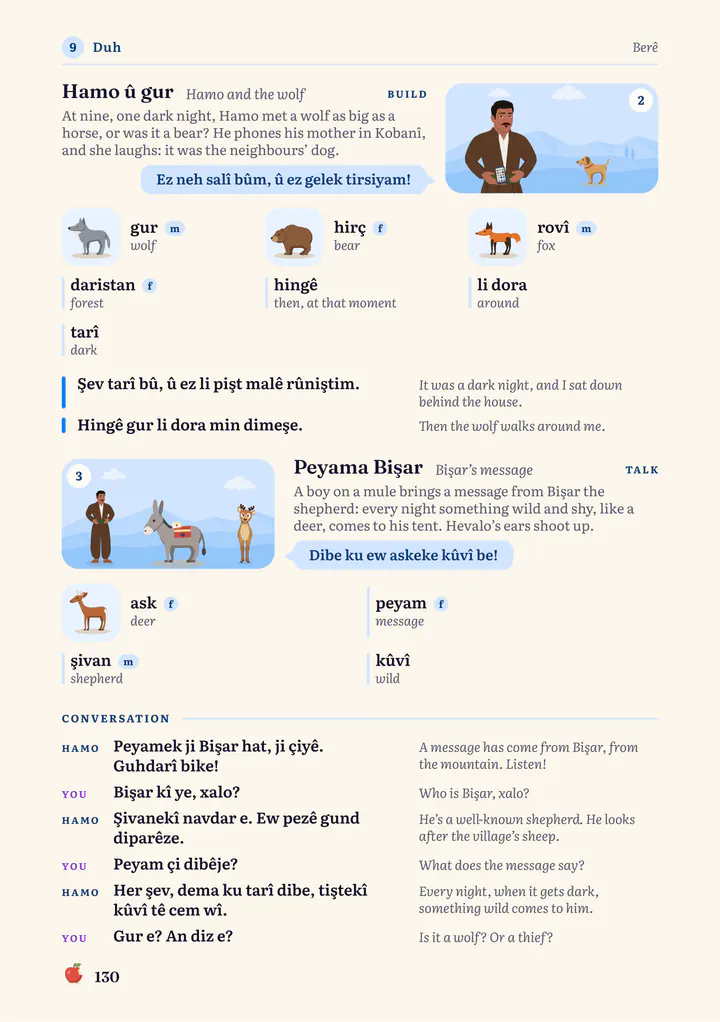
Hamo û gur · Hamo and the wolf · Build
At nine, one dark night, Hamo met a wolf as big as a horse, or was it a bear? He phones his mother in Kobanî, and she laughs: it was the neighbours’ dog.
Ez neh salî bûm, û ez gelek tirsiyam!
gur (m) · wolf
hirç (f) · bear
rovî (m) · fox
daristan (f) · forest
hingê · then, at that moment
li dora · around
tarî · dark
Şev tarî bû, û ez li pişt malê rûniştim. · It was a dark night, and I sat down behind the house.
Hingê gur li dora min dimeşe. · Then the wolf walks around me.
Peyama Bişar · Bişar’s message · Talk
A boy on a mule brings a message from Bişar the shepherd: every night something wild and shy, like a deer, comes to his tent. Hevalo’s ears shoot up.
Dibe ku ew askeke kûvî be!
ask (f) · deer
peyam (f) · message
şivan (m) · shepherd
kûvî · wild
Conversation
Hamo: Peyamek ji Bişar hat, ji çiyê. Guhdarî bike!
A message has come from Bişar, from the mountain. Listen!
You: Bişar kî ye, xalo? · Who is Bişar, xalo?
Hamo: Şivanekî navdar e. Ew pezê gund diparêze.
He’s a well-known shepherd. He looks after the village’s sheep.
You: Peyam çi dibêje? · What does the message say?
Hamo: Her şev, dema ku tarî dibe, tiştekî kûvî tê cem wî.
Every night, when it gets dark, something wild comes to him.
You: Gur e? An diz e? · Is it a wolf? Or a thief?
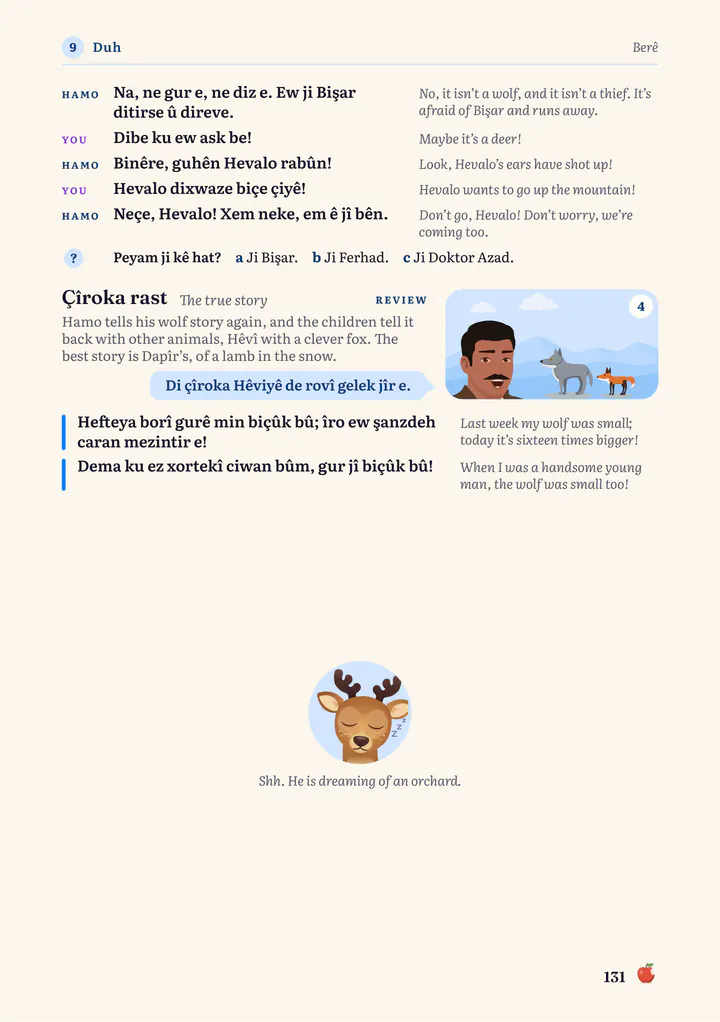
Hamo: Na, ne gur e, ne diz e. Ew ji Bişar ditirse û direve.
No, it isn’t a wolf, and it isn’t a thief. It’s afraid of Bişar and runs away.
You: Dibe ku ew ask be! · Maybe it’s a deer!
Hamo: Binêre, guhên Hevalo rabûn! · Look, Hevalo’s ears have shot up!
You: Hevalo dixwaze biçe çiyê! · Hevalo wants to go up the mountain!
Hamo: Neçe, Hevalo! Xem neke, em ê jî bên. · Don’t go, Hevalo! Don’t worry, we’re coming too.
Peyam ji kê hat? a Ji Bişar. b Ji Ferhad. c Ji Doktor Azad.
Çîroka rast · The true story · Review
Hamo tells his wolf story again, and the children tell it back with other animals, Hêvî with a clever fox. The best story is Dapîr’s, of a lamb in the snow.
Di çîroka Hêviyê de rovî gelek jîr e.
Hefteya borî gurê min biçûk bû; îro ew şanzdeh caran mezintir e!
Last week my wolf was small; today it’s sixteen times bigger!
Dema ku ez xortekî ciwan bûm, gur jî biçûk bû! · When I was a handsome young man, the wolf was small too!
Shh. He is dreaming of an orchard.
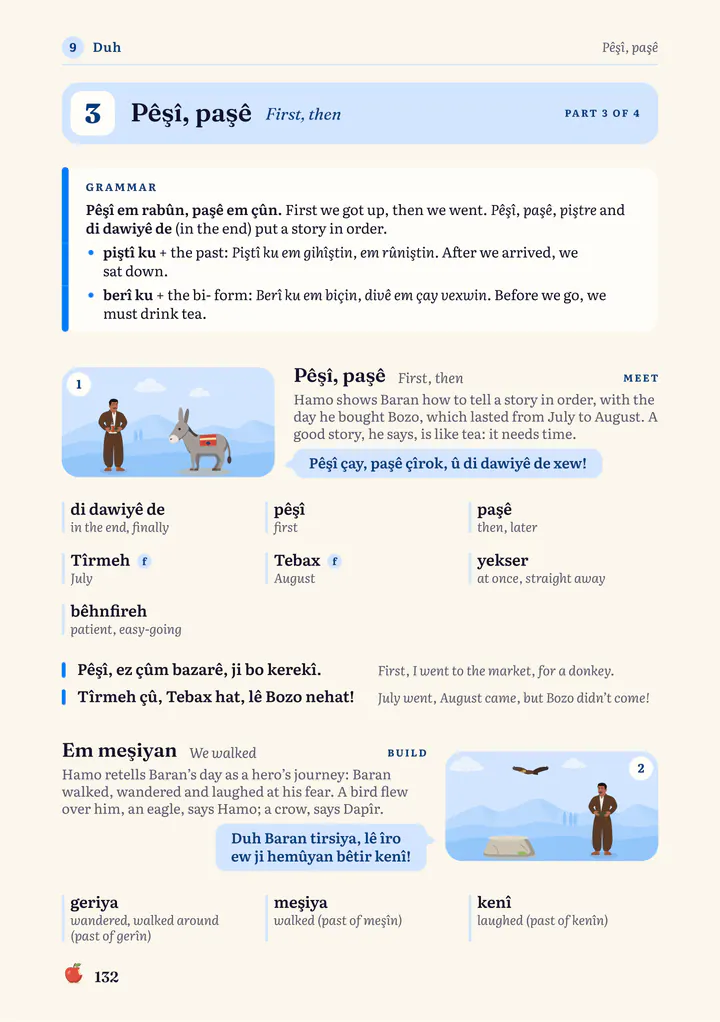
First, then · Part 3 of 4
Grammar
Pêşî em rabûn, paşê em çûn. First we got up, then we went. Pêşî, paşê, piştre and di dawiyê de (in the end) put a story in order.
piştî ku + the past: Piştî ku em gihîştin, em rûniştin. After we arrived, we sat down.
berî ku + the bi- form: Berî ku em biçin, divê em çay vexwin. Before we go, we must drink tea.
Pêşî, paşê · First, then · Meet
Hamo shows Baran how to tell a story in order, with the day he bought Bozo, which lasted from July to August. A good story, he says, is like tea: it needs time.
Pêşî çay, paşê çîrok, û di dawiyê de xew!
di dawiyê de · in the end, finally
pêşî · first
paşê · then, later
Tîrmeh (f) · July
Tebax (f) · August
yekser · at once, straight away
bêhnfireh · patient, easy-going
Pêşî, ez çûm bazarê, ji bo kerekî. · First, I went to the market, for a donkey.
Tîrmeh çû, Tebax hat, lê Bozo nehat! · July went, August came, but Bozo didn’t come!
Em meşiyan · We walked · Build
Hamo retells Baran’s day as a hero’s journey: Baran walked, wandered and laughed at his fear. A bird flew over him, an eagle, says Hamo; a crow, says Dapîr.
Duh Baran tirsiya, lê îro ew ji hemûyan bêtir kenî!
geriya · wandered, walked around (past of gerîn)
meşiya · walked (past of meşîn)
kenî · laughed (past of kenîn)
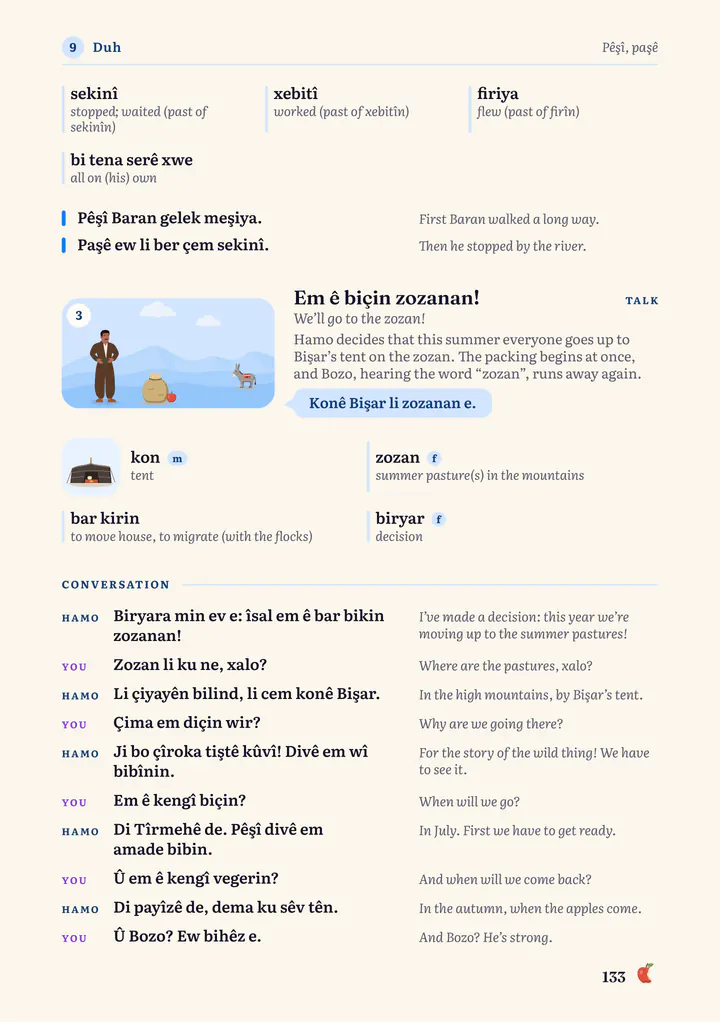
sekinî · stopped; waited (past of sekinîn)
xebitî · worked (past of xebitîn)
firiya · flew (past of firîn)
bi tena serê xwe · all on (his) own
Pêşî Baran gelek meşiya. · First Baran walked a long way.
Paşê ew li ber çem sekinî. · Then he stopped by the river.
Em ê biçin zozanan!
We’ll go to the zozan!
Talk
Hamo decides that this summer everyone goes up to Bişar’s tent on the zozan. The packing begins at once, and Bozo, hearing the word “zozan”, runs away again.
Konê Bişar li zozanan e.
kon (m) · tent
zozan (f) · summer pasture(s) in the mountains
bar kirin · to move house, to migrate (with the flocks)
biryar (f) · decision
Conversation
Hamo: Biryara min ev e: îsal em ê bar bikin zozanan!
I’ve made a decision: this year we’re moving up to the summer pastures!
You: Zozan li ku ne, xalo? · Where are the pastures, xalo?
Hamo: Li çiyayên bilind, li cem konê Bişar. · In the high mountains, by Bişar’s tent.
You: Çima em diçin wir? · Why are we going there?
Hamo: Ji bo çîroka tiştê kûvî! Divê em wî bibînin.
For the story of the wild thing! We have to see it.
You: Em ê kengî biçin? · When will we go?
Hamo: Di Tîrmehê de. Pêşî divê em amade bibin.
In July. First we have to get ready.
You: Û em ê kengî vegerin? · And when will we come back?
Hamo: Di payîzê de, dema ku sêv tên. · In the autumn, when the apples come.
You: Û Bozo? Ew bihêz e. · And Bozo? He’s strong.
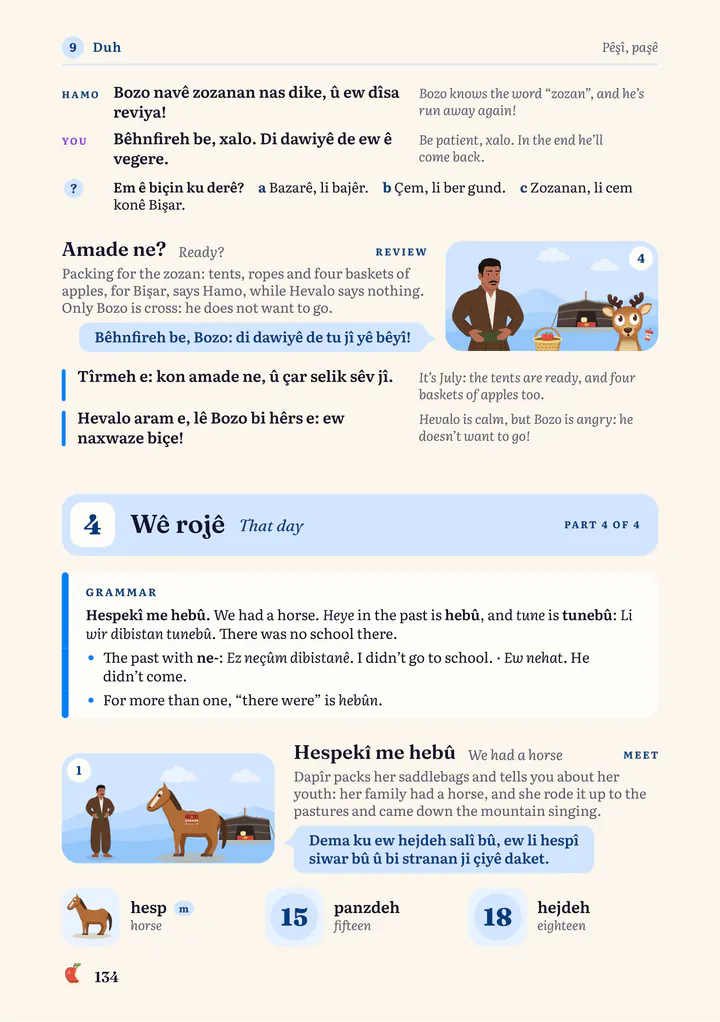
Hamo: Bozo navê zozanan nas dike, û ew dîsa reviya!
Bozo knows the word “zozan”, and he’s run away again!
You: Bêhnfireh be, xalo. Di dawiyê de ew ê vegere.
Be patient, xalo. In the end he’ll come back.
Em ê biçin ku derê? a Bazarê, li bajêr. b Çem, li ber gund. c Zozanan, li cem konê Bişar.
Amade ne? · Ready? · Review
Packing for the zozan: tents, ropes and four baskets of apples, for Bişar, says Hamo, while Hevalo says nothing. Only Bozo is cross: he does not want to go.
Bêhnfireh be, Bozo: di dawiyê de tu jî yê bêyî!
Tîrmeh e: kon amade ne, û çar selik sêv jî. · It’s July: the tents are ready, and four baskets of apples too.
Hevalo aram e, lê Bozo bi hêrs e: ew naxwaze biçe!
Hevalo is calm, but Bozo is angry: he doesn’t want to go!
That day · Part 4 of 4
Grammar
Hespekî me hebû. We had a horse. Heye in the past is hebû, and tune is tunebû: Li wir dibistan tunebû. There was no school there.
The past with ne-: Ez neçûm dibistanê. I didn’t go to school. · Ew nehat. He didn’t come.
For more than one, “there were” is hebûn.
Hespekî me hebû · We had a horse · Meet
Dapîr packs her saddlebags and tells you about her youth: her family had a horse, and she rode it up to the pastures and came down the mountain singing.
Dema ku ew hejdeh salî bû, ew li hespî siwar bû û bi stranan ji çiyê daket.
hesp (m) · horse
panzdeh · fifteen
hejdeh · eighteen
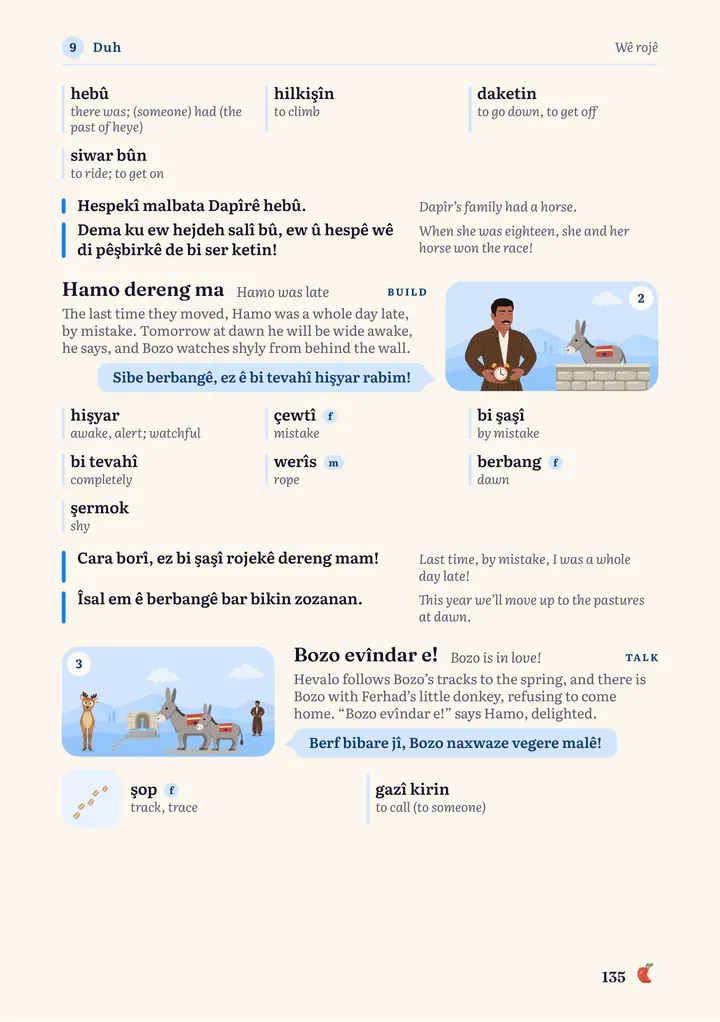
hebû · there was; (someone) had (the past of heye)
hilkişîn · to climb
daketin · to go down, to get off
siwar bûn · to ride; to get on
Hespekî malbata Dapîrê hebû. · Dapîr’s family had a horse.
Dema ku ew hejdeh salî bû, ew û hespê wê di pêşbirkê de bi ser ketin!
When she was eighteen, she and her horse won the race!
Hamo dereng ma · Hamo was late · Build
The last time they moved, Hamo was a whole day late, by mistake. Tomorrow at dawn he will be wide awake, he says, and Bozo watches shyly from behind the wall.
Sibe berbangê, ez ê bi tevahî hişyar rabim!
hişyar · awake, alert; watchful
çewtî (f) · mistake
bi şaşî · by mistake
bi tevahî · completely
werîs (m) · rope
berbang (f) · dawn
şermok · shy
Cara borî, ez bi şaşî rojekê dereng mam! · Last time, by mistake, I was a whole day late!
Îsal em ê berbangê bar bikin zozanan. · This year we’ll move up to the pastures at dawn.
Bozo evîndar e! · Bozo is in love! · Talk
Hevalo follows Bozo’s tracks to the spring, and there is Bozo with Ferhad’s little donkey, refusing to come home. “Bozo evîndar e!” says Hamo, delighted.
Berf bibare jî, Bozo naxwaze vegere malê!
şop (f) · track, trace
gazî kirin · to call (to someone)
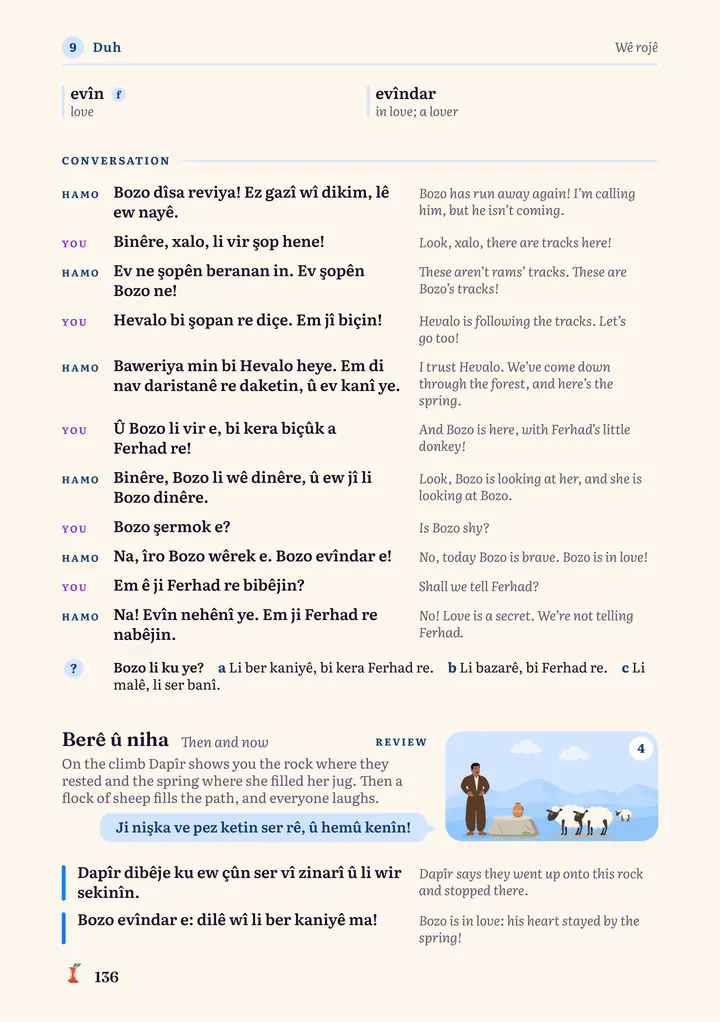
evîn (f) · love
evîndar · in love; a lover
Conversation
Hamo: Bozo dîsa reviya! Ez gazî wî dikim, lê ew nayê.
Bozo has run away again! I’m calling him, but he isn’t coming.
You: Binêre, xalo, li vir şop hene! · Look, xalo, there are tracks here!
Hamo: Ev ne şopên beranan in. Ev şopên Bozo ne!
These aren’t rams’ tracks. These are Bozo’s tracks!
You: Hevalo bi şopan re diçe. Em jî biçin! · Hevalo is following the tracks. Let’s go too!
Hamo: Baweriya min bi Hevalo heye. Em di nav daristanê re daketin, û ev kanî ye.
I trust Hevalo. We’ve come down through the forest, and here’s the spring.
You: Û Bozo li vir e, bi kera biçûk a Ferhad re!
And Bozo is here, with Ferhad’s little donkey!
Hamo: Binêre, Bozo li wê dinêre, û ew jî li Bozo dinêre.
Look, Bozo is looking at her, and she is looking at Bozo.
You: Bozo şermok e? · Is Bozo shy?
Hamo: Na, îro Bozo wêrek e. Bozo evîndar e! · No, today Bozo is brave. Bozo is in love!
You: Em ê ji Ferhad re bibêjin? · Shall we tell Ferhad?
Hamo: Na! Evîn nehênî ye. Em ji Ferhad re nabêjin.
No! Love is a secret. We’re not telling Ferhad.
Bozo li ku ye? a Li ber kaniyê, bi kera Ferhad re. b Li bazarê, bi Ferhad re. c Li malê, li ser banî.
Berê û niha · Then and now · Review
On the climb Dapîr shows you the rock where they rested and the spring where she filled her jug. Then a flock of sheep fills the path, and everyone laughs.
Ji nişka ve pez ketin ser rê, û hemû kenîn!
Dapîr dibêje ku ew çûn ser vî zinarî û li wir sekinîn.
Dapîr says they went up onto this rock and stopped there.
Bozo evîndar e: dilê wî li ber kaniyê ma! · Bozo is in love: his heart stayed by the spring!
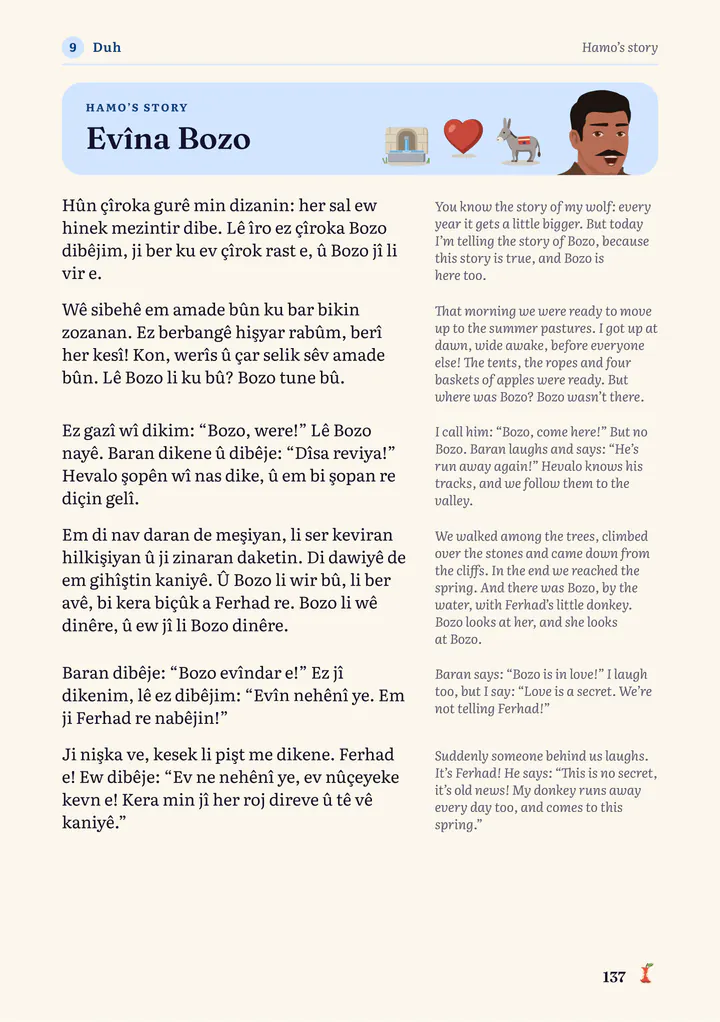
Hamo’s story
Hûn çîroka gurê min dizanin: her sal ew hinek mezintir dibe. Lê îro ez çîroka Bozo dibêjim, ji ber ku ev çîrok rast e, û Bozo jî li vir e.
You know the story of my wolf: every year it gets a little bigger. But today I’m telling the story of Bozo, because this story is true, and Bozo is here too.
Wê sibehê em amade bûn ku bar bikin zozanan. Ez berbangê hişyar rabûm, berî her kesî! Kon, werîs û çar selik sêv amade bûn. Lê Bozo li ku bû? Bozo tune bû.
That morning we were ready to move up to the summer pastures. I got up at dawn, wide awake, before everyone else! The tents, the ropes and four baskets of apples were ready. But where was Bozo? Bozo wasn’t there.
Ez gazî wî dikim: “Bozo, were!” Lê Bozo nayê. Baran dikene û dibêje: “Dîsa reviya!” Hevalo şopên wî nas dike, û em bi şopan re diçin gelî.
I call him: “Bozo, come here!” But no Bozo. Baran laughs and says: “He’s run away again!” Hevalo knows his tracks, and we follow them to the valley.
Em di nav daran de meşiyan, li ser keviran hilkişiyan û ji zinaran daketin. Di dawiyê de em gihîştin kaniyê. Û Bozo li wir bû, li ber avê, bi kera biçûk a Ferhad re. Bozo li wê dinêre, û ew jî li Bozo dinêre.
We walked among the trees, climbed over the stones and came down from the cliffs. In the end we reached the spring. And there was Bozo, by the water, with Ferhad’s little donkey. Bozo looks at her, and she looks at Bozo.
Baran dibêje: “Bozo evîndar e!” Ez jî dikenim, lê ez dibêjim: “Evîn nehênî ye. Em ji Ferhad re nabêjin!”
Baran says: “Bozo is in love!” I laugh too, but I say: “Love is a secret. We’re not telling Ferhad!”
Ji nişka ve, kesek li pişt me dikene. Ferhad e! Ew dibêje: “Ev ne nehênî ye, ev nûçeyeke kevn e! Kera min jî her roj direve û tê vê kaniyê.”
Suddenly someone behind us laughs. It’s Ferhad! He says: “This is no secret, it’s old news! My donkey runs away every day too, and comes to this spring.”
Biryara Ferhad ev e: kera wî jî tê zozanan, bi selikên Dapîrê. Û Bozo? Bozo, kerê herî hêdî yê gund, wê rojê ji hemûyan zûtir hilkişiya çiyê, û carekê jî nesekinî.
Ferhad’s decision is this: his donkey is coming up to the pastures too, with Dapîr’s baskets. And Bozo? Bozo, the slowest donkey in the village, climbed the mountain faster than anyone that day, and didn’t stop even once.
Hingê ez tê gihîştim: ji bo kerekî evîndar, rê ne dûr e, û çiya jî ne bilind e! Li ser çiyê, kesek gazî me dike. Ew kî ye? Hûn ê bibînin.
Then I understood: for a donkey in love, no road is far and no mountain is high! Up on the mountain, someone is calling to us. Who is it? You’ll see.
Questions about the story
1 · Em amade bûn ku biçin ku derê? Where were we ready to go?
a Zozanan b Bazarê c Kobaniyê
2 · Wê sibehê Hamo dereng ma? Was Hamo late that morning?
a · Erê, rojekê
b · Na, ew berî her kesî rabû
c · Erê, ew piştî her kesî rabû
3 · “Ez berbangê hişyar rabûm.” Berbang kengî ye? “I got up at berbang.” When is berbang?
a · Sibeha zû, berî rojê
b · Nîvro, dema ku tav germ e
c · Êvarê, piştî şîvê
4 · Berbangê çi amade bû? What was ready at dawn?
a · Nan, çay û penîr · b · Kon, werîs û sêv
c · Hesp û trên
5 · Kî dibêje: “Dîsa reviya!”? Who says: “He’s run away again!”?
a Hevalo b Ferhad c Baran
6 · Kî şopên Bozo nas dike? Who knows Bozo’s tracks?
a Hevalo b Dapîr c Ferhad
7 · Pêşî çi bû? What happened first?
a · Em di nav daran de meşiyan
b · Em gihîştin kaniyê
c · Ferhad ji pişt me derket
8 · Bozo li ku bû? Where was Bozo?
a · Li malê, li ser banê
b · Li zozanan, li cem Bişar
c · Li ber kaniyê, bi kera Ferhad re
9 · “Bozo evîndar e.” Ev çi ye? “Bozo evîndar e.” What does it mean?
a · Bozo li ber kaniyê nexweş e
b · Bozo ji kera Ferhad hez dike
c · Bozo birçî û westiyayî ye
10 · “Em ji Ferhad re nabêjin.” Hamo çi dixwaze? “We’re not telling Ferhad.” What does Hamo want?
a · Ev nehênî bimîne
b · Ferhad bê kaniyê
c · Bozo vegere malê
11 · Piştî ku em gihîştin kaniyê, kî hat? After we reached the spring, who came?
a Ferhad b Bişar c Dapîr
12 · Ferhad çima dikene? Why does Ferhad laugh?
a · Ji ber ku Hamo ket avê
b · Ji ber ku ev ji bo wî nûçeyeke kevn e
c · Ji ber ku Bozo reviya malê
13 · Biryara Ferhad çi ye? What is Ferhad’s decision?
a · Bozo li gund dimîne
b · Ew kera xwe difiroşe
c · Kera wî jî tê zozanan
14 · Çima wê rojê Bozo ji hemûyan zûtir hilkişiya? Why did Bozo climb faster than anyone that day?
a · Ji ber ku ew birçî bû
b · Ji ber ku kera Ferhad jî tê
c · Ji ber ku gur hat
15 · Ev çîrok li ser çi ye? What is this story about?
a · Gurê Hamo yê mezin
b · Bozo û evîna wî
c · Bazara Amedê
A moustache like this takes time. So does Kurdish.
Cover the pages before this one. The answers are on page 189.
A · Join them up · draw a line from each word to its meaning
ket · ran away · paşê · walked
reviya · fell · meşiya · then, later
derket · bear · siwar bûn · by mistake
hirç · went out · bi şaşî · to ride
B · Fill the gap · each word in the box goes in one line
ciwan · çû · pêşî · şaşî · tirsiya · zozanan
1 · Duh Baran bi Bozo re … çem.
2 · Baran …, lê ew wêrek bû.
Baran was afraid, but he was brave.
3 · Dema ku ez … bûm, simbêlê min kintir bû.
4 · Ez … çûm bazarê, paşê çûm cem Bozo.
5 · Îsal em ê biçin …!
6 · Ez bi … dereng mam.
C · What do you say? · Hamo speaks; write your answer
Tu duh çûyî ku derê?
You
Heb pêwîst e, an derzî?
You
Di çîroka Hêviyê de ew rovî ye. Di ya Baran de çi ye?
You
Zozan çiqas dûr e?
You
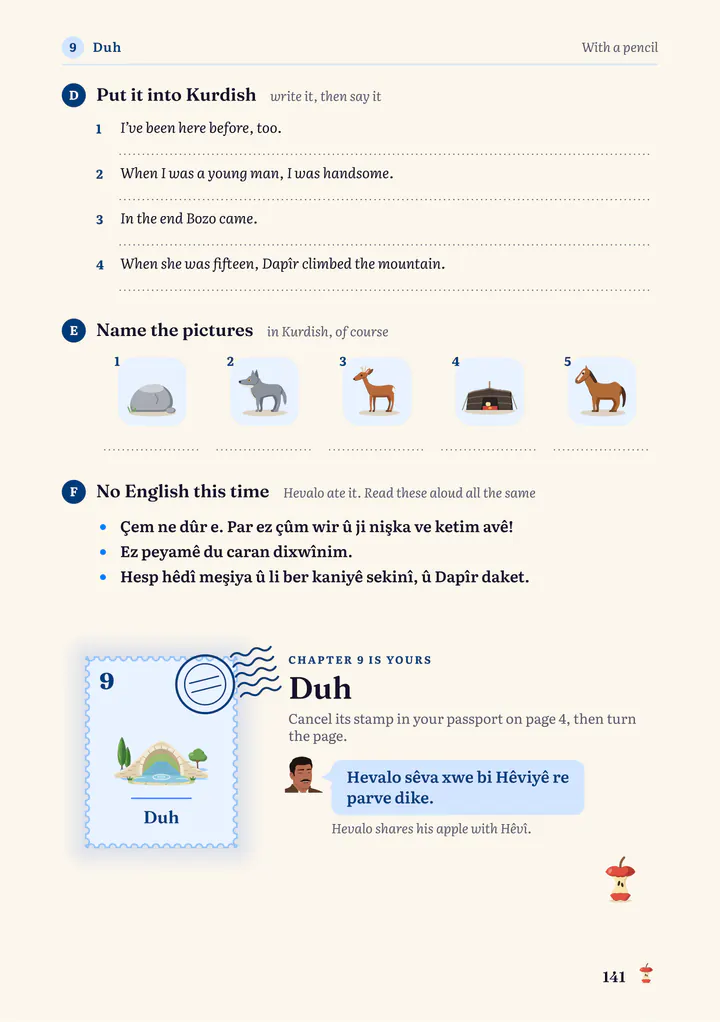
D · Put it into Kurdish · write it, then say it
1 · I’ve been here before, too.
2 · When I was a young man, I was handsome.
3 · In the end Bozo came.
4 · When she was fifteen, Dapîr climbed the mountain.
E · Name the pictures · in Kurdish, of course
F · No English this time · Hevalo ate it. Read these aloud all the same
Çem ne dûr e. Par ez çûm wir û ji nişka ve ketim avê!
Ez peyamê du caran dixwînim.
Hesp hêdî meşiya û li ber kaniyê sekinî, û Dapîr daket.
Duh
Chapter 9 is yours
Cancel its stamp in your passport on page 4, then turn the page.
Hevalo sêva xwe bi Hêviyê re parve dike.
Hevalo shares his apple with Hêvî.
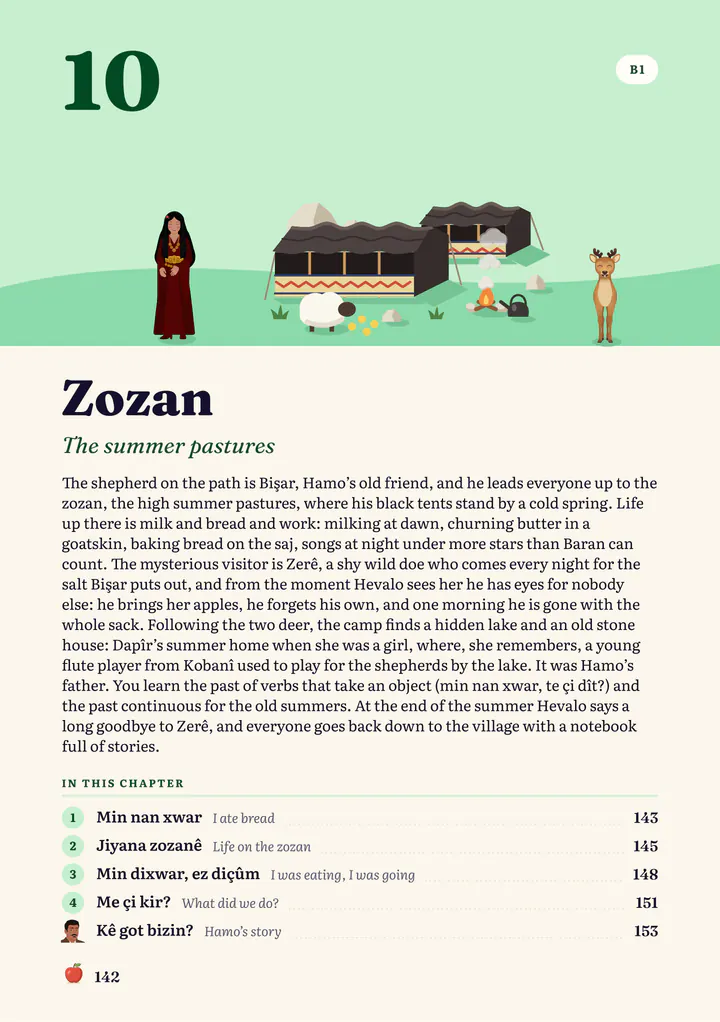
The summer pastures
The shepherd on the path is Bişar, Hamo’s old friend, and he leads everyone up to the zozan, the high summer pastures, where his black tents stand by a cold spring. Life up there is milk and bread and work: milking at dawn, churning butter in a goatskin, baking bread on the saj, songs at night under more stars than Baran can count. The mysterious visitor is Zerê, a shy wild doe who comes every night for the salt Bişar puts out, and from the moment Hevalo sees her he has eyes for nobody else: he brings her apples, he forgets his own, and one morning he is gone with the whole sack. Following the two deer, the camp finds a hidden lake and an old stone house: Dapîr’s summer home when she was a girl, where, she remembers, a young flute player from Kobanî used to play for the shepherds by the lake. It was Hamo’s father. You learn the past of verbs that take an object (min nan xwar, te çi dît?) and the past continuous for the old summers. At the end of the summer Hevalo says a long goodbye to Zerê, and everyone goes back down to the village with a notebook full of stories.
In this chapter
1 · Min nan xwar · I ate bread · 143
2 · Jiyana zozanê · Life on the zozan · 145
3 · Min dixwar, ez diçûm · I was eating, I was going · 148
4 · Me çi kir? · What did we do? · 151
Kê got bizin? · Hamo’s story · 153
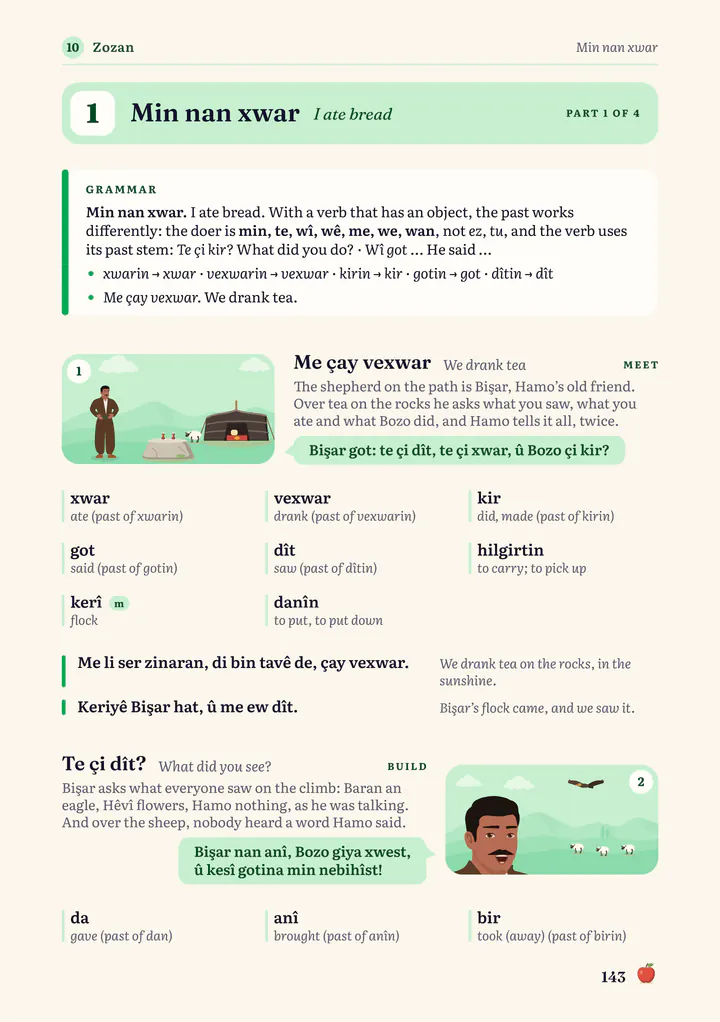
I ate bread · Part 1 of 4
Grammar
Min nan xwar. I ate bread. With a verb that has an object, the past works differently: the doer is min, te, wî, wê, me, we, wan, not ez, tu, and the verb uses its past stem: Te çi kir? What did you do? · Wî got … He said …
xwarin → xwar · vexwarin → vexwar · kirin → kir · gotin → got · dîtin → dît
Me çay vexwar. We drank tea.
Me çay vexwar · We drank tea · Meet
The shepherd on the path is Bişar, Hamo’s old friend. Over tea on the rocks he asks what you saw, what you ate and what Bozo did, and Hamo tells it all, twice.
Bişar got: te çi dît, te çi xwar, û Bozo çi kir?
xwar · ate (past of xwarin)
vexwar · drank (past of vexwarin)
kir · did, made (past of kirin)
got · said (past of gotin)
dît · saw (past of dîtin)
hilgirtin · to carry; to pick up
kerî (m) · flock
danîn · to put, to put down
Me li ser zinaran, di bin tavê de, çay vexwar. · We drank tea on the rocks, in the sunshine.
Keriyê Bişar hat, û me ew dît. · Bişar’s flock came, and we saw it.
Te çi dît? · What did you see? · Build
Bişar asks what everyone saw on the climb: Baran an eagle, Hêvî flowers, Hamo nothing, as he was talking. And over the sheep, nobody heard a word Hamo said.
Bişar nan anî, Bozo giya xwest, û kesî gotina min nebihîst!
da · gave (past of dan)
anî · brought (past of anîn)
bir · took (away) (past of birin)
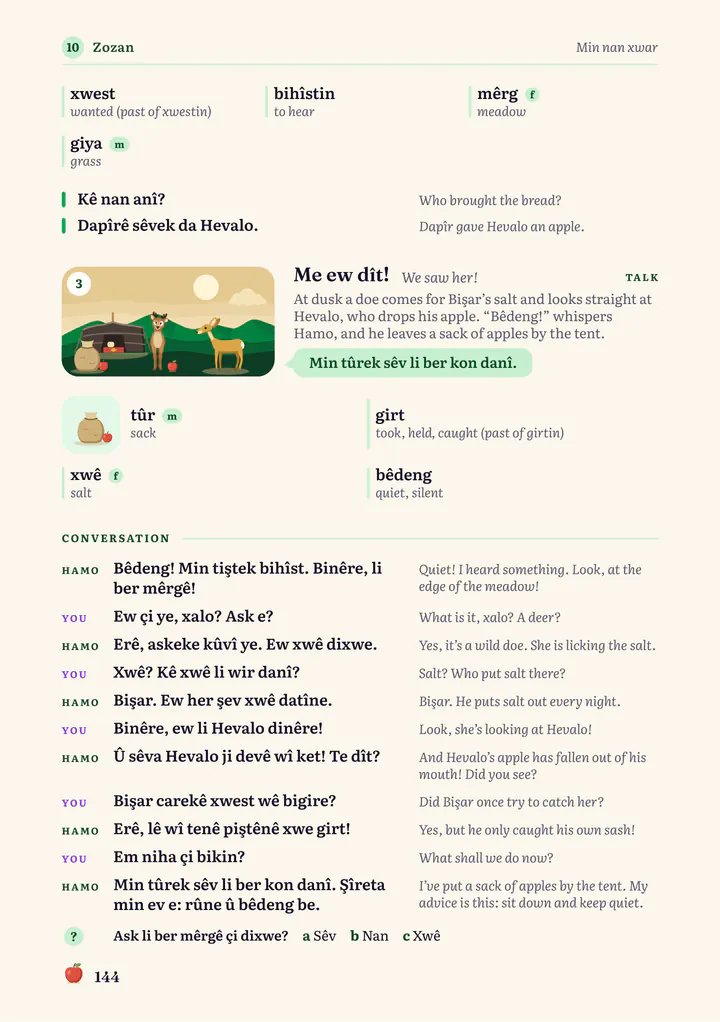
xwest · wanted (past of xwestin)
bihîstin · to hear
mêrg (f) · meadow
giya (m) · grass
Kê nan anî? · Who brought the bread?
Dapîrê sêvek da Hevalo. · Dapîr gave Hevalo an apple.
Me ew dît! · We saw her! · Talk
At dusk a doe comes for Bişar’s salt and looks straight at Hevalo, who drops his apple. “Bêdeng!” whispers Hamo, and he leaves a sack of apples by the tent.
Min tûrek sêv li ber kon danî.
tûr (m) · sack
girt · took, held, caught (past of girtin)
xwê (f) · salt
bêdeng · quiet, silent
Conversation
Hamo: Bêdeng! Min tiştek bihîst. Binêre, li ber mêrgê!
Quiet! I heard something. Look, at the edge of the meadow!
You: Ew çi ye, xalo? Ask e? · What is it, xalo? A deer?
Hamo: Erê, askeke kûvî ye. Ew xwê dixwe. · Yes, it’s a wild doe. She is licking the salt.
You: Xwê? Kê xwê li wir danî? · Salt? Who put salt there?
Hamo: Bişar. Ew her şev xwê datîne. · Bişar. He puts salt out every night.
You: Binêre, ew li Hevalo dinêre! · Look, she’s looking at Hevalo!
Hamo: Û sêva Hevalo ji devê wî ket! Te dît? · And Hevalo’s apple has fallen out of his mouth! Did you see?
You: Bişar carekê xwest wê bigire? · Did Bişar once try to catch her?
Hamo: Erê, lê wî tenê piştênê xwe girt! · Yes, but he only caught his own sash!
You: Em niha çi bikin? · What shall we do now?
Hamo: Min tûrek sêv li ber kon danî. Şîreta min ev e: rûne û bêdeng be.
I’ve put a sack of apples by the tent. My advice is this: sit down and keep quiet.
Ask li ber mêrgê çi dixwe? a Sêv b Nan c Xwê
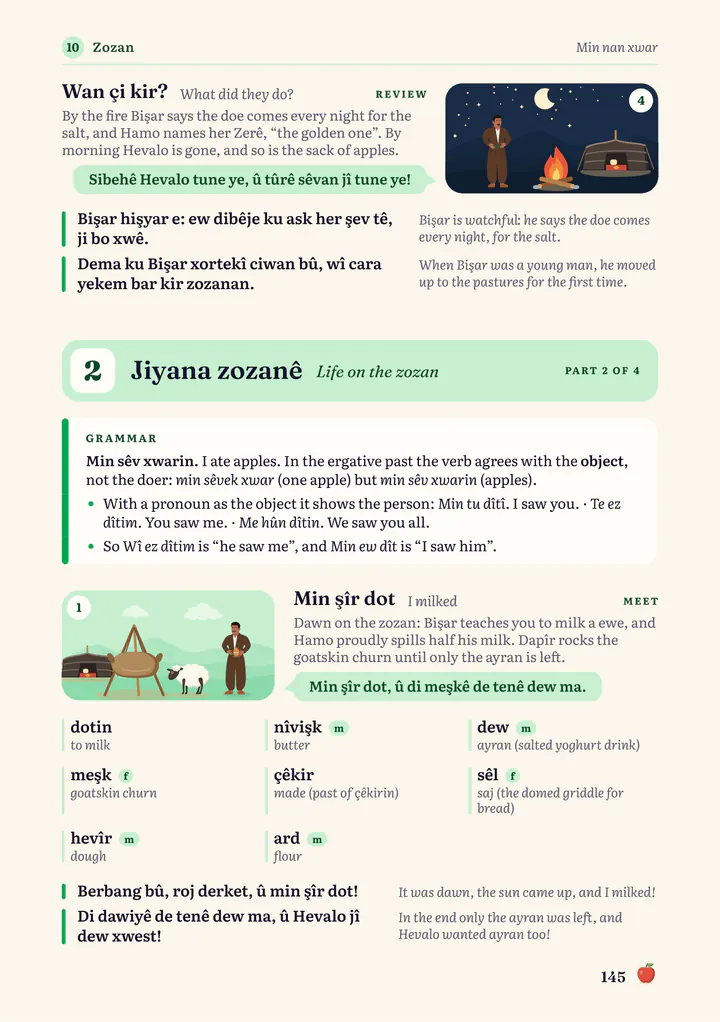
Wan çi kir? · What did they do? · Review
By the fire Bişar says the doe comes every night for the salt, and Hamo names her Zerê, “the golden one”. By morning Hevalo is gone, and so is the sack of apples.
Sibehê Hevalo tune ye, û tûrê sêvan jî tune ye!
Bişar hişyar e: ew dibêje ku ask her şev tê, ji bo xwê.
Bişar is watchful: he says the doe comes every night, for the salt.
Dema ku Bişar xortekî ciwan bû, wî cara yekem bar kir zozanan.
When Bişar was a young man, he moved up to the pastures for the first time.
Life on the zozan · Part 2 of 4
Grammar
Min sêv xwarin. I ate apples. In the ergative past the verb agrees with the object, not the doer: min sêvek xwar (one apple) but min sêv xwarin (apples).
With a pronoun as the object it shows the person: Min tu dîtî. I saw you. · Te ez dîtim. You saw me. · Me hûn dîtin. We saw you all.
So Wî ez dîtim is “he saw me”, and Min ew dît is “I saw him”.
Min şîr dot · I milked · Meet
Dawn on the zozan: Bişar teaches you to milk a ewe, and Hamo proudly spills half his milk. Dapîr rocks the goatskin churn until only the ayran is left.
Min şîr dot, û di meşkê de tenê dew ma.
dotin · to milk
nîvişk (m) · butter
dew (m) · ayran (salted yoghurt drink)
meşk (f) · goatskin churn
çêkir · made (past of çêkirin)
sêl (f) · saj (the domed griddle for bread)
hevîr (m) · dough
ard (m) · flour
Berbang bû, roj derket, û min şîr dot! · It was dawn, the sun came up, and I milked!
Di dawiyê de tenê dew ma, û Hevalo jî dew xwest!
In the end only the ayran was left, and Hevalo wanted ayran too!
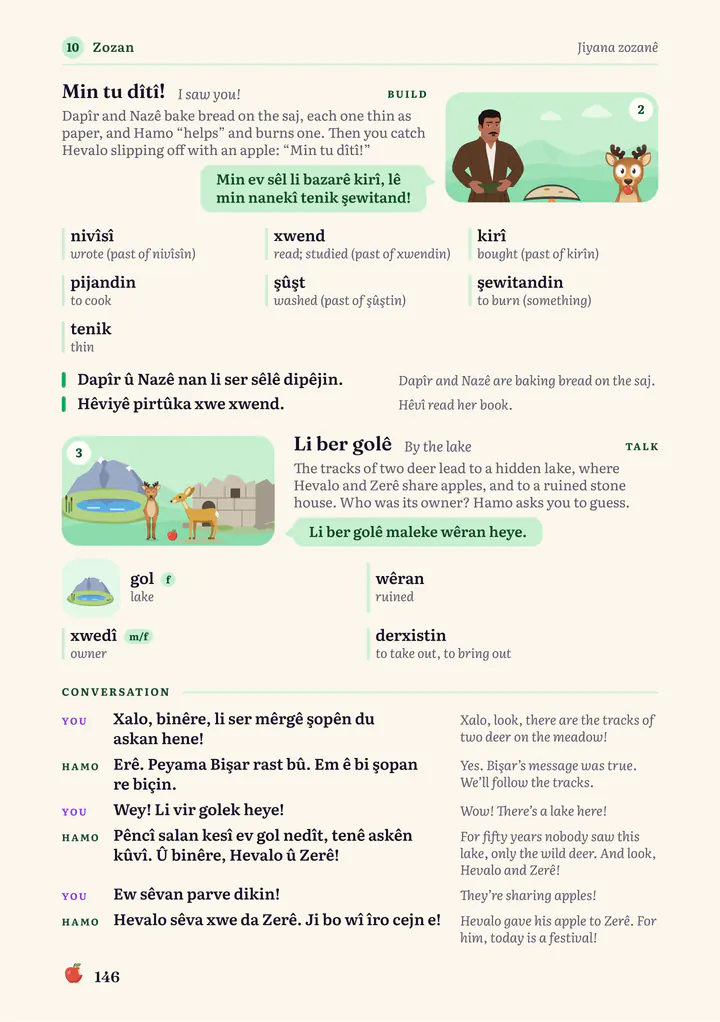
Min tu dîtî! · I saw you! · Build
Dapîr and Nazê bake bread on the saj, each one thin as paper, and Hamo “helps” and burns one. Then you catch Hevalo slipping off with an apple: “Min tu dîtî!”
Min ev sêl li bazarê kirî, lê min nanekî tenik şewitand!
nivîsî · wrote (past of nivîsîn)
xwend · read; studied (past of xwendin)
kirî · bought (past of kirîn)
pijandin · to cook
şûşt · washed (past of şûştin)
şewitandin · to burn (something)
tenik · thin
Dapîr û Nazê nan li ser sêlê dipêjin. · Dapîr and Nazê are baking bread on the saj.
Hêviyê pirtûka xwe xwend. · Hêvî read her book.
Li ber golê · By the lake · Talk
The tracks of two deer lead to a hidden lake, where Hevalo and Zerê share apples, and to a ruined stone house. Who was its owner? Hamo asks you to guess.
Li ber golê maleke wêran heye.
gol (f) · lake
wêran · ruined
xwedî · m/f · owner
derxistin · to take out, to bring out
Conversation
You: Xalo, binêre, li ser mêrgê şopên du askan hene!
Xalo, look, there are the tracks of two deer on the meadow!
Hamo: Erê. Peyama Bişar rast bû. Em ê bi şopan re biçin.
Yes. Bişar’s message was true. We’ll follow the tracks.
You: Wey! Li vir golek heye! · Wow! There’s a lake here!
Hamo: Pêncî salan kesî ev gol nedît, tenê askên kûvî. Û binêre, Hevalo û Zerê!
For fifty years nobody saw this lake, only the wild deer. And look, Hevalo and Zerê!
You: Ew sêvan parve dikin! · They’re sharing apples!
Hamo: Hevalo sêva xwe da Zerê. Ji bo wî îro cejn e! · Hevalo gave his apple to Zerê. For him, today is a festival!
You: Û ew mal? Ew wêran e. · And that house? It’s in ruins.
Hamo: Erê, maleke kevn û wêran. Xwediyê wê kî bû?
Yes, an old ruined house. Who was its owner?
You: Dibe ku şivanekî berê? · Maybe a shepherd from long ago?
Hamo: Dibe ku. Ez telefona xwe derdixim, ji bo wêneyekî.
Maybe. I’m taking out my phone, for a photo.
Li ber golê çi heye? a Maleke kevn û wêran b Bazareke mezin c Dibistaneke nû
Me ew dîtin! · We saw them! · Review
Back at the tents everyone tells what they saw at the lake. There is no zurna, but everyone sings and dances the govend, and Hevalo falls asleep dreaming of Zerê.
Zirne tunebû, lê me stran gotin, û em ketin govendê.
Me du ask dîtin: Hevalo û Zerê! Hevalo sêvek da Zerê.
We saw two deer: Hevalo and Zerê! Hevalo gave Zerê an apple.
Ez dibêjim ku min pêşî gol dît. Bişar kenî, û hêsir ji çavên wî hatin!
I say I saw the lake first. Bişar laughed till tears came to his eyes!
Hevalo has gone on ahead.
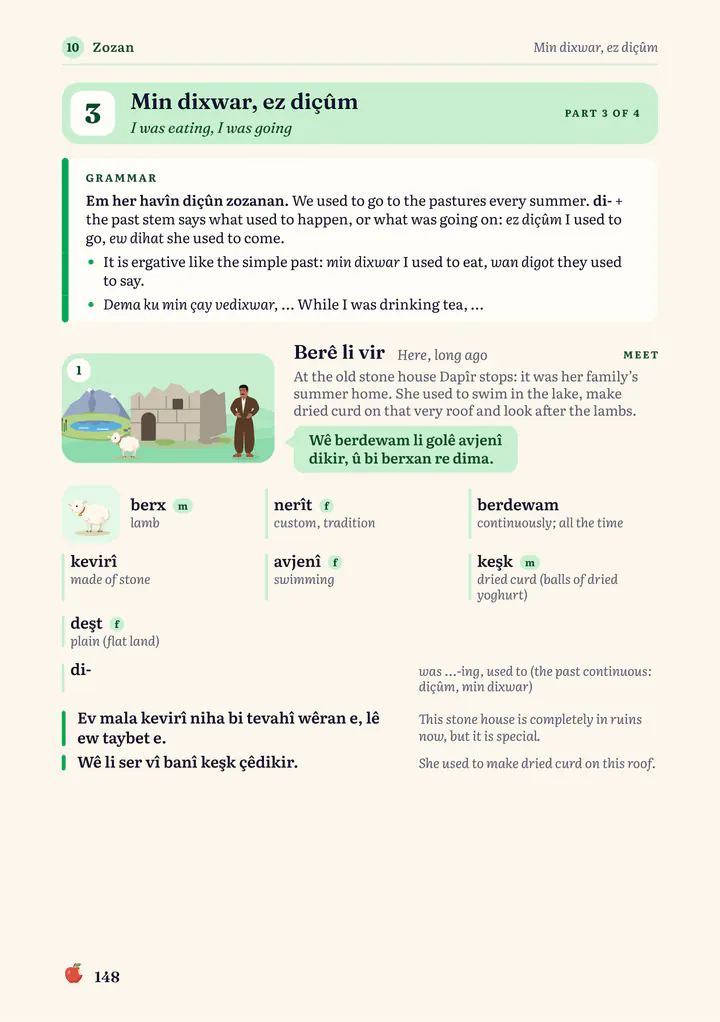
I was eating, I was going
Part 3 of 4
Grammar
Em her havîn diçûn zozanan. We used to go to the pastures every summer. di- + the past stem says what used to happen, or what was going on: ez diçûm I used to go, ew dihat she used to come.
It is ergative like the simple past: min dixwar I used to eat, wan digot they used to say.
Dema ku min çay vedixwar, … While I was drinking tea, …
Berê li vir · Here, long ago · Meet
At the old stone house Dapîr stops: it was her family’s summer home. She used to swim in the lake, make dried curd on that very roof and look after the lambs.
Wê berdewam li golê avjenî dikir, û bi berxan re dima.
berx (m) · lamb
nerît (f) · custom, tradition
berdewam · continuously; all the time
kevirî · made of stone
avjenî (f) · swimming
keşk (m) · dried curd (balls of dried yoghurt)
deşt (f) · plain (flat land)
di- · was …-ing, used to (the past continuous: diçûm, min dixwar)
Ev mala kevirî niha bi tevahî wêran e, lê ew taybet e.
This stone house is completely in ruins now, but it is special.
Wê li ser vî banî keşk çêdikir. · She used to make dried curd on this roof.
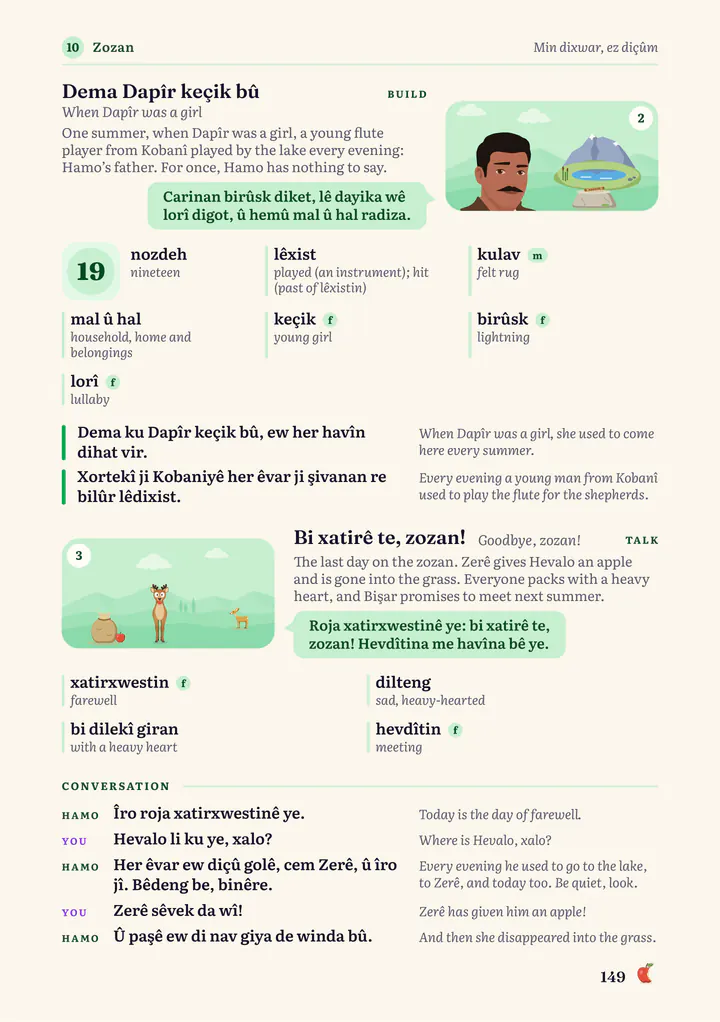
Dema Dapîr keçik bû
When Dapîr was a girl
Build
One summer, when Dapîr was a girl, a young flute player from Kobanî played by the lake every evening: Hamo’s father. For once, Hamo has nothing to say.
Carinan birûsk diket, lê dayika wê lorî digot, û hemû mal û hal radiza.
nozdeh · nineteen
lêxist · played (an instrument); hit (past of lêxistin)
kulav (m) · felt rug
mal û hal · household, home and belongings
keçik (f) · young girl
birûsk (f) · lightning
lorî (f) · lullaby
Dema ku Dapîr keçik bû, ew her havîn dihat vir.
When Dapîr was a girl, she used to come here every summer.
Xortekî ji Kobaniyê her êvar ji şivanan re bilûr lêdixist.
Every evening a young man from Kobanî used to play the flute for the shepherds.
Bi xatirê te, zozan! · Goodbye, zozan! · Talk
The last day on the zozan. Zerê gives Hevalo an apple and is gone into the grass. Everyone packs with a heavy heart, and Bişar promises to meet next summer.
Roja xatirxwestinê ye: bi xatirê te, zozan! Hevdîtina me havîna bê ye.
xatirxwestin (f) · farewell
dilteng · sad, heavy-hearted
bi dilekî giran · with a heavy heart
hevdîtin (f) · meeting
Conversation
Hamo: Îro roja xatirxwestinê ye. · Today is the day of farewell.
You: Hevalo li ku ye, xalo? · Where is Hevalo, xalo?
Hamo: Her êvar ew diçû golê, cem Zerê, û îro jî. Bêdeng be, binêre.
Every evening he used to go to the lake, to Zerê, and today too. Be quiet, look.
You: Zerê sêvek da wî! · Zerê has given him an apple!
Hamo: Û paşê ew di nav giya de winda bû. · And then she disappeared into the grass.
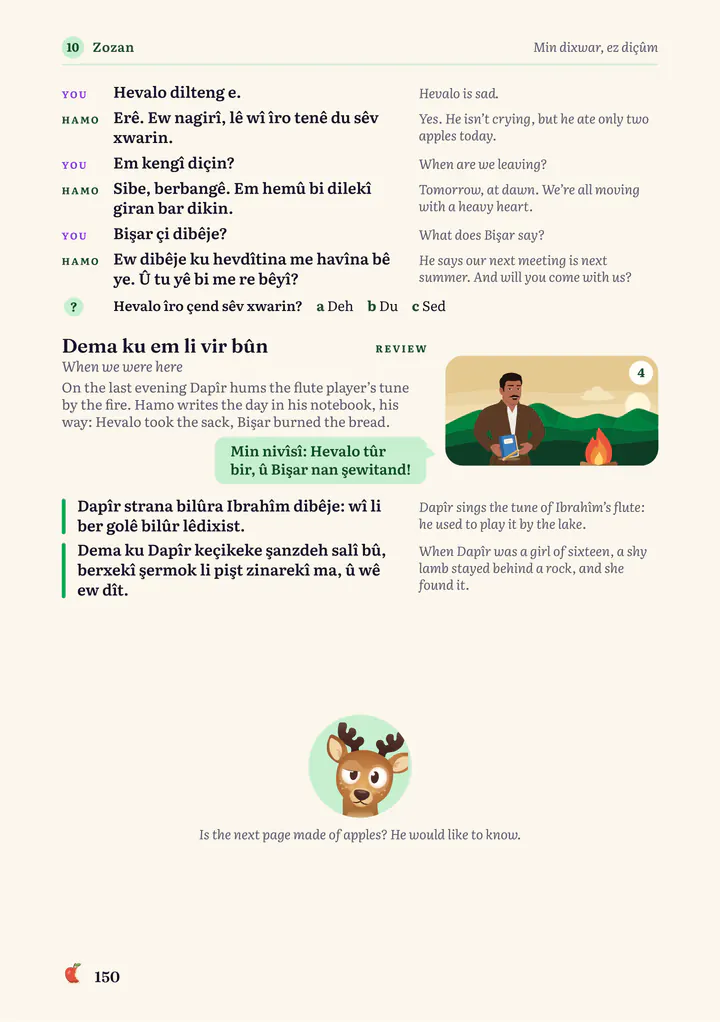
You: Hevalo dilteng e. · Hevalo is sad.
Hamo: Erê. Ew nagirî, lê wî îro tenê du sêv xwarin.
Yes. He isn’t crying, but he ate only two apples today.
You: Em kengî diçin? · When are we leaving?
Hamo: Sibe, berbangê. Em hemû bi dilekî giran bar dikin.
Tomorrow, at dawn. We’re all moving with a heavy heart.
You: Bişar çi dibêje? · What does Bişar say?
Hamo: Ew dibêje ku hevdîtina me havîna bê ye. Û tu yê bi me re bêyî?
He says our next meeting is next summer. And will you come with us?
Hevalo îro çend sêv xwarin? a Deh b Du c Sed
Dema ku em li vir bûn
When we were here
Review
On the last evening Dapîr hums the flute player’s tune by the fire. Hamo writes the day in his notebook, his way: Hevalo took the sack, Bişar burned the bread.
Min nivîsî: Hevalo tûr bir, û Bişar nan şewitand!
Dapîr strana bilûra Ibrahîm dibêje: wî li ber golê bilûr lêdixist.
Dapîr sings the tune of Ibrahîm’s flute: he used to play it by the lake.
Dema ku Dapîr keçikeke şanzdeh salî bû, berxekî şermok li pişt zinarekî ma, û wê ew dît.
When Dapîr was a girl of sixteen, a shy lamb stayed behind a rock, and she found it.
Is the next page made of apples? He would like to know.
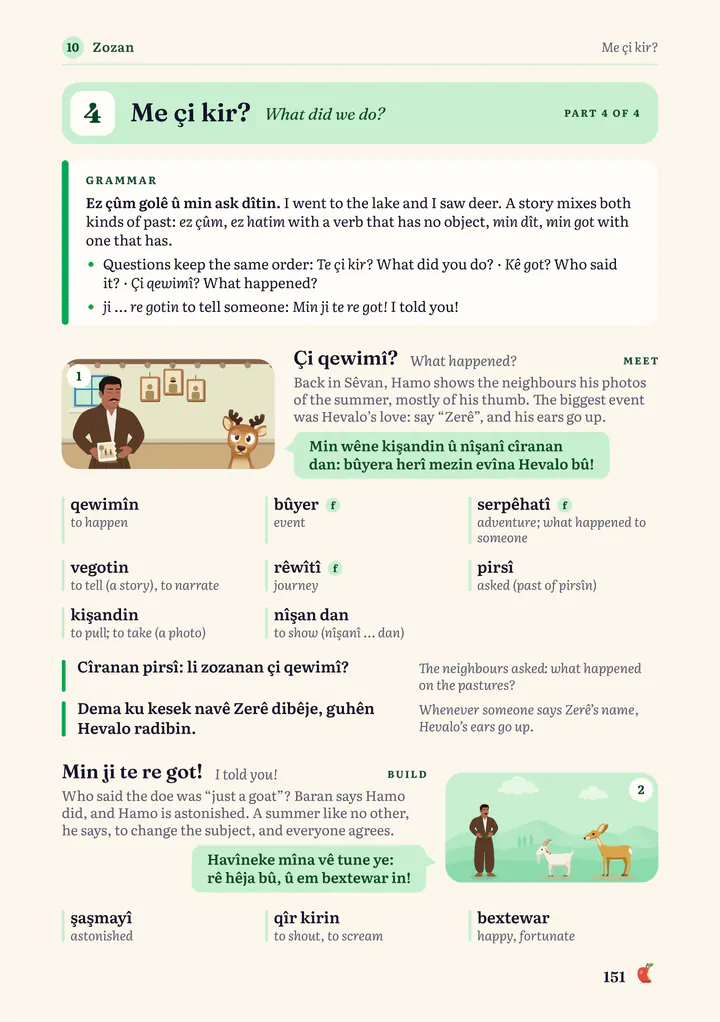
What did we do? · Part 4 of 4
Grammar
Ez çûm golê û min ask dîtin. I went to the lake and I saw deer. A story mixes both kinds of past: ez çûm, ez hatim with a verb that has no object, min dît, min got with one that has.
Questions keep the same order: Te çi kir? What did you do? · Kê got? Who said it? · Çi qewimî? What happened?
ji … re gotin to tell someone: Min ji te re got! I told you!
Çi qewimî? · What happened? · Meet
Back in Sêvan, Hamo shows the neighbours his photos of the summer, mostly of his thumb. The biggest event was Hevalo’s love: say “Zerê”, and his ears go up.
Min wêne kişandin û nîşanî cîranan dan: bûyera herî mezin evîna Hevalo bû!
qewimîn · to happen
bûyer (f) · event
serpêhatî (f) · adventure; what happened to someone
vegotin · to tell (a story), to narrate
rêwîtî (f) · journey
pirsî · asked (past of pirsîn)
kişandin · to pull; to take (a photo)
nîşan dan · to show (nîşanî … dan)
Cîranan pirsî: li zozanan çi qewimî? · The neighbours asked: what happened on the pastures?
Dema ku kesek navê Zerê dibêje, guhên Hevalo radibin.
Whenever someone says Zerê’s name, Hevalo’s ears go up.
Min ji te re got! · I told you! · Build
Who said the doe was “just a goat”? Baran says Hamo did, and Hamo is astonished. A summer like no other, he says, to change the subject, and everyone agrees.
Havîneke mîna vê tune ye: rê hêja bû, û em bextewar in!
şaşmayî · astonished
qîr kirin · to shout, to scream
bextewar · happy, fortunate
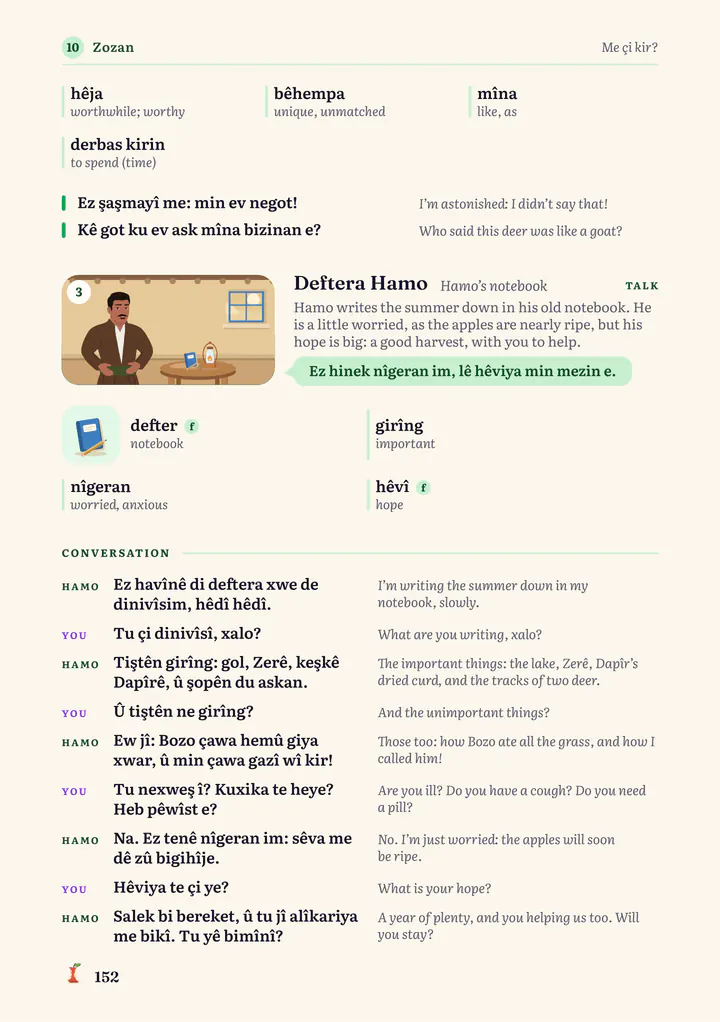
hêja · worthwhile; worthy
bêhempa · unique, unmatched
mîna · like, as
derbas kirin · to spend (time)
Ez şaşmayî me: min ev negot! · I’m astonished: I didn’t say that!
Kê got ku ev ask mîna bizinan e? · Who said this deer was like a goat?
Deftera Hamo · Hamo’s notebook · Talk
Hamo writes the summer down in his old notebook. He is a little worried, as the apples are nearly ripe, but his hope is big: a good harvest, with you to help.
Ez hinek nîgeran im, lê hêviya min mezin e.
defter (f) · notebook
girîng · important
nîgeran · worried, anxious
hêvî (f) · hope
Conversation
Hamo: Ez havînê di deftera xwe de dinivîsim, hêdî hêdî.
I’m writing the summer down in my notebook, slowly.
You: Tu çi dinivîsî, xalo? · What are you writing, xalo?
Hamo: Tiştên girîng: gol, Zerê, keşkê Dapîrê, û şopên du askan.
The important things: the lake, Zerê, Dapîr’s dried curd, and the tracks of two deer.
You: Û tiştên ne girîng? · And the unimportant things?
Hamo: Ew jî: Bozo çawa hemû giya xwar, û min çawa gazî wî kir!
Those too: how Bozo ate all the grass, and how I called him!
You: Tu nexweş î? Kuxika te heye? Heb pêwîst e?
Are you ill? Do you have a cough? Do you need a pill?
Hamo: Na. Ez tenê nîgeran im: sêva me dê zû bigihîje.
No. I’m just worried: the apples will soon be ripe.
You: Hêviya te çi ye? · What is your hope?
Hamo: Salek bi bereket, û tu jî alîkariya me bikî. Tu yê bimînî?
A year of plenty, and you helping us too. Will you stay?
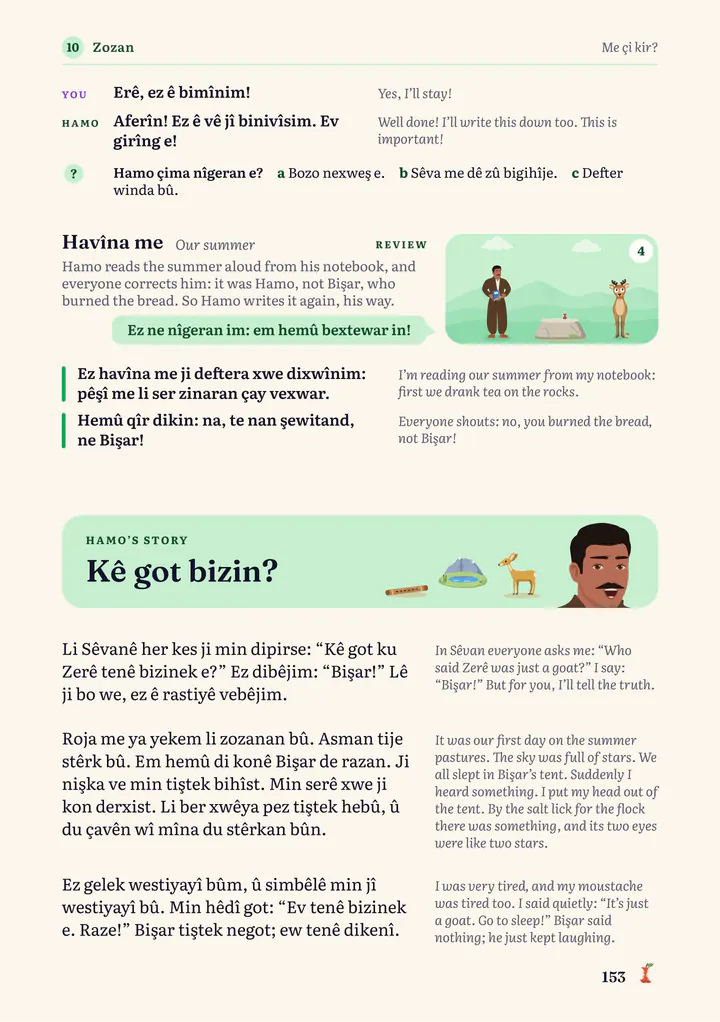
You: Erê, ez ê bimînim! · Yes, I’ll stay!
Hamo: Aferîn! Ez ê vê jî binivîsim. Ev girîng e!
Well done! I’ll write this down too. This is important!
Hamo çima nîgeran e? a Bozo nexweş e. b Sêva me dê zû bigihîje. c Defter winda bû.
Havîna me · Our summer · Review
Hamo reads the summer aloud from his notebook, and everyone corrects him: it was Hamo, not Bişar, who burned the bread. So Hamo writes it again, his way.
Ez ne nîgeran im: em hemû bextewar in!
Ez havîna me ji deftera xwe dixwînim: pêşî me li ser zinaran çay vexwar.
I’m reading our summer from my notebook: first we drank tea on the rocks.
Hemû qîr dikin: na, te nan şewitand, ne Bişar!
Everyone shouts: no, you burned the bread, not Bişar!
Hamo’s story
Li Sêvanê her kes ji min dipirse: “Kê got ku Zerê tenê bizinek e?” Ez dibêjim: “Bişar!” Lê ji bo we, ez ê rastiyê vebêjim.
In Sêvan everyone asks me: “Who said Zerê was just a goat?” I say: “Bişar!” But for you, I’ll tell the truth.
Roja me ya yekem li zozanan bû. Asman tije stêrk bû. Em hemû di konê Bişar de razan. Ji nişka ve min tiştek bihîst. Min serê xwe ji kon derxist. Li ber xwêya pez tiştek hebû, û du çavên wî mîna du stêrkan bûn.
It was our first day on the summer pastures. The sky was full of stars. We all slept in Bişar’s tent. Suddenly I heard something. I put my head out of the tent. By the salt lick for the flock there was something, and its two eyes were like two stars.
Ez gelek westiyayî bûm, û simbêlê min jî westiyayî bû. Min hêdî got: “Ev tenê bizinek e. Raze!” Bişar tiştek negot; ew tenê dikenî.
I was very tired, and my moustache was tired too. I said quietly: “It’s just a goat. Go to sleep!” Bişar said nothing; he just kept laughing.
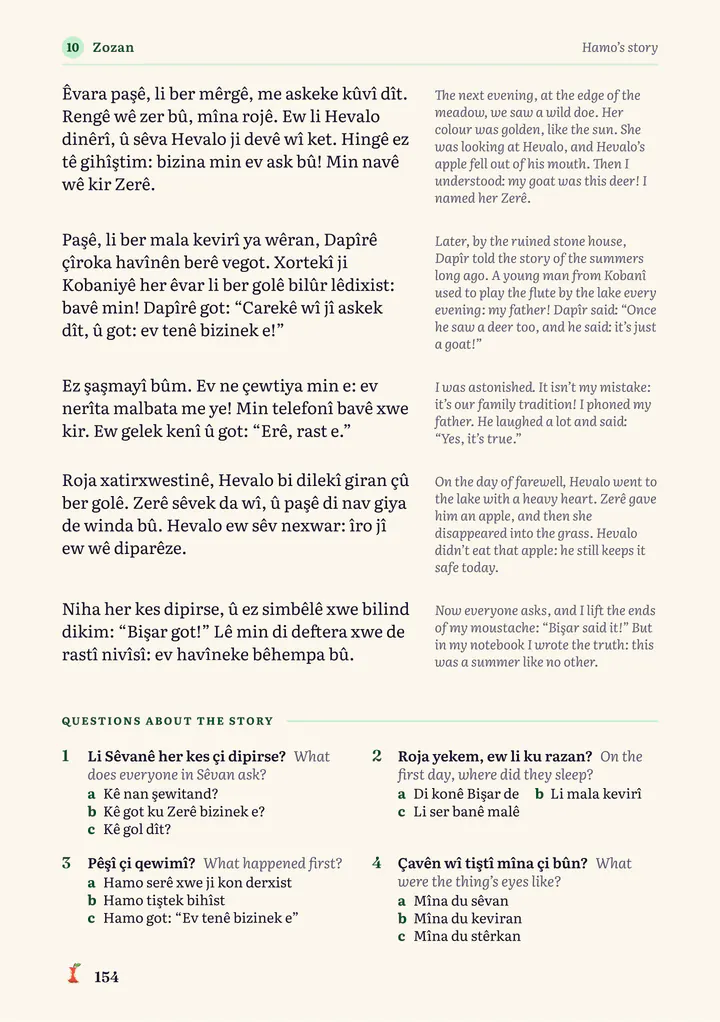
Êvara paşê, li ber mêrgê, me askeke kûvî dît. Rengê wê zer bû, mîna rojê. Ew li Hevalo dinêrî, û sêva Hevalo ji devê wî ket. Hingê ez tê gihîştim: bizina min ev ask bû! Min navê wê kir Zerê.
The next evening, at the edge of the meadow, we saw a wild doe. Her colour was golden, like the sun. She was looking at Hevalo, and Hevalo’s apple fell out of his mouth. Then I understood: my goat was this deer! I named her Zerê.
Paşê, li ber mala kevirî ya wêran, Dapîrê çîroka havînên berê vegot. Xortekî ji Kobaniyê her êvar li ber golê bilûr lêdixist: bavê min! Dapîrê got: “Carekê wî jî askek dît, û got: ev tenê bizinek e!”
Later, by the ruined stone house, Dapîr told the story of the summers long ago. A young man from Kobanî used to play the flute by the lake every evening: my father! Dapîr said: “Once he saw a deer too, and he said: it’s just a goat!”
Ez şaşmayî bûm. Ev ne çewtiya min e: ev nerîta malbata me ye! Min telefonî bavê xwe kir. Ew gelek kenî û got: “Erê, rast e.”
I was astonished. It isn’t my mistake: it’s our family tradition! I phoned my father. He laughed a lot and said: “Yes, it’s true.”
Roja xatirxwestinê, Hevalo bi dilekî giran çû ber golê. Zerê sêvek da wî, û paşê di nav giya de winda bû. Hevalo ew sêv nexwar: îro jî ew wê diparêze.
On the day of farewell, Hevalo went to the lake with a heavy heart. Zerê gave him an apple, and then she disappeared into the grass. Hevalo didn’t eat that apple: he still keeps it safe today.
Niha her kes dipirse, û ez simbêlê xwe bilind dikim: “Bişar got!” Lê min di deftera xwe de rastî nivîsî: ev havîneke bêhempa bû.
Now everyone asks, and I lift the ends of my moustache: “Bişar said it!” But in my notebook I wrote the truth: this was a summer like no other.
Questions about the story
1 · Li Sêvanê her kes çi dipirse? What does everyone in Sêvan ask?
a · Kê nan şewitand?
b · Kê got ku Zerê bizinek e?
c · Kê gol dît?
2 · Roja yekem, ew li ku razan? On the first day, where did they sleep?
a · Di konê Bişar de · b · Li mala kevirî
c · Li ser banê malê
3 · Pêşî çi qewimî? What happened first?
a · Hamo serê xwe ji kon derxist
b · Hamo tiştek bihîst
c · Hamo got: “Ev tenê bizinek e”
4 · Çavên wî tiştî mîna çi bûn? What were the thing’s eyes like?
a · Mîna du sêvan
b · Mîna du keviran
c · Mîna du stêrkan
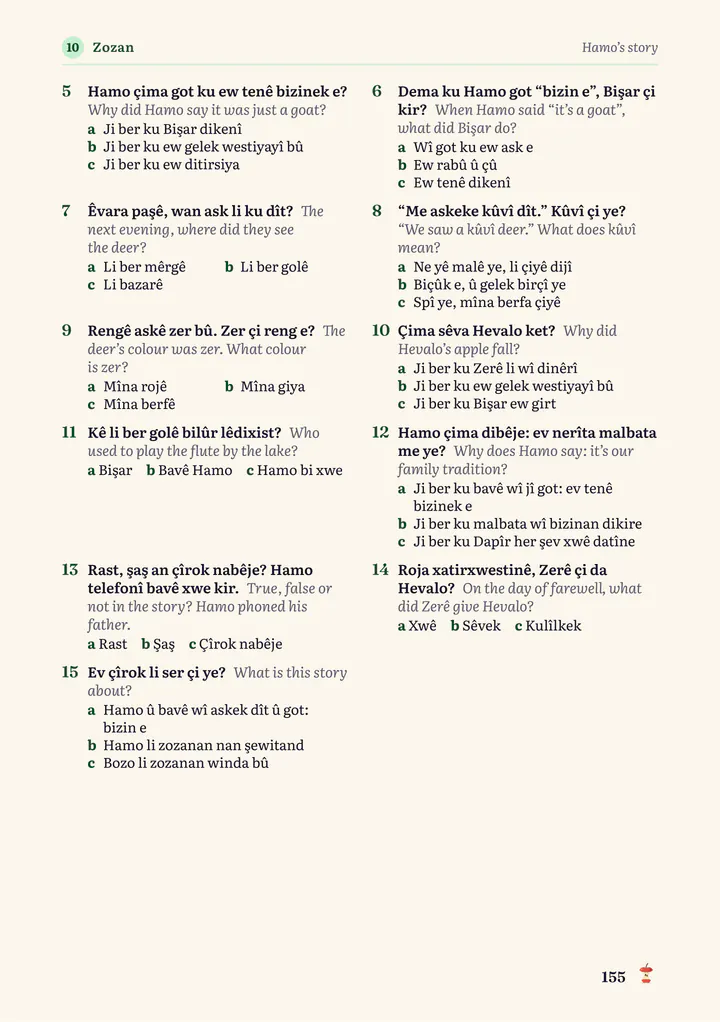
5 · Hamo çima got ku ew tenê bizinek e? Why did Hamo say it was just a goat?
a · Ji ber ku Bişar dikenî
b · Ji ber ku ew gelek westiyayî bû
c · Ji ber ku ew ditirsiya
6 · Dema ku Hamo got “bizin e”, Bişar çi kir? When Hamo said “it’s a goat”, what did Bişar do?
a · Wî got ku ew ask e
b · Ew rabû û çû
c · Ew tenê dikenî
7 · Êvara paşê, wan ask li ku dît? The next evening, where did they see the deer?
a · Li ber mêrgê · b · Li ber golê
c · Li bazarê
8 · “Me askeke kûvî dît.” Kûvî çi ye? “We saw a kûvî deer.” What does kûvî mean?
a · Ne yê malê ye, li çiyê dijî
b · Biçûk e, û gelek birçî ye
c · Spî ye, mîna berfa çiyê
9 · Rengê askê zer bû. Zer çi reng e? The deer’s colour was zer. What colour is zer?
a · Mîna rojê · b · Mîna giya
c · Mîna berfê
10 · Çima sêva Hevalo ket? Why did Hevalo’s apple fall?
a · Ji ber ku Zerê li wî dinêrî
b · Ji ber ku ew gelek westiyayî bû
c · Ji ber ku Bişar ew girt
11 · Kê li ber golê bilûr lêdixist? Who used to play the flute by the lake?
a Bişar b Bavê Hamo c Hamo bi xwe
12 · Hamo çima dibêje: ev nerîta malbata me ye? Why does Hamo say: it’s our family tradition?
a · Ji ber ku bavê wî jî got: ev tenê bizinek e
b · Ji ber ku malbata wî bizinan dikire
c · Ji ber ku Dapîr her şev xwê datîne
13 · Rast, şaş an çîrok nabêje? Hamo telefonî bavê xwe kir. True, false or not in the story? Hamo phoned his father.
a Rast b Şaş c Çîrok nabêje
14 · Roja xatirxwestinê, Zerê çi da Hevalo? On the day of farewell, what did Zerê give Hevalo?
a Xwê b Sêvek c Kulîlkek
15 · Ev çîrok li ser çi ye? What is this story about?
a · Hamo û bavê wî askek dît û got: bizin e
b · Hamo li zozanan nan şewitand
c · Bozo li zozanan winda bû
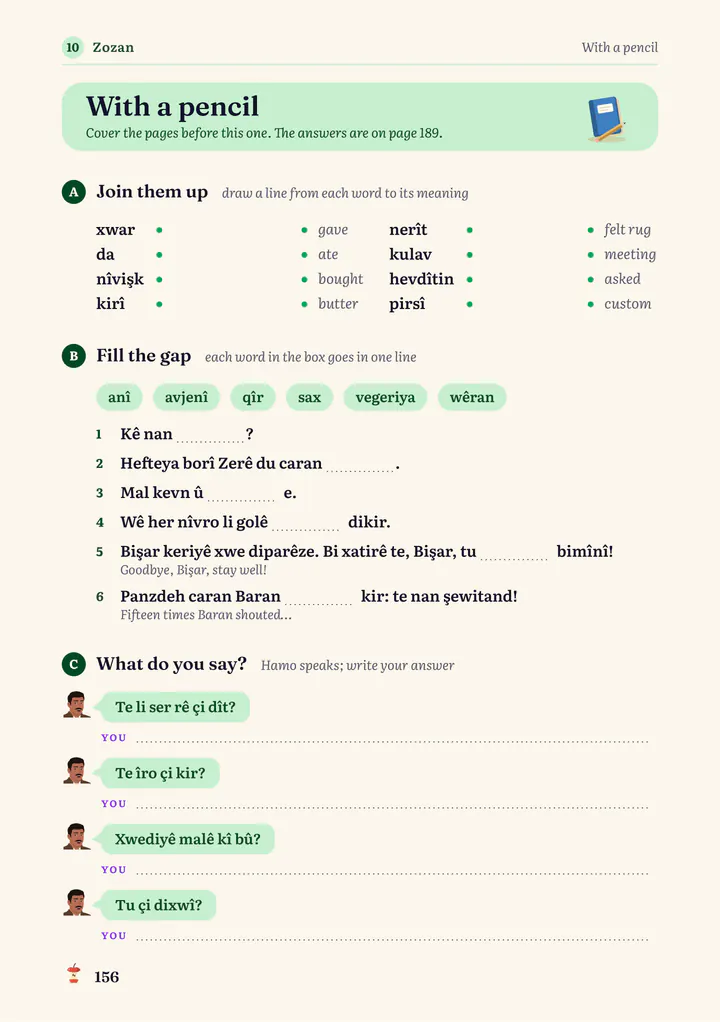
Cover the pages before this one. The answers are on page 189.
A · Join them up · draw a line from each word to its meaning
xwar · gave · nerît · felt rug
da · ate · kulav · meeting
nîvişk · bought · hevdîtin · asked
kirî · butter · pirsî · custom
B · Fill the gap · each word in the box goes in one line
anî · avjenî · qîr · sax · vegeriya · wêran
1 · Kê nan …?
2 · Hefteya borî Zerê du caran ….
3 · Mal kevn û … e.
4 · Wê her nîvro li golê … dikir.
5 · Bişar keriyê xwe diparêze. Bi xatirê te, Bişar, tu … bimînî!
Goodbye, Bişar, stay well!
6 · Panzdeh caran Baran … kir: te nan şewitand!
Fifteen times Baran shouted…
C · What do you say? · Hamo speaks; write your answer
Te li ser rê çi dît?
You
Te îro çi kir?
You
Xwediyê malê kî bû?
You
Tu çi dixwî?
You
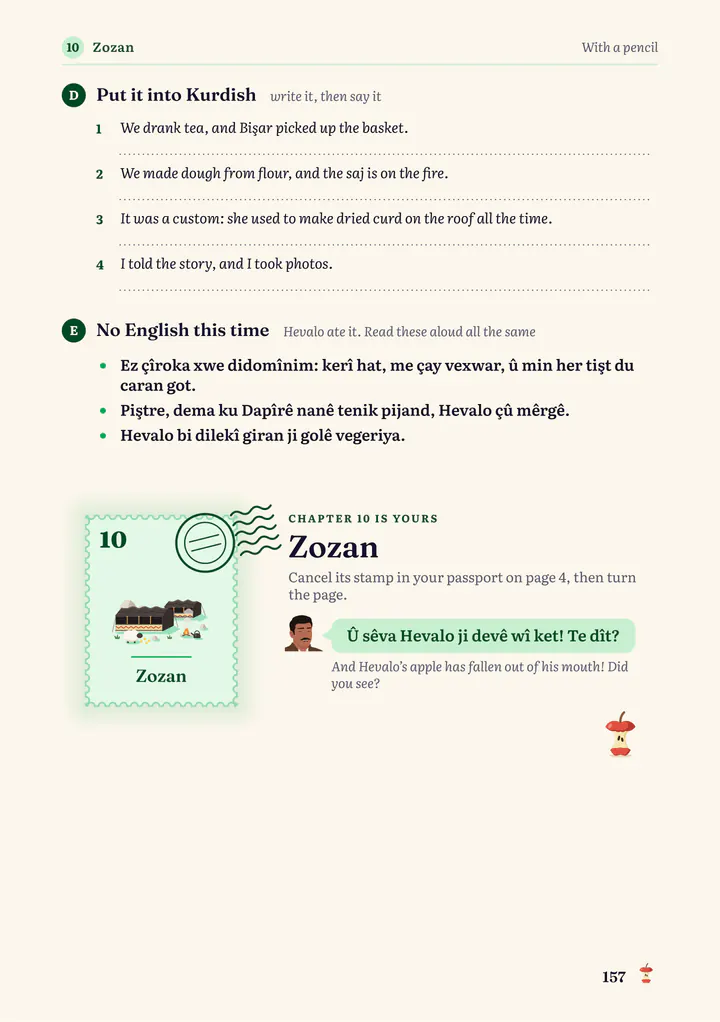
D · Put it into Kurdish · write it, then say it
1 · We drank tea, and Bişar picked up the basket.
2 · We made dough from flour, and the saj is on the fire.
3 · It was a custom: she used to make dried curd on the roof all the time.
4 · I told the story, and I took photos.
E · No English this time · Hevalo ate it. Read these aloud all the same
Ez çîroka xwe didomînim: kerî hat, me çay vexwar, û min her tişt du caran got.
Piştre, dema ku Dapîrê nanê tenik pijand, Hevalo çû mêrgê.
Hevalo bi dilekî giran ji golê vegeriya.
Zozan
Chapter 10 is yours
Cancel its stamp in your passport on page 4, then turn the page.
Û sêva Hevalo ji devê wî ket! Te dît?
And Hevalo’s apple has fallen out of his mouth! Did you see?
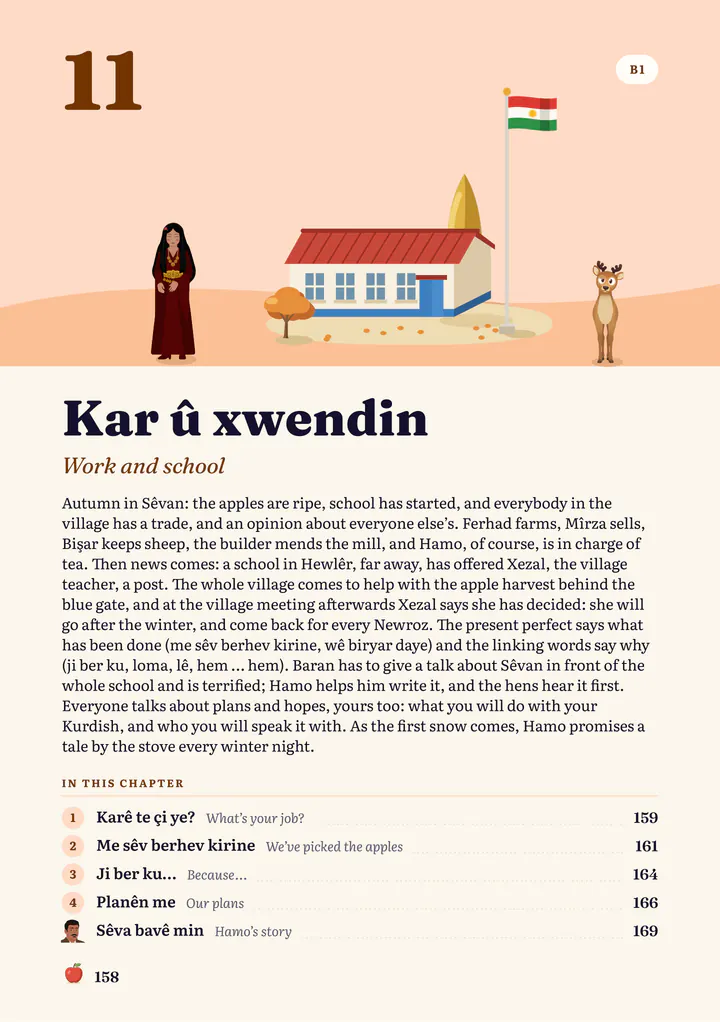
Work and school
Autumn in Sêvan: the apples are ripe, school has started, and everybody in the village has a trade, and an opinion about everyone else’s. Ferhad farms, Mîrza sells, Bişar keeps sheep, the builder mends the mill, and Hamo, of course, is in charge of tea. Then news comes: a school in Hewlêr, far away, has offered Xezal, the village teacher, a post. The whole village comes to help with the apple harvest behind the blue gate, and at the village meeting afterwards Xezal says she has decided: she will go after the winter, and come back for every Newroz. The present perfect says what has been done (me sêv berhev kirine, wê biryar daye) and the linking words say why (ji ber ku, loma, lê, hem … hem). Baran has to give a talk about Sêvan in front of the whole school and is terrified; Hamo helps him write it, and the hens hear it first. Everyone talks about plans and hopes, yours too: what you will do with your Kurdish, and who you will speak it with. As the first snow comes, Hamo promises a tale by the stove every winter night.
In this chapter
1 · Karê te çi ye? · What’s your job? · 159
2 · Me sêv berhev kirine · We’ve picked the apples · 161
3 · Ji ber ku… · Because… · 164
4 · Planên me · Our plans · 166
Sêva bavê min · Hamo’s story · 169
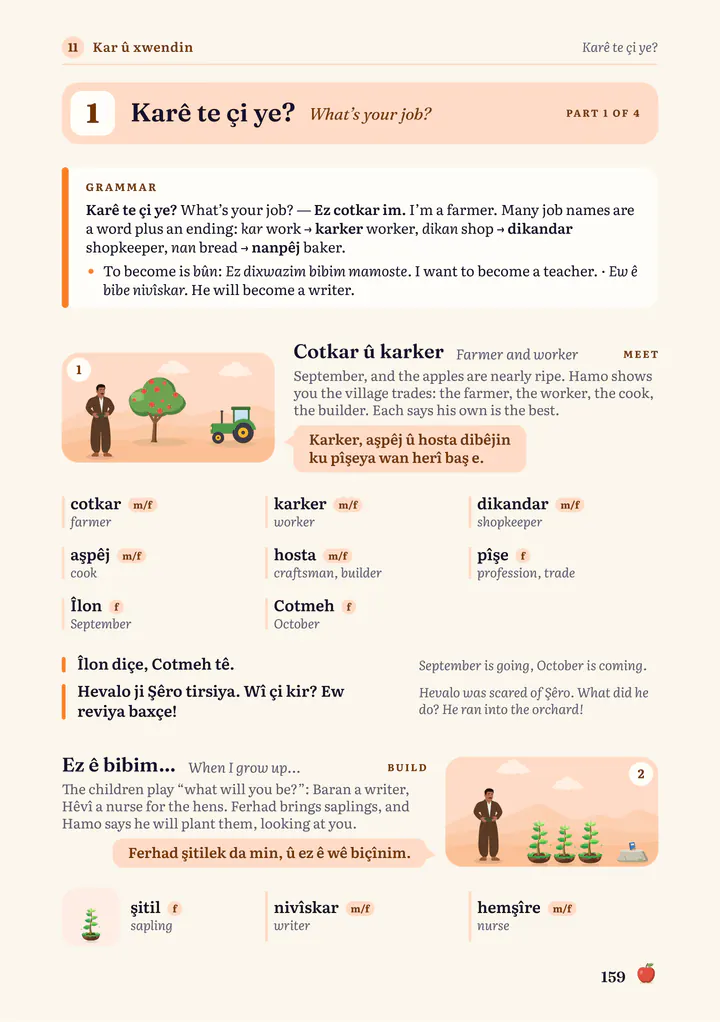
What’s your job? · Part 1 of 4
Grammar
Karê te çi ye? What’s your job? — Ez cotkar im. I’m a farmer. Many job names are a word plus an ending: kar work → karker worker, dikan shop → dikandar shopkeeper, nan bread → nanpêj baker.
To become is bûn: Ez dixwazim bibim mamoste. I want to become a teacher. · Ew ê bibe nivîskar. He will become a writer.
Cotkar û karker · Farmer and worker · Meet
September, and the apples are nearly ripe. Hamo shows you the village trades: the farmer, the worker, the cook, the builder. Each says his own is the best.
Karker, aşpêj û hosta dibêjin ku pîşeya wan herî baş e.
cotkar · m/f · farmer
karker · m/f · worker
dikandar · m/f · shopkeeper
aşpêj · m/f · cook
hosta · m/f · craftsman, builder
pîşe (f) · profession, trade
Îlon (f) · September
Cotmeh (f) · October
Îlon diçe, Cotmeh tê. · September is going, October is coming.
Hevalo ji Şêro tirsiya. Wî çi kir? Ew reviya baxçe!
Hevalo was scared of Şêro. What did he do? He ran into the orchard!
Ez ê bibim… · When I grow up… · Build
The children play “what will you be?”: Baran a writer, Hêvî a nurse for the hens. Ferhad brings saplings, and Hamo says he will plant them, looking at you.
Ferhad şitilek da min, û ez ê wê biçînim.
şitil (f) · sapling
nivîskar · m/f · writer
hemşîre · m/f · nurse
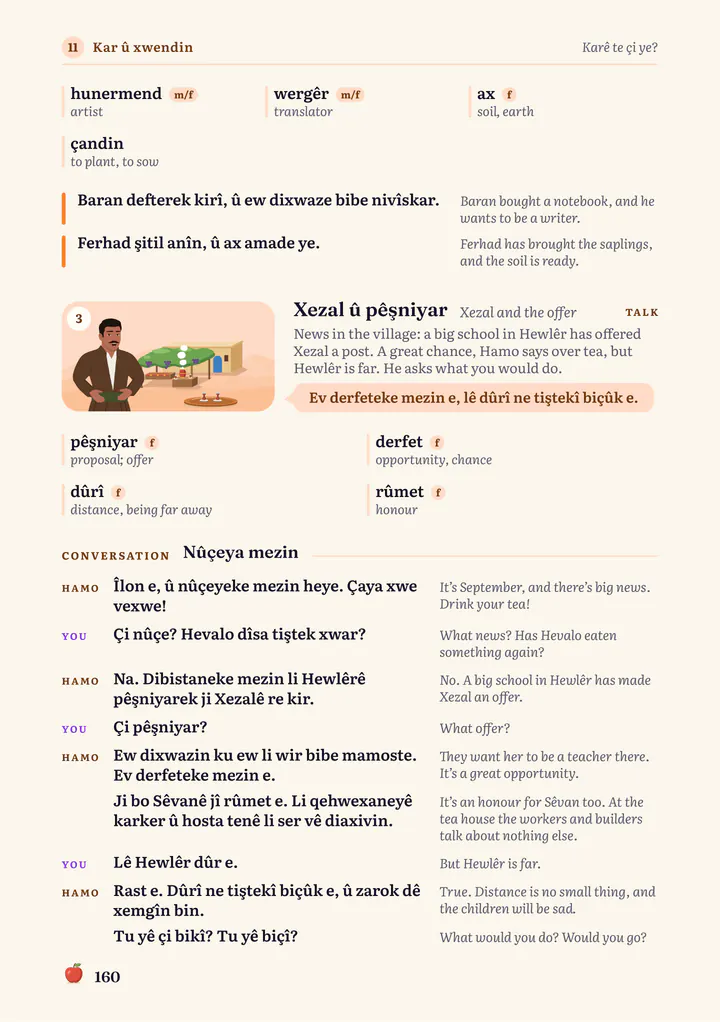
hunermend · m/f · artist
wergêr · m/f · translator
ax (f) · soil, earth
çandin · to plant, to sow
Baran defterek kirî, û ew dixwaze bibe nivîskar. · Baran bought a notebook, and he wants to be a writer.
Ferhad şitil anîn, û ax amade ye. · Ferhad has brought the saplings, and the soil is ready.
Xezal û pêşniyar · Xezal and the offer · Talk
News in the village: a big school in Hewlêr has offered Xezal a post. A great chance, Hamo says over tea, but Hewlêr is far. He asks what you would do.
Ev derfeteke mezin e, lê dûrî ne tiştekî biçûk e.
pêşniyar (f) · proposal; offer
derfet (f) · opportunity, chance
dûrî (f) · distance, being far away
rûmet (f) · honour
Conversation · Nûçeya mezin
Hamo: Îlon e, û nûçeyeke mezin heye. Çaya xwe vexwe!
It’s September, and there’s big news. Drink your tea!
You: Çi nûçe? Hevalo dîsa tiştek xwar? · What news? Has Hevalo eaten something again?
Hamo: Na. Dibistaneke mezin li Hewlêrê pêşniyarek ji Xezalê re kir.
No. A big school in Hewlêr has made Xezal an offer.
You: Çi pêşniyar? · What offer?
Hamo: Ew dixwazin ku ew li wir bibe mamoste. Ev derfeteke mezin e.
They want her to be a teacher there. It’s a great opportunity.
Ji bo Sêvanê jî rûmet e. Li qehwexaneyê karker û hosta tenê li ser vê diaxivin.
It’s an honour for Sêvan too. At the tea house the workers and builders talk about nothing else.
You: Lê Hewlêr dûr e. · But Hewlêr is far.
Hamo: Rast e. Dûrî ne tiştekî biçûk e, û zarok dê xemgîn bin.
True. Distance is no small thing, and the children will be sad.
Tu yê çi bikî? Tu yê biçî? · What would you do? Would you go?
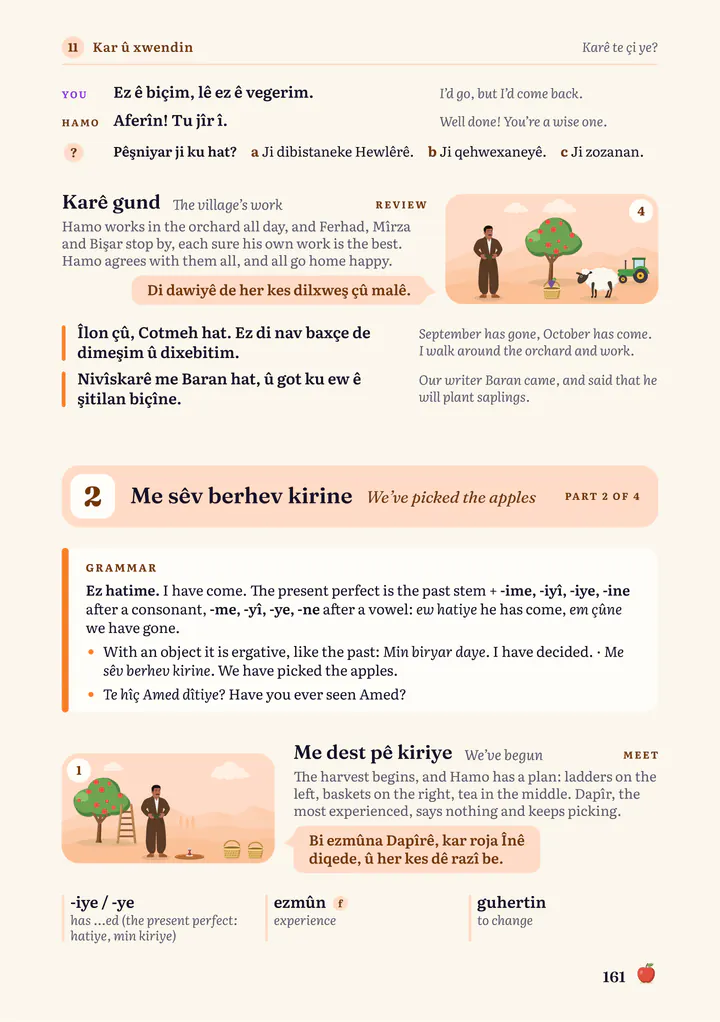
You: Ez ê biçim, lê ez ê vegerim. · I’d go, but I’d come back.
Hamo: Aferîn! Tu jîr î. · Well done! You’re a wise one.
Pêşniyar ji ku hat? a Ji dibistaneke Hewlêrê. b Ji qehwexaneyê. c Ji zozanan.
Karê gund · The village’s work · Review
Hamo works in the orchard all day, and Ferhad, Mîrza and Bişar stop by, each sure his own work is the best. Hamo agrees with them all, and all go home happy.
Di dawiyê de her kes dilxweş çû malê.
Îlon çû, Cotmeh hat. Ez di nav baxçe de dimeşim û dixebitim.
September has gone, October has come. I walk around the orchard and work.
Nivîskarê me Baran hat, û got ku ew ê şitilan biçîne.
Our writer Baran came, and said that he will plant saplings.
We’ve picked the apples · Part 2 of 4
Grammar
Ez hatime. I have come. The present perfect is the past stem + -ime, -iyî, -iye, -ine after a consonant, -me, -yî, -ye, -ne after a vowel: ew hatiye he has come, em çûne we have gone.
With an object it is ergative, like the past: Min biryar daye. I have decided. · Me sêv berhev kirine. We have picked the apples.
Te hîç Amed dîtiye? Have you ever seen Amed?
Me dest pê kiriye · We’ve begun · Meet
The harvest begins, and Hamo has a plan: ladders on the left, baskets on the right, tea in the middle. Dapîr, the most experienced, says nothing and keeps picking.
Bi ezmûna Dapîrê, kar roja Înê diqede, û her kes dê razî be.
-iye / -ye · has …ed (the present perfect: hatiye, min kiriye)
ezmûn (f) · experience
guhertin · to change
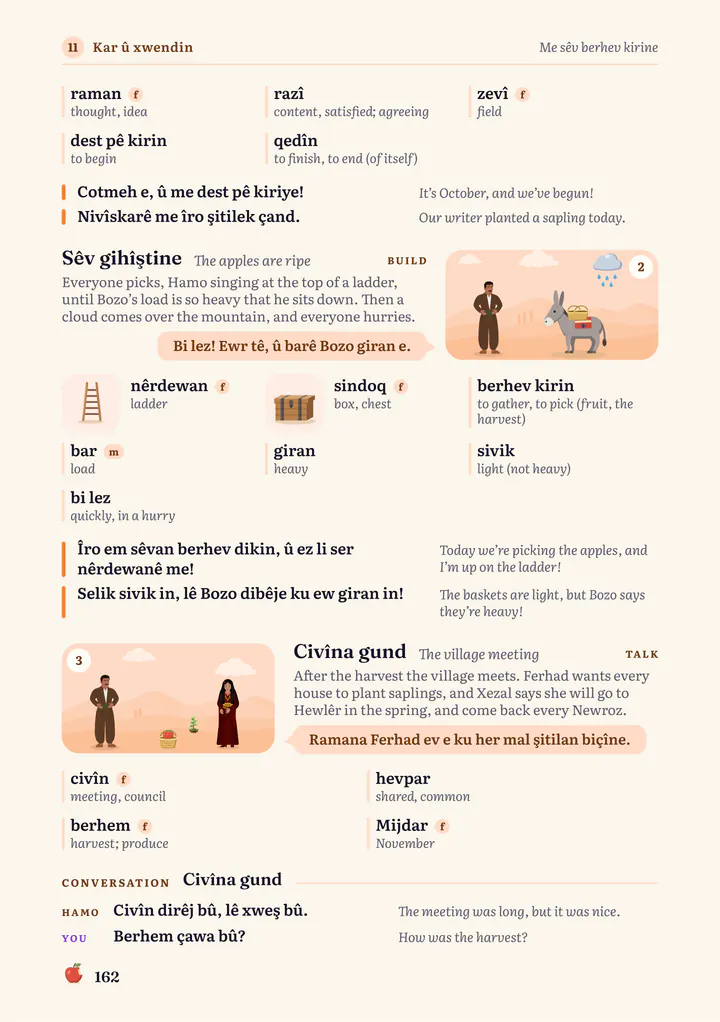
raman (f) · thought, idea
razî · content, satisfied; agreeing
zevî (f) · field
dest pê kirin · to begin
qedîn · to finish, to end (of itself)
Cotmeh e, û me dest pê kiriye! · It’s October, and we’ve begun!
Nivîskarê me îro şitilek çand. · Our writer planted a sapling today.
Sêv gihîştine · The apples are ripe · Build
Everyone picks, Hamo singing at the top of a ladder, until Bozo’s load is so heavy that he sits down. Then a cloud comes over the mountain, and everyone hurries.
Bi lez! Ewr tê, û barê Bozo giran e.
nêrdewan (f) · ladder
sindoq (f) · box, chest
berhev kirin · to gather, to pick (fruit, the harvest)
bar (m) · load
giran · heavy
sivik · light (not heavy)
bi lez · quickly, in a hurry
Îro em sêvan berhev dikin, û ez li ser nêrdewanê me!
Today we’re picking the apples, and I’m up on the ladder!
Selik sivik in, lê Bozo dibêje ku ew giran in! · The baskets are light, but Bozo says they’re heavy!
Civîna gund · The village meeting · Talk
After the harvest the village meets. Ferhad wants every house to plant saplings, and Xezal says she will go to Hewlêr in the spring, and come back every Newroz.
Ramana Ferhad ev e ku her mal şitilan biçîne.
civîn (f) · meeting, council
hevpar · shared, common
berhem (f) · harvest; produce
Mijdar (f) · November
Conversation · Civîna gund
Hamo: Civîn dirêj bû, lê xweş bû. · The meeting was long, but it was nice.
You: Berhem çawa bû? · How was the harvest?
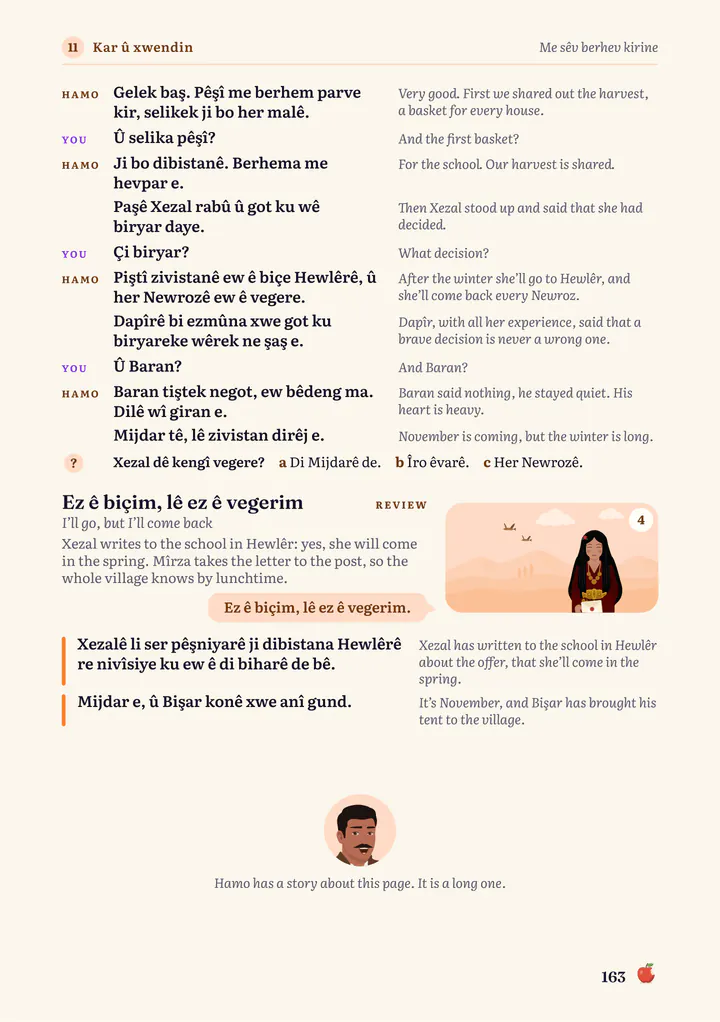
Hamo: Gelek baş. Pêşî me berhem parve kir, selikek ji bo her malê.
Very good. First we shared out the harvest, a basket for every house.
You: Û selika pêşî? · And the first basket?
Hamo: Ji bo dibistanê. Berhema me hevpar e.
For the school. Our harvest is shared.
Paşê Xezal rabû û got ku wê biryar daye.
Then Xezal stood up and said that she had decided.
You: Çi biryar? · What decision?
Hamo: Piştî zivistanê ew ê biçe Hewlêrê, û her Newrozê ew ê vegere.
After the winter she’ll go to Hewlêr, and she’ll come back every Newroz.
Dapîrê bi ezmûna xwe got ku biryareke wêrek ne şaş e.
Dapîr, with all her experience, said that a brave decision is never a wrong one.
You: Û Baran? · And Baran?
Hamo: Baran tiştek negot, ew bêdeng ma. Dilê wî giran e.
Baran said nothing, he stayed quiet. His heart is heavy.
Mijdar tê, lê zivistan dirêj e. · November is coming, but the winter is long.
Xezal dê kengî vegere? a Di Mijdarê de. b Îro êvarê. c Her Newrozê.
Ez ê biçim, lê ez ê vegerim
I’ll go, but I’ll come back
Review
Xezal writes to the school in Hewlêr: yes, she will come in the spring. Mîrza takes the letter to the post, so the whole village knows by lunchtime.
Ez ê biçim, lê ez ê vegerim.
Xezalê li ser pêşniyarê ji dibistana Hewlêrê re nivîsiye ku ew ê di biharê de bê.
Xezal has written to the school in Hewlêr about the offer, that she’ll come in the spring.
Mijdar e, û Bişar konê xwe anî gund. · It’s November, and Bişar has brought his tent to the village.
Hamo has a story about this page. It is a long one.
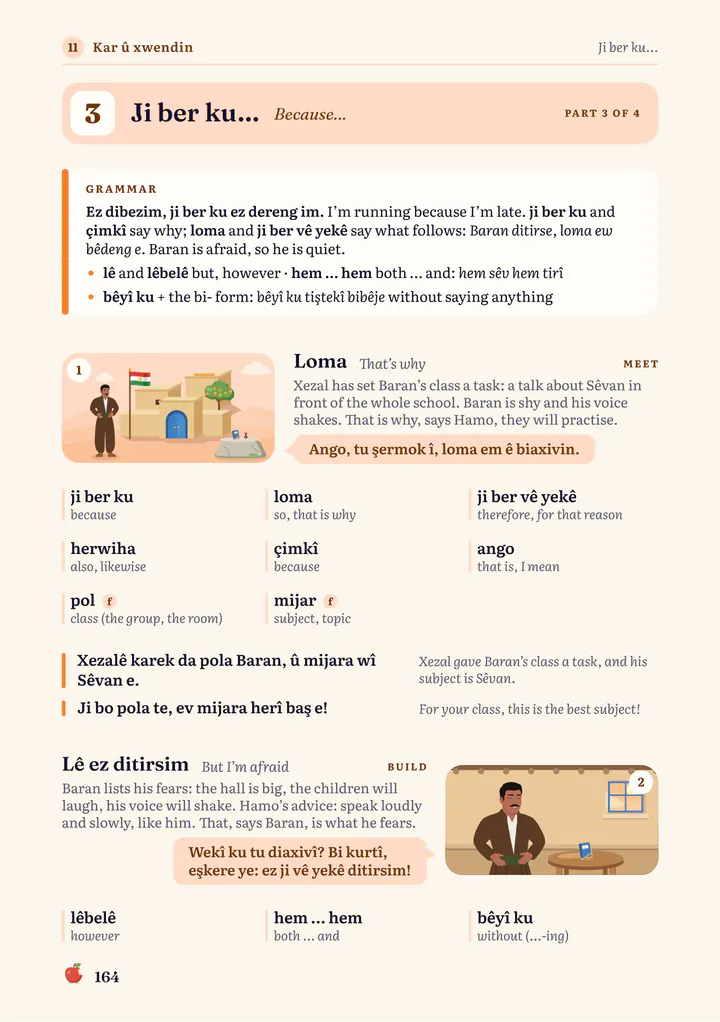
Because… · Part 3 of 4
Grammar
Ez dibezim, ji ber ku ez dereng im. I’m running because I’m late. ji ber ku and çimkî say why; loma and ji ber vê yekê say what follows: Baran ditirse, loma ew bêdeng e. Baran is afraid, so he is quiet.
lê and lêbelê but, however · hem … hem both … and: hem sêv hem tirî
bêyî ku + the bi- form: bêyî ku tiştekî bibêje without saying anything
Loma · That’s why · Meet
Xezal has set Baran’s class a task: a talk about Sêvan in front of the whole school. Baran is shy and his voice shakes. That is why, says Hamo, they will practise.
Ango, tu şermok î, loma em ê biaxivin.
ji ber ku · because
loma · so, that is why
ji ber vê yekê · therefore, for that reason
herwiha · also, likewise
çimkî · because
ango · that is, I mean
pol (f) · class (the group, the room)
mijar (f) · subject, topic
Xezalê karek da pola Baran, û mijara wî Sêvan e.
Xezal gave Baran’s class a task, and his subject is Sêvan.
Ji bo pola te, ev mijara herî baş e! · For your class, this is the best subject!
Lê ez ditirsim · But I’m afraid · Build
Baran lists his fears: the hall is big, the children will laugh, his voice will shake. Hamo’s advice: speak loudly and slowly, like him. That, says Baran, is what he fears.
Wekî ku tu diaxivî? Bi kurtî, eşkere ye: ez ji vê yekê ditirsim!
lêbelê · however
hem … hem · both … and
bêyî ku · without (…-ing)
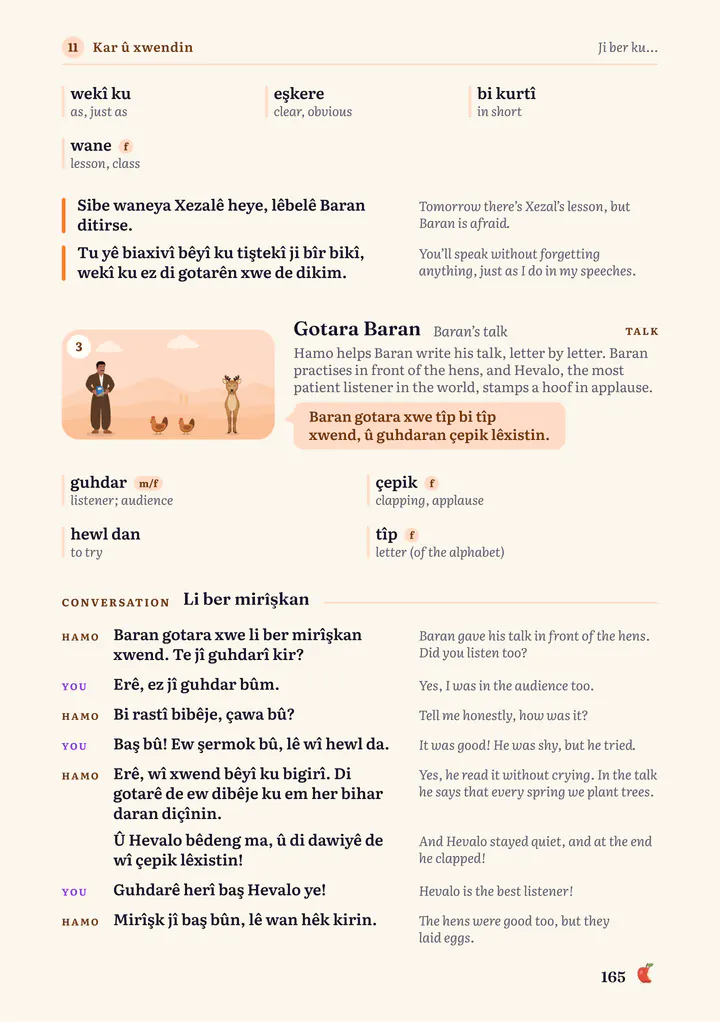
wekî ku · as, just as
eşkere · clear, obvious
bi kurtî · in short
wane (f) · lesson, class
Sibe waneya Xezalê heye, lêbelê Baran ditirse.
Tomorrow there’s Xezal’s lesson, but Baran is afraid.
Tu yê biaxivî bêyî ku tiştekî ji bîr bikî, wekî ku ez di gotarên xwe de dikim.
You’ll speak without forgetting anything, just as I do in my speeches.
Gotara Baran · Baran’s talk · Talk
Hamo helps Baran write his talk, letter by letter. Baran practises in front of the hens, and Hevalo, the most patient listener in the world, stamps a hoof in applause.
Baran gotara xwe tîp bi tîp xwend, û guhdaran çepik lêxistin.
guhdar · m/f · listener; audience
çepik (f) · clapping, applause
hewl dan · to try
tîp (f) · letter (of the alphabet)
Conversation · Li ber mirîşkan
Hamo: Baran gotara xwe li ber mirîşkan xwend. Te jî guhdarî kir?
Baran gave his talk in front of the hens. Did you listen too?
You: Erê, ez jî guhdar bûm. · Yes, I was in the audience too.
Hamo: Bi rastî bibêje, çawa bû? · Tell me honestly, how was it?
You: Baş bû! Ew şermok bû, lê wî hewl da. · It was good! He was shy, but he tried.
Hamo: Erê, wî xwend bêyî ku bigirî. Di gotarê de ew dibêje ku em her bihar daran diçînin.
Yes, he read it without crying. In the talk he says that every spring we plant trees.
Û Hevalo bêdeng ma, û di dawiyê de wî çepik lêxistin!
And Hevalo stayed quiet, and at the end he clapped!
You: Guhdarê herî baş Hevalo ye! · Hevalo is the best listener!
Hamo: Mirîşk jî baş bûn, lê wan hêk kirin. · The hens were good too, but they laid eggs.
You: Sibe ew ê li ber hemû polê bixwîne? · Tomorrow he’ll read it in front of the whole class?
Hamo: Erê, di waneya Xezalê de. Ew ê hewl bide, û ev her tişt e.
Yes, in Xezal’s lesson. He’ll try, and that’s all anyone can do.
Kê di dawiyê de çepik lêxistin? a Bozo. b Hevalo. c Dapîr.
Rojeke mezin · A big day · Review
Baran gives his talk in the school hall: Sêvan, its apples, its people, and Hevalo. Xezal says it was the best talk of the year, and Baran gives it again at home, twice.
Nehêniya Baran ev e ku wî pêşî li ber mirîşkan xwend.
Îro rojeke mezin e. Baran dê hewl bide, û ev ji bo wî ezmûneke nû ye.
Today is a big day. Baran will try, and for him it’s a new experience.
Li Sêvanê hem mezin hem jî zarok alîkariyê dikin, loma berhem hevpar e.
In Sêvan both grown-ups and children help, that’s why the harvest is shared.
Our plans · Part 4 of 4
Grammar
Hêvî dikim ku tu bêyî. I hope you’ll come. After hêvî dikim ku (I hope that) and armanca min ev e ku (my aim is to) the verb takes the bi- form.
dema ku + the bi- form looks ahead: Dema ku ez vegerim malê, ez ê bi kurdî biaxivim. When I go back home, I’ll speak Kurdish.
Armanca min ev e ku ez her roj hinek bixwînim. My aim is to read a little every day.
Armanca min · My goal · Meet
Hamo asks everyone their goals: Hêvî wants a cat, Nazê wants Hamo on time for once, and Hamo wants a new tea glass. Learning, he tells you, is one step at a time.
Gav bi gav, fêrbûna te serkeftî ye.
armanc (f) · goal, aim
bi dest xistin · to obtain, to achieve
pêk anîn · to carry out, to achieve
gav (f) · step
bername (f) · programme, plan
fêrbûn (f) · learning
plan (f) · plan
serkeftî · successful
Gotara Baran serkeftî bû, û niha armanca wî ev e ku gotareke nû bixwîne!
Baran’s talk was a success, and now his goal is to give a new one!
Armanca Nazê ev e ku ez carekê li ser demê bêm. Lêbelê ez her car dereng têm!
Nazê’s goal is for me to be on time once. But I’m late every time!
Dema ku ez vegerim · When I go back · Build
Hamo remembers leaving Kobanî: go, said his father, but don’t forget your roots. When he first came here he was homesick, and the village gave him warmth.
Dema ku min bêriya malê dikir, gund hêz û dilgermî da min.
cih (m) · place, spot
zimanê dayikê · mother tongue
bêriya malê kirin · to be homesick (word for word: to miss home)
reh (m) · root
hêz (f) · strength
welat (m) · country
dilgermî (f) · warmth, enthusiasm
Cihê Xezalê li Hewlêrê biçûk e, lê nêzîkî dibistanê ye.
Xezal’s place in Hewlêr is small, but it’s near the school.
Dema ku ez hatim Sêvanê, min bêriya malê dikir, lê rehên min li Kobaniyê man.
When I came to Sêvan, I was homesick, but my roots stayed in Kobanî.
Şevbêrk · Winter evenings · Talk
The first snow. Hamo lights the stove and plans a winter evening of tales every night, one of his father’s each time. He asks which you like better, a tale or a song.
Bavê min çîrokbêj bû, û şevbêrkên wî li ber sobeyê bûn.
sobe (f) · stove
şevbêrk (f) · a winter evening of stories and visits
çîrokbêj · m/f · storyteller
dengbêj · m/f · dengbêj, the traditional singer of tales
Conversation · Berfa yekem
Hamo: Berf hat, û şevbêrka me ya yekem dest pê dike.
The snow has come, and our first winter evening of tales is beginning.
You: Tu yê çi bikî? · What will you do?
Hamo: Ez ê çîrokeke bavê xwe vebêjim. Herwiha dew û nan jî hene!
I’ll tell one of my father’s tales. There’s ayran and bread too!
You: Bavê te çîrokbêj bû? · Was your father a storyteller?
Hamo: Erê, û niha ez jî hewl didim ku bibim çîrokbêjekî baş.
Yes, and now I’m trying to become a good storyteller too.
Baran deftera xwe aniye, û Hêvî ji gur nîgeran e.
Baran has brought his notebook, and Hêvî is worried about the wolf.
You: Û nûçeya Mîrza? · And Mîrza’s news?
Hamo: Dengbêjek di nav geliyan de geriya. Dibe ku ew bê Sêvanê jî.
A dengbêj has been wandering through the valleys. Maybe he’ll come to Sêvan too.
Piştî vê zivistanê xatirxwestina Xezalê ye, loma her şev hêja ye.
After this winter comes Xezal’s farewell, so every night is precious.
Tu ji çi bêtir hez dikî, çîrok an stran?
Which do you like better, a tale or a song?
You: Ez ji çîrokan û ji stranan hez dikim! · I love tales and songs!
Bavê Hamo çi bû? a Dengbêj. b Dikandar. c Çîrokbêj.
Zivistan hat · Winter has come · Review
The last winter before Xezal leaves, and snow on every roof. Hamo, your storyteller, puts the tea on the stove and begins the first tale of the winter.
Çîrokbêjê we çayê datîne ser sobeyê, û dibêje: hebû tunebû.
Zivistan hat, û berf li ser hemû banan e. · Winter has come, and there is snow on every roof.
Fêrbûn gav bi gav e, loma te gelek tişt bi dest xist.
Learning is step by step, that’s why you’ve achieved a lot.
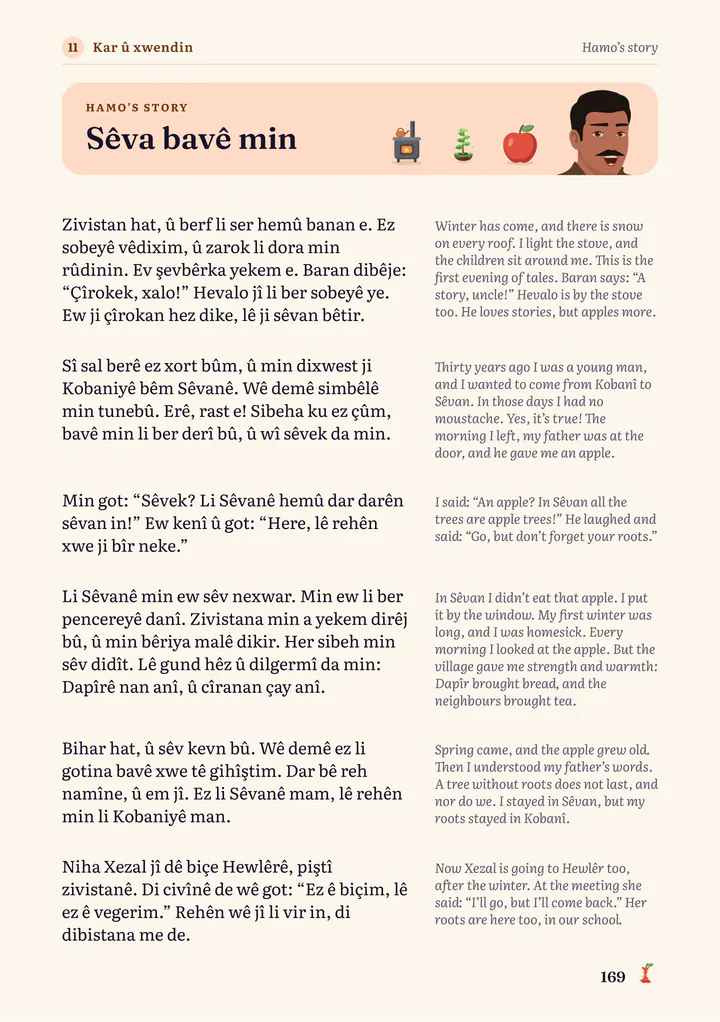
Hamo’s story
Zivistan hat, û berf li ser hemû banan e. Ez sobeyê vêdixim, û zarok li dora min rûdinin. Ev şevbêrka yekem e. Baran dibêje: “Çîrokek, xalo!” Hevalo jî li ber sobeyê ye. Ew ji çîrokan hez dike, lê ji sêvan bêtir.
Winter has come, and there is snow on every roof. I light the stove, and the children sit around me. This is the first evening of tales. Baran says: “A story, uncle!” Hevalo is by the stove too. He loves stories, but apples more.
Sî sal berê ez xort bûm, û min dixwest ji Kobaniyê bêm Sêvanê. Wê demê simbêlê min tunebû. Erê, rast e! Sibeha ku ez çûm, bavê min li ber derî bû, û wî sêvek da min.
Thirty years ago I was a young man, and I wanted to come from Kobanî to Sêvan. In those days I had no moustache. Yes, it’s true! The morning I left, my father was at the door, and he gave me an apple.
Min got: “Sêvek? Li Sêvanê hemû dar darên sêvan in!” Ew kenî û got: “Here, lê rehên xwe ji bîr neke.”
I said: “An apple? In Sêvan all the trees are apple trees!” He laughed and said: “Go, but don’t forget your roots.”
Li Sêvanê min ew sêv nexwar. Min ew li ber pencereyê danî. Zivistana min a yekem dirêj bû, û min bêriya malê dikir. Her sibeh min sêv didît. Lê gund hêz û dilgermî da min: Dapîrê nan anî, û cîranan çay anî.
In Sêvan I didn’t eat that apple. I put it by the window. My first winter was long, and I was homesick. Every morning I looked at the apple. But the village gave me strength and warmth: Dapîr brought bread, and the neighbours brought tea.
Bihar hat, û sêv kevn bû. Wê demê ez li gotina bavê xwe tê gihîştim. Dar bê reh namîne, û em jî. Ez li Sêvanê mam, lê rehên min li Kobaniyê man.
Spring came, and the apple grew old. Then I understood my father’s words. A tree without roots does not last, and nor do we. I stayed in Sêvan, but my roots stayed in Kobanî.
Niha Xezal jî dê biçe Hewlêrê, piştî zivistanê. Di civînê de wê got: “Ez ê biçim, lê ez ê vegerim.” Rehên wê jî li vir in, di dibistana me de.
Now Xezal is going to Hewlêr too, after the winter. At the meeting she said: “I’ll go, but I’ll come back.” Her roots are here too, in our school.
Baran pirsî: “Û sêv? Te çi kir?” Min got: “Di biharê de, min ew çand.” Ango dara sêvê ya kevn a baxçeyê me ji wê sêvê ye! Hevalo yekser rabû û çû ber darê. Ew bawer dike ku hemû sêvên wê ji bo wî ne.
Baran asked: “And the apple? What did you do with it?” I said: “In the spring, I planted it.” That is, the old apple tree in our orchard comes from that apple! Hevalo got up at once and went to the tree. He believes all its apples are for him.
Questions about the story
1 · Hamo kengî vê çîrokê vedibêje? When does Hamo tell this story?
a · Di civîna gund de
b · Di şevbêrka yekem de
c · Di havînê de, li zozanan
2 · Hevalo ji çi bêtir hez dike? What does Hevalo love more?
a Ji sêvan b Ji çîrokan c Ji berfê
3 · “Xort” kî ye? Who is a “xort”?
a · Zarokek biçûk · b · Dapîreke jîr
c · Kurekî ciwan
4 · Dema ku Hamo xort bû, çi tunebû? When Hamo was a young man, what didn’t he have?
a Simbêlê wî b Sêvên wî c Bavê wî
5 · Sibeha ku Hamo çû, bavê wî çi da wî? The morning Hamo left, what did his father give him?
a Bilûrek b Sêvek c Pirtûkek
6 · Çima Hamo bi sêvê şaşmayî bû? Why was Hamo surprised by the apple?
a · Ji ber ku sêv kevn bû
b · Ji ber ku ew ji sêvan hez nake
c · Ji ber ku li Sêvanê gelek sêv hene
7 · Bavê Hamo çi got? What did Hamo’s father say?
a · Here, lê rehên xwe ji bîr neke
b · Li Kobaniyê bimîne, û sêvê bixwe
c · Here, û zû vegere malê
8 · Rast, şaş an çîrok nabêje? Li Sêvanê, Hamo sêva bavê xwe xwar. True, false or not in the story? In Sêvan, Hamo ate his father’s apple.
a Rast b Şaş c Çîrok nabêje
9 · Hamo kengî li gotina bavê xwe tê gihîşt? When did Hamo understand his father’s words?
a · Sibeha ku ew ji Kobaniyê çû
b · Di civîna gund de, bi Xezalê re
c · Dema ku bihar hat û sêv kevn bû
10 · “Dar bê reh namîne.” Ango çi? “A tree without roots does not last.” What does that mean?
a · Dar bê reh mezintir dibe
b · Dar bê reh nikare bijî
c · Dar bê reh zû sêvan dide
11 · Çima Hamo dibêje ku rehên Xezalê jî li vir in? Why does Hamo say that Xezal’s roots are here too?
a · Ji ber ku ew li dibistana me mamoste ye
b · Ji ber ku ew ji Kobaniyê ye
c · Ji ber ku ew dara sêvê ye
12 · Hamo bi sêva bavê xwe çi kir? What did Hamo do with his father’s apple?
a · Wî ew da Hevalo
b · Wî ew çand
c · Wî ew xwar
13 · Ev çîrok li ser çi ye? What is this story about?
a · Karê baxçe di Cotmehê de, bi karkeran re
b · Rêwîtiya me ya zozanan, bi Bişar re
c · Sêva bavê Hamo û gotina wî: rehên xwe ji bîr neke
He is not hungry, he says.
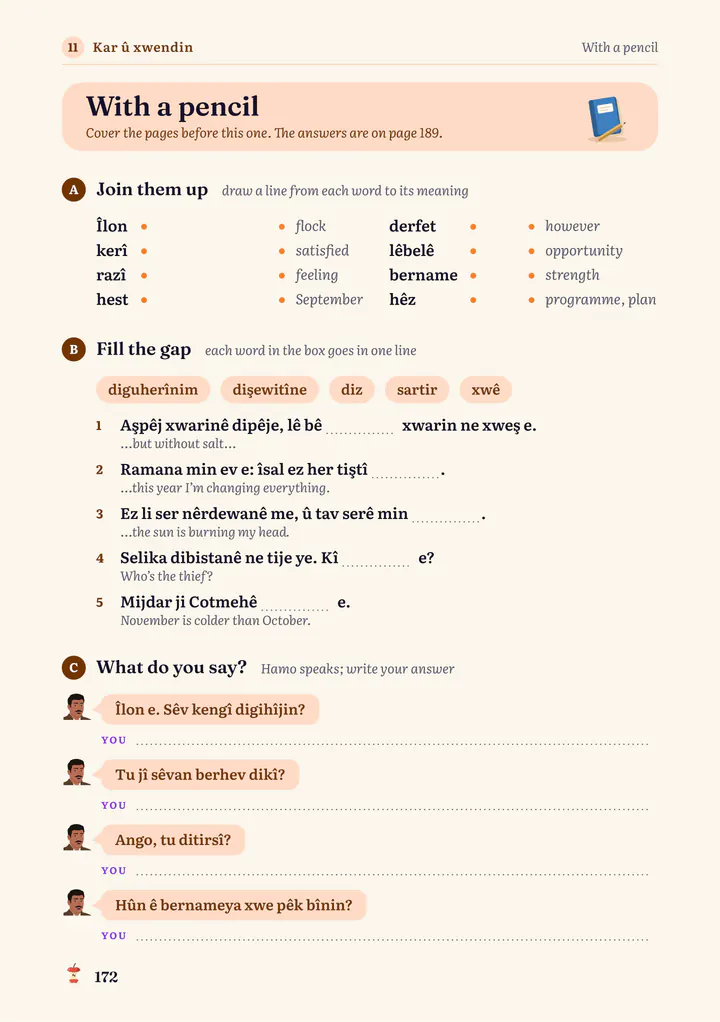
Cover the pages before this one. The answers are on page 189.
A · Join them up · draw a line from each word to its meaning
Îlon · flock · derfet · however
kerî · satisfied · lêbelê · opportunity
razî · feeling · bername · strength
hest · September · hêz · programme, plan
B · Fill the gap · each word in the box goes in one line
diguherînim · dişewitîne · diz · sartir · xwê
1 · Aşpêj xwarinê dipêje, lê bê … xwarin ne xweş e.
…but without salt…
2 · Ramana min ev e: îsal ez her tiştî ….
…this year I’m changing everything.
3 · Ez li ser nêrdewanê me, û tav serê min ….
…the sun is burning my head.
4 · Selika dibistanê ne tije ye. Kî … e?
Who’s the thief?
5 · Mijdar ji Cotmehê … e.
November is colder than October.
C · What do you say? · Hamo speaks; write your answer
Îlon e. Sêv kengî digihîjin?
You
Tu jî sêvan berhev dikî?
You
Ango, tu ditirsî?
You
Hûn ê bernameya xwe pêk bînin?
You
D · Put it into Kurdish · write it, then say it
1 · I’m a cook, not a builder.
2 · I check the saplings, and the soil is good.
3 · I believe in Baran.
4 · Xezal took a photo, and said it was the best talk of the year.
E · No English this time · Hevalo ate it. Read these aloud all the same
Dikandar ji karkeran re çay û nan difiroşe.
Civîn dirêj bû, û Hevalo raza.
Civîna gund dirêj e, lê ramanên her kesî girîng in.
Kar û xwendin
Chapter 11 is yours
Cancel its stamp in your passport on page 4, then turn the page.
Çi nûçe? Hevalo dîsa tiştek xwar?
What news? Has Hevalo eaten something again?
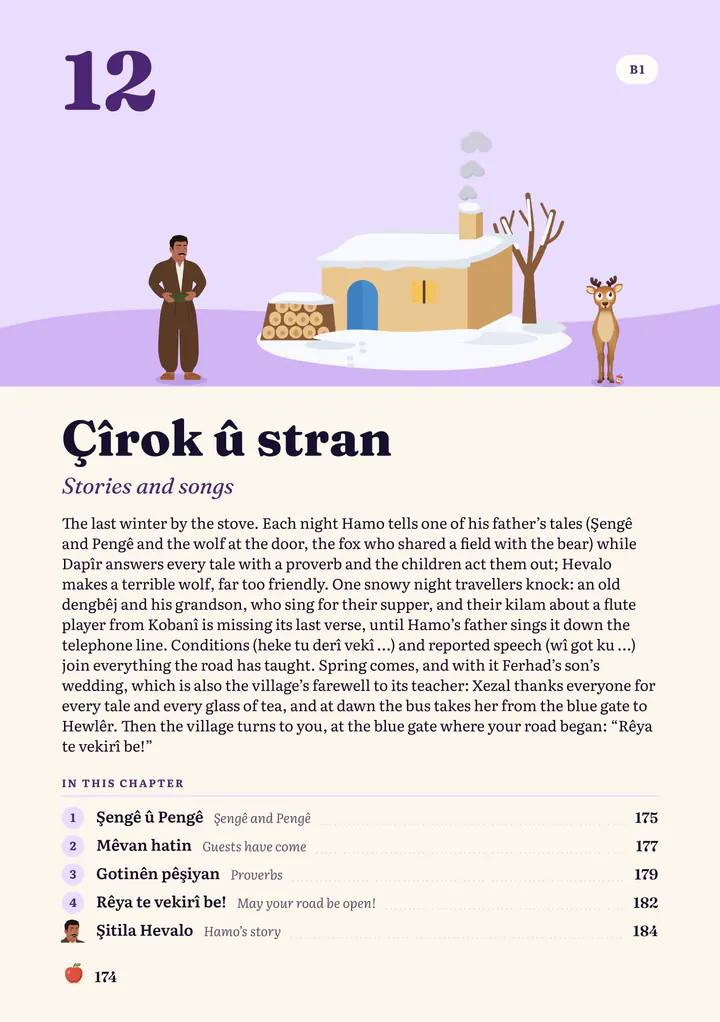
Stories and songs
The last winter by the stove. Each night Hamo tells one of his father’s tales (Şengê and Pengê and the wolf at the door, the fox who shared a field with the bear) while Dapîr answers every tale with a proverb and the children act them out; Hevalo makes a terrible wolf, far too friendly. One snowy night travellers knock: an old dengbêj and his grandson, who sing for their supper, and their kilam about a flute player from Kobanî is missing its last verse, until Hamo’s father sings it down the telephone line. Conditions (heke tu derî vekî …) and reported speech (wî got ku …) join everything the road has taught. Spring comes, and with it Ferhad’s son’s wedding, which is also the village’s farewell to its teacher: Xezal thanks everyone for every tale and every glass of tea, and at dawn the bus takes her from the blue gate to Hewlêr. Then the village turns to you, at the blue gate where your road began: “Rêya te vekirî be!”
In this chapter
1 · Şengê û Pengê · Şengê and Pengê · 175
2 · Mêvan hatin · Guests have come · 177
3 · Gotinên pêşiyan · Proverbs · 179
4 · Rêya te vekirî be! · May your road be open! · 182
Şitila Hevalo · Hamo’s story · 184
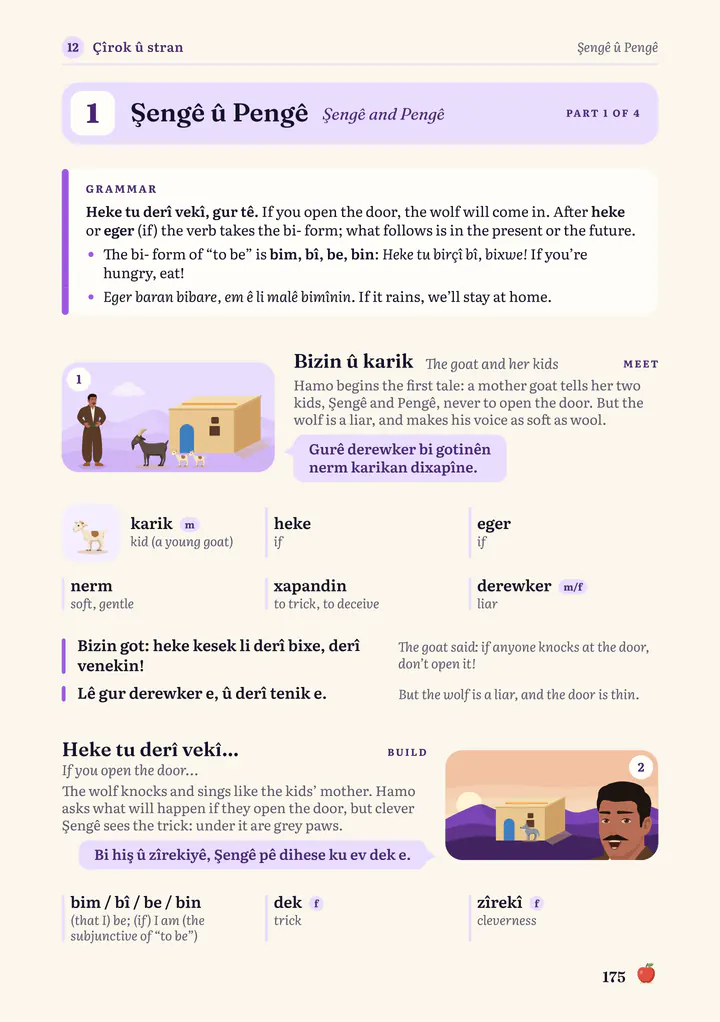
Şengê and Pengê · Part 1 of 4
Grammar
Heke tu derî vekî, gur tê. If you open the door, the wolf will come in. After heke or eger (if) the verb takes the bi- form; what follows is in the present or the future.
The bi- form of “to be” is bim, bî, be, bin: Heke tu birçî bî, bixwe! If you’re hungry, eat!
Eger baran bibare, em ê li malê bimînin. If it rains, we’ll stay at home.
Bizin û karik · The goat and her kids · Meet
Hamo begins the first tale: a mother goat tells her two kids, Şengê and Pengê, never to open the door. But the wolf is a liar, and makes his voice as soft as wool.
Gurê derewker bi gotinên nerm karikan dixapîne.
karik (m) · kid (a young goat)
heke · if
eger · if
nerm · soft, gentle
xapandin · to trick, to deceive
derewker · m/f · liar
Bizin got: heke kesek li derî bixe, derî venekin!
The goat said: if anyone knocks at the door, don’t open it!
Lê gur derewker e, û derî tenik e. · But the wolf is a liar, and the door is thin.
Heke tu derî vekî…
If you open the door…
Build
The wolf knocks and sings like the kids’ mother. Hamo asks what will happen if they open the door, but clever Şengê sees the trick: under it are grey paws.
Bi hiş û zîrekiyê, Şengê pê dihese ku ev dek e.
bim / bî / be / bin · (that I) be; (if) I am (the subjunctive of “to be”)
dek (f) · trick
zîrekî (f) · cleverness
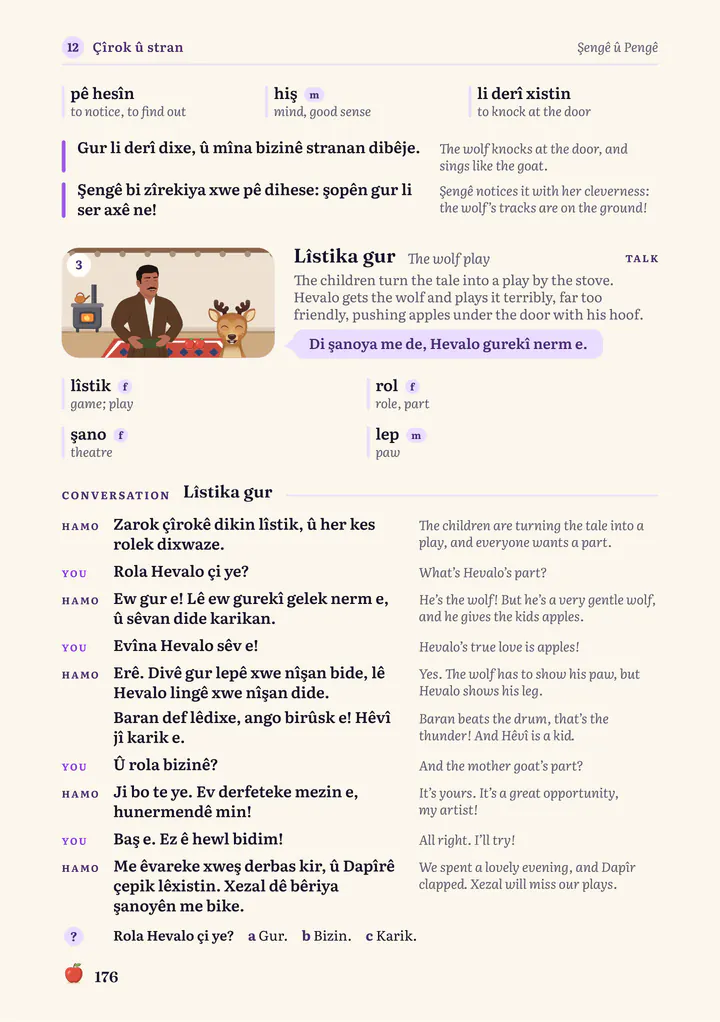
pê hesîn · to notice, to find out
hiş (m) · mind, good sense
li derî xistin · to knock at the door
Gur li derî dixe, û mîna bizinê stranan dibêje. · The wolf knocks at the door, and sings like the goat.
Şengê bi zîrekiya xwe pê dihese: şopên gur li ser axê ne!
Şengê notices it with her cleverness: the wolf’s tracks are on the ground!
Lîstika gur · The wolf play · Talk
The children turn the tale into a play by the stove. Hevalo gets the wolf and plays it terribly, far too friendly, pushing apples under the door with his hoof.
Di şanoya me de, Hevalo gurekî nerm e.
lîstik (f) · game; play
rol (f) · role, part
şano (f) · theatre
lep (m) · paw
Conversation · Lîstika gur
Hamo: Zarok çîrokê dikin lîstik, û her kes rolek dixwaze.
The children are turning the tale into a play, and everyone wants a part.
You: Rola Hevalo çi ye? · What’s Hevalo’s part?
Hamo: Ew gur e! Lê ew gurekî gelek nerm e, û sêvan dide karikan.
He’s the wolf! But he’s a very gentle wolf, and he gives the kids apples.
You: Evîna Hevalo sêv e! · Hevalo’s true love is apples!
Hamo: Erê. Divê gur lepê xwe nîşan bide, lê Hevalo lingê xwe nîşan dide.
Yes. The wolf has to show his paw, but Hevalo shows his leg.
Baran def lêdixe, ango birûsk e! Hêvî jî karik e.
Baran beats the drum, that’s the thunder! And Hêvî is a kid.
You: Û rola bizinê? · And the mother goat’s part?
Hamo: Ji bo te ye. Ev derfeteke mezin e, hunermendê min!
It’s yours. It’s a great opportunity, my artist!
You: Baş e. Ez ê hewl bidim! · All right. I’ll try!
Hamo: Me êvareke xweş derbas kir, û Dapîrê çepik lêxistin. Xezal dê bêriya şanoyên me bike.
We spent a lovely evening, and Dapîr clapped. Xezal will miss our plays.
Rola Hevalo çi ye? a Gur. b Bizin. c Karik.
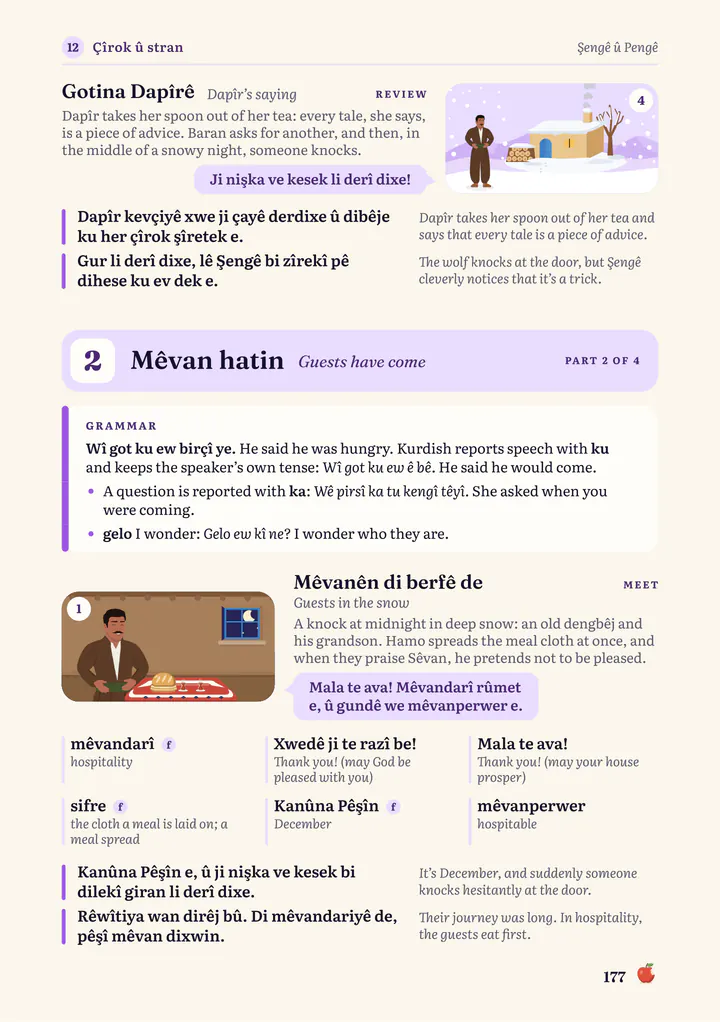
Gotina Dapîrê · Dapîr’s saying · Review
Dapîr takes her spoon out of her tea: every tale, she says, is a piece of advice. Baran asks for another, and then, in the middle of a snowy night, someone knocks.
Ji nişka ve kesek li derî dixe!
Dapîr kevçiyê xwe ji çayê derdixe û dibêje ku her çîrok şîretek e.
Dapîr takes her spoon out of her tea and says that every tale is a piece of advice.
Gur li derî dixe, lê Şengê bi zîrekî pê dihese ku ev dek e.
The wolf knocks at the door, but Şengê cleverly notices that it’s a trick.
Guests have come · Part 2 of 4
Grammar
Wî got ku ew birçî ye. He said he was hungry. Kurdish reports speech with ku and keeps the speaker’s own tense: Wî got ku ew ê bê. He said he would come.
A question is reported with ka: Wê pirsî ka tu kengî têyî. She asked when you were coming.
gelo I wonder: Gelo ew kî ne? I wonder who they are.
Mêvanên di berfê de
Guests in the snow
Meet
A knock at midnight in deep snow: an old dengbêj and his grandson. Hamo spreads the meal cloth at once, and when they praise Sêvan, he pretends not to be pleased.
Mala te ava! Mêvandarî rûmet e, û gundê we mêvanperwer e.
mêvandarî (f) · hospitality
Xwedê ji te razî be! · Thank you! (may God be pleased with you)
Mala te ava! · Thank you! (may your house prosper)
sifre (f) · the cloth a meal is laid on; a meal spread
Kanûna Pêşîn (f) · December
mêvanperwer · hospitable
Kanûna Pêşîn e, û ji nişka ve kesek bi dilekî giran li derî dixe.
It’s December, and suddenly someone knocks hesitantly at the door.
Rêwîtiya wan dirêj bû. Di mêvandariyê de, pêşî mêvan dixwin.
Their journey was long. In hospitality, the guests eat first.
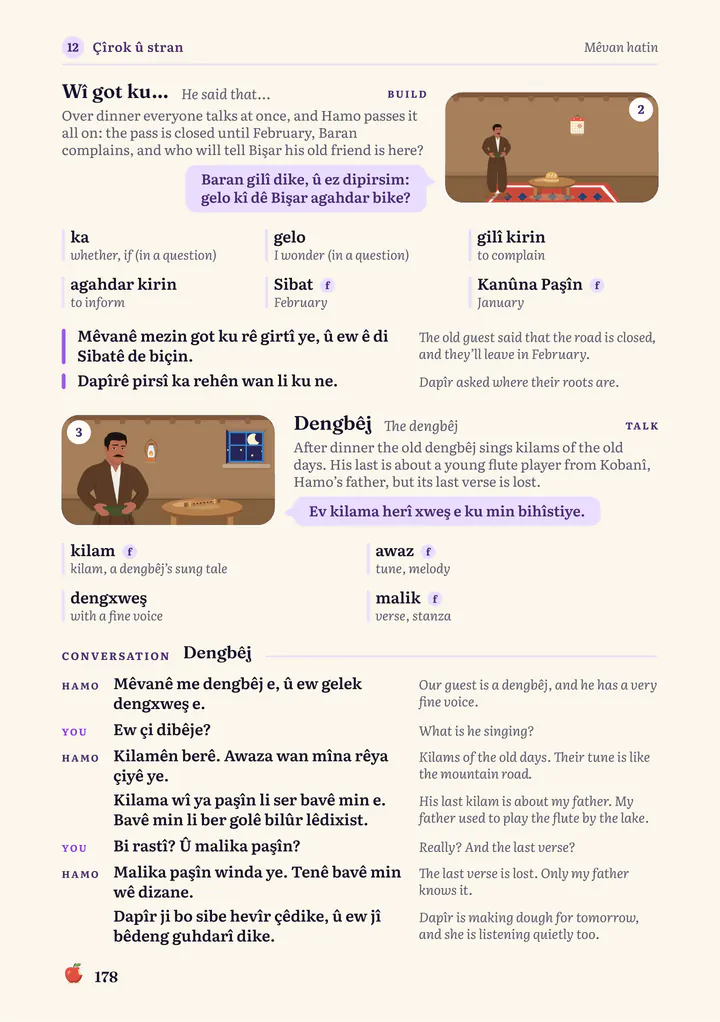
Wî got ku… · He said that… · Build
Over dinner everyone talks at once, and Hamo passes it all on: the pass is closed until February, Baran complains, and who will tell Bişar his old friend is here?
Baran gilî dike, û ez dipirsim: gelo kî dê Bişar agahdar bike?
ka · whether, if (in a question)
gelo · I wonder (in a question)
gilî kirin · to complain
agahdar kirin · to inform
Sibat (f) · February
Kanûna Paşîn (f) · January
Mêvanê mezin got ku rê girtî ye, û ew ê di Sibatê de biçin.
The old guest said that the road is closed, and they’ll leave in February.
Dapîrê pirsî ka rehên wan li ku ne. · Dapîr asked where their roots are.
Dengbêj · The dengbêj · Talk
After dinner the old dengbêj sings kilams of the old days. His last is about a young flute player from Kobanî, Hamo’s father, but its last verse is lost.
Ev kilama herî xweş e ku min bihîstiye.
kilam (f) · kilam, a dengbêj’s sung tale
awaz (f) · tune, melody
dengxweş · with a fine voice
malik (f) · verse, stanza
Conversation · Dengbêj
Hamo: Mêvanê me dengbêj e, û ew gelek dengxweş e.
Our guest is a dengbêj, and he has a very fine voice.
You: Ew çi dibêje? · What is he singing?
Hamo: Kilamên berê. Awaza wan mîna rêya çiyê ye.
Kilams of the old days. Their tune is like the mountain road.
Kilama wî ya paşîn li ser bavê min e. Bavê min li ber golê bilûr lêdixist.
His last kilam is about my father. My father used to play the flute by the lake.
You: Bi rastî? Û malika paşîn? · Really? And the last verse?
Hamo: Malika paşîn winda ye. Tenê bavê min wê dizane.
The last verse is lost. Only my father knows it.
Dapîr ji bo sibe hevîr çêdike, û ew jî bêdeng guhdarî dike.
Dapîr is making dough for tomorrow, and she is listening quietly too.
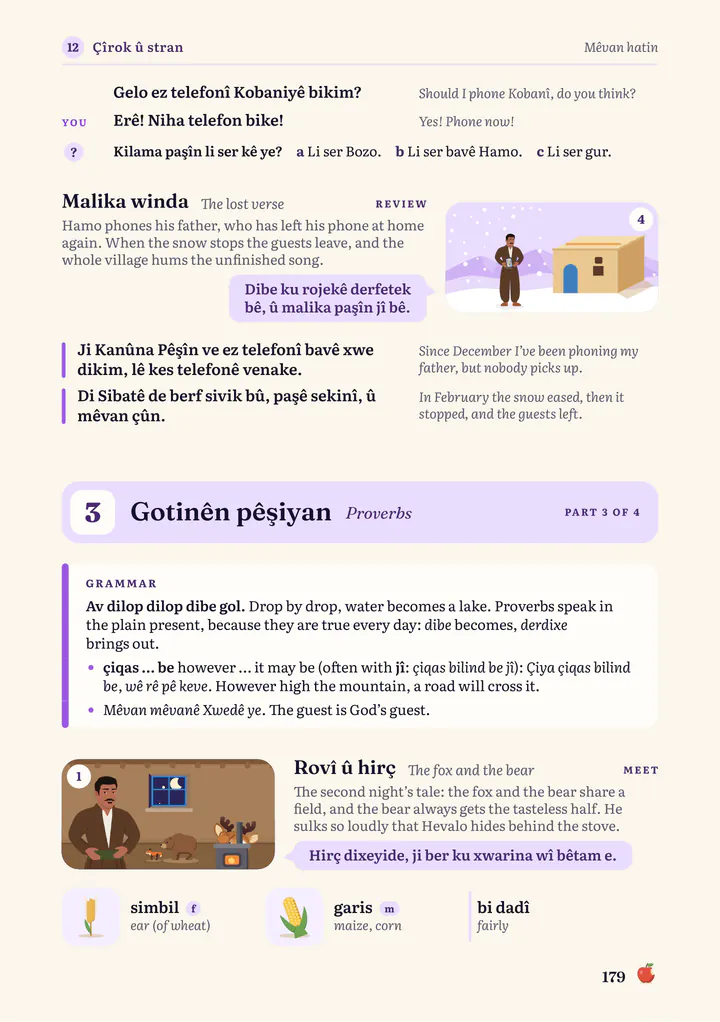
Gelo ez telefonî Kobaniyê bikim? · Should I phone Kobanî, do you think?
You: Erê! Niha telefon bike! · Yes! Phone now!
Kilama paşîn li ser kê ye? a Li ser Bozo. b Li ser bavê Hamo. c Li ser gur.
Malika winda · The lost verse · Review
Hamo phones his father, who has left his phone at home again. When the snow stops the guests leave, and the whole village hums the unfinished song.
Dibe ku rojekê derfetek bê, û malika paşîn jî bê.
Ji Kanûna Pêşîn ve ez telefonî bavê xwe dikim, lê kes telefonê venake.
Since December I’ve been phoning my father, but nobody picks up.
Di Sibatê de berf sivik bû, paşê sekinî, û mêvan çûn.
In February the snow eased, then it stopped, and the guests left.
Proverbs · Part 3 of 4
Grammar
Av dilop dilop dibe gol. Drop by drop, water becomes a lake. Proverbs speak in the plain present, because they are true every day: dibe becomes, derdixe brings out.
çiqas … be however … it may be (often with jî: çiqas bilind be jî): Çiya çiqas bilind be, wê rê pê keve. However high the mountain, a road will cross it.
Mêvan mêvanê Xwedê ye. The guest is God’s guest.
Rovî û hirç · The fox and the bear · Meet
The second night’s tale: the fox and the bear share a field, and the bear always gets the tasteless half. He sulks so loudly that Hevalo hides behind the stove.
Hirç dixeyide, ji ber ku xwarina wî bêtam e.
simbil (f) · ear (of wheat)
garis (m) · maize, corn
bi dadî · fairly
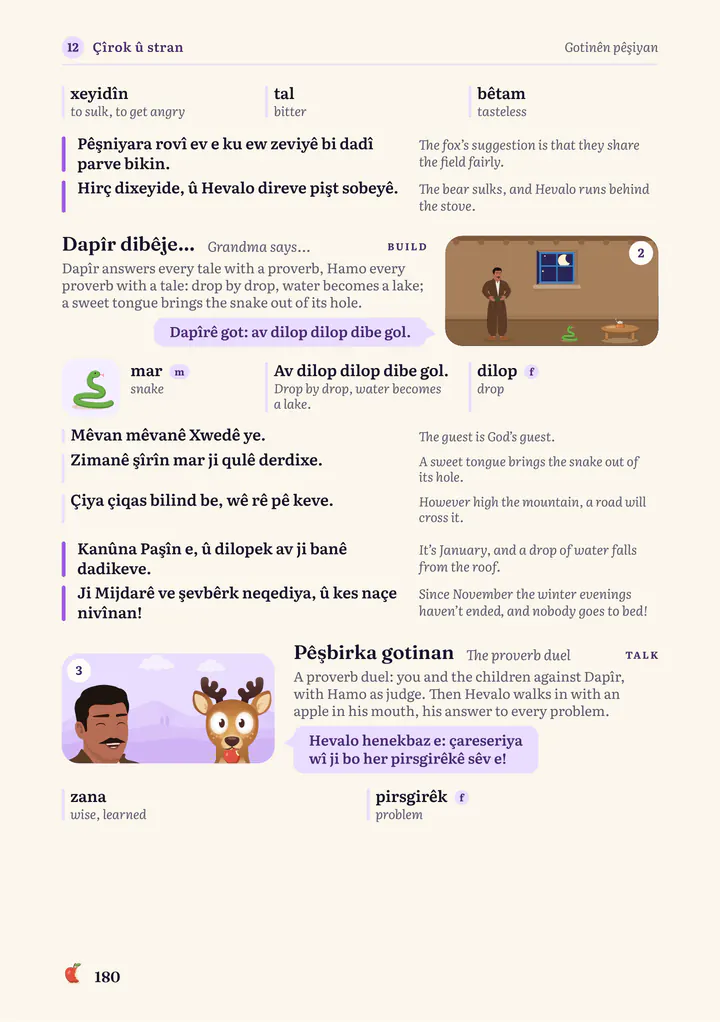
xeyidîn · to sulk, to get angry
tal · bitter
bêtam · tasteless
Pêşniyara rovî ev e ku ew zeviyê bi dadî parve bikin.
The fox’s suggestion is that they share the field fairly.
Hirç dixeyide, û Hevalo direve pişt sobeyê. · The bear sulks, and Hevalo runs behind the stove.
Dapîr dibêje… · Grandma says… · Build
Dapîr answers every tale with a proverb, Hamo every proverb with a tale: drop by drop, water becomes a lake; a sweet tongue brings the snake out of its hole.
Dapîrê got: av dilop dilop dibe gol.
mar (m) · snake
Av dilop dilop dibe gol. · Drop by drop, water becomes a lake.
dilop (f) · drop
Mêvan mêvanê Xwedê ye. · The guest is God’s guest.
Zimanê şîrîn mar ji qulê derdixe. · A sweet tongue brings the snake out of its hole.
Çiya çiqas bilind be, wê rê pê keve. · However high the mountain, a road will cross it.
Kanûna Paşîn e, û dilopek av ji banê dadikeve.
It’s January, and a drop of water falls from the roof.
Ji Mijdarê ve şevbêrk neqediya, û kes naçe nivînan!
Since November the winter evenings haven’t ended, and nobody goes to bed!
Pêşbirka gotinan · The proverb duel · Talk
A proverb duel: you and the children against Dapîr, with Hamo as judge. Then Hevalo walks in with an apple in his mouth, his answer to every problem.
Hevalo henekbaz e: çareseriya wî ji bo her pirsgirêkê sêv e!
zana · wise, learned
pirsgirêk (f) · problem
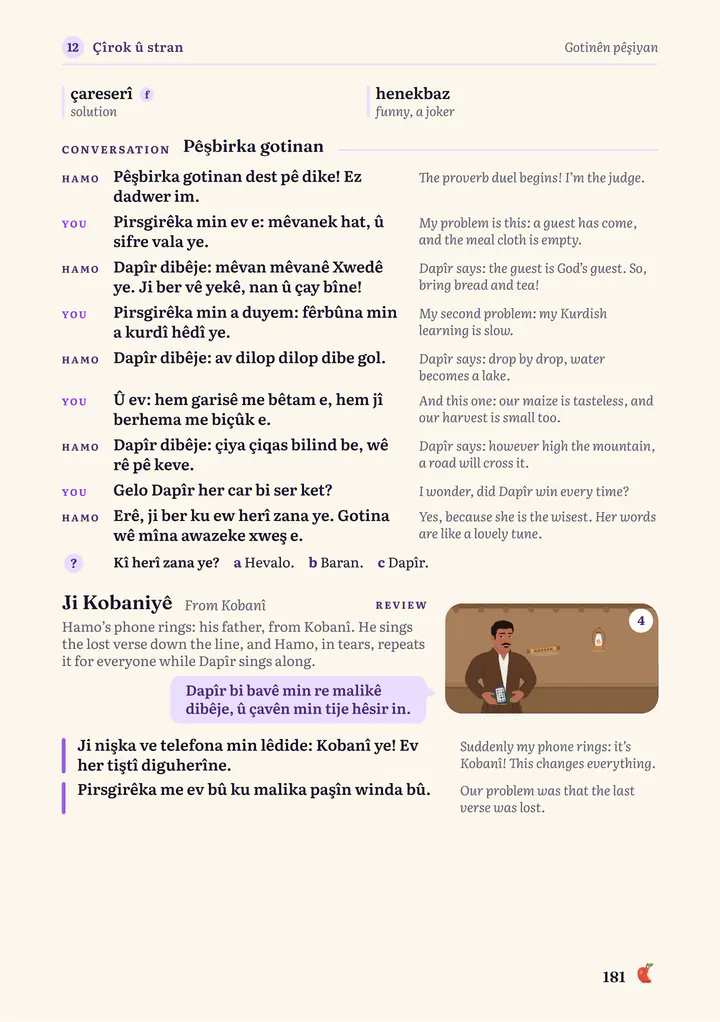
çareserî (f) · solution
henekbaz · funny, a joker
Conversation · Pêşbirka gotinan
Hamo: Pêşbirka gotinan dest pê dike! Ez dadwer im.
The proverb duel begins! I’m the judge.
You: Pirsgirêka min ev e: mêvanek hat, û sifre vala ye.
My problem is this: a guest has come, and the meal cloth is empty.
Hamo: Dapîr dibêje: mêvan mêvanê Xwedê ye. Ji ber vê yekê, nan û çay bîne!
Dapîr says: the guest is God’s guest. So, bring bread and tea!
You: Pirsgirêka min a duyem: fêrbûna min a kurdî hêdî ye.
My second problem: my Kurdish learning is slow.
Hamo: Dapîr dibêje: av dilop dilop dibe gol. · Dapîr says: drop by drop, water becomes a lake.
You: Û ev: hem garisê me bêtam e, hem jî berhema me biçûk e.
And this one: our maize is tasteless, and our harvest is small too.
Hamo: Dapîr dibêje: çiya çiqas bilind be, wê rê pê keve.
Dapîr says: however high the mountain, a road will cross it.
You: Gelo Dapîr her car bi ser ket? · I wonder, did Dapîr win every time?
Hamo: Erê, ji ber ku ew herî zana ye. Gotina wê mîna awazeke xweş e.
Yes, because she is the wisest. Her words are like a lovely tune.
Kî herî zana ye? a Hevalo. b Baran. c Dapîr.
Ji Kobaniyê · From Kobanî · Review
Hamo’s phone rings: his father, from Kobanî. He sings the lost verse down the line, and Hamo, in tears, repeats it for everyone while Dapîr sings along.
Dapîr bi bavê min re malikê dibêje, û çavên min tije hêsir in.
Ji nişka ve telefona min lêdide: Kobanî ye! Ev her tiştî diguherîne.
Suddenly my phone rings: it’s Kobanî! This changes everything.
Pirsgirêka me ev bû ku malika paşîn winda bû. · Our problem was that the last verse was lost.
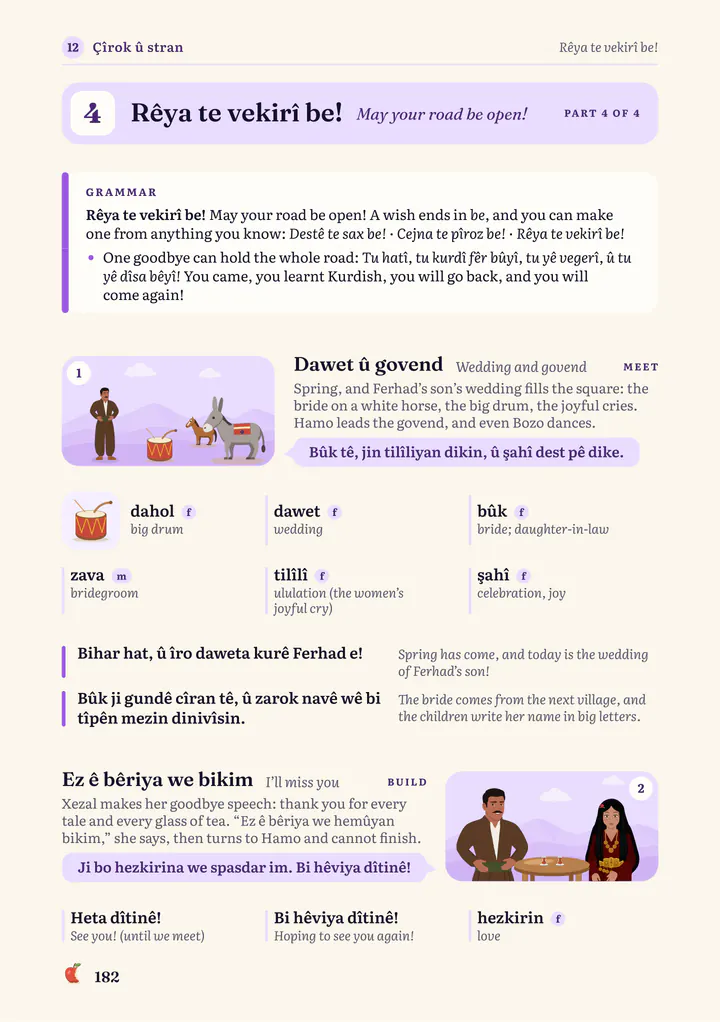
May your road be open! · Part 4 of 4
Grammar
Rêya te vekirî be! May your road be open! A wish ends in be, and you can make one from anything you know: Destê te sax be! · Cejna te pîroz be! · Rêya te vekirî be!
One goodbye can hold the whole road: Tu hatî, tu kurdî fêr bûyî, tu yê vegerî, û tu yê dîsa bêyî! You came, you learnt Kurdish, you will go back, and you will come again!
Dawet û govend · Wedding and govend · Meet
Spring, and Ferhad’s son’s wedding fills the square: the bride on a white horse, the big drum, the joyful cries. Hamo leads the govend, and even Bozo dances.
Bûk tê, jin tilîliyan dikin, û şahî dest pê dike.
dahol (f) · big drum
dawet (f) · wedding
bûk (f) · bride; daughter-in-law
zava (m) · bridegroom
tilîlî (f) · ululation (the women’s joyful cry)
şahî (f) · celebration, joy
Bihar hat, û îro daweta kurê Ferhad e! · Spring has come, and today is the wedding of Ferhad’s son!
Bûk ji gundê cîran tê, û zarok navê wê bi tîpên mezin dinivîsin.
The bride comes from the next village, and the children write her name in big letters.
Ez ê bêriya we bikim · I’ll miss you · Build
Xezal makes her goodbye speech: thank you for every tale and every glass of tea. “Ez ê bêriya we hemûyan bikim,” she says, then turns to Hamo and cannot finish.
Ji bo hezkirina we spasdar im. Bi hêviya dîtinê!
Heta dîtinê! · See you! (until we meet)
Bi hêviya dîtinê! · Hoping to see you again!
hezkirin (f) · love
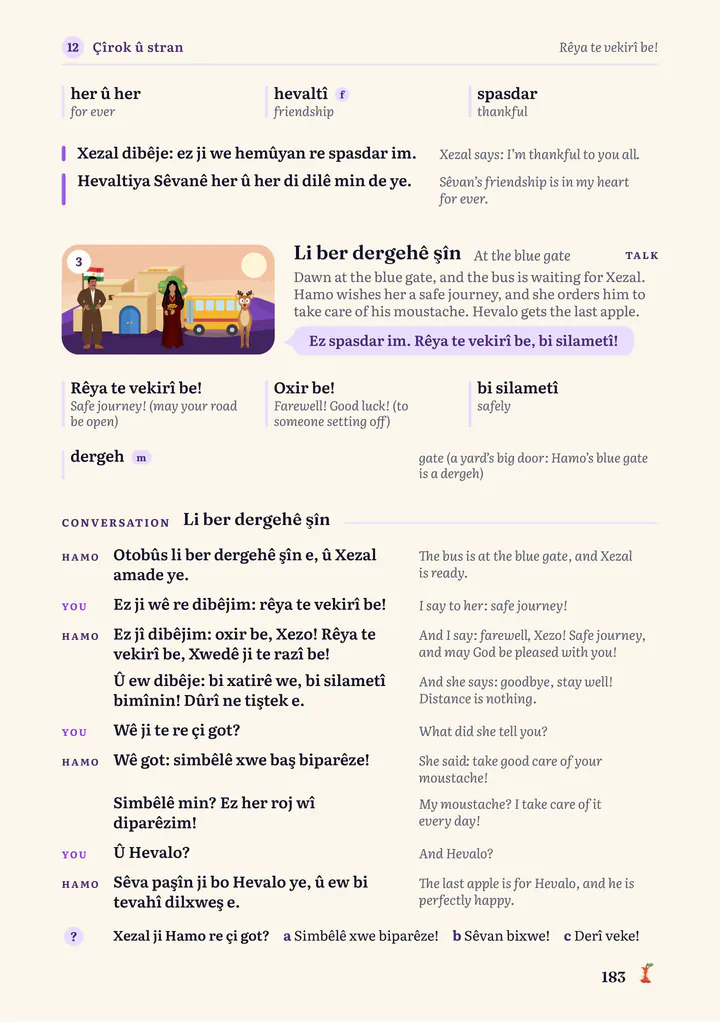
her û her · for ever
hevaltî (f) · friendship
spasdar · thankful
Xezal dibêje: ez ji we hemûyan re spasdar im. · Xezal says: I’m thankful to you all.
Hevaltiya Sêvanê her û her di dilê min de ye. · Sêvan’s friendship is in my heart for ever.
Li ber dergehê şîn · At the blue gate · Talk
Dawn at the blue gate, and the bus is waiting for Xezal. Hamo wishes her a safe journey, and she orders him to take care of his moustache. Hevalo gets the last apple.
Ez spasdar im. Rêya te vekirî be, bi silametî!
Rêya te vekirî be! · Safe journey! (may your road be open)
Oxir be! · Farewell! Good luck! (to someone setting off)
bi silametî · safely
dergeh (m) · gate (a yard’s big door: Hamo’s blue gate is a dergeh)
Conversation · Li ber dergehê şîn
Hamo: Otobûs li ber dergehê şîn e, û Xezal amade ye.
The bus is at the blue gate, and Xezal is ready.
You: Ez ji wê re dibêjim: rêya te vekirî be! · I say to her: safe journey!
Hamo: Ez jî dibêjim: oxir be, Xezo! Rêya te vekirî be, Xwedê ji te razî be!
And I say: farewell, Xezo! Safe journey, and may God be pleased with you!
Û ew dibêje: bi xatirê we, bi silametî bimînin! Dûrî ne tiştek e.
And she says: goodbye, stay well! Distance is nothing.
You: Wê ji te re çi got? · What did she tell you?
Hamo: Wê got: simbêlê xwe baş biparêze! · She said: take good care of your moustache!
Simbêlê min? Ez her roj wî diparêzim!
My moustache? I take care of it every day!
You: Û Hevalo? · And Hevalo?
Hamo: Sêva paşîn ji bo Hevalo ye, û ew bi tevahî dilxweş e.
The last apple is for Hevalo, and he is perfectly happy.
Xezal ji Hamo re çi got? a Simbêlê xwe biparêze! b Sêvan bixwe! c Derî veke!
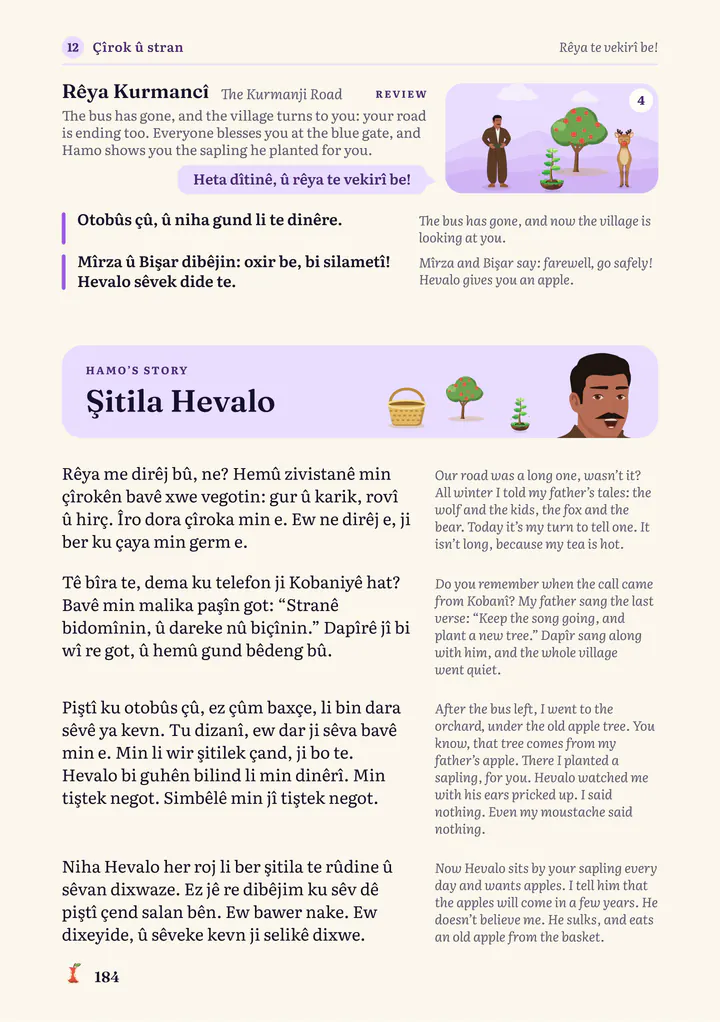
Rêya Kurmancî · The Kurmanji Road · Review
The bus has gone, and the village turns to you: your road is ending too. Everyone blesses you at the blue gate, and Hamo shows you the sapling he planted for you.
Heta dîtinê, û rêya te vekirî be!
Otobûs çû, û niha gund li te dinêre. · The bus has gone, and now the village is looking at you.
Mîrza û Bişar dibêjin: oxir be, bi silametî! Hevalo sêvek dide te.
Mîrza and Bişar say: farewell, go safely! Hevalo gives you an apple.
Hamo’s story
Rêya me dirêj bû, ne? Hemû zivistanê min çîrokên bavê xwe vegotin: gur û karik, rovî û hirç. Îro dora çîroka min e. Ew ne dirêj e, ji ber ku çaya min germ e.
Our road was a long one, wasn’t it? All winter I told my father’s tales: the wolf and the kids, the fox and the bear. Today it’s my turn to tell one. It isn’t long, because my tea is hot.
Tê bîra te, dema ku telefon ji Kobaniyê hat? Bavê min malika paşîn got: “Stranê bidomînin, û dareke nû biçînin.” Dapîrê jî bi wî re got, û hemû gund bêdeng bû.
Do you remember when the call came from Kobanî? My father sang the last verse: “Keep the song going, and plant a new tree.” Dapîr sang along with him, and the whole village went quiet.
Piştî ku otobûs çû, ez çûm baxçe, li bin dara sêvê ya kevn. Tu dizanî, ew dar ji sêva bavê min e. Min li wir şitilek çand, ji bo te. Hevalo bi guhên bilind li min dinêrî. Min tiştek negot. Simbêlê min jî tiştek negot.
After the bus left, I went to the orchard, under the old apple tree. You know, that tree comes from my father’s apple. There I planted a sapling, for you. Hevalo watched me with his ears pricked up. I said nothing. Even my moustache said nothing.
Niha Hevalo her roj li ber şitila te rûdine û sêvan dixwaze. Ez jê re dibêjim ku sêv dê piştî çend salan bên. Ew bawer nake. Ew dixeyide, û sêveke kevn ji selikê dixwe.
Now Hevalo sits by your sapling every day and wants apples. I tell him that the apples will come in a few years. He doesn’t believe me. He sulks, and eats an old apple from the basket.
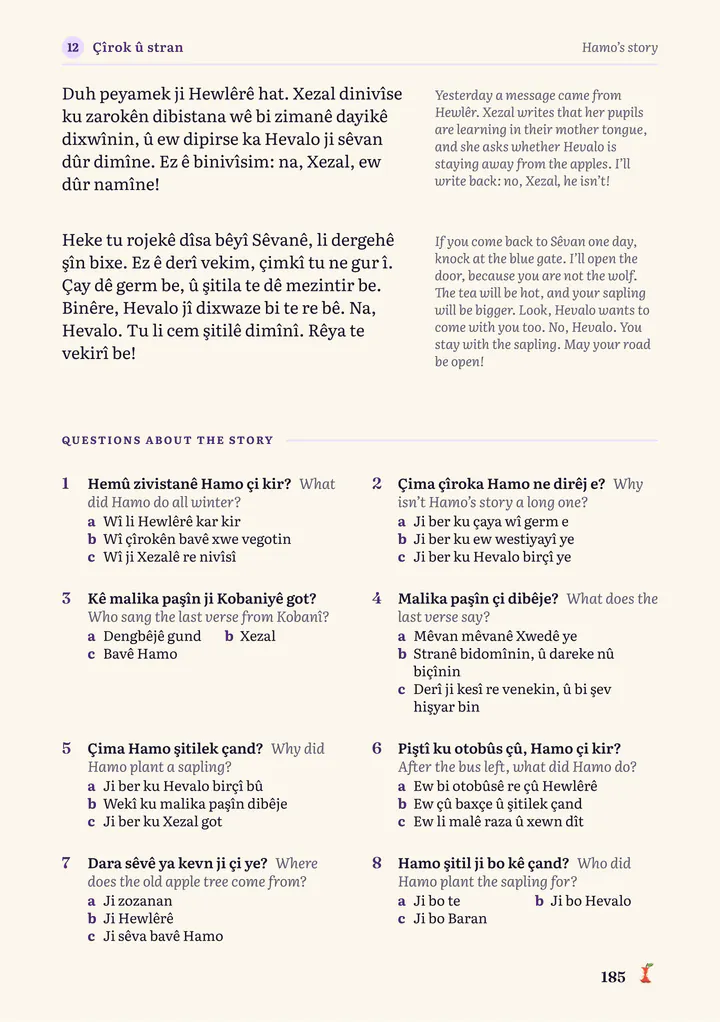
Duh peyamek ji Hewlêrê hat. Xezal dinivîse ku zarokên dibistana wê bi zimanê dayikê dixwînin, û ew dipirse ka Hevalo ji sêvan dûr dimîne. Ez ê binivîsim: na, Xezal, ew dûr namîne!
Yesterday a message came from Hewlêr. Xezal writes that her pupils are learning in their mother tongue, and she asks whether Hevalo is staying away from the apples. I’ll write back: no, Xezal, he isn’t!
Heke tu rojekê dîsa bêyî Sêvanê, li dergehê şîn bixe. Ez ê derî vekim, çimkî tu ne gur î. Çay dê germ be, û şitila te dê mezintir be. Binêre, Hevalo jî dixwaze bi te re bê. Na, Hevalo. Tu li cem şitilê dimînî. Rêya te vekirî be!
If you come back to Sêvan one day, knock at the blue gate. I’ll open the door, because you are not the wolf. The tea will be hot, and your sapling will be bigger. Look, Hevalo wants to come with you too. No, Hevalo. You stay with the sapling. May your road be open!
Questions about the story
1 · Hemû zivistanê Hamo çi kir? What did Hamo do all winter?
a · Wî li Hewlêrê kar kir
b · Wî çîrokên bavê xwe vegotin
c · Wî ji Xezalê re nivîsî
2 · Çima çîroka Hamo ne dirêj e? Why isn’t Hamo’s story a long one?
a · Ji ber ku çaya wî germ e
b · Ji ber ku ew westiyayî ye
c · Ji ber ku Hevalo birçî ye
3 · Kê malika paşîn ji Kobaniyê got? Who sang the last verse from Kobanî?
a · Dengbêjê gund · b · Xezal
c · Bavê Hamo
4 · Malika paşîn çi dibêje? What does the last verse say?
a · Mêvan mêvanê Xwedê ye
b · Stranê bidomînin, û dareke nû biçînin
c · Derî ji kesî re venekin, û bi şev hişyar bin
5 · Çima Hamo şitilek çand? Why did Hamo plant a sapling?
a · Ji ber ku Hevalo birçî bû
b · Wekî ku malika paşîn dibêje
c · Ji ber ku Xezal got
6 · Piştî ku otobûs çû, Hamo çi kir? After the bus left, what did Hamo do?
a · Ew bi otobûsê re çû Hewlêrê
b · Ew çû baxçe û şitilek çand
c · Ew li malê raza û xewn dît
7 · Dara sêvê ya kevn ji çi ye? Where does the old apple tree come from?
a · Ji zozanan
b · Ji Hewlêrê
c · Ji sêva bavê Hamo
8 · Hamo şitil ji bo kê çand? Who did Hamo plant the sapling for?
a · Ji bo te · b · Ji bo Hevalo
c · Ji bo Baran
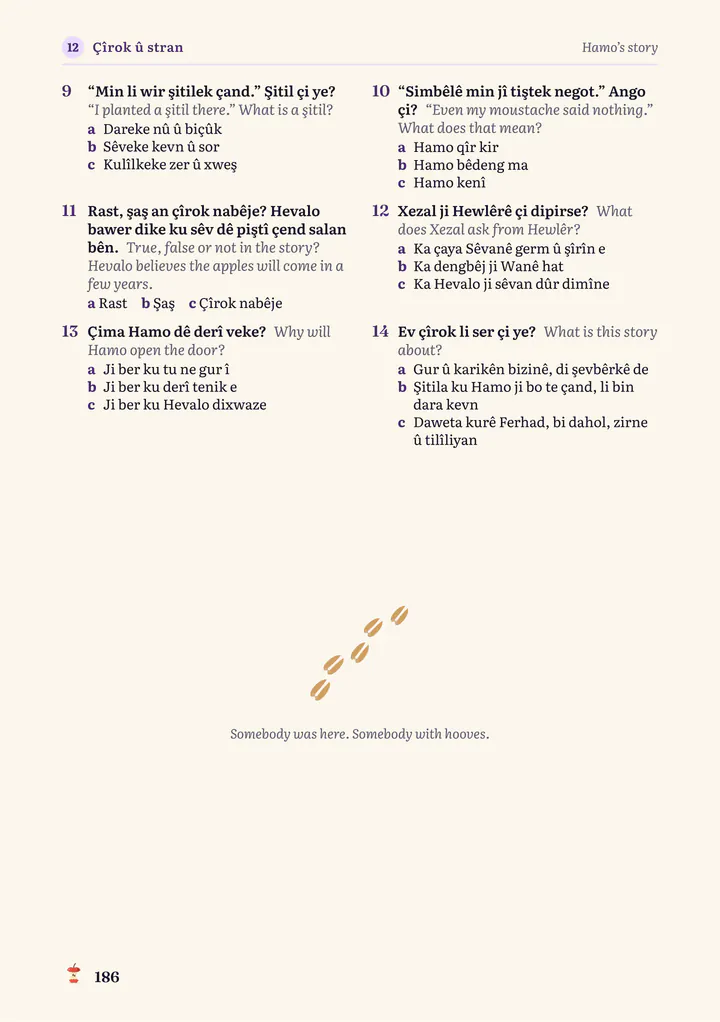
9 · “Min li wir şitilek çand.” Şitil çi ye? “I planted a şitil there.” What is a şitil?
a · Dareke nû û biçûk
b · Sêveke kevn û sor
c · Kulîlkeke zer û xweş
10 · “Simbêlê min jî tiştek negot.” Ango çi? “Even my moustache said nothing.” What does that mean?
a · Hamo qîr kir
b · Hamo bêdeng ma
c · Hamo kenî
11 · Rast, şaş an çîrok nabêje? Hevalo bawer dike ku sêv dê piştî çend salan bên. True, false or not in the story? Hevalo believes the apples will come in a few years.
a Rast b Şaş c Çîrok nabêje
12 · Xezal ji Hewlêrê çi dipirse? What does Xezal ask from Hewlêr?
a · Ka çaya Sêvanê germ û şîrîn e
b · Ka dengbêj ji Wanê hat
c · Ka Hevalo ji sêvan dûr dimîne
13 · Çima Hamo dê derî veke? Why will Hamo open the door?
a · Ji ber ku tu ne gur î
b · Ji ber ku derî tenik e
c · Ji ber ku Hevalo dixwaze
14 · Ev çîrok li ser çi ye? What is this story about?
a · Gur û karikên bizinê, di şevbêrkê de
b · Şitila ku Hamo ji bo te çand, li bin dara kevn
c · Daweta kurê Ferhad, bi dahol, zirne û tilîliyan
Somebody was here. Somebody with hooves.
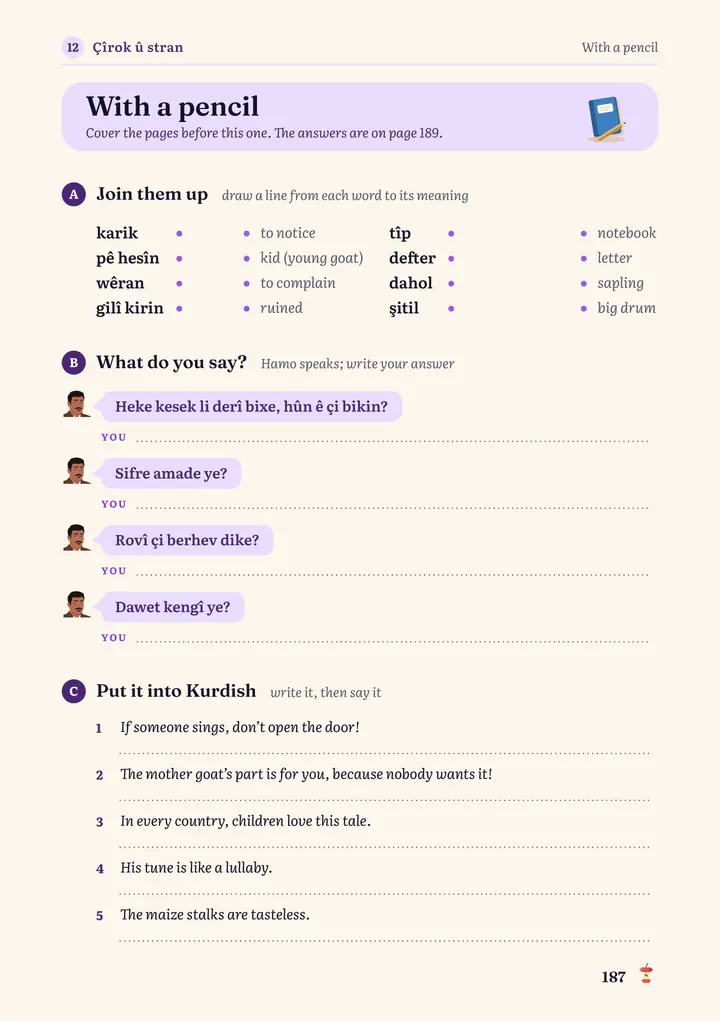
Cover the pages before this one. The answers are on page 189.
A · Join them up · draw a line from each word to its meaning
karik · to notice · tîp · notebook
pê hesîn · kid (young goat) · defter · letter
wêran · to complain · dahol · sapling
gilî kirin · ruined · şitil · big drum
B · What do you say? · Hamo speaks; write your answer
Heke kesek li derî bixe, hûn ê çi bikin?
You
Sifre amade ye?
You
Rovî çi berhev dike?
You
Dawet kengî ye?
You
C · Put it into Kurdish · write it, then say it
1 · If someone sings, don’t open the door!
2 · The mother goat’s part is for you, because nobody wants it!
3 · In every country, children love this tale.
4 · His tune is like a lullaby.
5 · The maize stalks are tasteless.
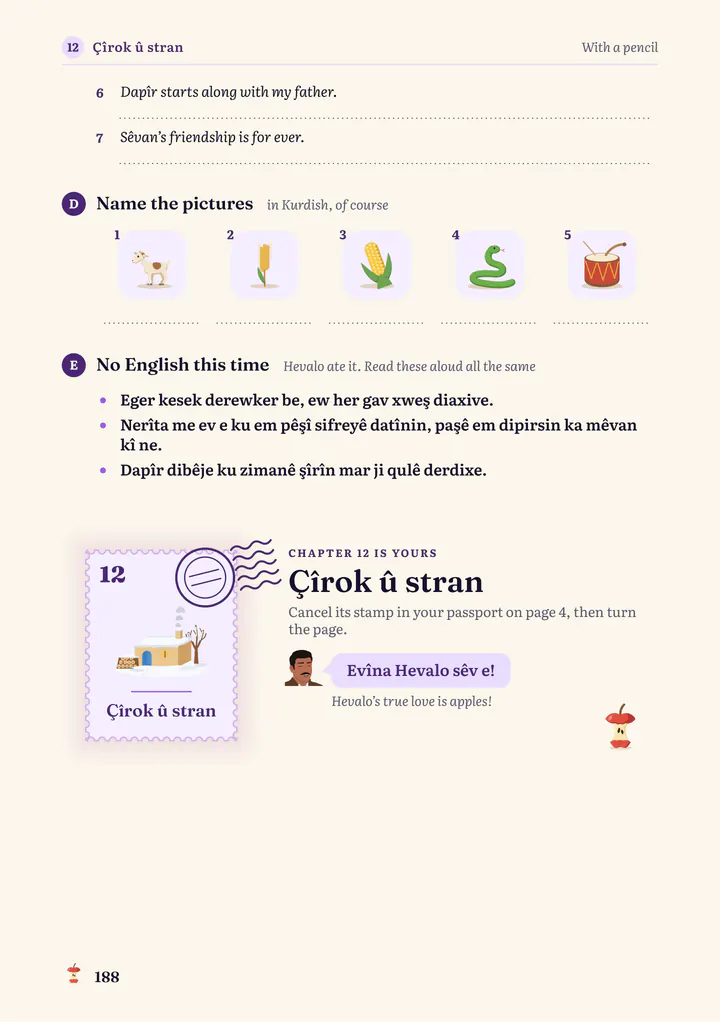
6 · Dapîr starts along with my father.
7 · Sêvan’s friendship is for ever.
D · Name the pictures · in Kurdish, of course
E · No English this time · Hevalo ate it. Read these aloud all the same
Eger kesek derewker be, ew her gav xweş diaxive.
Nerîta me ev e ku em pêşî sifreyê datînin, paşê em dipirsin ka mêvan kî ne.
Dapîr dibêje ku zimanê şîrîn mar ji qulê derdixe.
Çîrok û stran
Chapter 12 is yours
Cancel its stamp in your passport on page 4, then turn the page.
Evîna Hevalo sêv e!
Hevalo’s true love is apples!
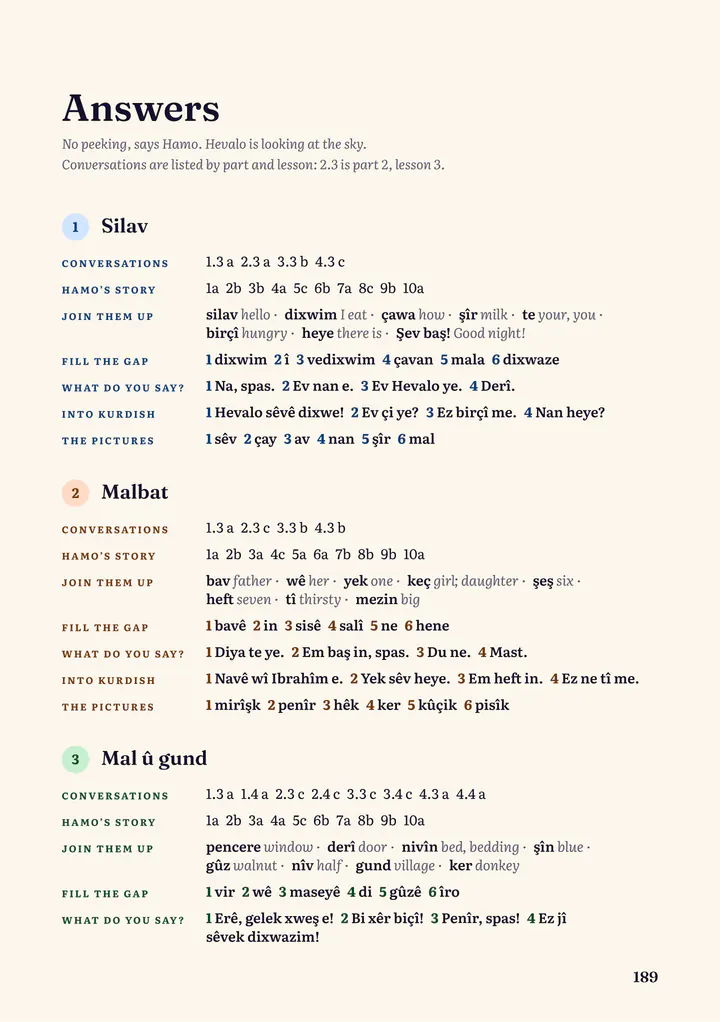
No peeking, says Hamo. Hevalo is looking at the sky.
Conversations are listed by part and lesson: 2.3 is part 2, lesson 3.
1 · Silav
Conversations · 1.3 a 2.3 a 3.3 b 4.3 c
Hamo’s story · 1a 2b 3b 4a 5c 6b 7a 8c 9b 10a
Join them up · silav hello · dixwim I eat · çawa how · şîr milk · te your, you · birçî hungry · heye there is · Şev baş! Good night!
Fill the gap · 1 dixwim 2 î 3 vedixwim 4 çavan 5 mala 6 dixwaze
What do you say? · 1 Na, spas. 2 Ev nan e. 3 Ev Hevalo ye. 4 Derî.
Into Kurdish · 1 Hevalo sêvê dixwe! 2 Ev çi ye? 3 Ez birçî me. 4 Nan heye?
The pictures · 1 sêv 2 çay 3 av 4 nan 5 şîr 6 mal
2 · Malbat
Conversations · 1.3 a 2.3 c 3.3 b 4.3 b
Hamo’s story · 1a 2b 3a 4c 5a 6a 7b 8b 9b 10a
Join them up · bav father · wê her · yek one · keç girl; daughter · şeş six · heft seven · tî thirsty · mezin big
Fill the gap · 1 bavê 2 in 3 sisê 4 salî 5 ne 6 hene
What do you say? · 1 Diya te ye. 2 Em baş in, spas. 3 Du ne. 4 Mast.
Into Kurdish · 1 Navê wî Ibrahîm e. 2 Yek sêv heye. 3 Em heft in. 4 Ez ne tî me.
The pictures · 1 mirîşk 2 penîr 3 hêk 4 ker 5 kûçik 6 pisîk
3 · Mal û gund
Conversations · 1.3 a 1.4 a 2.3 c 2.4 c 3.3 c 3.4 c 4.3 a 4.4 a
Hamo’s story · 1a 2b 3a 4a 5c 6b 7a 8b 9b 10a
Join them up · pencere window · derî door · nivîn bed, bedding · şîn blue · gûz walnut · nîv half · gund village · ker donkey
Fill the gap · 1 vir 2 wê 3 maseyê 4 di 5 gûzê 6 îro
What do you say? · 1 Erê, gelek xweş e! 2 Bi xêr biçî! 3 Penîr, spas! 4 Ez jî sêvek dixwazim!
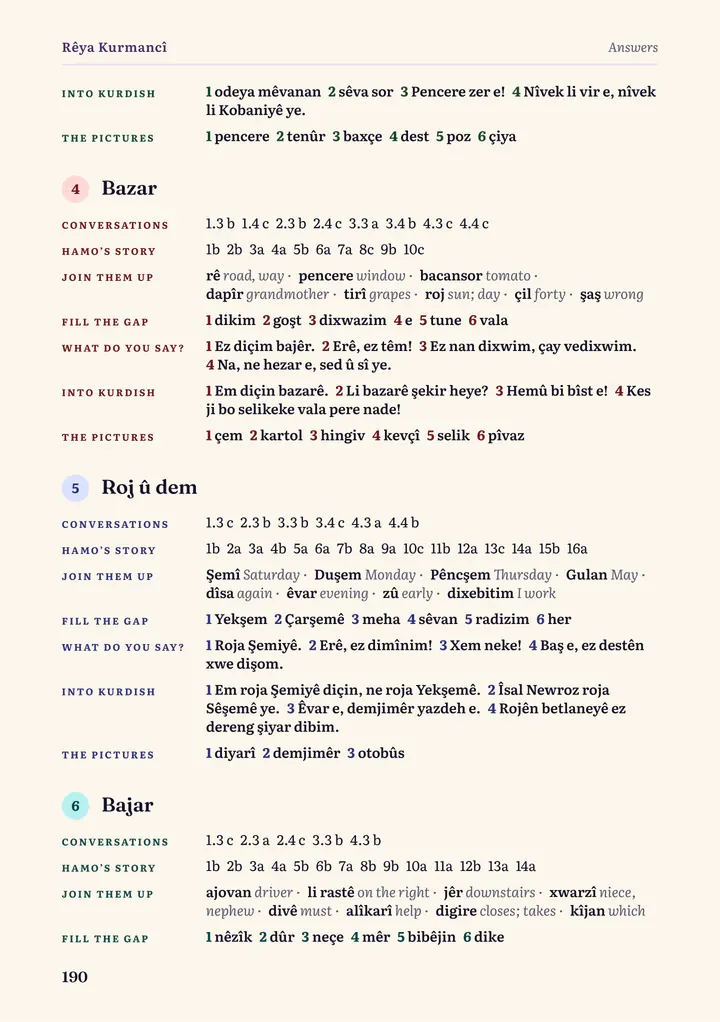
Into Kurdish · 1 odeya mêvanan 2 sêva sor 3 Pencere zer e! 4 Nîvek li vir e, nîvek li Kobaniyê ye.
The pictures · 1 pencere 2 tenûr 3 baxçe 4 dest 5 poz 6 çiya
4 · Bazar
Conversations · 1.3 b 1.4 c 2.3 b 2.4 c 3.3 a 3.4 b 4.3 c 4.4 c
Hamo’s story · 1b 2b 3a 4a 5b 6a 7a 8c 9b 10c
Join them up · rê road, way · pencere window · bacansor tomato · dapîr grandmother · tirî grapes · roj sun; day · çil forty · şaş wrong
Fill the gap · 1 dikim 2 goşt 3 dixwazim 4 e 5 tune 6 vala
What do you say? · 1 Ez diçim bajêr. 2 Erê, ez têm! 3 Ez nan dixwim, çay vedixwim. 4 Na, ne hezar e, sed û sî ye.
Into Kurdish · 1 Em diçin bazarê. 2 Li bazarê şekir heye? 3 Hemû bi bîst e! 4 Kes ji bo selikeke vala pere nade!
The pictures · 1 çem 2 kartol 3 hingiv 4 kevçî 5 selik 6 pîvaz
5 · Roj û dem
Conversations · 1.3 c 2.3 b 3.3 b 3.4 c 4.3 a 4.4 b
Hamo’s story · 1b 2a 3a 4b 5a 6a 7b 8a 9a 10c 11b 12a 13c 14a 15b 16a
Join them up · Şemî Saturday · Duşem Monday · Pêncşem Thursday · Gulan May · dîsa again · êvar evening · zû early · dixebitim I work
Fill the gap · 1 Yekşem 2 Çarşemê 3 meha 4 sêvan 5 radizim 6 her
What do you say? · 1 Roja Şemiyê. 2 Erê, ez dimînim! 3 Xem neke! 4 Baş e, ez destên xwe dişom.
Into Kurdish · 1 Em roja Şemiyê diçin, ne roja Yekşemê. 2 Îsal Newroz roja Sêşemê ye. 3 Êvar e, demjimêr yazdeh e. 4 Rojên betlaneyê ez dereng şiyar dibim.
The pictures · 1 diyarî 2 demjimêr 3 otobûs
6 · Bajar
Conversations · 1.3 c 2.3 a 2.4 c 3.3 b 4.3 b
Hamo’s story · 1b 2b 3a 4a 5b 6b 7a 8b 9b 10a 11a 12b 13a 14a
Join them up · ajovan driver · li rastê on the right · jêr downstairs · xwarzî niece, nephew · divê must · alîkarî help · digire closes; takes · kîjan which
Fill the gap · 1 nêzîk 2 dûr 3 neçe 4 mêr 5 bibêjin 6 dike
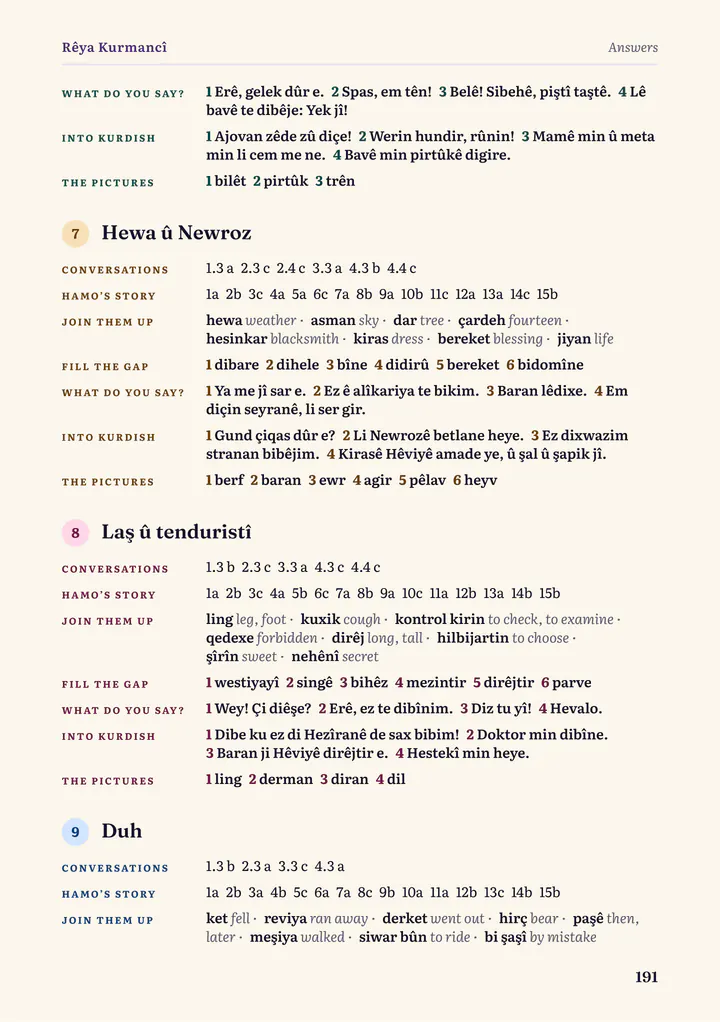
What do you say? · 1 Erê, gelek dûr e. 2 Spas, em tên! 3 Belê! Sibehê, piştî taştê. 4 Lê bavê te dibêje: Yek jî!
Into Kurdish · 1 Ajovan zêde zû diçe! 2 Werin hundir, rûnin! 3 Mamê min û meta min li cem me ne. 4 Bavê min pirtûkê digire.
The pictures · 1 bilêt 2 pirtûk 3 trên
7 · Hewa û Newroz
Conversations · 1.3 a 2.3 c 2.4 c 3.3 a 4.3 b 4.4 c
Hamo’s story · 1a 2b 3c 4a 5a 6c 7a 8b 9a 10b 11c 12a 13a 14c 15b
Join them up · hewa weather · asman sky · dar tree · çardeh fourteen · hesinkar blacksmith · kiras dress · bereket blessing · jiyan life
Fill the gap · 1 dibare 2 dihele 3 bîne 4 didirû 5 bereket 6 bidomîne
What do you say? · 1 Ya me jî sar e. 2 Ez ê alîkariya te bikim. 3 Baran lêdixe. 4 Em diçin seyranê, li ser gir.
Into Kurdish · 1 Gund çiqas dûr e? 2 Li Newrozê betlane heye. 3 Ez dixwazim stranan bibêjim. 4 Kirasê Hêviyê amade ye, û şal û şapik jî.
The pictures · 1 berf 2 baran 3 ewr 4 agir 5 pêlav 6 heyv
8 · Laş û tenduristî
Conversations · 1.3 b 2.3 c 3.3 a 4.3 c 4.4 c
Hamo’s story · 1a 2b 3c 4a 5b 6c 7a 8b 9a 10c 11a 12b 13a 14b 15b
Join them up · ling leg, foot · kuxik cough · kontrol kirin to check, to examine · qedexe forbidden · dirêj long, tall · hilbijartin to choose · şîrîn sweet · nehênî secret
Fill the gap · 1 westiyayî 2 singê 3 bihêz 4 mezintir 5 dirêjtir 6 parve
What do you say? · 1 Wey! Çi diêşe? 2 Erê, ez te dibînim. 3 Diz tu yî! 4 Hevalo.
Into Kurdish · 1 Dibe ku ez di Hezîranê de sax bibim! 2 Doktor min dibîne. 3 Baran ji Hêviyê dirêjtir e. 4 Hestekî min heye.
The pictures · 1 ling 2 derman 3 diran 4 dil
9 · Duh
Conversations · 1.3 b 2.3 a 3.3 c 4.3 a
Hamo’s story · 1a 2b 3a 4b 5c 6a 7a 8c 9b 10a 11a 12b 13c 14b 15b
Join them up · ket fell · reviya ran away · derket went out · hirç bear · paşê then, later · meşiya walked · siwar bûn to ride · bi şaşî by mistake
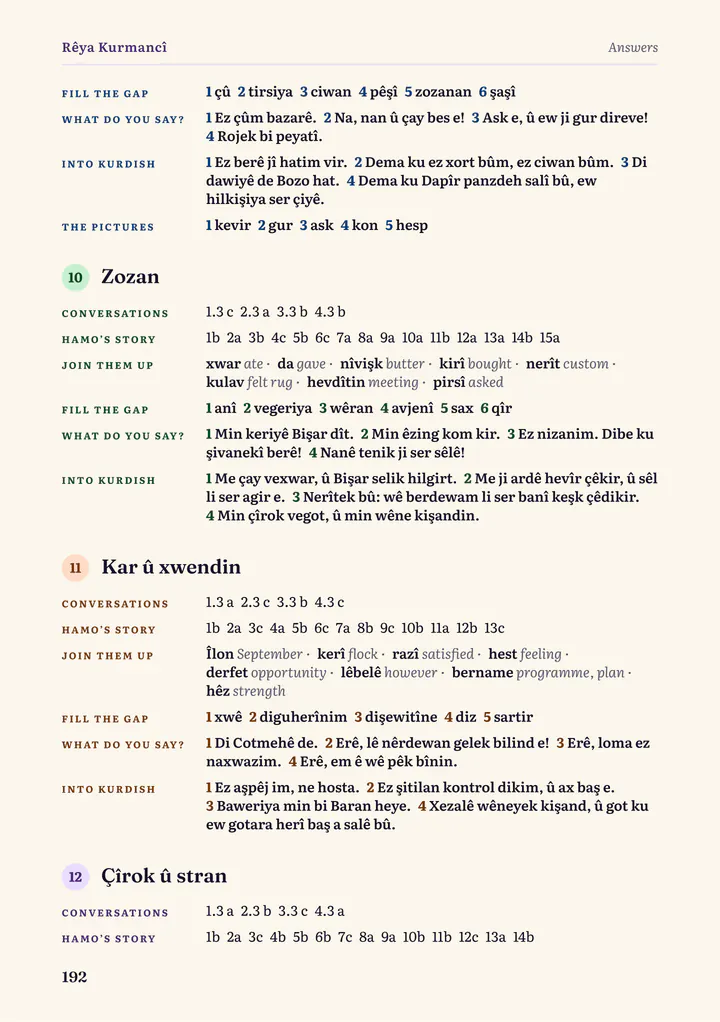
Fill the gap · 1 çû 2 tirsiya 3 ciwan 4 pêşî 5 zozanan 6 şaşî
What do you say? · 1 Ez çûm bazarê. 2 Na, nan û çay bes e! 3 Ask e, û ew ji gur direve! 4 Rojek bi peyatî.
Into Kurdish · 1 Ez berê jî hatim vir. 2 Dema ku ez xort bûm, ez ciwan bûm. 3 Di dawiyê de Bozo hat. 4 Dema ku Dapîr panzdeh salî bû, ew hilkişiya ser çiyê.
The pictures · 1 kevir 2 gur 3 ask 4 kon 5 hesp
10 · Zozan
Conversations · 1.3 c 2.3 a 3.3 b 4.3 b
Hamo’s story · 1b 2a 3b 4c 5b 6c 7a 8a 9a 10a 11b 12a 13a 14b 15a
Join them up · xwar ate · da gave · nîvişk butter · kirî bought · nerît custom · kulav felt rug · hevdîtin meeting · pirsî asked
Fill the gap · 1 anî 2 vegeriya 3 wêran 4 avjenî 5 sax 6 qîr
What do you say? · 1 Min keriyê Bişar dît. 2 Min êzing kom kir. 3 Ez nizanim. Dibe ku şivanekî berê! 4 Nanê tenik ji ser sêlê!
Into Kurdish · 1 Me çay vexwar, û Bişar selik hilgirt. 2 Me ji ardê hevîr çêkir, û sêl li ser agir e. 3 Nerîtek bû: wê berdewam li ser banî keşk çêdikir. 4 Min çîrok vegot, û min wêne kişandin.
11 · Kar û xwendin
Conversations · 1.3 a 2.3 c 3.3 b 4.3 c
Hamo’s story · 1b 2a 3c 4a 5b 6c 7a 8b 9c 10b 11a 12b 13c
Join them up · Îlon September · kerî flock · razî satisfied · hest feeling · derfet opportunity · lêbelê however · bername programme, plan · hêz strength
Fill the gap · 1 xwê 2 diguherînim 3 dişewitîne 4 diz 5 sartir
What do you say? · 1 Di Cotmehê de. 2 Erê, lê nêrdewan gelek bilind e! 3 Erê, loma ez naxwazim. 4 Erê, em ê wê pêk bînin.
Into Kurdish · 1 Ez aşpêj im, ne hosta. 2 Ez şitilan kontrol dikim, û ax baş e. 3 Baweriya min bi Baran heye. 4 Xezalê wêneyek kişand, û got ku ew gotara herî baş a salê bû.
12 · Çîrok û stran
Conversations · 1.3 a 2.3 b 3.3 c 4.3 a
Hamo’s story · 1b 2a 3c 4b 5b 6b 7c 8a 9a 10b 11b 12c 13a 14b
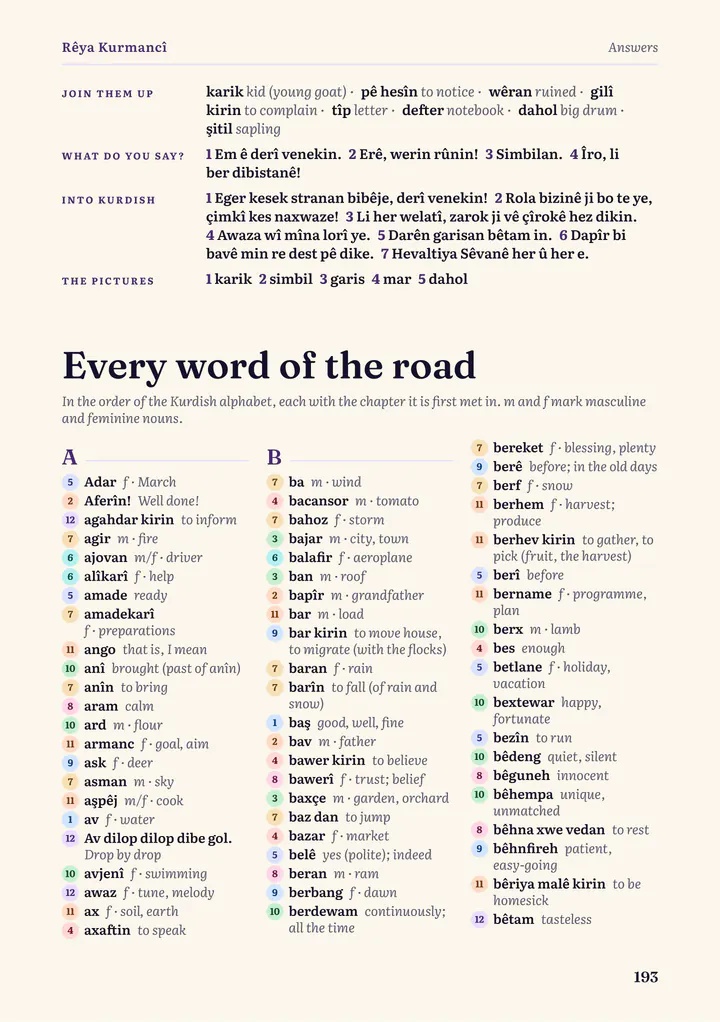
Join them up · karik kid (young goat) · pê hesîn to notice · wêran ruined · gilî kirin to complain · tîp letter · defter notebook · dahol big drum · şitil sapling
What do you say? · 1 Em ê derî venekin. 2 Erê, werin rûnin! 3 Simbilan. 4 Îro, li ber dibistanê!
Into Kurdish · 1 Eger kesek stranan bibêje, derî venekin! 2 Rola bizinê ji bo te ye, çimkî kes naxwaze! 3 Li her welatî, zarok ji vê çîrokê hez dikin. 4 Awaza wî mîna lorî ye. 5 Darên garisan bêtam in. 6 Dapîr bi bavê min re dest pê dike. 7 Hevaltiya Sêvanê her û her e.
The pictures · 1 karik 2 simbil 3 garis 4 mar 5 dahol
In the order of the Kurdish alphabet, each with the chapter it is first met in. m and f mark masculine and feminine nouns.
5 · Adar f · March
2 · Aferîn! Well done!
12 · agahdar kirin to inform
7 · agir m · fire
6 · ajovan m/f · driver
6 · alîkarî f · help
5 · amade ready
7 · amadekarî f · preparations
11 · ango that is, I mean
10 · anî brought (past of anîn)
7 · anîn to bring
8 · aram calm
10 · ard m · flour
11 · armanc f · goal, aim
9 · ask f · deer
7 · asman m · sky
11 · aşpêj m/f · cook
1 · av f · water
12 · Av dilop dilop dibe gol. Drop by drop
10 · avjenî f · swimming
12 · awaz f · tune, melody
11 · ax f · soil, earth
4 · axaftin to speak
7 · ba m · wind
4 · bacansor m · tomato
7 · bahoz f · storm
3 · bajar m · city, town
6 · balafir f · aeroplane
3 · ban m · roof
2 · bapîr m · grandfather
11 · bar m · load
9 · bar kirin to move house, to migrate (with the flocks)
7 · baran f · rain
7 · barîn to fall (of rain and snow)
1 · baş good, well, fine
2 · bav m · father
4 · bawer kirin to believe
8 · bawerî f · trust; belief
3 · baxçe m · garden, orchard
7 · baz dan to jump
4 · bazar f · market
5 · belê yes (polite); indeed
8 · beran m · ram
9 · berbang f · dawn
10 · berdewam continuously; all the time
7 · bereket f · blessing, plenty
9 · berê before; in the old days
7 · berf f · snow
11 · berhem f · harvest; produce
11 · berhev kirin to gather, to pick (fruit, the harvest)
5 · berî before
11 · bername f · programme, plan
10 · berx m · lamb
4 · bes enough
5 · betlane f · holiday, vacation
10 · bextewar happy, fortunate
5 · bezîn to run
10 · bêdeng quiet, silent
8 · bêguneh innocent
10 · bêhempa unique, unmatched
8 · bêhna xwe vedan to rest
9 · bêhnfireh patient, easy-going
11 · bêriya malê kirin to be homesick
12 · bêtam tasteless
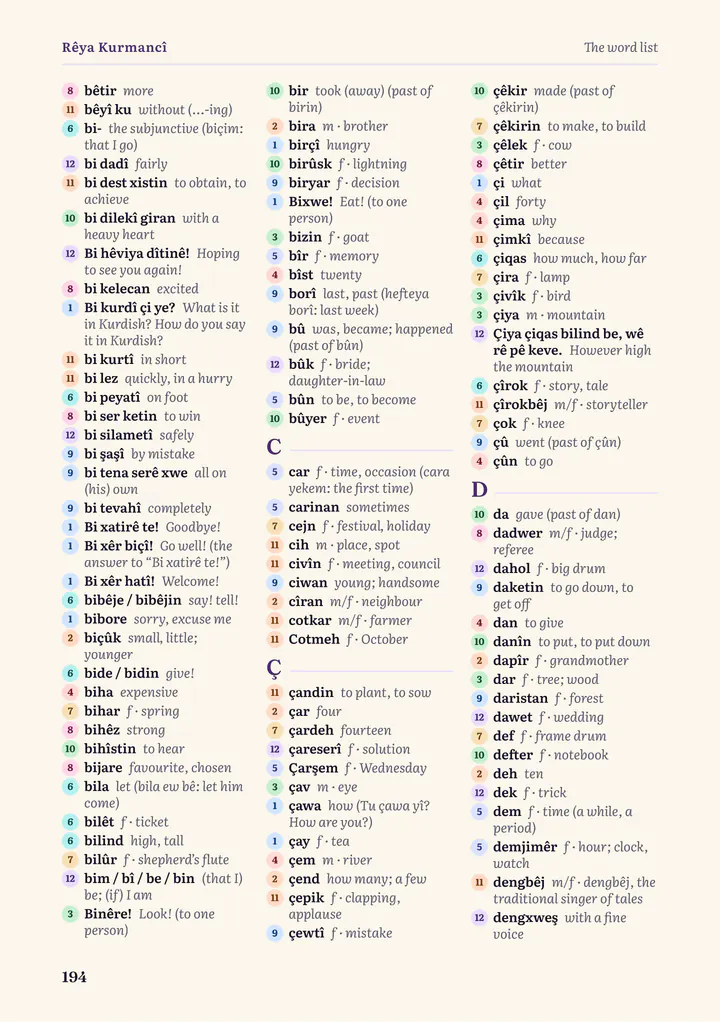
8 · bêtir more
11 · bêyî ku without (…-ing)
6 · bi- the subjunctive (biçim: that I go)
12 · bi dadî fairly
11 · bi dest xistin to obtain, to achieve
10 · bi dilekî giran with a heavy heart
12 · Bi hêviya dîtinê! Hoping to see you again!
8 · bi kelecan excited
1 · Bi kurdî çi ye? What is it in Kurdish? How do you say it in Kurdish?
11 · bi kurtî in short
11 · bi lez quickly, in a hurry
6 · bi peyatî on foot
8 · bi ser ketin to win
12 · bi silametî safely
9 · bi şaşî by mistake
9 · bi tena serê xwe all on (his) own
9 · bi tevahî completely
1 · Bi xatirê te! Goodbye!
1 · Bi xêr biçî! Go well! (the answer to “Bi xatirê te!”)
1 · Bi xêr hatî! Welcome!
6 · bibêje / bibêjin say! tell!
1 · bibore sorry, excuse me
2 · biçûk small, little; younger
6 · bide / bidin give!
4 · biha expensive
7 · bihar f · spring
8 · bihêz strong
10 · bihîstin to hear
8 · bijare favourite, chosen
6 · bila let (bila ew bê: let him come)
6 · bilêt f · ticket
6 · bilind high, tall
7 · bilûr f · shepherd’s flute
12 · bim / bî / be / bin (that I) be; (if) I am
3 · Binêre! Look! (to one person)
10 · bir took (away) (past of birin)
2 · bira m · brother
1 · birçî hungry
10 · birûsk f · lightning
9 · biryar f · decision
1 · Bixwe! Eat! (to one person)
3 · bizin f · goat
5 · bîr f · memory
4 · bîst twenty
9 · borî last, past (hefteya borî: last week)
9 · bû was, became; happened (past of bûn)
12 · bûk f · bride; daughter-in-law
5 · bûn to be, to become
10 · bûyer f · event
5 · car f · time, occasion (cara yekem: the first time)
5 · carinan sometimes
7 · cejn f · festival, holiday
11 · cih m · place, spot
11 · civîn f · meeting, council
9 · ciwan young; handsome
2 · cîran m/f · neighbour
11 · cotkar m/f · farmer
11 · Cotmeh f · October
11 · çandin to plant, to sow
2 · çar four
7 · çardeh fourteen
12 · çareserî f · solution
5 · Çarşem f · Wednesday
3 · çav m · eye
1 · çawa how (Tu çawa yî? How are you?)
1 · çay f · tea
4 · çem m · river
2 · çend how many; a few
11 · çepik f · clapping, applause
9 · çewtî f · mistake
10 · çêkir made (past of çêkirin)
7 · çêkirin to make, to build
3 · çêlek f · cow
8 · çêtir better
1 · çi what
4 · çil forty
4 · çima why
11 · çimkî because
6 · çiqas how much, how far
7 · çira f · lamp
3 · çivîk f · bird
3 · çiya m · mountain
12 · Çiya çiqas bilind be, wê rê pê keve. However high the mountain
6 · çîrok f · story, tale
11 · çîrokbêj m/f · storyteller
7 · çok f · knee
9 · çû went (past of çûn)
4 · çûn to go
10 · da gave (past of dan)
8 · dadwer m/f · judge; referee
12 · dahol f · big drum
9 · daketin to go down, to get off
4 · dan to give
10 · danîn to put, to put down
2 · dapîr f · grandmother
3 · dar f · tree; wood
9 · daristan f · forest
12 · dawet f · wedding
7 · def f · frame drum
10 · defter f · notebook
2 · deh ten
12 · dek f · trick
5 · dem f · time (a while, a period)
5 · demjimêr f · hour; clock, watch
11 · dengbêj m/f · dengbêj, the traditional singer of tales
12 · dengxweş with a fine voice
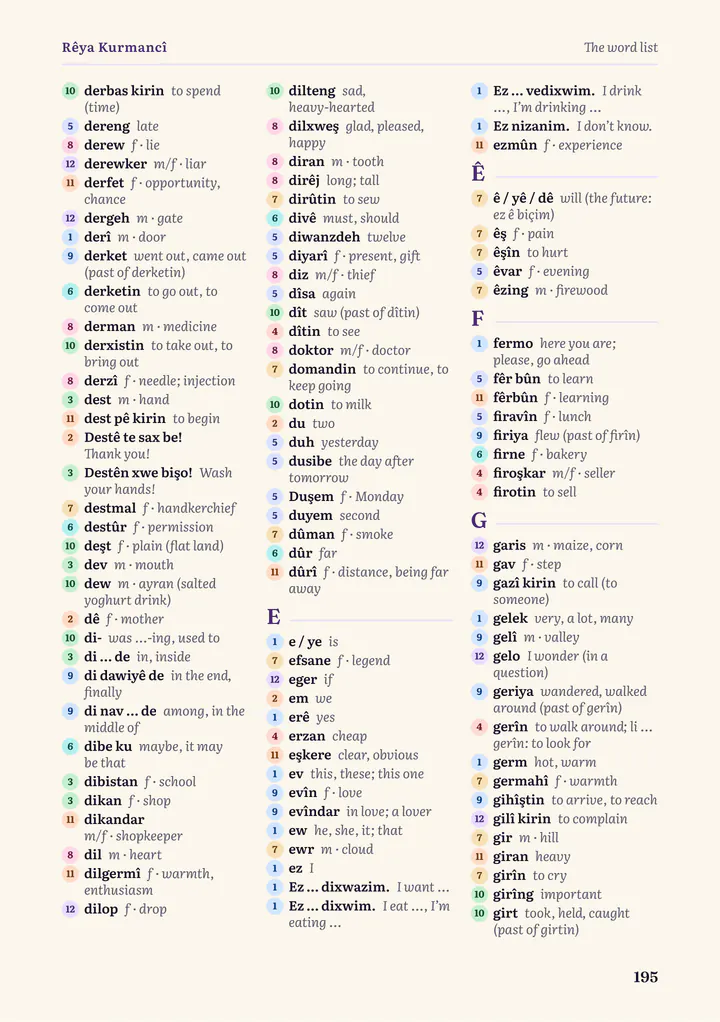
10 · derbas kirin to spend (time)
5 · dereng late
8 · derew f · lie
12 · derewker m/f · liar
11 · derfet f · opportunity, chance
12 · dergeh m · gate
1 · derî m · door
9 · derket went out, came out (past of derketin)
6 · derketin to go out, to come out
8 · derman m · medicine
10 · derxistin to take out, to bring out
8 · derzî f · needle; injection
3 · dest m · hand
11 · dest pê kirin to begin
2 · Destê te sax be! Thank you!
3 · Destên xwe bişo! Wash your hands!
7 · destmal f · handkerchief
6 · destûr f · permission
10 · deşt f · plain (flat land)
3 · dev m · mouth
10 · dew m · ayran (salted yoghurt drink)
2 · dê f · mother
10 · di- was …-ing, used to
3 · di … de in, inside
9 · di dawiyê de in the end, finally
9 · di nav … de among, in the middle of
6 · dibe ku maybe, it may be that
3 · dibistan f · school
3 · dikan f · shop
11 · dikandar m/f · shopkeeper
8 · dil m · heart
11 · dilgermî f · warmth, enthusiasm
12 · dilop f · drop
10 · dilteng sad, heavy-hearted
8 · dilxweş glad, pleased, happy
8 · diran m · tooth
8 · dirêj long; tall
7 · dirûtin to sew
6 · divê must, should
5 · diwanzdeh twelve
5 · diyarî f · present, gift
8 · diz m/f · thief
5 · dîsa again
10 · dît saw (past of dîtin)
4 · dîtin to see
8 · doktor m/f · doctor
7 · domandin to continue, to keep going
10 · dotin to milk
2 · du two
5 · duh yesterday
5 · dusibe the day after tomorrow
5 · Duşem f · Monday
5 · duyem second
7 · dûman f · smoke
6 · dûr far
11 · dûrî f · distance, being far away
1 · e / ye is
7 · efsane f · legend
12 · eger if
2 · em we
1 · erê yes
4 · erzan cheap
11 · eşkere clear, obvious
1 · ev this, these; this one
9 · evîn f · love
9 · evîndar in love; a lover
1 · ew he, she, it; that
7 · ewr m · cloud
1 · ez I
1 · Ez … dixwazim. I want …
1 · Ez … dixwim. I eat …, I’m eating …
1 · Ez … vedixwim. I drink …, I’m drinking …
1 · Ez nizanim. I don’t know.
11 · ezmûn f · experience
7 · ê / yê / dê will (the future: ez ê biçim)
7 · êş f · pain
7 · êşîn to hurt
5 · êvar f · evening
7 · êzing m · firewood
1 · fermo here you are; please, go ahead
5 · fêr bûn to learn
11 · fêrbûn f · learning
5 · firavîn f · lunch
9 · firiya flew (past of firîn)
6 · firne f · bakery
4 · firoşkar m/f · seller
4 · firotin to sell
12 · garis m · maize, corn
11 · gav f · step
9 · gazî kirin to call (to someone)
1 · gelek very, a lot, many
9 · gelî m · valley
12 · gelo I wonder (in a question)
9 · geriya wandered, walked around (past of gerîn)
4 · gerîn to walk around; li … gerîn: to look for
1 · germ hot, warm
7 · germahî f · warmth
9 · gihîştin to arrive, to reach
12 · gilî kirin to complain
7 · gir m · hill
11 · giran heavy
7 · girîn to cry
10 · girîng important
10 · girt took, held, caught (past of girtin)
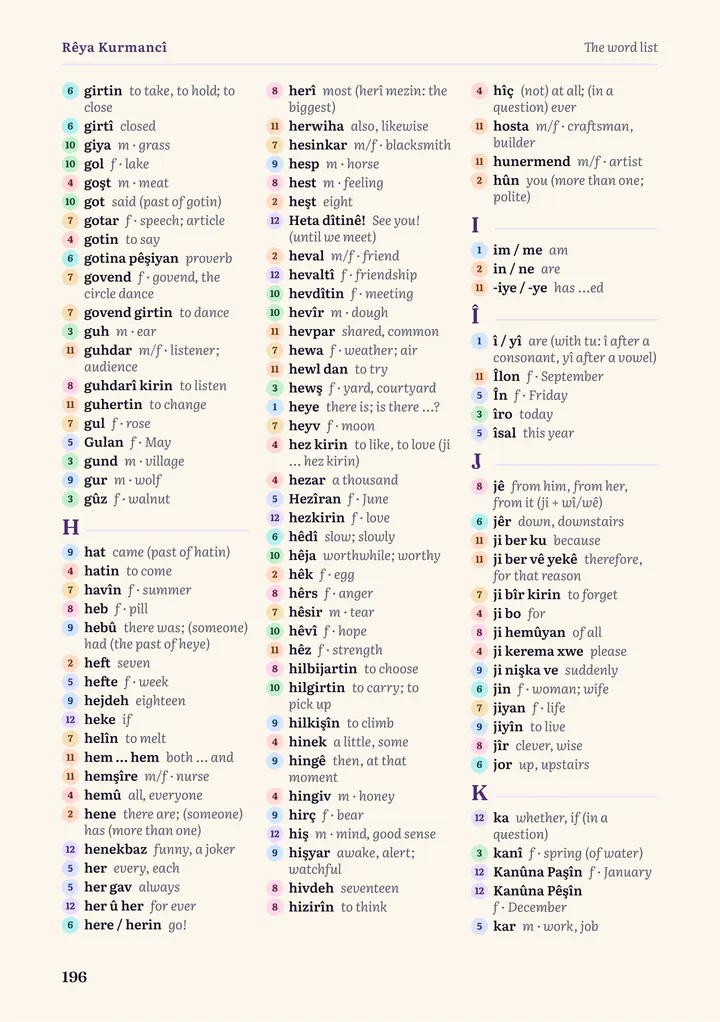
6 · girtin to take, to hold; to close
6 · girtî closed
10 · giya m · grass
10 · gol f · lake
4 · goşt m · meat
10 · got said (past of gotin)
7 · gotar f · speech; article
4 · gotin to say
6 · gotina pêşiyan proverb
7 · govend f · govend, the circle dance
7 · govend girtin to dance
3 · guh m · ear
11 · guhdar m/f · listener; audience
8 · guhdarî kirin to listen
11 · guhertin to change
7 · gul f · rose
5 · Gulan f · May
3 · gund m · village
9 · gur m · wolf
3 · gûz f · walnut
9 · hat came (past of hatin)
4 · hatin to come
7 · havîn f · summer
8 · heb f · pill
9 · hebû there was; (someone) had (the past of heye)
2 · heft seven
5 · hefte f · week
9 · hejdeh eighteen
12 · heke if
7 · helîn to melt
11 · hem … hem both … and
11 · hemşîre m/f · nurse
4 · hemû all, everyone
2 · hene there are; (someone) has (more than one)
12 · henekbaz funny, a joker
5 · her every, each
5 · her gav always
12 · her û her for ever
6 · here / herin go!
8 · herî most (herî mezin: the biggest)
11 · herwiha also, likewise
7 · hesinkar m/f · blacksmith
9 · hesp m · horse
8 · hest m · feeling
2 · heşt eight
12 · Heta dîtinê! See you! (until we meet)
2 · heval m/f · friend
12 · hevaltî f · friendship
10 · hevdîtin f · meeting
10 · hevîr m · dough
11 · hevpar shared, common
7 · hewa f · weather; air
11 · hewl dan to try
3 · hewş f · yard, courtyard
1 · heye there is; is there …?
7 · heyv f · moon
4 · hez kirin to like, to love (ji … hez kirin)
4 · hezar a thousand
5 · Hezîran f · June
12 · hezkirin f · love
6 · hêdî slow; slowly
10 · hêja worthwhile; worthy
2 · hêk f · egg
8 · hêrs f · anger
7 · hêsir m · tear
10 · hêvî f · hope
11 · hêz f · strength
8 · hilbijartin to choose
10 · hilgirtin to carry; to pick up
9 · hilkişîn to climb
4 · hinek a little, some
9 · hingê then, at that moment
4 · hingiv m · honey
9 · hirç f · bear
12 · hiş m · mind, good sense
9 · hişyar awake, alert; watchful
8 · hivdeh seventeen
8 · hizirîn to think
4 · hîç (not) at all; (in a question) ever
11 · hosta m/f · craftsman, builder
11 · hunermend m/f · artist
2 · hûn you (more than one; polite)
1 · im / me am
2 · in / ne are
11 · -iye / -ye has …ed
1 · î / yî are (with tu: î after a consonant, yî after a vowel)
11 · Îlon f · September
5 · În f · Friday
3 · îro today
5 · îsal this year
8 · jê from him, from her, from it (ji + wî/wê)
6 · jêr down, downstairs
11 · ji ber ku because
11 · ji ber vê yekê therefore, for that reason
7 · ji bîr kirin to forget
4 · ji bo for
8 · ji hemûyan of all
4 · ji kerema xwe please
9 · ji nişka ve suddenly
6 · jin f · woman; wife
7 · jiyan f · life
9 · jiyîn to live
8 · jîr clever, wise
6 · jor up, upstairs
12 · ka whether, if (in a question)
3 · kanî f · spring (of water)
12 · Kanûna Paşîn f · January
12 · Kanûna Pêşîn f · December
5 · kar m · work, job
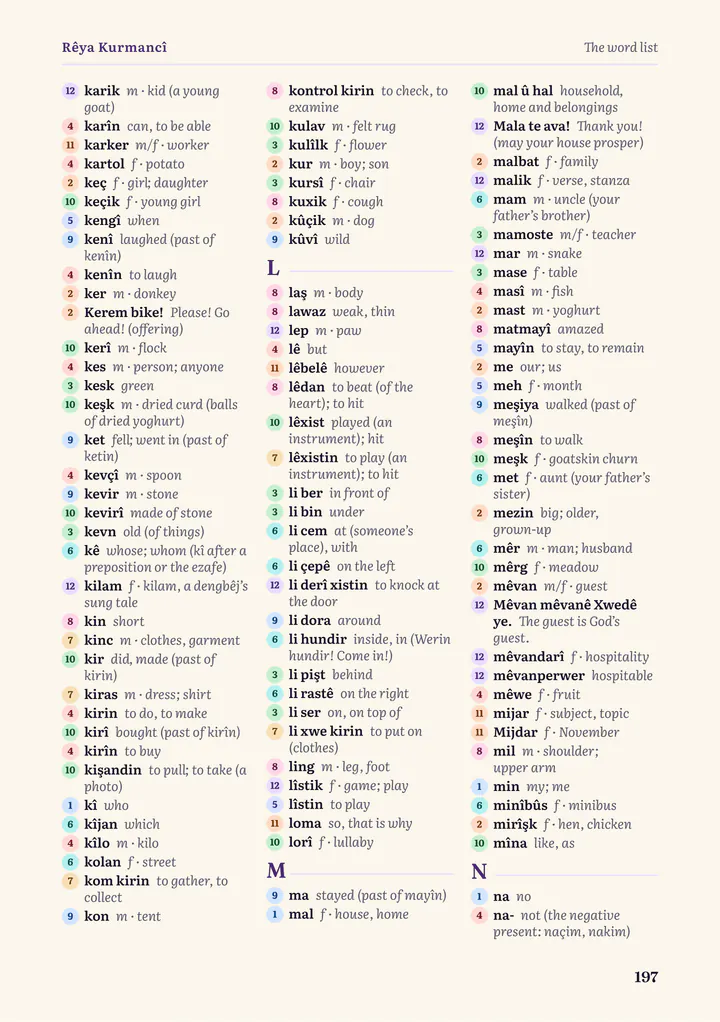
12 · karik m · kid (a young goat)
4 · karîn can, to be able
11 · karker m/f · worker
4 · kartol f · potato
2 · keç f · girl; daughter
10 · keçik f · young girl
5 · kengî when
9 · kenî laughed (past of kenîn)
4 · kenîn to laugh
2 · ker m · donkey
2 · Kerem bike! Please! Go ahead! (offering)
10 · kerî m · flock
4 · kes m · person; anyone
3 · kesk green
10 · keşk m · dried curd (balls of dried yoghurt)
9 · ket fell; went in (past of ketin)
4 · kevçî m · spoon
9 · kevir m · stone
10 · kevirî made of stone
3 · kevn old (of things)
6 · kê whose; whom (kî after a preposition or the ezafe)
12 · kilam f · kilam, a dengbêj’s sung tale
8 · kin short
7 · kinc m · clothes, garment
10 · kir did, made (past of kirin)
7 · kiras m · dress; shirt
4 · kirin to do, to make
10 · kirî bought (past of kirîn)
4 · kirîn to buy
10 · kişandin to pull; to take (a photo)
1 · kî who
6 · kîjan which
4 · kîlo m · kilo
6 · kolan f · street
7 · kom kirin to gather, to collect
9 · kon m · tent
8 · kontrol kirin to check, to examine
10 · kulav m · felt rug
3 · kulîlk f · flower
2 · kur m · boy; son
3 · kursî f · chair
8 · kuxik f · cough
2 · kûçik m · dog
9 · kûvî wild
8 · laş m · body
8 · lawaz weak, thin
12 · lep m · paw
4 · lê but
11 · lêbelê however
8 · lêdan to beat (of the heart); to hit
10 · lêxist played (an instrument); hit
7 · lêxistin to play (an instrument); to hit
3 · li ber in front of
3 · li bin under
6 · li cem at (someone’s place), with
6 · li çepê on the left
12 · li derî xistin to knock at the door
9 · li dora around
6 · li hundir inside, in (Werin hundir! Come in!)
3 · li pişt behind
6 · li rastê on the right
3 · li ser on, on top of
7 · li xwe kirin to put on (clothes)
8 · ling m · leg, foot
12 · lîstik f · game; play
5 · lîstin to play
11 · loma so, that is why
10 · lorî f · lullaby
9 · ma stayed (past of mayîn)
1 · mal f · house, home
10 · mal û hal household, home and belongings
12 · Mala te ava! Thank you! (may your house prosper)
2 · malbat f · family
12 · malik f · verse, stanza
6 · mam m · uncle (your father’s brother)
3 · mamoste m/f · teacher
12 · mar m · snake
3 · mase f · table
4 · masî m · fish
2 · mast m · yoghurt
8 · matmayî amazed
5 · mayîn to stay, to remain
2 · me our; us
5 · meh f · month
9 · meşiya walked (past of meşîn)
8 · meşîn to walk
10 · meşk f · goatskin churn
6 · met f · aunt (your father’s sister)
2 · mezin big; older, grown-up
6 · mêr m · man; husband
10 · mêrg f · meadow
2 · mêvan m/f · guest
12 · Mêvan mêvanê Xwedê ye. The guest is God’s guest.
12 · mêvandarî f · hospitality
12 · mêvanperwer hospitable
4 · mêwe f · fruit
11 · mijar f · subject, topic
11 · Mijdar f · November
8 · mil m · shoulder; upper arm
1 · min my; me
6 · minîbûs f · minibus
2 · mirîşk f · hen, chicken
10 · mîna like, as
1 · na no
4 · na- not (the negative present: naçim, nakim)
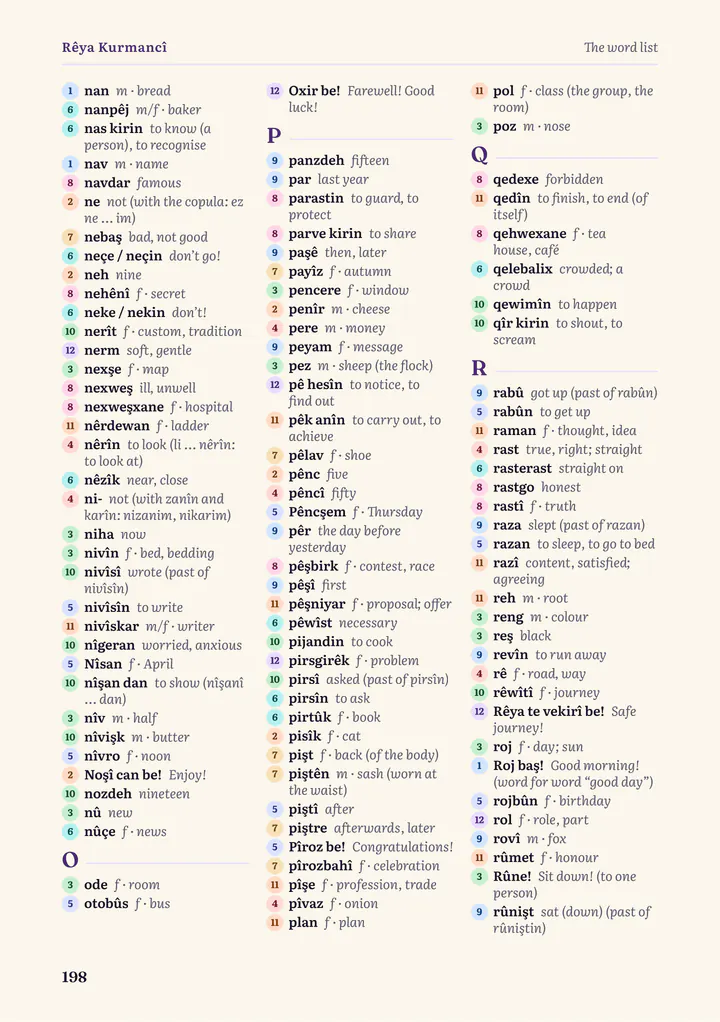
1 · nan m · bread
6 · nanpêj m/f · baker
6 · nas kirin to know (a person), to recognise
1 · nav m · name
8 · navdar famous
2 · ne not (with the copula: ez ne … im)
7 · nebaş bad, not good
6 · neçe / neçin don’t go!
2 · neh nine
8 · nehênî f · secret
6 · neke / nekin don’t!
10 · nerît f · custom, tradition
12 · nerm soft, gentle
3 · nexşe f · map
8 · nexweş ill, unwell
8 · nexweşxane f · hospital
11 · nêrdewan f · ladder
4 · nêrîn to look (li … nêrîn: to look at)
6 · nêzîk near, close
4 · ni- not (with zanîn and karîn: nizanim, nikarim)
3 · niha now
3 · nivîn f · bed, bedding
10 · nivîsî wrote (past of nivîsîn)
5 · nivîsîn to write
11 · nivîskar m/f · writer
10 · nîgeran worried, anxious
5 · Nîsan f · April
10 · nîşan dan to show (nîşanî … dan)
3 · nîv m · half
10 · nîvişk m · butter
5 · nîvro f · noon
2 · Noşî can be! Enjoy!
10 · nozdeh nineteen
3 · nû new
6 · nûçe f · news
3 · ode f · room
5 · otobûs f · bus
12 · Oxir be! Farewell! Good luck!
9 · panzdeh fifteen
9 · par last year
8 · parastin to guard, to protect
8 · parve kirin to share
9 · paşê then, later
7 · payîz f · autumn
3 · pencere f · window
2 · penîr m · cheese
4 · pere m · money
9 · peyam f · message
3 · pez m · sheep (the flock)
12 · pê hesîn to notice, to find out
11 · pêk anîn to carry out, to achieve
7 · pêlav f · shoe
2 · pênc five
4 · pêncî fifty
5 · Pêncşem f · Thursday
9 · pêr the day before yesterday
8 · pêşbirk f · contest, race
9 · pêşî first
11 · pêşniyar f · proposal; offer
6 · pêwîst necessary
10 · pijandin to cook
12 · pirsgirêk f · problem
10 · pirsî asked (past of pirsîn)
6 · pirsîn to ask
6 · pirtûk f · book
2 · pisîk f · cat
7 · pişt f · back (of the body)
7 · piştên m · sash (worn at the waist)
5 · piştî after
7 · piştre afterwards, later
5 · Pîroz be! Congratulations!
7 · pîrozbahî f · celebration
11 · pîşe f · profession, trade
4 · pîvaz f · onion
11 · plan f · plan
11 · pol f · class (the group, the room)
3 · poz m · nose
8 · qedexe forbidden
11 · qedîn to finish, to end (of itself)
8 · qehwexane f · tea house, café
6 · qelebalix crowded; a crowd
10 · qewimîn to happen
10 · qîr kirin to shout, to scream
9 · rabû got up (past of rabûn)
5 · rabûn to get up
11 · raman f · thought, idea
4 · rast true, right; straight
6 · rasterast straight on
8 · rastgo honest
8 · rastî f · truth
9 · raza slept (past of razan)
5 · razan to sleep, to go to bed
11 · razî content, satisfied; agreeing
11 · reh m · root
3 · reng m · colour
3 · reş black
9 · revîn to run away
4 · rê f · road, way
10 · rêwîtî f · journey
12 · Rêya te vekirî be! Safe journey!
3 · roj f · day; sun
1 · Roj baş! Good morning! (word for word “good day”)
5 · rojbûn f · birthday
12 · rol f · role, part
9 · rovî m · fox
11 · rûmet f · honour
3 · Rûne! Sit down! (to one person)
9 · rûnişt sat (down) (past of rûniştin)
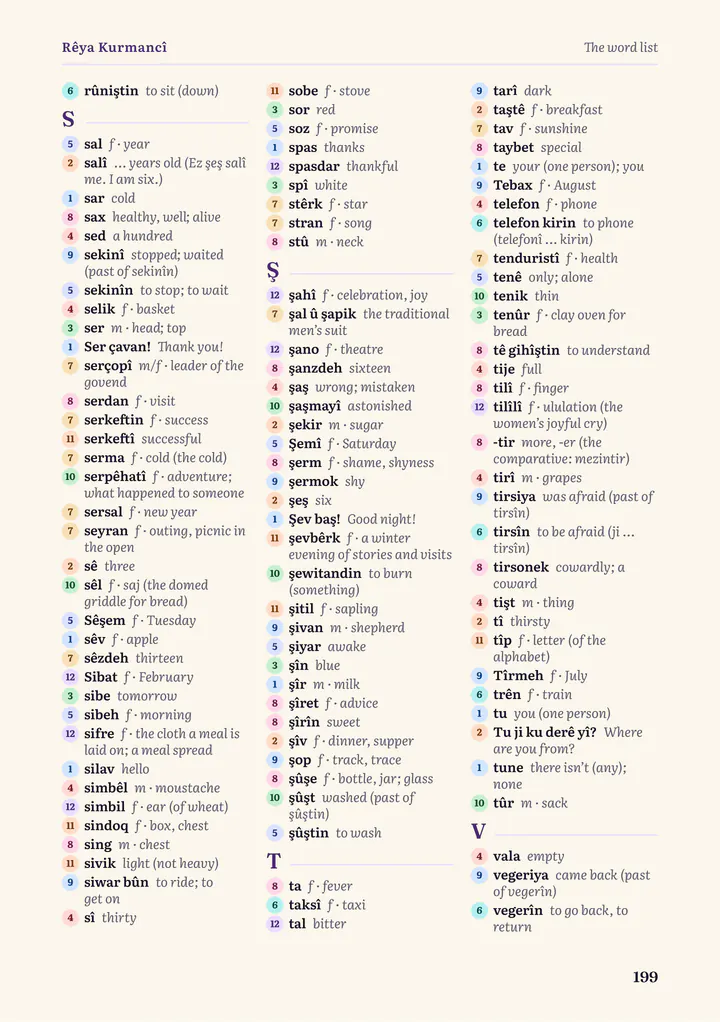
6 · rûniştin to sit (down)
5 · sal f · year
2 · salî … years old (Ez şeş salî me. I am six.)
1 · sar cold
8 · sax healthy, well; alive
4 · sed a hundred
9 · sekinî stopped; waited (past of sekinîn)
5 · sekinîn to stop; to wait
4 · selik f · basket
3 · ser m · head; top
1 · Ser çavan! Thank you!
7 · serçopî m/f · leader of the govend
8 · serdan f · visit
7 · serkeftin f · success
11 · serkeftî successful
7 · serma f · cold (the cold)
10 · serpêhatî f · adventure; what happened to someone
7 · sersal f · new year
7 · seyran f · outing, picnic in the open
2 · sê three
10 · sêl f · saj (the domed griddle for bread)
5 · Sêşem f · Tuesday
1 · sêv f · apple
7 · sêzdeh thirteen
12 · Sibat f · February
3 · sibe tomorrow
5 · sibeh f · morning
12 · sifre f · the cloth a meal is laid on; a meal spread
1 · silav hello
4 · simbêl m · moustache
12 · simbil f · ear (of wheat)
11 · sindoq f · box, chest
8 · sing m · chest
11 · sivik light (not heavy)
9 · siwar bûn to ride; to get on
4 · sî thirty
11 · sobe f · stove
3 · sor red
5 · soz f · promise
1 · spas thanks
12 · spasdar thankful
3 · spî white
7 · stêrk f · star
7 · stran f · song
8 · stû m · neck
12 · şahî f · celebration, joy
7 · şal û şapik the traditional men’s suit
12 · şano f · theatre
8 · şanzdeh sixteen
4 · şaş wrong; mistaken
10 · şaşmayî astonished
2 · şekir m · sugar
5 · Şemî f · Saturday
8 · şerm f · shame, shyness
9 · şermok shy
2 · şeş six
1 · Şev baş! Good night!
11 · şevbêrk f · a winter evening of stories and visits
10 · şewitandin to burn (something)
11 · şitil f · sapling
9 · şivan m · shepherd
5 · şiyar awake
3 · şîn blue
1 · şîr m · milk
8 · şîret f · advice
8 · şîrîn sweet
2 · şîv f · dinner, supper
9 · şop f · track, trace
8 · şûşe f · bottle, jar; glass
10 · şûşt washed (past of şûştin)
5 · şûştin to wash
8 · ta f · fever
6 · taksî f · taxi
12 · tal bitter
9 · tarî dark
2 · taştê f · breakfast
7 · tav f · sunshine
8 · taybet special
1 · te your (one person); you
9 · Tebax f · August
4 · telefon f · phone
6 · telefon kirin to phone (telefonî … kirin)
7 · tenduristî f · health
5 · tenê only; alone
10 · tenik thin
3 · tenûr f · clay oven for bread
8 · tê gihîştin to understand
4 · tije full
8 · tilî f · finger
12 · tilîlî f · ululation (the women’s joyful cry)
8 · -tir more, -er (the comparative: mezintir)
4 · tirî m · grapes
9 · tirsiya was afraid (past of tirsîn)
6 · tirsîn to be afraid (ji … tirsîn)
8 · tirsonek cowardly; a coward
4 · tişt m · thing
2 · tî thirsty
11 · tîp f · letter (of the alphabet)
9 · Tîrmeh f · July
6 · trên f · train
1 · tu you (one person)
2 · Tu ji ku derê yî? Where are you from?
1 · tune there isn’t (any); none
10 · tûr m · sack
4 · vala empty
9 · vegeriya came back (past of vegerîn)
6 · vegerîn to go back, to return
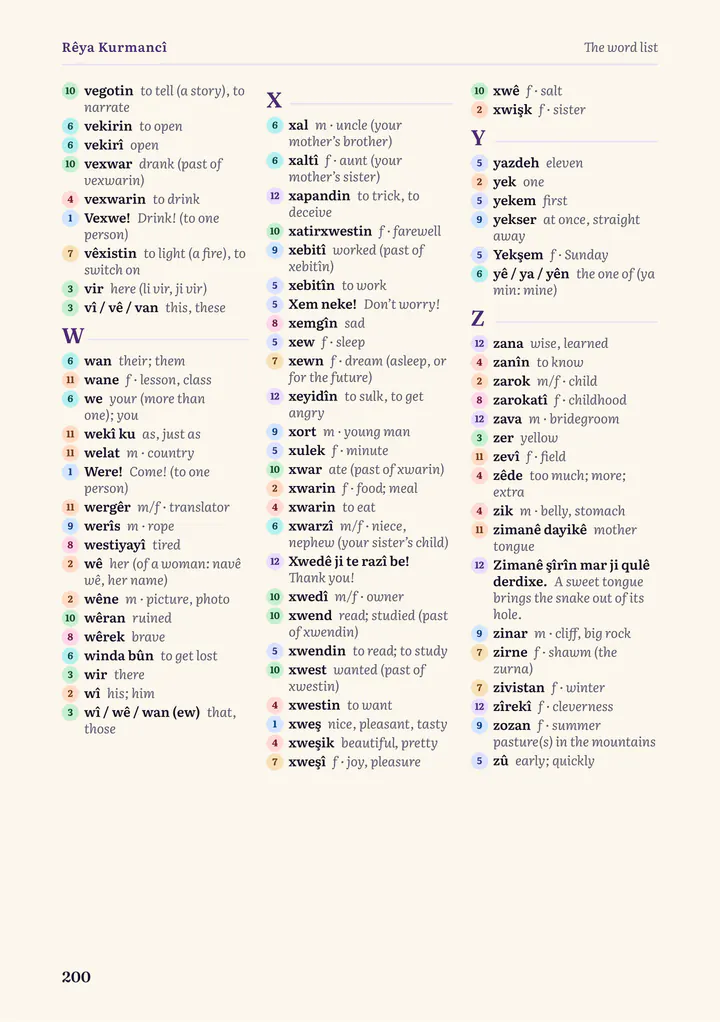
10 · vegotin to tell (a story), to narrate
6 · vekirin to open
6 · vekirî open
10 · vexwar drank (past of vexwarin)
4 · vexwarin to drink
1 · Vexwe! Drink! (to one person)
7 · vêxistin to light (a fire), to switch on
3 · vir here (li vir, ji vir)
3 · vî / vê / van this, these
6 · wan their; them
11 · wane f · lesson, class
6 · we your (more than one); you
11 · wekî ku as, just as
11 · welat m · country
1 · Were! Come! (to one person)
11 · wergêr m/f · translator
9 · werîs m · rope
8 · westiyayî tired
2 · wê her (of a woman: navê wê, her name)
2 · wêne m · picture, photo
10 · wêran ruined
8 · wêrek brave
6 · winda bûn to get lost
3 · wir there
2 · wî his; him
3 · wî / wê / wan (ew) that, those
6 · xal m · uncle (your mother’s brother)
6 · xaltî f · aunt (your mother’s sister)
12 · xapandin to trick, to deceive
10 · xatirxwestin f · farewell
9 · xebitî worked (past of xebitîn)
5 · xebitîn to work
5 · Xem neke! Don’t worry!
8 · xemgîn sad
5 · xew f · sleep
7 · xewn f · dream (asleep, or for the future)
12 · xeyidîn to sulk, to get angry
9 · xort m · young man
5 · xulek f · minute
10 · xwar ate (past of xwarin)
2 · xwarin f · food; meal
4 · xwarin to eat
6 · xwarzî m/f · niece, nephew (your sister’s child)
12 · Xwedê ji te razî be! Thank you!
10 · xwedî m/f · owner
10 · xwend read; studied (past of xwendin)
5 · xwendin to read; to study
10 · xwest wanted (past of xwestin)
4 · xwestin to want
1 · xweş nice, pleasant, tasty
4 · xweşik beautiful, pretty
7 · xweşî f · joy, pleasure
10 · xwê f · salt
2 · xwişk f · sister
5 · yazdeh eleven
2 · yek one
5 · yekem first
9 · yekser at once, straight away
5 · Yekşem f · Sunday
6 · yê / ya / yên the one of (ya min: mine)
12 · zana wise, learned
4 · zanîn to know
2 · zarok m/f · child
8 · zarokatî f · childhood
12 · zava m · bridegroom
3 · zer yellow
11 · zevî f · field
4 · zêde too much; more; extra
4 · zik m · belly, stomach
11 · zimanê dayikê mother tongue
12 · Zimanê şîrîn mar ji qulê derdixe. A sweet tongue brings the snake out of its hole.
9 · zinar m · cliff, big rock
7 · zirne f · shawm (the zurna)
7 · zivistan f · winter
12 · zîrekî f · cleverness
9 · zozan f · summer pasture(s) in the mountains
5 · zû early; quickly
My name is Mohamad Saleh Abdulrahman. I was born in Kobanê and grew up with Kurdish roots, and later built my life in the Netherlands.
Like many Kurds growing up outside their homeland, I came to understand how important language is to preserving identity, culture and the connection between generations.
This inspired me to create Hevalo, a platform built to make learning, practising and preserving the Kurdish language more accessible, engaging and enjoyable.
I believe Kurdish is more than a language. It carries our history, our stories and expressions, and the experiences of the generations before us.
This book is one small contribution to keeping that heritage alive, and to making it easier for future generations to discover, learn and embrace their language.
Mohamad Saleh Abdulrahman
Safe journey!
Rêya Kurmancî, the Kurmanji Road: every word, line and story as the lessons have them, with Hamo’s voice in the app at hevalo.app. The drawings are Hevalo’s own, made for the app and for this book. Set in Fraunces and Literata, both under the SIL Open Font Licence.
No apples were left over in the making of this book.
Bazı sayfalar yüklenemedi.
Ok tuşları sayfa çevirir; [ ve ] önceki ya da sonraki bölüme gider; + ve − yakınlaştırır ve uzaklaştırır.
Silav!Çay û nanNavê te çi ye?Şev baş!
Malbat û cîranYek, du, sêTaştêHeye û tune
Ev mala me yeRengên SêvanêLi ku ye?Gundê me
Em diçin bazarêÇi dixwazî?Bi çend e?Na, naxwazim
Rojên hefteyêMeh û salDemjimêr çend e?Her roj
Li bajêrWerin, rûnin!Divê em biçinBi çi diçî?
Hewa çawa ye?Ez ê biçimGovendNewroz pîroz be!
Serê min diêşeEz te dibînimMezintir, herî mezinEz ditirsim
Duh çi bû?BerêPêşî, paşêWê rojê
Min nan xwarJiyana zozanêMin dixwar, ez diçûmMe çi kir?
Karê te çi ye?Me sêv berhev kirineJi ber ku…Planên me
Şengê û PengêMêvan hatinGotinên pêşiyanRêya te vekirî be!
17 Kasım 2026 baskısı
Öğrenmek için ücretsiz indirilebilir, yazdırılabilir ve paylaşılabilir; satılamaz.
Hevalo’da her satırı Hamo’nun sesinden dinleyin
Kitabı yazdırmak için PDF’i https://zagrosian.com/book/reya-kurmanci.pdf adresinden indirin.